
Baseline CK Test Calculator
Determine if you need a baseline creatine kinase test before starting statins based on your personal health factors.
Do you have any of these risk factors?
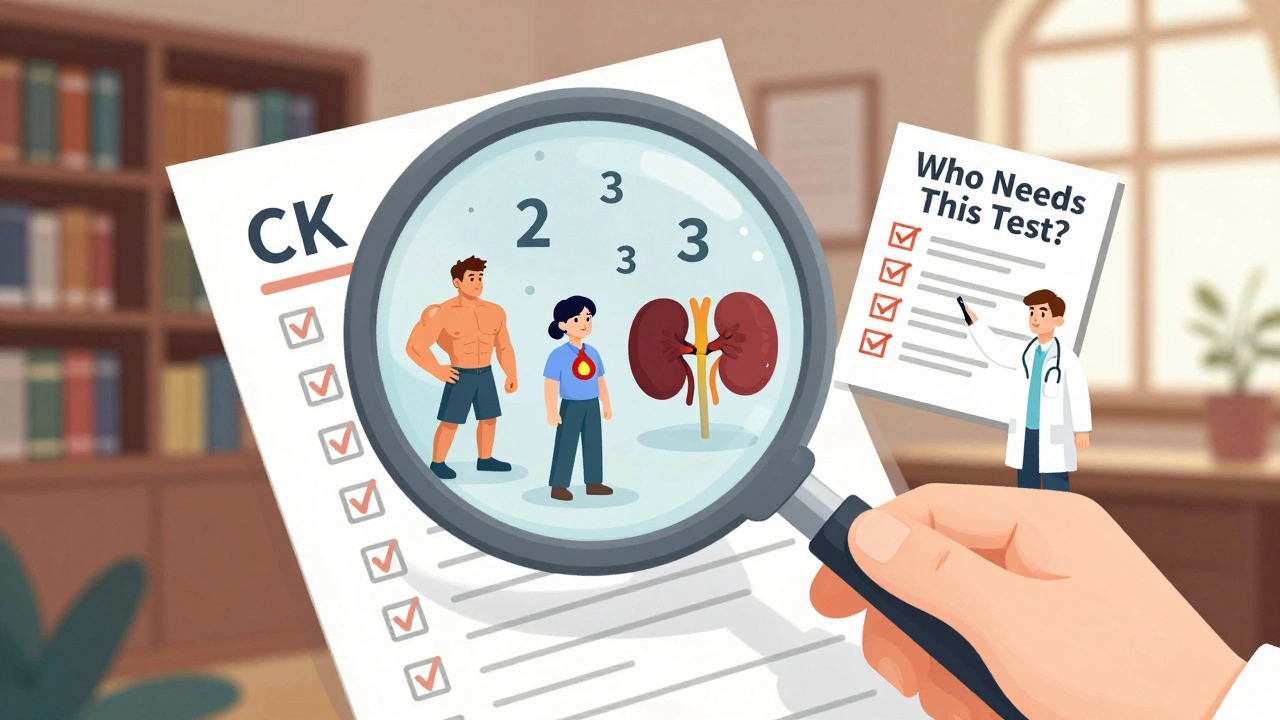
When you start a statin, your doctor might order a blood test for creatine kinase (CK) before you even take your first pill. But is this really necessary for everyone? Or is it just another routine check that adds cost without real benefit? The answer isn’t simple - it depends on who you are and what your risk factors are.
Why CK Testing Matters at All
Creatine kinase (CK) is an enzyme found in muscle tissue. When muscles get damaged - whether from intense exercise, an injury, or a drug like a statin - CK leaks into the bloodstream. High levels can signal muscle breakdown. In rare cases, statins can cause a severe condition called rhabdomyolysis, where muscle cells break down so badly they overwhelm the kidneys. That’s why CK testing exists: to catch early signs of trouble. But here’s the catch: most people who take statins never have serious muscle problems. Only about 0.1% develop rhabdomyolysis. And for the 5-10% who feel muscle aches or weakness, it’s often not even the statin’s fault. Studies show up to 78% of muscle symptoms in statin users have nothing to do with the drug. So why test at all? The real value of baseline CK isn’t to predict who will get side effects. It’s to help figure out, after symptoms show up, whether they’re caused by the statin - or something else.When Baseline CK Is Worth It
Not everyone needs this test. But for certain groups, skipping it can lead to misdiagnosis, unnecessary statin stops, or even missed diagnoses of other conditions.- People with hypothyroidism: About 1 in 8 statin users have an underactive thyroid. Low thyroid function raises CK naturally. If you start a statin without knowing your baseline CK, your doctor might think the statin caused the rise - when it was already high.
- Those with kidney problems: If your eGFR is below 60 mL/min/1.73m², your body clears statins slower. This increases muscle risk. A baseline CK helps track changes more accurately.
- Patients on statin-fibrate combos: Taking both a statin and a fibrate (like fenofibrate) raises muscle injury risk by 6 to 15 times. For these patients, baseline CK is non-negotiable.
- People who’ve had statin side effects before: If you stopped a statin in the past due to muscle pain or high CK, you’re at higher risk again. A baseline helps compare future results.
- Those on high-intensity statins: Atorvastatin 40-80 mg or rosuvastatin 20-40 mg carry a slightly higher risk. For these, baseline CK gives a clearer picture if symptoms appear later.
These groups make up a small portion of statin users - maybe 20-30% - but they’re the ones who benefit most from knowing their starting CK level.
What the Numbers Mean
CK levels vary widely between people. A normal range for men is usually 145-195 U/L, and for women, 65-110 U/L. But that’s just a general guide. Some healthy people naturally have CK levels 2 or even 3 times higher - especially African Americans, athletes, or people who recently lifted weights or got a shot in the muscle. That’s why a baseline matters. If your CK was 400 U/L before starting a statin, and it jumps to 500 U/L later, that’s not alarming. But if your baseline was 120 U/L and now it’s 800 U/L, that’s a red flag. Here’s how doctors use the numbers:- CK under 3x ULN and no symptoms? Keep taking the statin. No change needed.
- CK 3-10x ULN with muscle pain? Pause the statin, check thyroid and kidney function, and retest in a week. See a specialist if it doesn’t drop.
- CK over 10x ULN? Stop the statin immediately. This is a medical emergency.
Many patients stop their statins because they feel sore - only to find out later their CK was normal. Without a baseline, doctors can’t tell if the rise is real or just noise.

What the Guidelines Say
Different countries and organizations have different rules:- Canada (RxFiles, 2023): Recommends baseline CK for high-risk patients only. Says routine testing in healthy people adds cost without benefit.
- United States (ACC/AHA, 2022): Doesn’t require it for everyone, but says it’s useful when symptoms appear - especially if you’re on high-dose statins or have other risk factors.
- Europe (ESC/EAS, 2019): Calls baseline CK optional (Class IIb). Doesn’t push for it unless there’s concern.
- Japan: Requires baseline CK for everyone. Why? Higher reported rates of muscle side effects - about 12.7% vs. 7.3% in the West.
- American Association of Clinical Endocrinologists (AACE, 2020): Strongly recommends it for all statin starters. Level A evidence - meaning solid data supports it.
There’s no global standard. But the trend is clear: don’t test everyone. Test those who need it.
Why Some Experts Say Skip It
Not everyone agrees. Dr. John Kastelein, a top European lipid expert, argues that baseline CK testing causes more harm than good. He points to a 2016 Cochrane review of nearly 48,000 patients: no difference in muscle injury rates between those who got tested and those who didn’t. He’s right about one thing: testing healthy people without symptoms doesn’t prevent rhabdomyolysis. And it can backfire. A high CK - even if it’s normal for that person - can trigger anxiety. Patients may stop their statin unnecessarily. Doctors may switch to a less effective drug. All because a number was slightly off. In Canada, the Choosing Wisely campaign estimates baseline CK testing for low-risk patients costs $14.7 million a year - and only 1.2% of abnormal results actually change treatment.What You Should Do
If you’re starting a statin, here’s what to ask:- Do I have any risk factors? (Thyroid issues? Kidney problems? Taking other meds like amiodarone or fibrates?)
- Have I had muscle pain on statins before?
- Have I done heavy exercise, gotten injections, or had a muscle injury in the last 48 hours?
If you answered yes to any of these, ask for a baseline CK test. If you’re healthy, young, and have no risk factors, you can probably skip it.
And if you start the statin and feel muscle soreness? Don’t panic. Don’t stop the drug on your own. Call your doctor. Bring your baseline CK result if you have one. It could save you from quitting a life-saving medication.
What’s Next for CK Testing?
New tools are on the horizon. Genetic testing for the SLCO1B1 gene variant can tell you if you’re at higher risk for statin myopathy - especially with simvastatin. About 12% of Europeans have this variant. It increases risk 4.5-fold. But this test isn’t widely used yet - it’s expensive and not covered by most insurance. There’s also emerging point-of-care CK devices. These are like glucose meters - you prick your finger, get a result in minutes. Phase 3 trials show they’re accurate. If they get approved, clinics could test CK during your visit. No waiting for lab results. That could make baseline testing more practical for high-risk patients. For now, the best approach is simple: test smart, not often.Documentation Matters
If you do get a baseline CK, make sure your doctor records:- The exact number (not just “normal” or “abnormal”)
- When you last exercised
- Any recent injections or muscle trauma
- All other medications you’re taking
These factors explain 68% of why CK levels vary. Without this context, even a good number can be misinterpreted.
And remember: CK is just one piece. Your doctor should also check your kidney function, thyroid levels, and liver enzymes - especially if you’re over 65 or on multiple drugs.
Do I need a baseline CK test if I’m starting a statin for the first time?
Not if you’re healthy, young, and have no risk factors like kidney disease, thyroid issues, or are taking interacting drugs. But if you’re over 65, have reduced kidney function, hypothyroidism, or are on a fibrate or high-dose statin, yes - it’s worth getting.
Can a high CK level mean I have a muscle disease?
Yes. A very high CK - especially if it’s been high before you started statins - could signal an underlying neuromuscular condition like muscular dystrophy or polymyositis. That’s why baseline testing can uncover hidden problems, not just statin side effects.
If my CK is high before starting a statin, should I still take it?
It depends. If your high CK is due to something harmless - like recent exercise or being African American - you can usually start the statin safely. If it’s due to an undiagnosed condition, your doctor may delay the statin, treat the underlying issue first, or choose a different statin with lower muscle risk.
Do I need repeat CK tests while on statins?
No - not if you feel fine. Major guidelines agree: routine CK monitoring in asymptomatic patients doesn’t improve outcomes. Only test again if you develop muscle pain, weakness, or dark urine.
Can I avoid CK testing altogether by choosing a different statin?
Some statins carry lower muscle risk. Pravastatin and fluvastatin are gentler on muscles than simvastatin or atorvastatin. But switching doesn’t eliminate the need for baseline testing if you’re high-risk. The goal isn’t to avoid the test - it’s to use it wisely.
Why do some countries test everyone and others don’t?
Japan has higher reported rates of statin-related muscle issues, so they test everyone. In North America and Europe, the risk is lower, and the cost-benefit doesn’t favor universal testing. It’s about matching the strategy to the local risk profile.
joanne humphreys
December 5, 2025 AT 15:08As someone who’s been on statins for five years with zero muscle issues, I appreciate how this breaks down the real clinical reasoning behind CK testing. It’s not about fear-mongering or blanket protocols-it’s about context. I had a baseline done because I’m over 65 and on a low-dose rosuvastatin, and honestly, knowing my starting number gave me peace of mind when I had a weird ache last winter. Turned out it was just a new yoga routine. Without that baseline, I might’ve panicked and stopped the med. This post saved me from a dumb decision.
Saketh Sai Rachapudi
December 7, 2025 AT 15:02USA always over test everything! In India we dont waste money on CK for evryone. Only if patinet have pain or kidney problem then test. Why USA waste 14 million dollar on useless test? Our system is better. No need for fancy labs. Doctor know what to do. You guys test for everything even if you sneeze!
pallavi khushwani
December 7, 2025 AT 21:38I’ve always thought of statins as this black-and-white thing-either they work or they don’t. But this really opened my eyes to how nuanced muscle symptoms are. I used to think if you felt sore, it had to be the statin. Turns out, it’s often just aging, dehydration, or even stress. It’s wild how much our bodies are just… noisy. The part about athletes and African Americans having naturally high CK? That’s the kind of detail that makes medicine feel human, not just algorithmic.
Nigel ntini
December 9, 2025 AT 03:43This is one of the clearest, most balanced takes on statin CK testing I’ve read in years. The distinction between ‘testing to prevent’ versus ‘testing to clarify’ is absolutely critical-and too often lost in the noise. I’m a GP in London, and I’ve seen too many patients stop their statins after a vague muscle ache, only to have a heart attack six months later. Baseline CK isn’t about paranoia-it’s about precision. And the footnote about documenting recent exercise or injections? That’s gold. Most EHRs don’t even prompt for that. Someone should make a clinical checklist for this.
Ashish Vazirani
December 11, 2025 AT 02:45Let me tell you something… I was on a statin… I felt a little ache… I went to the doctor… they said, ‘Oh, your CK is high’… I said, ‘But I just lifted weights!’… they said, ‘Still, we’ll stop it’… I said, ‘But I have familial hypercholesterolemia!’… they said, ‘We’ll try a different one’… I said, ‘But I’ve been on this one for five years!’… they said, ‘We’ll monitor’… I said, ‘You’re throwing away my life!’… I stopped the statin… and then… I had a stroke… I’m alive… but I’m angry… and this post? This post… is… the truth… I wish I’d read this before…
Mansi Bansal
December 12, 2025 AT 05:24It is imperative to underscore that the indiscriminate administration of statins without prior biochemical stratification constitutes a gross violation of the principle of beneficence in clinical medicine. The proliferation of baseline creatine kinase assays among low-risk populations is not merely a fiscal inefficiency-it is an epistemological failure, wherein quantitative metrics are elevated above clinical judgment, thereby infantilizing the patient-provider relationship. Furthermore, the normalization of elevated CK levels in certain ethnic cohorts, without adequate contextual documentation, perpetuates diagnostic arbitrariness and potentially exacerbates health disparities. This is not healthcare. This is algorithmic negligence.
Brooke Evers
December 13, 2025 AT 15:08I just want to say how much I appreciate this post-not just because it’s accurate, but because it’s kind. So many medical discussions feel like they’re written for doctors, not patients. This one speaks to people who are scared, confused, and just trying to do the right thing. I’m a nurse, and I’ve seen so many patients shut down when their doctor says, ‘It’s probably the statin,’ without ever checking a baseline. I’ve had patients cry because they thought they were broken, when really, their CK was just naturally high. This post gives people permission to ask questions. It gives doctors a script to say, ‘Let’s talk about whether this test makes sense for YOU.’ That’s not just good medicine-that’s good humanity.
And to the person who said, ‘In India we don’t waste money’-I get it. But here’s the thing: healthcare isn’t just about cost. It’s about dignity. If a $15 test helps someone keep their heart medication and avoid a stroke, that’s not a waste. That’s wisdom.
I’ve had patients who didn’t know their own CK levels because their doctor said, ‘It’s normal.’ But normal for whom? Normal for a 25-year-old swimmer? Or a 70-year-old with hypothyroidism? We need to stop treating labs like yes/no buttons. They’re dials. And we need to know where the needle starts.
Also, I’ve had patients come in with CK levels over 2,000 and no symptoms, and it turned out they had undiagnosed polymyositis. That’s not a statin side effect. That’s a hidden disease. And if you never test, you never find it. That’s not over-testing. That’s saving lives.
So thank you. For writing this. For being clear. For not just saying ‘test or don’t test’-but for saying, ‘Test smart.’ That’s the kind of medicine we all need more of.
Dan Cole
December 14, 2025 AT 20:53Let’s be brutally honest: baseline CK testing isn’t about medicine-it’s about liability. Doctors order it because if you have a bad outcome and didn’t test, you get sued. Not because it changes outcomes. The Cochrane review says it flat out: no difference in rhabdo rates. So why do we do it? Because the legal system rewards overtesting, not clinical insight. The real problem isn’t the test-it’s the fear-driven culture of medicine. We’ve turned prevention into paranoia. We’re so afraid of being wrong that we’ve forgotten how to be thoughtful. And now, patients are the ones paying-in money, anxiety, and unnecessary drug switches. This isn’t evidence-based care. It’s fear-based practice. And until we fix that, no amount of ‘test smart’ advice will fix the system.