When someone hears the word brain tumor, they often imagine something instantly deadly. But not all brain tumors are the same. Some grow slowly over years, while others spread aggressively within weeks. The difference isn’t just in how they look under a microscope-it’s in their molecular code, their grade, and how doctors choose to treat them. Today’s approach to brain tumors isn’t about one-size-fits-all surgery or radiation. It’s about precision: matching the right treatment to the exact biology of the tumor.
Understanding Brain Tumor Types
Brain tumors are grouped by where they start and what kind of cells they come from. The most common types arise from glial cells-the supportive cells in the brain. These are called gliomas. There are three main kinds: astrocytomas, oligodendrogliomas, and ependymomas.Astrocytomas begin in star-shaped cells called astrocytes. They can be low grade (slow-growing) or high grade (fast-growing and aggressive). Glioblastoma, the most common and deadliest form, is a grade 4 astrocytoma. It makes up over half of all malignant brain tumors in adults.
Oligodendrogliomas come from cells that produce myelin, the insulation around nerve fibers. These tumors often have a unique genetic signature: both the 1p and 19q chromosomes are deleted together. This codeletion is a game-changer-it means the tumor is more likely to respond to chemotherapy and has a better long-term outlook.
Ependymomas form in the lining of the brain’s fluid-filled spaces. They’re more common in children but can occur in adults. Unlike gliomas, they rarely spread beyond the central nervous system.
Then there are meningiomas. These don’t start in brain tissue-they grow from the membranes covering the brain and spinal cord. Most are benign (grade 1), but some can become grade 2 or 3, meaning they grow faster and may invade nearby bone or tissue.
What Brain Tumor Grades Really Mean
Grades tell you how aggressive a tumor is. The World Health Organization (WHO) uses a scale from 1 to 4. Grade 1 is the mildest; grade 4 is the most dangerous.Grade 1 tumors, like pilocytic astrocytoma, look almost normal under a microscope. They grow slowly and often don’t spread. Many can be cured with surgery alone. These are the tumors doctors hope to find early-before they cause serious symptoms.
Grade 2 tumors, such as diffuse astrocytoma or oligodendroglioma, have slightly abnormal cells. They grow slowly but can creep into healthy brain tissue. Even if removed, they often come back, sometimes as a higher-grade tumor. This is why doctors monitor them closely, even after surgery.
Grade 3 tumors are called anaplastic. The cells look very abnormal and multiply quickly. Anaplastic astrocytoma and anaplastic oligodendroglioma fall here. These tumors invade surrounding brain tissue and almost always require radiation and chemotherapy after surgery.
Grade 4 is the worst. Glioblastoma is the most common type at this level. These tumors grow so fast they create their own blood supply and develop dead centers (necrosis). They spread like roots through the brain, making complete removal impossible. Even with the best treatment, survival is measured in months-not years.
Here’s the key shift: since 2021, the WHO no longer grades all tumors the same way. Before, an anaplastic astrocytoma was automatically grade 3. Now, grading depends on the tumor type. Oligodendrogliomas only go up to grade 3. Meningiomas go up to grade 3. Glioblastomas are always grade 4. This change reflects a deeper understanding: tumors behave differently based on their origin, not just how wild they look.
The Molecular Revolution in Diagnosis
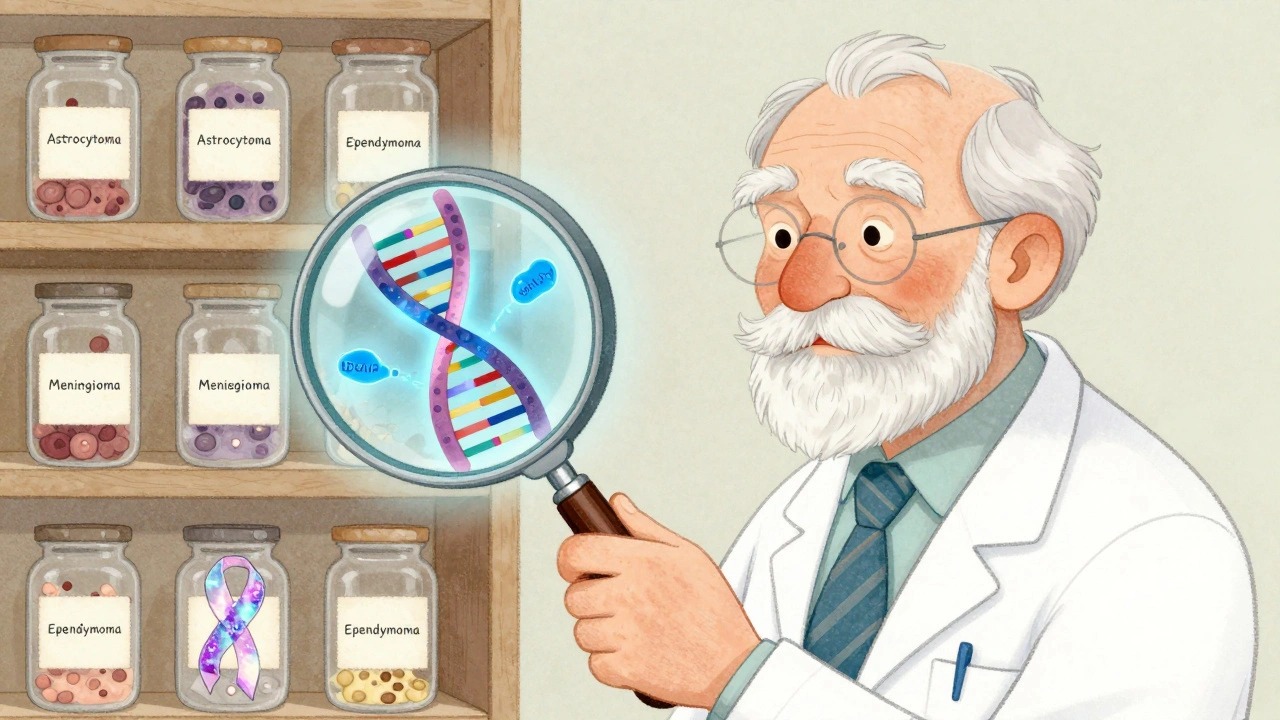
The biggest change in brain tumor diagnosis since 2021 isn’t what pathologists see under the microscope-it’s what they find in the DNA.Two critical markers now define treatment: IDH mutation and 1p/19q codeletion.
If a tumor has an IDH mutation, it’s biologically different from one without it. IDH-mutant glioblastomas (grade 4) survive more than twice as long as IDH-wildtype ones. That’s not a small difference-it changes everything about prognosis and treatment planning.
1p/19q codeletion is another game-changer. When both chromosome arms are missing, the tumor is almost certainly an oligodendroglioma. These tumors respond better to chemo, especially PCV (procarbazine, lomustine, vincristine). Patients with this marker often live 10-15 years after diagnosis, even with grade 3 tumors.
MGMT promoter methylation is another key test. It tells doctors whether the tumor is likely to respond to temozolomide, the standard chemo drug for glioblastoma. If methylated, the tumor is more sensitive to the drug. If not, doctors may look for alternatives.
These tests aren’t optional anymore. They’re required for accurate diagnosis. A tumor that looks like a grade 3 astrocytoma under the microscope might actually be a grade 4 glioblastoma if it’s IDH-wildtype. Without molecular testing, you could be treating the wrong tumor.
Testing takes time-usually 7 to 10 days-and adds $3,200 to $5,800 to the diagnostic bill. But the cost of getting it wrong? That’s far higher.
How Treatments Are Chosen Today
Treatment is no longer just surgery, then radiation, then chemo. It’s a tailored mix-multimodal-based on tumor type, grade, and molecular profile.For low-grade tumors (grade 1 or 2), doctors may watch and wait if the tumor isn’t causing symptoms. If surgery is needed, they aim for complete removal without damaging critical brain areas. Radiation and chemo are held off unless the tumor grows or changes.
For high-grade tumors, the standard used to be the Stupp protocol: surgery, followed by six weeks of radiation and daily temozolomide, then maintenance chemo. That’s still the baseline for glioblastoma. But now, if the tumor is IDH-mutant, doctors may delay radiation and use targeted drugs instead.
In 2023, the FDA approved vorasidenib for grade 2 gliomas with IDH mutations. In the INDIGO trial, patients on vorasidenib had 27.7 months without tumor growth-more than double the 11.1 months seen with placebo. For many, this means avoiding radiation and chemo for years, preserving cognitive function and quality of life.
For oligodendrogliomas with 1p/19q codeletion, PCV chemotherapy has proven more effective than temozolomide in long-term studies. Some patients now get PCV before radiation, not after.
And for those with recurrent tumors, clinical trials are offering new hope. Liquid biopsies-testing cerebrospinal fluid for tumor DNA-are becoming more reliable. One 2023 study showed 89% accuracy in detecting tumor DNA, meaning doctors might soon monitor tumor changes without repeated brain surgeries.

What Patients Are Experiencing
Behind every statistic is a person. One patient diagnosed with a grade 2 oligodendroglioma at age 32 was told she had 72 hours to decide whether to freeze her eggs before surgery. Another, told he had glioblastoma, learned his tumor was IDH-mutant-changing his prognosis from 15 months to over three years.But delays are still common. A 2022 survey found 68% of patients waited more than eight weeks for a diagnosis. Those with low-grade tumors waited longer-on average, 14 weeks-because doctors often assume they’re less urgent.
And misinformation runs rampant. One study found 42% of patients thought a grade 2 tumor meant a 20% chance of survival. That’s not true. Grade 2 doesn’t mean death-it means careful monitoring and sometimes delayed treatment.
For many, the emotional toll is heavier than the physical. The uncertainty of waiting for molecular results, the fear of recurrence, the loss of independence-these are the hidden battles.
What’s Next for Brain Tumor Care
The future is moving fast. The CODEL trial, testing combined chemo for oligodendroglioma, will release results in late 2024. If successful, it could become the new standard.Researchers are also testing vaccines and immunotherapies. Early trials show promise for tumors with specific mutations. And AI is being trained to predict tumor behavior from MRI scans alone-potentially reducing the need for invasive biopsies.
But the biggest shift is cultural. Doctors are learning to talk differently about brain tumors. Instead of saying, “It’s grade 4, so you have 15 months,” they’re saying, “Here’s what we know about your tumor’s biology. Here’s what we can do now. Here’s what’s coming next.”
The WHO classification system has evolved five times since 1979. Each update has made diagnosis more accurate. The 2021 version wasn’t the end-it was the beginning of a new era. One where treatment isn’t based on what a tumor looks like, but on what it is at the genetic level.
For patients, that means more time. More options. More hope.
What’s the difference between a low-grade and high-grade brain tumor?
Low-grade brain tumors (grades 1 and 2) grow slowly, have well-defined edges, and rarely spread to other parts of the brain. They may not need immediate treatment after surgery. High-grade tumors (grades 3 and 4) grow fast, invade healthy tissue, and often come back after treatment. Grade 4 tumors, like glioblastoma, are aggressive cancers with poor survival rates without advanced treatment.
Can a brain tumor be cured?
Some low-grade tumors, especially grade 1, can be cured with complete surgical removal. Grade 2 tumors are often controllable for many years but rarely cured outright. High-grade tumors like glioblastoma are not currently curable, but treatments like targeted therapy and clinical trials are extending survival significantly. For example, IDH-mutant grade 4 tumors now have a median survival of 31 months, compared to 14.6 months for IDH-wildtype.
Why does molecular testing matter for brain tumors?
Molecular testing looks at the tumor’s DNA to identify mutations like IDH or 1p/19q codeletion. These markers determine tumor type, prognosis, and treatment response. A tumor that looks like a grade 3 astrocytoma under the microscope might actually be a grade 4 glioblastoma if it lacks an IDH mutation. Without molecular testing, patients could receive the wrong treatment.
What is vorasidenib and who can take it?
Vorasidenib is a targeted drug approved by the FDA in June 2023 for grade 2 gliomas with IDH mutations. It blocks the abnormal protein made by the mutated IDH gene, slowing tumor growth. In the INDIGO trial, patients on vorasidenib went 27.7 months without tumor progression, compared to 11.1 months on placebo. It’s not for everyone-only those with confirmed IDH-mutant grade 2 tumors.
How long does it take to get brain tumor test results?
Standard pathology results take 7 to 10 days. Molecular tests for IDH, 1p/19q, and MGMT can add another week. But since the FDA approved the IDH IHC antibody in 2021, testing time has dropped from 2-3 weeks to as little as 48 hours in some hospitals. Faster results mean quicker treatment decisions.
Are brain tumor survival rates improving?
Yes, especially for certain subtypes. For IDH-mutant glioblastomas, median survival has jumped from under 15 months to over 31 months. For grade 2 IDH-mutant gliomas, the new drug vorasidenib has nearly tripled the time before tumor growth. Overall, five-year survival for all brain tumors has increased by 10% since 2010, largely due to better molecular diagnosis and targeted therapies.
Lauren Scrima
December 11, 2025 AT 15:26So let me get this straight: we’re now diagnosing brain tumors by their DNA… and it’s cheaper than my monthly Netflix subscription? 😅
Constantine Vigderman
December 12, 2025 AT 12:00OMG this is insane!! 🤯 I had no idea a tumor could be 'IDH-mutant' like some kind of secret code!! I feel like I just watched a sci-fi movie but it's REAL?? Someone please tell my grandma this is real and not a dream!! 💪🧠
Casey Mellish
December 12, 2025 AT 18:13This is one of the most lucid and scientifically rigorous summaries of modern neuro-oncology I’ve encountered outside of a peer-reviewed journal. The integration of molecular diagnostics into clinical decision-making represents not merely an evolution but a paradigm shift-particularly in how prognosis is no longer dictated by histology alone. Australia’s own neuro-oncology units are adopting these protocols with remarkable speed. Kudos to the authors for distilling such complexity with clarity.
Tyrone Marshall
December 13, 2025 AT 22:23It’s funny how we used to treat tumors like they were all the same monster-now we’re learning they each have their own personality, their own story written in DNA. That’s not just medicine. That’s listening. And maybe, just maybe, that’s the most powerful treatment of all. I’ve sat with people who lost years waiting for answers. This isn’t just science-it’s dignity.
Yatendra S
December 15, 2025 AT 19:55life is just a series of random mutations... 🤔 maybe the tumor is just the brain's way of asking for a better OS update... 🧬
Webster Bull
December 17, 2025 AT 07:23They spent 10k on DNA tests but forgot to tell patients they might wait 14 weeks for a diagnosis? 😑 Guess we still live in the Stone Age of healthcare.
Bruno Janssen
December 18, 2025 AT 21:31I had a cousin who died of a glioblastoma. They told her it was 'grade 4' like it was a hotel rating. She cried for three days. No one told her what it really meant. This post? It’s the first thing that made sense. Thank you. I wish I’d had this before she died.
Tommy Watson
December 19, 2025 AT 06:34Wait so you're telling me we could've avoided all this if we just... tested the DNA first?? Like, why didn't anyone think of this before?? 🤦♂️ This is why I hate doctors. They're all just guessing until someone with a lab coat says 'oh wait, here's the actual code'.