
When a teenager stops sleeping, loses interest in friends, or starts talking about not wanting to live anymore, it’s not just a phase. It’s depression - and it’s more common than most parents realize. About 1 in 5 adolescents experiences a major depressive episode before age 18. The good news? There are real, evidence-based ways to help. The hard part? Deciding what works best. Should you start with talk therapy that includes the whole family? Or consider medication? Or both? There’s no one-size-fits-all answer, but there are clear patterns based on what research and real-world results show.
What We Know About Depression in Kids and Teens
Depression in children and teens isn’t just sadness. It’s persistent low mood, irritability, fatigue, trouble concentrating, changes in appetite or sleep, and sometimes thoughts of death or suicide. The Diagnostic and Statistical Manual of Mental Disorders (DSM-5) is the standard used by clinicians to diagnose it. Symptoms can show up as early as age 3, but the most common age range for diagnosis is between 12 and 17.
What makes adolescent depression different from adult depression? For one, teens often express it through anger, withdrawal, or school refusal instead of crying or talking about feeling hopeless. And because their brains are still developing - especially the parts that regulate emotion and impulse control - depression can have long-lasting effects on learning, relationships, and future mental health.
Studies show that untreated depression in youth increases the risk of substance abuse, academic failure, and suicide. The 988 Suicide & Crisis Lifeline saw a 21% rise in contacts related to teens in 2023 alone. That’s why early, effective intervention matters more than ever.
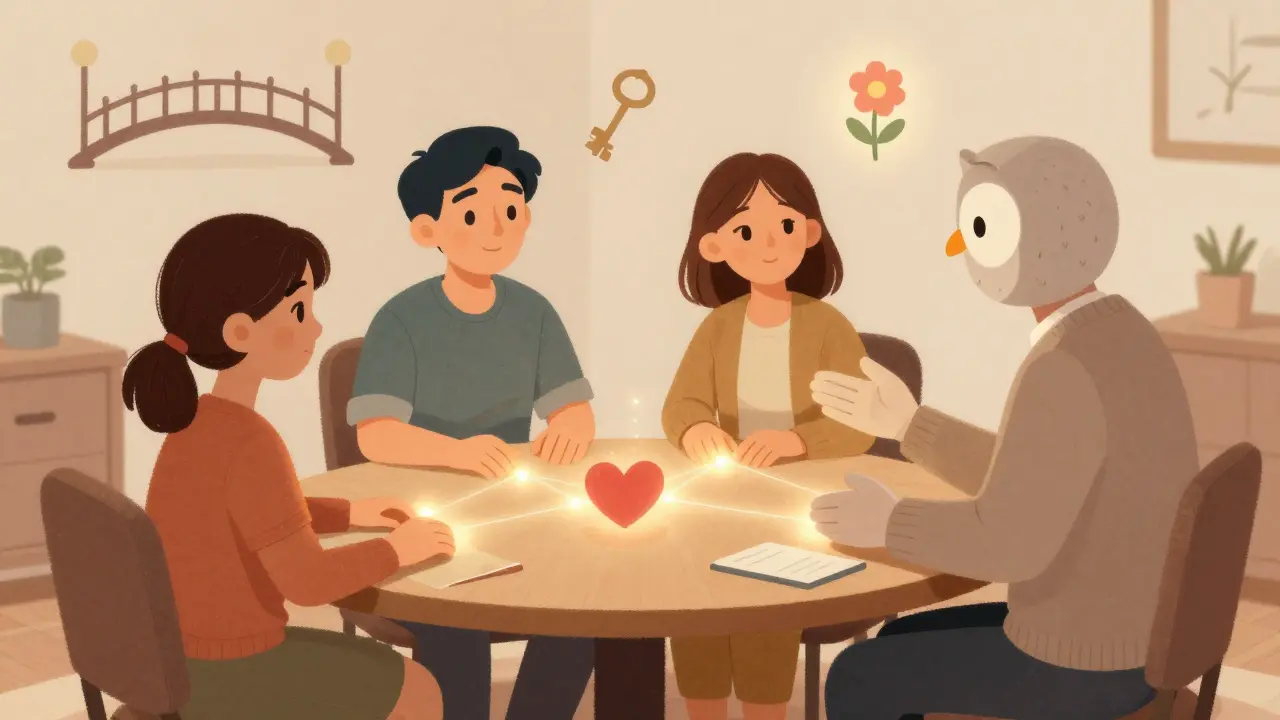
Family Therapy: More Than Just Talking Together
Family therapy isn’t about blaming parents. It’s about changing how the family system works - the patterns of communication, conflict, and emotional support that either help or hurt a teen’s mental health.
There are several types of family therapy used for depression:
- Attachment-Based Family Therapy (ABFT) focuses on repairing broken emotional bonds between parent and child. It’s especially effective for teens with suicidal thoughts. In one 2022 study, ABFT reduced suicidal ideation more than standard care.
- Structural Family Therapy looks at power dynamics. Is the teen the de facto decision-maker? Are parents too distant or too controlling? The therapist helps reset healthy boundaries.
- Strategic Family Therapy uses clever, sometimes surprising techniques - like asking the teen to “keep being depressed” so the family understands how much it’s affecting everyone. It sounds odd, but it breaks cycles of frustration.
Most family therapy programs last 12 to 16 weeks, with weekly 50- to 90-minute sessions. Parents and siblings attend together. The goal isn’t to fix the teen - it’s to fix the environment they live in.
Real-world feedback from parents is mixed but leans positive. In programs at the Children’s Hospital of Philadelphia, 80% of families reported better communication after 10 weeks. But 41% of parents in NAMI forums said one family member refused to participate - and that made therapy much harder.
Medication: What Works, What Doesn’t
When depression is moderate to severe, or when therapy alone isn’t enough, medication may be recommended. But not all antidepressants are safe for teens.
The U.S. Food and Drug Administration (FDA) has approved only two SSRIs for children and adolescents as of 2023:
- Fluoxetine (Prozac) - 10 to 20 mg per day
- Escitalopram (Lexapro) - 10 to 20 mg per day
These are the only two with enough evidence to show they’re more effective than placebo in teens. Other SSRIs like sertraline or citalopram are sometimes prescribed off-label, but they lack the same level of safety data.
It takes 4 to 6 weeks for these medications to start working. That’s why doctors often recommend combining them with therapy - so the teen has support during the waiting period.
Side effects are real. In the Treatment for Adolescents with Depression Study (TADS), 11% to 18% of teens on SSRIs experienced activation syndrome - increased anxiety, agitation, or even suicidal thoughts in the first few weeks. That’s why the FDA requires a black box warning on all antidepressants for under-18s.
Still, for many teens, the relief is life-changing. One 16-year-old in a 2023 Reddit thread said, “I didn’t feel like I was drowning anymore after two months on Prozac. Therapy helped me understand why, but meds gave me the air to breathe.”
Which Approach Works Best?
There’s no winner - but there are clear scenarios where one option shines.
Choose family therapy if:
- Your teen’s depression seems tied to family conflict, criticism, or emotional distance
- They have suicidal thoughts - ABFT has shown stronger results than standard care for this group
- You’re willing to show up, listen, and change how you interact
Choose medication if:
- Depression is severe - your teen can’t get out of bed, skip school, or eat regularly
- Therapy hasn’t helped after 12 weeks
- There’s a family history of depression that responded well to medication
Best results come from combining both. The Agency for Healthcare Research and Quality found that medication plus therapy leads to better symptom reduction and improved daily functioning than either alone. A 2023 Johns Hopkins study estimated that combined treatment saves $5,700 per quality-adjusted life year compared to medication only.
But here’s the catch: You can’t do both if you can’t access either. Only 8,500 certified child and adolescent family therapists serve 42 million U.S. teens. Waitlists can be 12 to 18 months long. Meanwhile, pediatricians can prescribe SSRIs in a 15-minute visit.
What If Neither Option Feels Right?
Some families explore alternatives. Exercise, for example, has been shown to reduce depressive symptoms as effectively as SSRIs in some studies - without side effects. A 2022 trial found that teens who did 45 minutes of moderate exercise three times a week saw a 30% drop in depression scores over 10 weeks.
Spirituality-based programs, like an eight-week online course focused on gratitude and forgiveness, also showed modest improvement in a 2023 pilot study. No harm, but no miracle either.
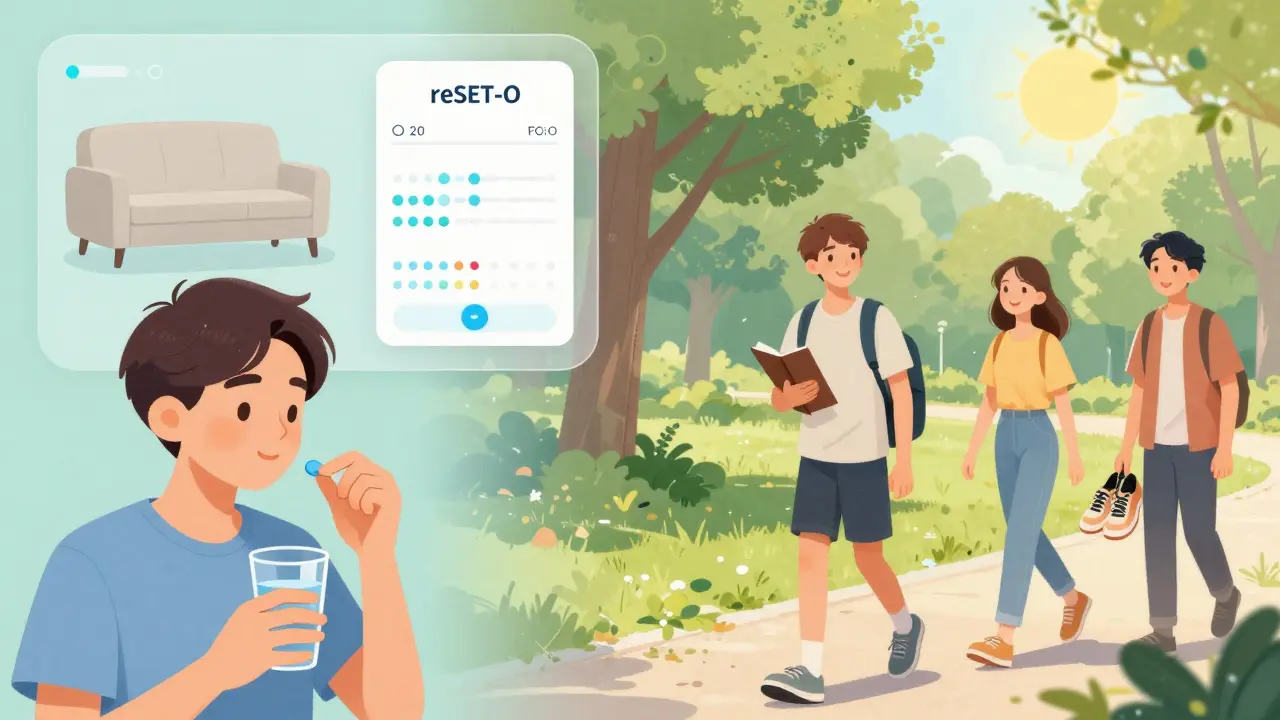
And now, digital tools are entering the space. The FDA approved reSET-O, a digital therapeutic app that helps teens track mood and practice coping skills. It’s not a replacement for therapy, but it can support it - especially when in-person access is limited.
What Parents Need to Know
- Don’t wait six months to act. The longer depression goes untreated, the harder it is to reverse.
- Therapy doesn’t mean your child is “broken.” It means the system they live in needs adjustment.
- Medication isn’t a quick fix. It’s a tool. It works best when paired with emotional support.
- Ask about the therapist’s training. Look for someone certified in ABFT, Structural Family Therapy, or another evidence-based model.
- Monitor side effects closely if medication is started. Call the doctor if your teen becomes more agitated, isolated, or talks about self-harm.
- Use tools like the Family Assessment Device (FAD) to track progress. Scores above 2.0 suggest dysfunction that needs attention.
Looking Ahead
By 2030, experts predict family therapy will be the first-line treatment for nearly half of all adolescent depression cases - up from less than 30% today. Why? Because it’s not just treating symptoms. It’s healing relationships.
The National Institute of Mental Health just awarded $4.7 million to expand ABFT in 15 community clinics. Early results show a 58% drop in suicidal thoughts after 12 weeks.
But access remains the biggest barrier. If you’re in a rural area or can’t afford therapy, start with your pediatrician. Ask about fluoxetine or escitalopram. Ask about telehealth options. Ask about school-based counseling. Don’t wait for the perfect solution - start with what’s possible today.
Can family therapy help even if my teen refuses to talk?
Yes. Family therapy doesn’t require the teen to be open right away. Therapists work with parents first to change how they respond - which often shifts the teen’s behavior over time. In ABFT, for example, the teen may not speak much in early sessions, but when parents stop criticizing and start listening, the teen often begins to open up on their own.
Is medication safe for teens?
Fluoxetine and escitalopram are the only two SSRIs FDA-approved for teens, and they’ve been studied in thousands of adolescents. While they carry a black box warning for increased suicidal thoughts in the first few weeks, this risk is rare and usually short-lived. The bigger danger is leaving depression untreated. Most teens who take these medications under careful supervision feel better and safer within months.
How long does family therapy take to work?
Some families see improvements in communication and mood within 4 to 6 weeks. For teens with suicidal thoughts, ABFT typically shows significant reduction in symptoms by 10 to 12 weeks. Full healing often takes 12 to 16 sessions. The key is consistency - missing sessions slows progress.
What if my partner won’t attend therapy?
Therapy can still help. Many family therapists will work with the parent who is willing to participate. The goal isn’t to force the other parent - it’s to change the dynamics the teen experiences. Even one engaged parent can create enough shift to make a difference. Some therapists even offer single-parent sessions as a starting point.
Are there any natural alternatives to medication?
Regular physical activity, consistent sleep, and sunlight exposure can significantly reduce mild to moderate depression symptoms. One study found teens who exercised 3 times a week had results similar to those on SSRIs. But for moderate to severe depression, these alone aren’t enough. They work best as supports - not replacements - for therapy or medication.
Next Steps
If you’re worried about your teen:
- Start with their pediatrician. Ask about depression screening and next steps.
- Ask if they can refer you to a therapist trained in ABFT or structural family therapy.
- If therapy waitlists are long, ask about telehealth or digital tools like reSET-O.
- If medication is recommended, insist on fluoxetine or escitalopram - and request weekly check-ins for the first month.
- Call the SAMHSA National Helpline at 1-800-662-4357. They offer free, confidential support and can help you find local resources.
There’s no shame in asking for help. And there’s no timeline that says you have to fix it alone. Depression in teens is treatable - but it takes the right mix of tools, patience, and support.
Charlotte Dacre
February 16, 2026 AT 03:11Family therapy? Sure. But let's be real - if Mom's still yelling about grades while crying into her wine, no therapist in the world can fix that. I've seen it. It's not the teen. It's the whole damn house.
Also - 80% of families report better communication? Bro. That's because the therapist told them to stop saying 'I'm just worried' and start saying 'I'm here'. Simple. Human. Revolutionary.
Esha Pathak
February 16, 2026 AT 21:07When was the last time a parent sat with their child and didn't try to fix it? Not fix. Just sit.
Fluoxetine? It's a band-aid on a broken spine.
Family therapy? That's the scalpel. But only if you're brave enough to let it cut deep.
💔
Mike Hammer
February 17, 2026 AT 19:50Turned out she was right. We were. Therapy didn't fix her - it fixed us. Now we eat dinner without phones. Weird, right?
Also - exercise. No joke. She started biking after school. Said it was the first time she felt like she could breathe. No meds needed.
Chiruvella Pardha Krishna
February 18, 2026 AT 21:45Depression in adolescents is not a chemical imbalance. It is a cry from a system that has forgotten how to listen.
The family is not a backdrop. It is the stage. And we are all actors - some playing roles we never auditioned for.
Therapy is not treatment. It is reclamation.
Joe Grushkin
February 19, 2026 AT 23:43Prozac works. Period. The studies are peer-reviewed. The FDA says so. The 11% risk? That’s less than the risk of crossing the street blindfolded.
Stop romanticizing dysfunction. We need solutions, not poetry.
Virginia Kimball
February 21, 2026 AT 09:41You’re already doing it. You’re here. You’re reading. You care.
And that’s the first step.
Therapy doesn’t have to be perfect. Just show up.
Medication isn’t weakness - it’s courage.
And if your kid won’t talk? Sit next to them. Watch a dumb movie. Hold their hand. Don’t say a word.
You’re not failing. You’re loving.
Michael Page
February 23, 2026 AT 05:24She tried to end it at 17.
They gave her Prozac. It took 6 weeks. She didn't say thank you. She didn't cry. She just started doing laundry again.
That's the thing no one tells you - recovery isn't dramatic. It's quiet. It's socks folded. It's breakfast eaten.
Don't wait for a breakthrough. Just keep showing up.
Mandeep Singh
February 24, 2026 AT 21:01The real issue is the collapse of discipline. Kids today are coddled like fragile porcelain dolls while their brains are rotting from TikTok and social media.
Family therapy? That's just a fancy way of letting teens rule the house.
And SSRIs? They're chemical pacifiers for parents too lazy to set boundaries.
My nephew got a 15-minute script from his pediatrician and now he's on Lexapro at 14. What a victory.
Pathetic.
Charlotte Dacre
February 25, 2026 AT 23:39Let me guess - you think 'discipline' means yelling louder until they cry?
Try listening. Just once. Not to fix. Not to control. Just to hear.
And if your nephew's on Lexapro at 14? Congrats. You just turned a cry for help into a prescription.
Good job.