
Sulfonylurea Hypoglycemia Risk Estimator
Risk Assessment
Configure your parameters and click calculate to see the estimated hypoglycemia risk profile.
You’ve been taking your diabetes medication for years. It works. Your blood sugar numbers are where they should be. But lately, you’ve felt that familiar, terrifying shake in your hands or the cold sweat on your forehead before dinner. You know what it is-low blood sugar, or hypoglycemia is a condition characterized by abnormally low blood glucose levels, often causing symptoms like shakiness, sweating, and confusion.. And you suspect your pill might be the culprit.
If you are on a sulfonylurea is a class of oral antidiabetic medications that stimulate insulin secretion from pancreatic beta cells to lower blood glucose levels., you are not alone. These drugs have been around since the 1950s and remain one of the most common treatments for type 2 diabetes because they are incredibly effective and cheap. But here is the hard truth: not all sulfonylureas are created equal. Some carry a significantly higher risk of dangerous lows than others. The difference between staying safe and ending up in the emergency room often comes down to which specific drug you take and how long it stays in your system.
The Core Problem: How Sulfonylureas Work
To understand why some of these drugs cause more problems than others, you need to look at what they actually do. Unlike newer medications that help your body use insulin better or slow down sugar absorption, sulfonylureas push your pancreas to squeeze out more insulin. Think of it like stepping on the gas pedal of a car. If you keep your foot on the pedal even when you’re stopped at a red light (like skipping a meal or exercising), the engine revs too high-or in this case, your blood sugar drops too low.
This mechanism is powerful. Studies show sulfonylureas can reduce HbA1c levels by 1.5% to 2.0%. That is a significant drop. However, because they force insulin production regardless of your current blood sugar level, they leave little room for error. If you eat less than usual, move more than planned, or if your kidneys aren’t filtering the drug out quickly enough, that insulin keeps working. This leads to the primary side effect we are worried about: severe hypoglycemia.
Glyburide vs. Glipizide: The Safety Gap
When doctors prescribe sulfonylureas, they usually choose from three main options available in the U.S.: glyburide (also known as glibenclamide), Diabeta, Glynase, is a long-acting second-generation sulfonylurea with a half-life of approximately 10 hours and active metabolites that persist up to 24 hours., glipizide (Glucotrol) is a short-acting second-generation sulfonylurea with a half-life of 2-4 hours, considered safer for patients at risk of hypoglycemia., and glimepiride (Amaryl) is an intermediate-acting sulfonylurea with a hypoglycemia risk profile between glyburide and glipizide.. While they belong to the same family, their safety profiles are vastly different.
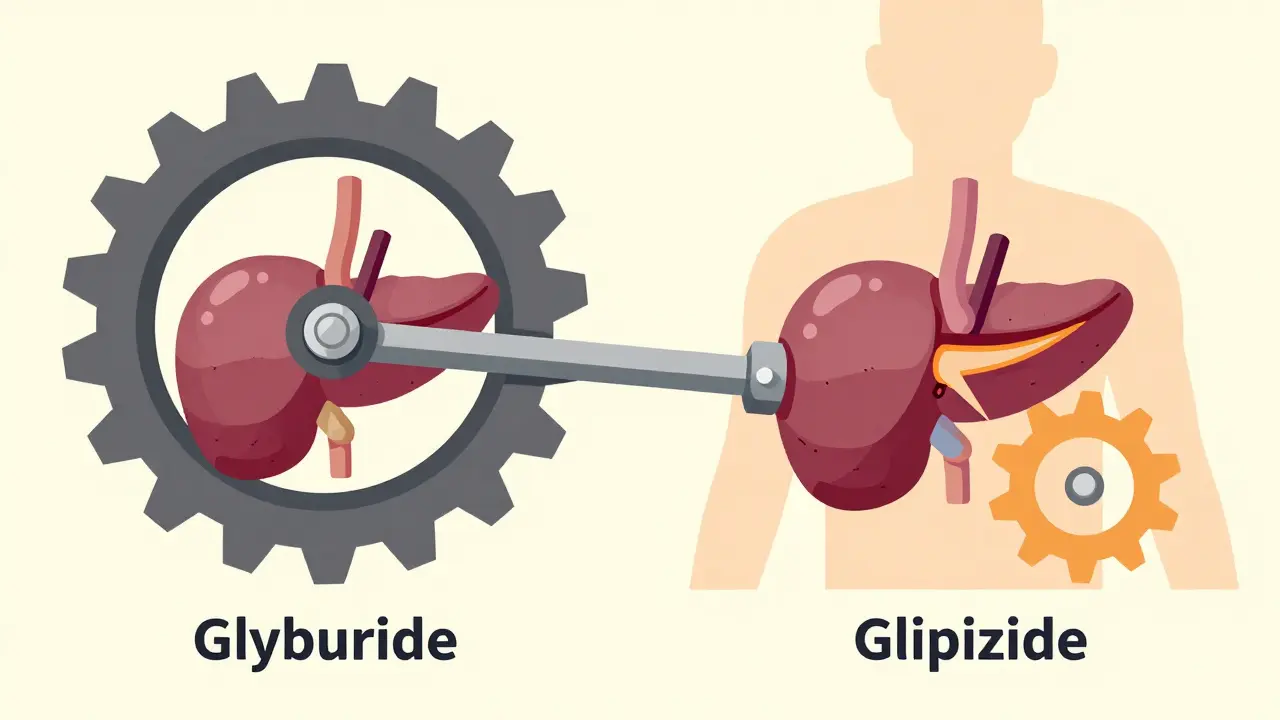
Glyburide is the heavy hitter. It lasts a long time in your body. Its half-life is about 10 hours, but its active metabolites-the parts of the drug still doing work-can hang around for up to 24 hours. This means if you take it in the morning, it’s still pushing your pancreas late into the night. For many people, especially older adults or those with kidney issues, this prolonged activity is dangerous.
Glipizide, on the other hand, is much lighter. It has a half-life of only 2 to 4 hours. It does its job and then clears out. This shorter duration gives you a buffer. If you skip lunch, the drug won’t be lingering in your system hours later trying to drive your sugar down further. Data backs this up starkly. A 2017 study in Diabetes Care found that long-acting agents like glyburide caused severe hypoglycemia at a rate of 7.4 episodes per 1,000 patient-years. Short-acting agents like glipizide? Only 3.8 episodes. That is nearly double the risk for glyburide users.
| Drug Name | Half-Life | Hypoglycemia Risk (per 1,000 patient-years) | Best For |
|---|---|---|---|
| Glyburide | 10 hours (active metabolites up to 24h) | High (12.1 - 19.9) | Patient with regular meals, healthy kidneys, young age |
| Glipizide | 2-4 hours | Low (4.2) | Elderly patients, irregular eating schedules, kidney impairment |
| Glimepiride | 5-9 hours | Moderate (7.8) | Patients needing once-daily dosing with moderate risk tolerance |
Why Age and Kidney Function Matter
Your body changes as you get older, and so does how it handles medication. The American Geriatrics Society’s Beers Criteria explicitly recommends avoiding glyburide in adults aged 65 and older. Why? Because aging kidneys don’t filter drugs as efficiently. When your kidney function declines, glyburide builds up in your blood. Since it already has a long half-life, adding accumulation to the mix creates a perfect storm for severe lows.
A retrospective study of over 14,000 patients aged 65 and older revealed that glibenclamide (the international name for glyburide) caused 19.9 episodes of serious hypoglycemia per 1,000 person-years. Compare that to tolbutamide (an older, short-acting drug) at just 3.5 episodes. In the U.S., where tolbutamide is rarely used, glipizide is the preferred alternative for seniors. It requires no dose adjustment until kidney function drops significantly (eGFR <30 mL/min/1.73m²), whereas glyburide should be avoided when eGFR falls below 60.
If you are over 65, or if you have any history of kidney disease, asking your doctor about switching from glyburide to glipizide isn’t just a preference-it’s a safety imperative. Real-world data from the FDA shows that glyburide accounts for 68.2% of sulfonylurea-related hypoglycemia reports, despite making up only about a third of prescriptions. That disproportionate number tells a clear story.
Cost vs. Safety: The Modern Dilemma
Let’s talk money. One reason sulfonylureas are still prescribed is cost. Generic glipizide or glyburide can cost as little as $4 per month. Newer drugs like GLP-1 receptor agonists (such as semaglutide/Ozempic) can cost $500-$600 monthly. For millions of people, especially those on Medicare without robust supplemental coverage, sulfonylureas are the only affordable option to get their HbA1c under control.
However, the cost of treating severe hypoglycemia is steep. Emergency room visits, hospitalizations, and the long-term cognitive damage associated with recurrent lows add up quickly. Dr. Robert A. Vigersky, an endocrinologist at Walter Reed National Military Medical Center, noted that the choice isn’t whether to use a sulfonylurea, but which one to use based on the patient’s risk profile. Choosing a cheaper drug that lands you in the ER defeats the purpose of saving money.
Furthermore, usage patterns are shifting. A 2023 study in JAMA Internal Medicine showed that initiation rates for sulfonylureas dropped from 28.5% in 2010 to 12.3% in 2022 among new diabetes patients. Doctors are increasingly turning to SGLT2 inhibitors and DPP-4 inhibitors, which have much lower hypoglycemia risks. Yet, in resource-limited settings or for patients with strict budget constraints, sulfonylureas remain vital. The key is selecting the safest agent within that class.
Practical Steps to Minimize Risk
If you must stay on a sulfonylurea, or if you are currently on one, there are concrete steps you can take to protect yourself. Knowledge is your best defense against hypoglycemia.
- Start Low, Go Slow: The American Association of Clinical Endocrinologists recommends starting at the lowest possible dose. For glipizide, that’s 2.5mg. For glyburide, 1.25mg. Titrate slowly every 2-3 weeks while monitoring your response.
- Know the 15-15 Rule: If you feel shaky, sweaty, or confused, check your blood sugar. If it’s below 70 mg/dL, consume 15 grams of fast-acting carbohydrates (like 4 ounces of juice or 3-4 glucose tablets). Wait 15 minutes, then retest. Repeat if necessary.
- Adjust for Illness or Hospitalization: If you are hospitalized or severely ill, your food intake likely drops. The Society of Hospital Medicine mandates a 50% dose reduction of sulfonylureas during hospitalization. Always inform healthcare providers of your medication.
- Watch Your Kidneys: Get your kidney function checked annually. If your eGFR drops, discuss medication adjustments immediately. Glyburide should generally be avoided if eGFR is below 60.
- Consider Timing: Take your medication right before a meal, not hours before. This ensures the peak insulin release aligns with the influx of glucose from food.
Real Patient Experiences
Numbers tell one story; patient experiences tell another. On the American Diabetes Association Community Forum, a thread titled “Switching from glyburide to glipizide” featured 87 responses. Of those, 72.4% reported fewer hypoglycemic episodes after switching. One user wrote, “I was having 2-3 severe lows monthly on glyburide... since switching to glipizide 6 months ago, I've had zero.”
Conversely, negative experiences with long-acting agents are frequent. In a Reddit discussion, over 60% of respondents shared stories of emergency room visits related to glyburide-induced hypoglycemia. One 72-year-old user recounted spending three days in the hospital after their glyburide dose wasn’t adjusted for declining kidney function. These anecdotes mirror the clinical data: the wrong sulfonylurea for the wrong patient can have life-altering consequences.
Looking Ahead: New Formulations and Guidelines
The landscape is evolving. In 2023, the FDA approved a new extended-release formulation of glipizide (Glucotrol XL) that offers more stable pharmacokinetics. Early phase 3 trials showed a 32% lower hypoglycemia risk compared to immediate-release glipizide. This could provide an even safer option for those who need once-daily dosing but want to avoid the peaks and troughs of older formulations.
Additionally, the American Diabetes Association’s 2024 Standards of Care strengthened recommendations to prefer short-acting sulfonylureas like glipizide over long-acting agents like glyburide, particularly in older adults or those with irregular meal patterns. The message from experts is clear: treat sulfonylureas as distinct tools, not interchangeable commodities.
If you are currently experiencing unexplained lows, fatigue, or confusion, don’t dismiss it as “just part of diabetes.” Talk to your doctor about reviewing your medication list. Switching from a long-acting to a short-acting sulfonylurea might be the simple change that restores your safety and quality of life.
Is glipizide safer than glyburide?
Yes, glipizide is generally considered safer than glyburide, especially for older adults and those with kidney impairment. Glipizide has a shorter half-life (2-4 hours) compared to glyburide (10+ hours with active metabolites lasting up to 24 hours). This shorter duration reduces the risk of prolonged hypoglycemia. Studies show glyburide has nearly double the rate of severe hypoglycemia events compared to short-acting agents like glipizide.
What are the common side effects of sulfonylureas?
The most common and serious side effect is hypoglycemia (low blood sugar), which can cause shakiness, sweating, confusion, and in severe cases, seizures or loss of consciousness. Other potential side effects include weight gain, as increased insulin production can promote fat storage. Some patients may also experience gastrointestinal upset, though this is less common than with metformin.
Can I take sulfonylureas if I have kidney disease?
Caution is required. Glyburide should generally be avoided if your estimated glomerular filtration rate (eGFR) is below 60 mL/min/1.73m² due to the risk of active metabolite accumulation. Glipizide is safer and typically requires no dose adjustment until eGFR falls below 30 mL/min/1.73m². Always consult your healthcare provider for personalized advice based on your specific kidney function.
How do sulfonylureas compare to newer diabetes drugs like Ozempic?
Sulfonylureas are significantly cheaper (often under $10/month) but carry a higher risk of hypoglycemia and weight gain. Newer drugs like GLP-1 receptor agonists (Ozempic, Mounjaro) have much lower hypoglycemia risks, promote weight loss, and offer cardiovascular benefits. However, they are far more expensive ($500-$600/month) and may not be covered by all insurance plans. The choice often depends on cost, insurance coverage, and individual health goals.
What should I do if I experience low blood sugar while on a sulfonylurea?
Follow the "15-15 Rule": Consume 15 grams of fast-acting carbohydrates (such as 4 ounces of fruit juice, regular soda, or glucose tablets). Wait 15 minutes, then check your blood sugar again. If it is still below 70 mg/dL, repeat the process. Once your blood sugar normalizes, eat a small snack or meal to maintain levels. If you cannot swallow or are unconscious, seek emergency medical help immediately for glucagon administration.