Medication-Citrus Interaction Checker
Most people know grapefruit can mess with their meds. But if you’re eating pomelo or savoring Seville orange marmalade, you might be at just as much risk-maybe even more. These fruits aren’t just exotic snacks. They’re powerful biochemical actors that can turn safe doses of your pills into dangerous overdoses. And no, you won’t always see a warning on the label.
Why Pomelo Is Grapefruit’s Bigger, Riskier Cousin
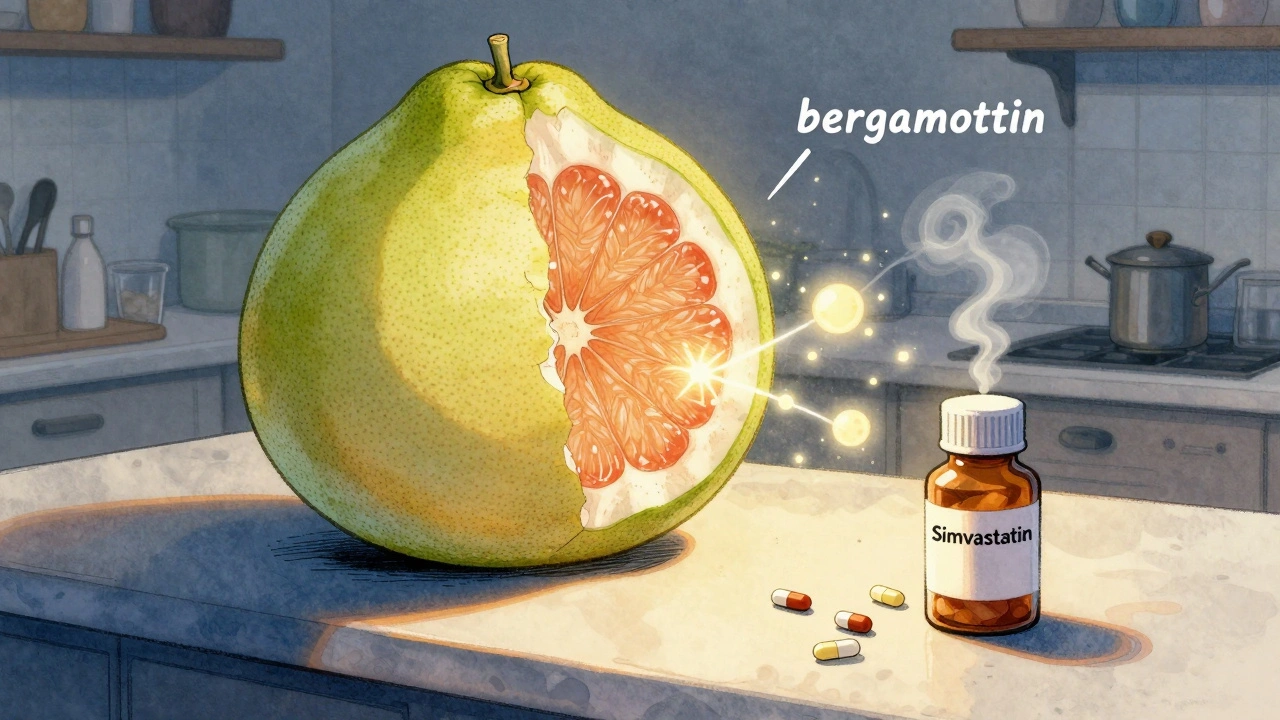
Pomelo, the giant citrus fruit from Southeast Asia, looks like a pale green grapefruit but can weigh up to 2 pounds. It’s sweet, juicy, and often sold as a luxury item in Asian grocery stores. But here’s what most shoppers don’t know: pomelo contains more of the dangerous compounds than grapefruit does. Studies show it has 1.5 to 2.5 micromoles of bergamottin per liter-higher than grapefruit’s 1.0 to 2.0. That’s the key chemical that shuts down your body’s ability to break down certain drugs.When you eat pomelo, those compounds block CYP3A4, an enzyme in your gut that normally filters out toxins and medications before they enter your bloodstream. Without it, drugs like simvastatin (a cholesterol pill) can flood your system. One 2018 study found pomelo juice increased simvastatin levels by 350%, compared to 300% with grapefruit. That’s not a small difference-it’s the gap between a safe dose and muscle damage so severe it can cause kidney failure.
And it’s not just juice. Eating the flesh alone can trigger the same reaction. A patient in Vancouver developed rhabdomyolysis after eating half a pomelo every day for two weeks while on simvastatin. No one warned them. Not their doctor. Not the pharmacist. Not the store clerk who sold them the fruit.
Seville Orange: The Hidden Danger in Your Marmalade
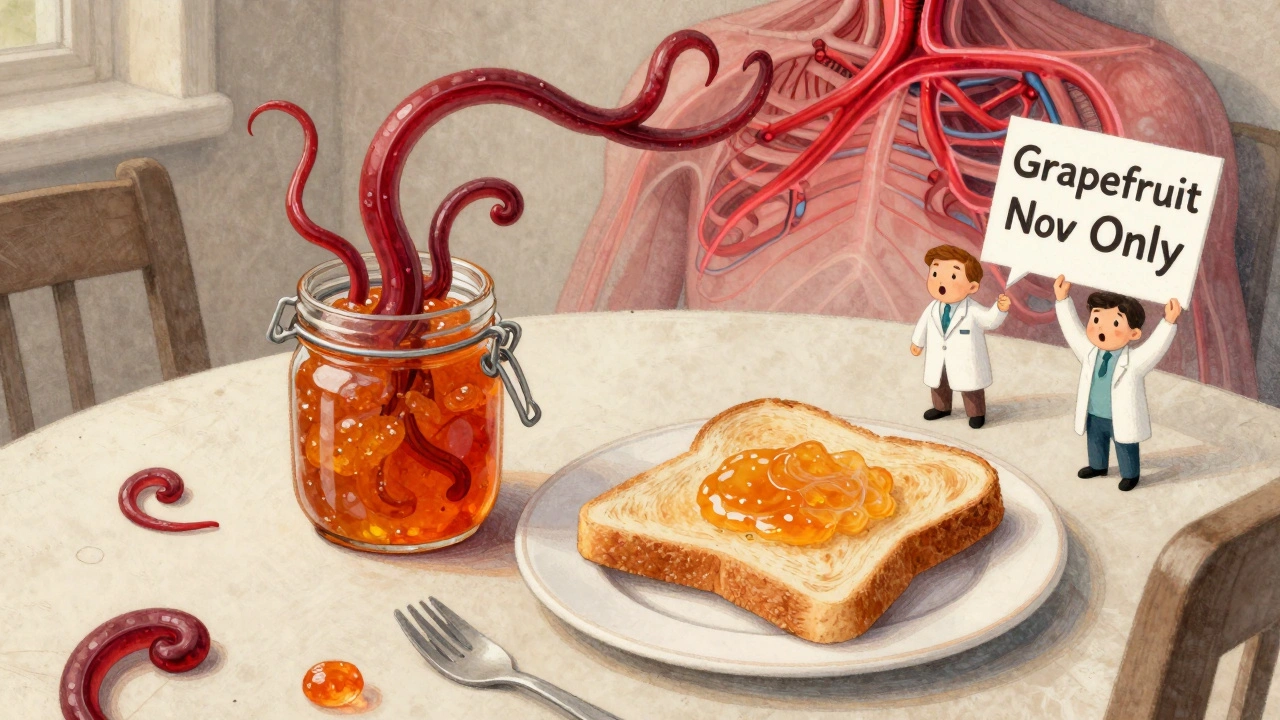
Seville orange, also called bitter orange, isn’t eaten raw. It’s too sour. But it’s the star ingredient in traditional British marmalade, Spanish sauces, and some herbal supplements. What makes it dangerous? Its peel and pulp contain up to 30% more bergamottin than grapefruit. Some cultivars hit 4.0 micromoles per liter-among the highest recorded in any citrus fruit.Here’s the twist: people don’t think of marmalade as a drug-interacting food. They think of it as breakfast. But a 2011 case report in Transplantation Proceedings documented a kidney transplant patient who went into toxic shock after eating Seville orange marmalade daily. His tacrolimus levels-his anti-rejection drug-spiked 400%. He ended up in the hospital. His doctors had never considered marmalade as a culprit.
Unlike grapefruit juice, which is often labeled with warnings, Seville orange marmalade rarely carries any. A 2022 FDA review found only 37% of pomelo and Seville orange products included interaction warnings, compared to 78% for grapefruit. That’s not negligence-it’s ignorance. Most manufacturers don’t even test for furanocoumarin levels.
Which Medications Are at Risk?
Not every drug is affected. But the ones that are? They’re serious. The main culprits include:- Statins like simvastatin, lovastatin, and atorvastatin-used for cholesterol. These can cause muscle breakdown (rhabdomyolysis), which can lead to kidney failure.
- Calcium channel blockers like amlodipine and felodipine-used for high blood pressure. Interaction can cause dangerously low blood pressure, dizziness, or fainting.
- Immunosuppressants like tacrolimus and cyclosporine-critical for transplant patients. Even small increases can cause kidney damage or rejection.
- Some anti-anxiety and sleep drugs like buspirone and midazolam-can cause excessive sedation or breathing problems.
- Some heart rhythm drugs like amiodarone and quinidine-risk of irregular heartbeat.
Drugs metabolized by CYP2D6-like some antidepressants or beta-blockers-are generally safe. But if you’re on any of the above, pomelo and Seville orange aren’t just “maybe” risky. They’re outright dangerous.
How Long Does the Effect Last?
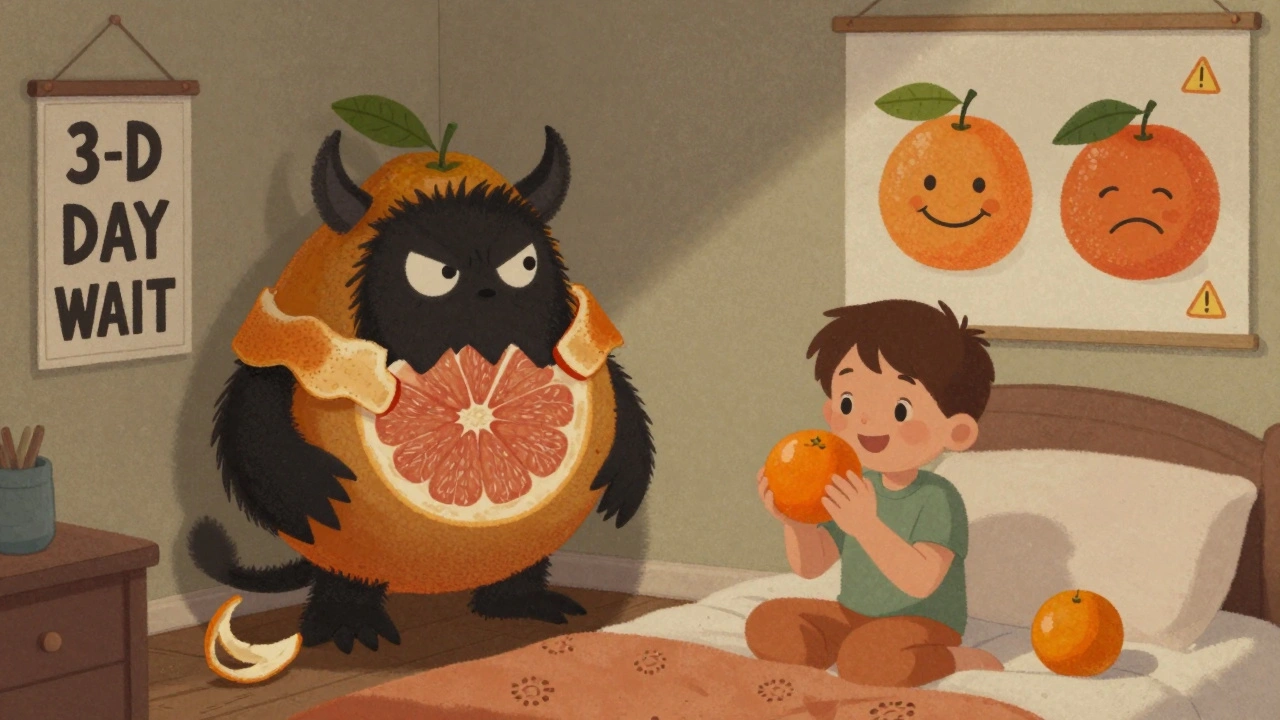
This is where most people get tripped up. It’s not just about what you eat today. Furanocoumarins don’t just slow down the enzyme-they destroy it. Your body has to grow new enzymes to replace them. That takes time.Even if you eat pomelo at breakfast, the effect can last 72 hours. That means if you take your statin on Wednesday morning and eat a slice of pomelo Tuesday night, you’re still at risk. The FDA recommends avoiding these fruits for at least three days before starting a new medication-and during the entire course of treatment.
And here’s the kicker: one glass of juice (200 mL) is enough. You don’t need to binge. Just one serving can trigger the interaction. That’s why so many cases go unnoticed-patients think they’re safe because they only had a little bit.
Why Aren’t We Hearing More About This?
Grapefruit gets all the attention. Pomelo and Seville orange? They’re the silent players. Partly because they’re less common in North America. Partly because the research is newer. But mostly because the system isn’t built to catch them.As of 2023, only 29% of major pharmacy chains have these fruits included in their electronic drug interaction alerts. Most systems only flag “grapefruit.” So when a pharmacist screens your meds, pomelo doesn’t even show up as a red flag.
And patients? A 2023 survey found 68% of people taking interacting medications had never been warned about pomelo or Seville orange by their provider. They assume if it’s not grapefruit, it’s safe. That’s a deadly assumption.
What Should You Do?
If you’re on any of the medications listed above, here’s your action plan:- Check your meds. Look up your prescription on the University of Florida’s Drug Interaction Checker (they list 107 drugs affected by pomelo and Seville orange).
- Ask your pharmacist. Don’t assume they know. Say: “Does my medication interact with pomelo or Seville orange?”
- Read labels. If you buy marmalade, check the ingredients. Is it made with Seville oranges? If yes, avoid it.
- Swap your citrus. Sweet oranges, tangerines, and clementines are safe. They don’t contain furanocoumarins. A 2022 Mayo Clinic survey found 82% of patients who switched to these fruits reported no issues.
- Wait three days. If you accidentally eat one of these fruits, delay your medication by at least 72 hours if possible-and talk to your doctor.
The Bigger Picture
Pomelo consumption has jumped 50% since 2015, according to FAO data. More people are eating it. More people are on statins. More people are transplant recipients. The risk is growing. The FDA is finally catching up-they proposed new labeling rules in 2023, with changes expected by mid-2025. But until then, you’re on your own.There’s no magic bullet. No app that scans your fruit. No barcode that tells you it’s safe. Only knowledge. Only questions. Only the courage to ask: “Is this fruit going to hurt me?”
It’s not about fear. It’s about control. You can still enjoy citrus. You just need to know which ones to avoid.
Can I eat oranges if I’m on medication?
Yes. Sweet oranges, tangerines, and clementines are safe. They don’t contain furanocoumarins, the compounds that cause drug interactions. Stick to these if you’re on statins, blood pressure meds, or immunosuppressants. Avoid anything labeled as “bitter orange,” “Seville orange,” or “pomelo.”
Does cooking destroy the interaction risk?
No. Furanocoumarins are heat-stable. Boiling, baking, or making marmalade won’t break them down. Seville orange marmalade is just as dangerous as the raw fruit. The concentration might even be higher if the peel is used, since that’s where the compounds are most concentrated.
I ate pomelo and didn’t feel anything. Does that mean it’s safe?
Not at all. These interactions don’t cause immediate symptoms. You won’t feel dizzy or sick right away. The danger is that your drug levels build up slowly over days. By the time you feel unwell-like muscle pain, weakness, or confusion-it might already be too late. The absence of symptoms doesn’t mean absence of risk.
Are all grapefruit-like fruits dangerous?
Not all. Only those with high furanocoumarin content: grapefruit, pomelo, and Seville orange. Blood oranges, mandarins, and regular oranges are safe. But be careful-pomelo is often mislabeled as “Chinese grapefruit” in stores. If it’s large, pale yellow, and tastes sweet but slightly bitter, it’s likely pomelo. Avoid it if you’re on interacting meds.
Can I have these fruits if I take my meds at night?
No. The interaction isn’t about timing-it’s about enzyme destruction. Eating pomelo in the morning and taking your pill at night still puts you at risk. The enzyme inhibition lasts up to 72 hours. You need to avoid these fruits entirely for at least three days before and during treatment.
What should I do if I accidentally ate pomelo while on medication?
Don’t panic, but don’t ignore it. Stop eating the fruit immediately. Contact your pharmacist or doctor. If you’re on a statin and feel unexplained muscle pain, weakness, or dark urine, seek medical help right away-it could be rhabdomyolysis. For transplant patients on tacrolimus, even a small amount can be life-threatening. Better safe than sorry.
Haley P Law
December 9, 2025 AT 04:57OMG I ate pomelo yesterday with my statin 😱 I’m fine?? I think?? 😅
Sabrina Thurn
December 9, 2025 AT 21:10Actually, this is a critical public health blind spot. CYP3A4 inhibition isn't just theoretical-it's documented in clinical case reports going back over a decade. The FDA's lag in updating labeling protocols is a systemic failure of pharmacovigilance. Most patients assume ‘no warning = safe,’ but the biochemistry doesn’t care about regulatory inertia. The real issue is that commercial citrus producers aren’t required to test for furanocoumarins. That’s not negligence-it’s profit-driven deregulation.
And yes, cooking doesn’t help. Furanocoumarins are terpenoid derivatives with high thermal stability. Boiling marmalade concentrates them further by reducing water content. The peel? That’s where 70% of the bergamottin lives. So yes, your ‘natural’ Seville orange jam is a pharmacokinetic landmine.
Switching to sweet oranges isn’t just advice-it’s evidence-based. Citrus sinensis lacks the furanocoumarin profile entirely. Clementines, tangerines, satsumas-all safe. The Mayo Clinic data is robust. But until pharmacies update their drug interaction engines, we’re all playing Russian roulette with our meds.
And for the love of science, stop assuming ‘I didn’t feel anything’ means ‘it didn’t happen.’ Rhabdomyolysis doesn’t announce itself with a bang. It whispers for weeks until your creatine kinase hits 100,000 and your kidneys start shutting down.
Knowledge isn’t optional. It’s your last line of defense.
Andrea Petrov
December 10, 2025 AT 01:44Of course they don’t warn you. Big Pharma doesn’t want you to know that a $2 fruit can outmaneuver their billion-dollar drugs. They’d rather you keep paying for pills and blame your ‘bad metabolism.’
And don’t get me started on how the FDA is in bed with citrus conglomerates. Pomelo imports are booming from Thailand and Vietnam-guess who’s lobbying to keep labels off? The same people who made grapefruit warnings optional too.
They’re letting people die so they can keep selling statins. It’s not a mistake. It’s a business model.
And yes, I’ve seen it happen. My aunt’s kidney failed after her ‘healthy’ marmalade habit. No one told her. Not even her ‘holistic’ naturopath.
Suzanne Johnston
December 10, 2025 AT 02:30There’s something deeply ironic here. We live in an age where we can sequence genomes in hours, yet we still let people ingest life-threatening drug interactions because the fruit isn’t labeled ‘dangerous’ in big red letters.
Perhaps the real issue isn’t the fruit-it’s our collective failure to treat pharmacology as a shared responsibility. Doctors assume pharmacists know. Pharmacists assume patients read the pamphlets. Patients assume ‘natural’ means ‘harmless.’ And the fruit? It just sits there, sweet and silent, waiting for someone to bite.
Maybe the solution isn’t more warnings. Maybe it’s a cultural shift: treating food-drug interactions like we treat food allergies. No ‘maybe.’ No ‘probably.’ Just clear, universal labeling. No exceptions.
And yes, I’ve had my tacrolimus levels checked. I avoid all citrus except sweet oranges. It’s not fear. It’s respect-for the science, and for the fact that my body doesn’t get a second chance.
Graham Abbas
December 11, 2025 AT 11:01Oh my god. I just realized-I’ve been eating Seville orange marmalade on my toast every morning for five years. And I’m on amlodipine.
I’m not even kidding. I thought it was just ‘bitter’ because of tradition. I had no idea it was basically liquid pharmacology.
I just threw out the whole jar. Like, right now. I’m sitting here in my kitchen with a spoon in one hand and my blood pressure monitor in the other, wondering if I’ve already done irreversible damage.
Why does no one talk about this? Why is this not on every pharmacy shelf? Why is this not in the ‘Things You Should Know Before You Turn 30’ pamphlets?
I feel like I’ve been living in a parallel universe where citrus is just fruit, not a silent assassin.
Thank you for this post. I’m terrified. But I’m also grateful.
Nikhil Pattni
December 12, 2025 AT 19:19Bro you guys are overreacting. I am from India and we eat pomelo every day in monsoon and nobody dies. My uncle takes atorvastatin and eats whole pomelo like apple. He is 72 and still walks 10km daily. You westerners think everything is poison. CYP3A4 inhibition is real but it depends on dosage, frequency, and individual metabolism. Not everyone has same enzyme activity. Some people are slow metabolizers, some are ultra-rapid. You can't generalize like this. Also, most of these studies are done on juice, not whole fruit. Whole fruit has fiber which slows absorption. You are scaring people for no reason. Also, I checked your FDA stat, 78% grapefruit warning? So what? 22% didn't warn, maybe they didn't test. Not all companies are same. And why you think marmalade is dangerous? I have made marmalade with Seville orange and boiled it for 2 hours. Furanocoumarin is stable but concentration decreases due to evaporation. You need to eat 500ml of juice daily for 3 days to see effect. One spoon of marmalade? No way. You are creating panic. I have seen people in Delhi eat bitter orange peel in chutney with hypertension meds. No problem. So chill. Not everything is a threat. Your brain is too wired for fear. Eat sweet orange if you want to be safe. But don't make this a conspiracy. It's biology, not a Netflix documentary.
Courtney Black
December 13, 2025 AT 11:23So... the fruit doesn’t lie.
But the system does.
iswarya bala
December 15, 2025 AT 06:36thank u so much for this post!! i was eating pomelo every weekend with my blood pressure pill and i had no idea 😭 now i switched to banana and apple 😊 i feel so much better already!!
om guru
December 15, 2025 AT 18:34Richard Eite
December 16, 2025 AT 14:03Philippa Barraclough
December 18, 2025 AT 06:24I’m curious-has anyone tracked whether the increase in pomelo consumption correlates with rising cases of statin-induced rhabdomyolysis over the last decade? The FAO data shows a 50% rise in pomelo imports since 2015. Meanwhile, the CDC’s drug interaction surveillance reports have been silent on non-grapefruit citrus. Is that because the data isn’t being collected, or because the system doesn’t recognize the pattern?
I work in clinical data analysis. We’ve got the tools to map this. We’ve got the databases. But no one’s connecting the dots. Why? Is it because pomelo isn’t ‘mainstream’ enough? Or because the pharmaceutical industry has no incentive to track side effects from unpatentable food?
I’d love to see a peer-reviewed epidemiological study on this. Not just case reports. Real population-level data. Until then, I’m erring on the side of caution. But I’m also angry that we’re treating this like a niche issue. It’s not. It’s a systemic blind spot.
Tim Tinh
December 18, 2025 AT 11:06Yo I just wanna say thank you for this. I’m a transplant guy-tacrolimus, daily. I thought marmalade was just ‘British breakfast.’ I had no clue. I’ve been eating it since 2020. I just called my pharmacy and they were like ‘oh yeah that’s a thing’ and they had to look it up.
I threw out my jar. Bought sweet orange juice instead. My wife is mad because she loves the bitter taste but I told her ‘honey, I’d rather live with bland toast than die from a breakfast spread.’
Also-my mom in Texas just sent me a box of ‘Chinese grapefruit’ she bought at the market. I opened it. It was pomelo. I gave it to my neighbor who doesn’t take meds. He’s gonna make a fruit salad.
Thanks for saving my life, stranger. I owe you a coffee. Or a safe orange.