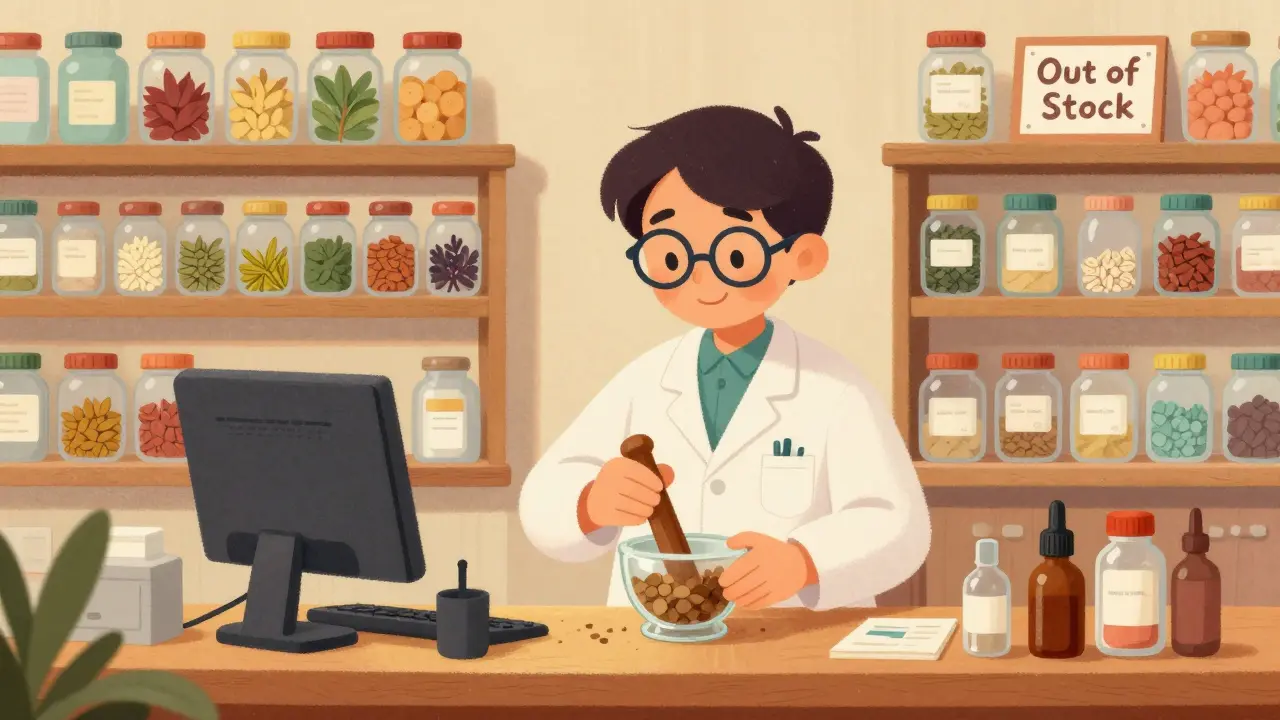
Imagine this: you’ve been taking the same medication for years. It works. Then, one day, your regular pharmacy says they’re out of stock. Not just for a week, but indefinitely. This isn’t a rare glitch in the system; it’s becoming a frustrating reality for millions of patients facing drug shortages. When the standard supply chain breaks down, or when a commercial drug contains an ingredient that triggers a severe allergy, you need a backup plan. That is where compounding pharmacies step in.
These specialized facilities are not just another type of drug store. They are custom manufacturing hubs for medicine, creating tailored solutions when off-the-shelf options fail. If you are dealing with a shortage, a swallowing difficulty, or a sensitivity to dyes and fillers, understanding how these pharmacies work can be the difference between staying on track with your health and going without treatment.
What Exactly Is a Compounding Pharmacy?
Think of them as the tailors of the medical world. A big-box retailer sells shirts in sizes Small, Medium, and Large. If none fit perfectly, you go to a tailor who measures you and sews a shirt that fits your exact dimensions. Similarly, while traditional retail pharmacies dispense FDA-approved products exactly as manufactured, compounding pharmacies mix raw ingredients to meet unique clinical requirements.
In the United States alone, there are approximately 7,500 pharmacies specializing in these services, with many more community pharmacies offering basic compounding capabilities. They operate under strict regulatory frameworks, primarily governed by the Food and Drug Administration (FDA) and state boards of pharmacy. Their primary job is to fill therapeutic gaps-situations where no commercial product exists that meets a specific patient’s medical needs.
When Do You Actually Need a Compounded Medication?
You might assume compounding is only for exotic treatments, but it often solves everyday problems. The most common trigger is a drug shortage. With 300 to 400 drug shortages occurring annually in the U.S., patients frequently find their essential medications unavailable. In these cases, a compounding pharmacist can recreate the active ingredient using alternative sources, provided the formulation is safe and stable.
However, shortages are just one scenario. Here are other critical reasons why doctors prescribe compounded meds:
- Allergies and Sensitivities: Many commercial pills contain gluten, lactose, soy, artificial dyes, or preservatives like parabens. About 15-20% of the population has sensitivities to these additives. Compounding pharmacies can strip these out, leaving only the active drug and safe fillers.
- Dosage Adjustments: Sometimes a patient needs a dose that doesn't exist commercially. For example, if a child needs 12.5 mg of a drug, but tablets come in 25 mg or 50 mg, splitting pills is inaccurate and dangerous. A compounder can make a precise 12.5 mg liquid or capsule.
- Delivery Method Changes: If you cannot swallow pills-a problem affecting 30% of elderly patients and 40% of children-pharmacists can convert a tablet into a liquid, a cream, a gel, or even a troche (a dissolvable lozenge).
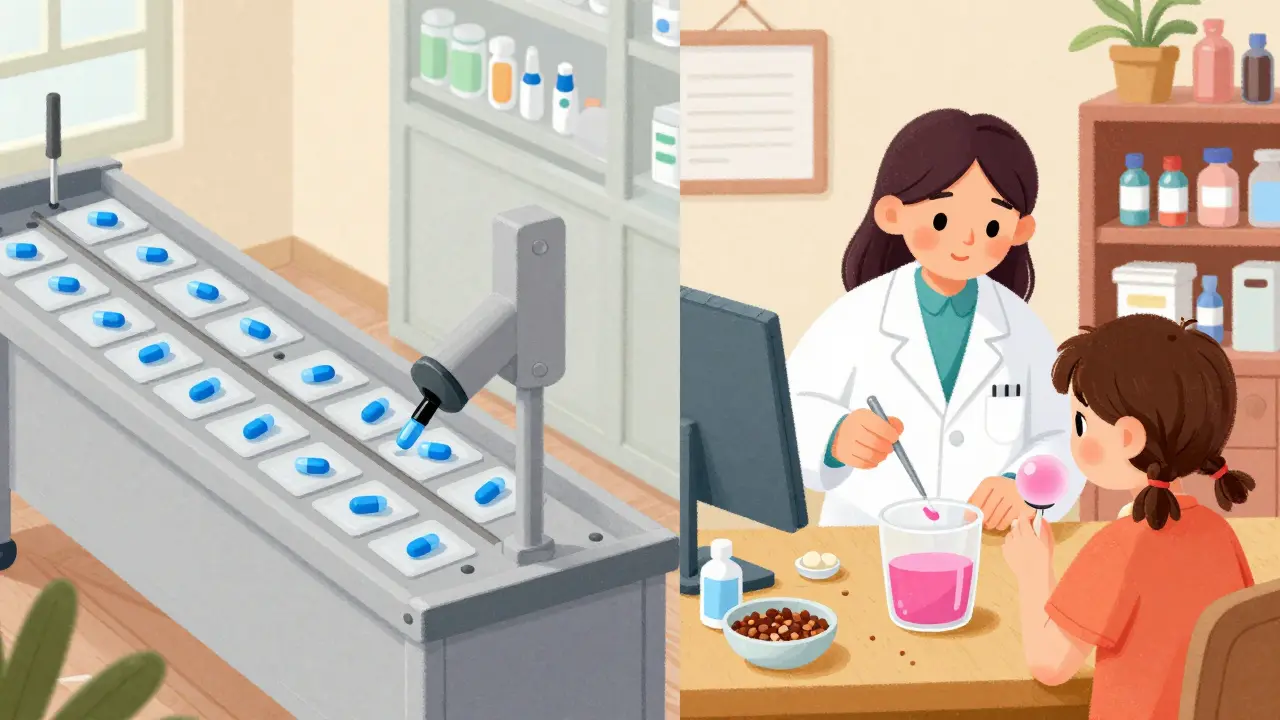
- Flavoring for Adherence: Bitter medicine leads to skipped doses. Compounding allows for flavors like bubblegum, strawberry, or grape, which significantly improves adherence in pediatric patients.
How Compounding Differs from Traditional Pharmacy
It is crucial to understand that compounding is not the same as manufacturing new drugs. There is a distinct line between the two, and crossing it can be illegal and unsafe.
| Feature | Traditional Retail Pharmacy | Compounding Pharmacy |
|---|---|---|
| Product Source | FDA-approved manufacturers | Custom-mixed by pharmacists |
| Regulatory Approval | Rigorous pre-market testing required | No pre-market FDA approval; regulated post-market |
| Customization | Fixed strengths and forms | Tailored strength, form, and ingredients |
| Availability | Immediate (usually) | 24-72 hours preparation time |
| Insurance Coverage | Widely covered | Often requires prior authorization or copay |
The biggest difference lies in regulation. Commercial drugs undergo years of clinical trials to prove safety and efficacy before hitting the shelves. Compounded medications skip this pre-market phase because they are made for individual patients, not the general public. Instead, quality control falls on the pharmacist and the facility itself. This is why choosing a reputable compounding pharmacy is non-negotiable.
Safety First: Regulations and Accreditation
Because compounding lacks the uniform oversight of mass production, safety protocols are paramount. The industry operates under two main FDA classifications: 503A and 503B.
503A Pharmacies are traditional, independent community pharmacies. They compound small batches for specific patients based on individual prescriptions. They must follow USP <795> guidelines for non-sterile compounds (like creams and capsules) and USP <797> for sterile compounds (like injections). These standards dictate everything from the cleanliness of the room to the expiration dating of the final product.
503B Outsourcing Facilities are larger operations that produce greater volumes of compounded drugs. They register with the FDA and undergo inspections, similar to drug manufacturers. They can respond to broader drug shortages but still cannot claim therapeutic equivalence to FDA-approved brands.
To ensure you are getting safe medication, look for accreditation from the Pharmacy Compounding Accreditation Board (PCAB). As of recent data, only about 1,200 facilities hold this voluntary accreditation, signaling they meet rigorous standards for quality and safety. Always ask your pharmacist if their facility is PCAB-accredited or inspected by your state board.
Navigating Costs and Insurance Hurdles
One of the most common complaints about compounding is cost. Because these medications are handmade, they take time and specialized labor. On average, pharmacists spend 25-35% more time per compounded prescription than on standard ones. Consequently, insurance coverage is inconsistent.
Approximately 45% of patients report paying out-of-pocket for compounded medications, compared to just 15% for standard prescriptions. However, this is changing. Many insurers now cover compounding if you can demonstrate medical necessity-for example, proving you have a documented allergy to a dye in the commercial version. To improve your chances of coverage:
- Get Documentation: Ensure your doctor clearly states why the commercial drug is unsuitable (e.g., "patient allergic to lactose").
- Prior Authorization: Be prepared to submit a prior authorization request to your insurance provider.
- Shop Around: Prices vary significantly between compounding pharmacies. Get quotes from multiple providers.

Limitations: What Compounding Can’t Do
Despite their versatility, compounding pharmacies have hard limits. They cannot replicate complex biologics, such as insulin analogs or monoclonal antibodies, which require sophisticated manufacturing processes. They also cannot clone brand-name drugs simply to save money; doing so violates federal law.
Furthermore, stability is a concern. Since compounded drugs are not tested long-term by manufacturers, pharmacists must assign a "beyond-use date" based on scientific literature or testing. This means compounded medications often have shorter shelf lives than commercial counterparts. You may need to reorder more frequently, which adds to the logistical burden.
Steps to Access Compounded Medications
If you think you need a compounded drug, here is the practical path forward:
- Consult Your Doctor: Discuss your issue-whether it’s a shortage, an allergy, or difficulty swallowing. Ask if compounding is a viable option.
- Find a Qualified Pharmacy: Look for a local compounding pharmacy or a reputable national service. Verify their PCAB accreditation or state inspection status.
- Submit the Prescription: Your doctor will send a detailed prescription specifying the active ingredient, strength, dosage form, and any exclusionary ingredients (e.g., "no gluten").
- Wait for Preparation: Expect a turnaround time of 24 to 72 hours. Sterile compounds may take longer due to additional validation steps.
- Review the Label: Check the beyond-use date and storage instructions carefully. Some compounded liquids need refrigeration.
The Future of Personalized Medicine
As drug shortages persist and healthcare moves toward personalization, the role of compounding pharmacies is expanding. Innovations like digital formulation tools are reducing errors by nearly 40%, and improved stability testing is extending shelf lives. We are seeing a rise in demand for hormone replacement therapies, pain management gels, and dermatological creams-all areas where customization offers clear benefits over one-size-fits-all pills.
While regulatory scrutiny remains high, the consensus among experts is clear: compounding is an essential safety net. It bridges the gap when industrial manufacturing fails to meet individual human needs. By understanding how these pharmacies work, what they can do, and how to navigate the costs, you empower yourself to stay healthy even when the standard supply chain falters.
Are compounded medications safe?
Yes, when prepared by accredited pharmacies following USP standards. While they lack pre-market FDA approval, reputable compounding pharmacies adhere to strict quality control guidelines for sterility, accuracy, and stability. Always choose a PCAB-accredited facility to minimize risk.
Does insurance cover compounding pharmacies?
Coverage varies widely. Many plans cover compounding if medical necessity is proven, such as allergies to commercial ingredients. However, roughly 45% of patients pay out-of-pocket. Contact your insurer beforehand and ask your doctor to document the specific reason compounding is required.
Can compounding pharmacies make any drug?
No. They cannot replicate complex biologics (like certain insulins or cancer drugs) or clone brand-name drugs for cost savings. They are best suited for altering dosage forms, strengths, or removing allergens from existing approved drugs.
How long does it take to get a compounded medication?
Typically 24 to 72 hours. Simple non-sterile compounds like creams or capsules may be ready sooner, while sterile injections require additional testing and validation, potentially extending the wait time.
What is the difference between 503A and 503B pharmacies?
503A pharmacies are traditional community pharmacies that compound for individual patients based on prescriptions. 503B outsourcing facilities are larger operations registered with the FDA that produce higher volumes, often responding to widespread drug shortages, and undergo federal inspections.
Cici arya Arya
June 9, 2026 AT 04:34honestly this is such a relief to read because my mom has been struggling with finding her thyroid meds for months and the big chain pharmacies just keep saying they are out of stock so we have no idea what to do next
Callie Skipper
June 9, 2026 AT 16:29i mean its kinda wild that we still live in a world where you cant just buy your regular meds without jumping through hoops but yeah compounding is definitely the way to go when the system fails you like it always seems to do these days
Hailey Dunston
June 11, 2026 AT 06:26One must be exceedingly cautious, however. The notion that any local pharmacy can simply 'mix' drugs safely is a dangerous oversimplification often perpetuated by those who lack a proper understanding of pharmaceutical chemistry. I recently had to source a specific compounded hormone gel from a facility in Switzerland because the domestic options were frankly subpar and lacked the requisite stability testing. Do not settle for mediocrity when your health is at stake. ;)
Emily Barnhill
June 13, 2026 AT 00:27Look, while your point about quality is valid, dismissing local accredited pharmacies as 'subpar' is incredibly elitist and unhelpful to people who actually need affordable care right now. Not everyone can import meds from Europe. We need to support the infrastructure we have here and ensure it meets standards rather than acting like the rest of us are clueless. It is frustrating when people use their privilege to gatekeep basic healthcare information.
rebecca torres
June 13, 2026 AT 08:09actually the FDA doesn't regulate compounding nearly as strictly as people think which is why there have been several outbreaks linked to contaminated compounded injections in the past so you really need to check if they are PCAB accredited or you might end up getting infected
Brandon Brodsky
June 13, 2026 AT 19:57Sure, let's all panic about outbreaks. Because clearly, the alternative-paying $500 for a pill that should cost $4-is somehow safer. I'm sure the FDA would love to inspect every single small batch made for individual patients, but good luck with that bureaucracy. Meanwhile, I'll stick to my compounding pharmacy that has never given me an issue.
Glenn Davis
June 14, 2026 AT 09:01We need to stop relying on foreign supply chains for our medicine. This whole shortage crisis is a failure of American manufacturing. Compounding is a band-aid. We should be making our own drugs domestically instead of outsourcing everything. It is a national security issue.
Erin Livengood
June 16, 2026 AT 01:33There is a certain poetic justice in the return of the apothecary model isn't there? In a world of mass-produced homogeneity the act of tailoring a remedy to the unique constitution of an individual feels almost rebellious. It reminds me of how we used to view medicine before the industrial complex took over completely. Perhaps we are circling back to a more holistic approach where the pharmacist is once again a craftsman rather than a mere dispenser of pills. It is a fascinating shift in the paradigm of healthcare delivery.
Christina S.
June 16, 2026 AT 15:40I totally get what you are saying about the craftsmanship aspect but let's not forget the practical side too. For my daughter who has severe sensory processing issues the ability to remove dyes and flavor the medication correctly has been a game changer. She actually takes her meds now which she refused to do before. So while the philosophy is nice the real win is seeing her healthy and happy without the daily battle.
AnneKatherine Stiekes
June 17, 2026 AT 02:47it is really nice to see people sharing their experiences because it helps others feel less alone in this struggle i know i was so stressed when i first found out about the shortages but learning about compounding gave me hope that there are still options available for us
Ganesh Honikol
June 18, 2026 AT 23:36Indeed, the landscape of pharmaceutical accessibility is evolving rapidly, and it is crucial that we remain informed about these developments. The role of compounding pharmacies cannot be understated in providing personalized care solutions that address specific patient needs, especially in times of widespread drug shortages. By leveraging technology and adhering to strict regulatory standards, these facilities can offer high-quality medications that are tailored to individual requirements. Furthermore, the integration of digital tools in formulation processes has significantly reduced errors and improved overall efficiency. As we move forward, it is imperative that healthcare providers, pharmacists, and patients collaborate closely to ensure safe and effective treatment outcomes. Let us continue to support initiatives that promote transparency and quality in compounding practices. :)