
When you can hear people talking but everything sounds muffled-like they’re speaking through a pillow-that’s often a sign of conductive hearing loss. It’s not about your inner ear or nerve damage. It’s about sound getting stuck. Something in your middle ear is blocking it from reaching the cochlea. This isn’t rare. Up to 80% of kids will have at least one episode of fluid behind the eardrum by age three. And in adults, it’s often tied to infections, earwax, or bone changes you didn’t even know were happening.
What’s Really Going On in Your Middle Ear?
Your middle ear is a tiny, delicate space. It’s filled with air and three small bones-the malleus, incus, and stapes-that work like a chain to pass sound vibrations from your eardrum to the inner ear. If any part of this system gets blocked, stiffened, or damaged, sound can’t move forward. That’s conductive hearing loss. The most common causes aren’t dramatic. Earwax buildup, fluid from colds or allergies, or a simple perforated eardrum can all do it. But there are deeper problems too. Otosclerosis is one. It’s a genetic condition where the stapes bone fuses to the surrounding bone, locking it in place. You can’t hear whispers anymore because that tiny bone won’t vibrate. Cholesteatomas are worse. They’re not tumors, but abnormal skin growths that eat away at the bones in your ear. Left untreated, they can destroy your hearing and even spread to your brain. Aural atresia is another cause, mostly in babies born without a fully formed ear canal. It’s rare-about 1 in 10,000-but it’s serious. And then there’s glue ear, or otitis media with effusion. Fluid sits behind the eardrum like syrup. Kids get it often. Their hearing drops, they zone out in class, and parents think they’re being stubborn. It’s not defiance. It’s physics.How Do You Know It’s Conductive and Not Something Else?
A basic hearing test at a drugstore won’t cut it. You need an audiologist with real training. They’ll do two tests: air conduction and bone conduction. Air conduction sends sound through headphones. Bone conduction sends vibrations through a device on your skull. If the numbers don’t match-say, you hear better through bone than through air-that gap means sound is being blocked before it reaches the inner ear. That’s your air-bone gap. A gap of 15 to 60 dB confirms conductive loss. Tympanometry is another tool. A tiny probe goes in your ear and changes the pressure. If your eardrum doesn’t move right, the machine shows a flat line-Type B tympanogram. That’s 92% likely to mean fluid is trapped behind your eardrum. A doctor will also look inside with an otoscope. If they see a hole, wax, or a white mass, that’s your clue. The key is timing. If your hearing drops suddenly-like after a loud bang or a dive underwater-get checked immediately. It could be a ruptured eardrum or a dislocated bone. If it’s been slowly getting worse over months, it’s likely otosclerosis or cholesteatoma. Both need surgery, but one is an emergency, the other isn’t.When Surgery Becomes Necessary
Not every case needs an operation. In fact, 65% of kids with fluid in their ears get better on their own within three months. Antibiotics, decongestants, or just waiting helps. But if hearing stays below 25-30 dB for 3-4 months, or if there’s a cholesteatoma, surgery is the next step. For cholesteatomas, the goal isn’t just hearing. It’s safety. These growths destroy bone. They can cause dizziness, facial paralysis, or meningitis. Surgery removes them completely. It’s not simple. The surgeon opens the mastoid bone behind the ear and clears out the skin buildup. Recovery takes 4-6 weeks. Some patients say sounds feel “off” afterward-too sharp, too echoey. That’s because the ear’s natural acoustics have been rebuilt. Tympanoplasty fixes holes in the eardrum. The surgeon takes a graft-usually from your own body, like a piece of muscle tissue or fat-and patches the tear. Success rates? 85-95% for small holes, 70-85% for larger ones. You can’t get your ear wet for six weeks. No swimming, no showering without protection. But once it heals, most people hear better than before.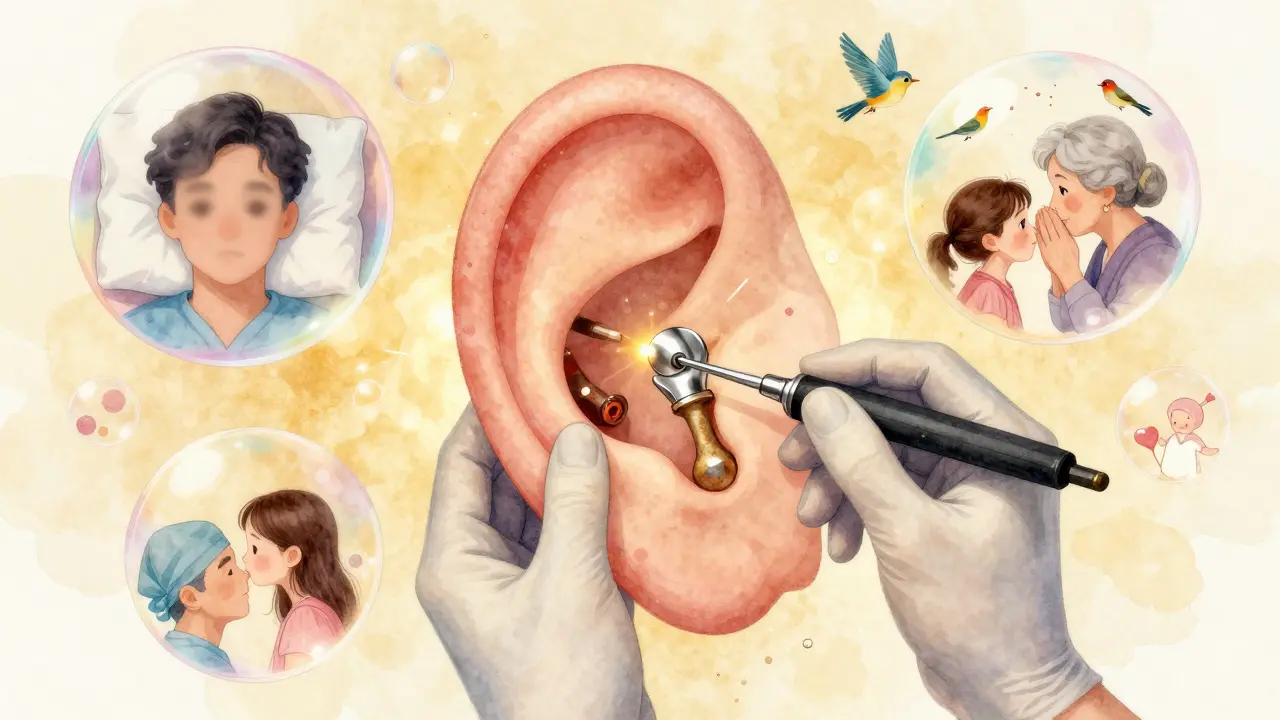
The Stapedectomy: Restoring the Tiny Bone
Otosclerosis is where stapedectomy shines. The stapes bone is removed or drilled, and a tiny prosthesis is inserted. Think of it like replacing a rusted hinge with a smooth one. Modern laser-assisted techniques have cut complications from 15% down to under 2%. In 80-90% of cases, the air-bone gap closes to within 10 dB. People report hearing their spouse’s whisper, the ticking of a clock, birds outside the window. One patient from Mass Eye and Ear said, “I used to ask people to repeat everything. Now I hear my granddaughter say ‘I love you’ without turning up the TV.” That’s the kind of change this surgery brings. But it’s not perfect. About 12% of patients get temporary vertigo or taste changes. Some notice their own voice sounds louder. These usually fade in weeks. Rarely, hearing gets worse. That’s why choosing an experienced surgeon matters.For Kids: Tubes, Not Trauma
In children with chronic fluid buildup, doctors don’t do tympanoplasty. They put in tubes. A tiny incision is made in the eardrum, and a small plastic tube is inserted. It lets air in and fluid out. This is the most common pediatric surgery in the U.S.-nearly 667,000 done each year. Most kids feel better right away. Their speech improves. They stop pulling at their ears. The tubes fall out on their own after 6-12 months. In 75% of cases, the fluid doesn’t come back. Some parents worry about the tubes. “Will it hurt?” “Will it affect swimming?” The answer: it’s safer than repeated ear infections. Drainage happens sometimes-about 18% of kids need antibiotics after-but that’s better than hearing loss.What About Aural Atresia?
Babies born without an ear canal face a different challenge. The outer ear may look normal, but the canal is missing. Sound can’t reach the middle ear. Surgery-called canalplasty-can rebuild it. But it’s complex. Multiple procedures are often needed. Success? 60-70% get functional hearing. Some still need bone-conduction devices, but many avoid them entirely after surgery.
What Comes After Surgery?
Recovery isn’t quick. After any middle ear surgery, you avoid water, pressure changes, and heavy lifting for 6-8 weeks. No flying. No scuba diving. No lifting kids over your head. Your ear needs time to heal inside. Follow-up appointments are critical. A second hearing test confirms improvement. A CT scan might be done to check the placement of implants or to make sure no cholesteatoma returned. New tech is making things better. Intraoperative navigation systems guide surgeons with real-time 3D maps of the ear. Bioengineered grafts are replacing old tissue patches, with higher success rates. And 3D-printed ossicular prostheses-custom-made for your exact ear shape-are showing 94% hearing improvement in trials.What’s Next for Hearing Surgery?
The future is less invasive. Endoscopic surgery-using a tiny camera through the ear canal-is already replacing traditional incisions in many cases. It means no external cuts, less pain, and faster recovery. By 2028, experts predict 60% of middle ear surgeries will be done this way. The market for these devices is growing fast-projected to hit $1.8 billion by 2027. That’s because more people are seeking help. Hearing loss isn’t just about volume. It’s about connection. Missing a child’s laugh. Not hearing your name called. Feeling isolated in a crowd. Surgery doesn’t just fix ears. It fixes lives.Frequently Asked Questions
Can conductive hearing loss be reversed without surgery?
Yes, in many cases. Earwax removal, antibiotics for infections, or simply waiting for fluid to clear can restore hearing. About 65% of children with fluid behind the eardrum recover without surgery. But if the cause is otosclerosis, cholesteatoma, or a structural defect, surgery is the only way to fix it.
How long does it take to recover from middle ear surgery?
Recovery varies. For tympanoplasty or stapedectomy, most people return to light activities in 1-2 weeks, but full healing takes 6-8 weeks. You’ll need to avoid water, pressure changes, and strenuous activity during that time. Cholesteatoma surgery often requires longer recovery-4 to 6 weeks-because it’s more invasive.
Is surgery for otosclerosis safe?
Modern stapedectomy is very safe. With laser-assisted techniques, complication rates have dropped from 15% to under 2%. Common side effects like temporary dizziness or altered taste usually fade within weeks. Permanent hearing loss happens in less than 1% of cases when performed by experienced surgeons.
Will I hear normally after surgery?
Most people experience significant improvement. After stapedectomy, 80-90% of patients close their air-bone gap to within 10 dB-close to normal hearing. Tympanoplasty restores hearing in 70-95% of cases, depending on the size of the hole. Some notice sounds are clearer but different at first. Your brain needs time to adjust to the new input.
Are there alternatives to surgery for conductive hearing loss?
Yes. Bone-conduction hearing aids or implantable devices like BAHA (Bone Anchored Hearing Aid) can bypass the middle ear entirely. These are often used for people who aren’t surgical candidates, like those with chronic ear infections or congenital atresia. They don’t restore natural hearing, but they make sound much clearer.
Can conductive hearing loss come back after surgery?
It can, especially if the original cause isn’t fully resolved. Cholesteatomas can recur in 5-10% of cases, requiring follow-up surgery. Fluid can return after tubes fall out. Otosclerosis may progress slowly over time. That’s why regular hearing checks are essential-even years after surgery.
How do I know if I need to see an ENT specialist?
If you’ve had muffled hearing for more than a few weeks, especially with ear pain, drainage, or a history of ear infections, see an ENT. If your hearing drops suddenly after trauma or flying, get checked immediately. Audiologists can confirm conductive loss, but only an ENT can determine if surgery is needed.
Meina Taiwo
December 20, 2025 AT 23:17Fluid behind the eardrum is way more common than people think. My kid had it at 18 months-no fever, no crying, just zoning out in daycare. Tubes fixed it in a week. No big deal.
Cameron Hoover
December 22, 2025 AT 20:50I had a stapedectomy last year. Before? I couldn’t hear my cat purr. After? I heard the fridge hum. It’s wild how much silence you learn to live with until it’s gone. Don’t wait. Get tested.
Jerry Peterson
December 24, 2025 AT 00:58My uncle got cholesteatoma surgery in the 90s. They had to crack open his skull basically. He lost taste for a year. But he could hear his grandkids say ‘Hi’ again. Worth every second of hell.
Jon Paramore
December 24, 2025 AT 06:46Air-bone gap >15 dB = conductive. Tympanogram Type B = fluid. Otosclerosis = fixed stapes. Cholesteatoma = bone erosion. These aren’t guesses. They’re diagnostic criteria. If your audiologist doesn’t mention these terms, find a new one.
Hannah Taylor
December 26, 2025 AT 01:27they say surgery fixes it but what if the doc is just trying to make money? i heard they push tubes on kids just to bill insurance. my cousin got 3 sets of tubes by age 5. he never had an infection. just… quiet.
Adrian Thompson
December 27, 2025 AT 00:47They want you to believe this is about hearing. Nah. It’s about control. Who owns your ear? The FDA? The implant manufacturers? The 12% vertigo rate? That’s not a side effect-that’s a warning sign they’re testing on you. Wake up.
Stacey Smith
December 28, 2025 AT 05:30My mom had glue ear as a kid in the 70s. No tubes. Just duct tape over her ear and a radio. She says she learned to read lips before she could read words. We’re weak now.
Ben Warren
December 28, 2025 AT 14:46It is imperative to underscore the medical and ethical imperatives underpinning the surgical intervention paradigm for conductive hearing loss. The prevailing reductionist paradigm, which privileges technological intervention over holistic auditory rehabilitation, constitutes a dangerous epistemological deviation from the foundational principles of otological science. One must interrogate the commodification of auditory function within the neoliberal healthcare apparatus.
Teya Derksen Friesen
December 28, 2025 AT 20:41It’s fascinating how we’ve moved from watching ears heal naturally to engineering them with 3D-printed bones. We’re not just fixing hearing-we’re redesigning human biology. It’s beautiful, in a quiet way.
Sandy Crux
December 30, 2025 AT 14:55...and yet, despite the ‘94% improvement’ claims... have any of you considered the ecological cost of bioengineered grafts? The microplastic runoff from silicone prostheses? The carbon footprint of intraoperative navigation systems?... Or is this just another ‘progress’ narrative we’re too numb to question?
Jason Silva
December 31, 2025 AT 22:54Bro. I had otosclerosis. Stapedectomy. Laser. Went from ‘what?’ to ‘I hear my dog’s toenails clicking on the floor.’ 😭🙌 You think you’re fine until you realize you’ve been living in a dream. Get checked. Now.
Theo Newbold
January 2, 2026 AT 14:2180% of kids get fluid by age 3? That’s not a medical condition-that’s a systemic failure. Why are we letting 80% of children develop hearing deficits before we fix their environment? It’s not the ear. It’s the air. The water. The food. The noise. The system is broken.
Michael Ochieng
January 4, 2026 AT 08:52I’m from Kenya and we don’t have access to this stuff. But I’ve seen kids with ear infections go silent. No tubes. No tests. Just… quiet. This post made me realize how lucky we are to even have options. Thanks for writing this.
Erika Putri Aldana
January 4, 2026 AT 16:41So… you’re saying if you can’t hear your spouse whisper, you need surgery? That’s just laziness. Maybe you just need to stop being a baby. I’ve been deaf in one ear for 15 years. I’m fine. You’re not.