Medication Value & Cost Estimator
US Informal Threshold:
- Good Value $50k–$150k per QALY
- Marginal $150k–$250k per QALY
- Poor Value >$250k per QALY
Based on common health economic standards discussed in the article.
Assessment Results
Verdict
Analysis text goes here.
Recommendations Based on Article Data:
Disclaimer: This tool is for educational purposes only and does not constitute medical or financial advice. It uses simplified models based on general health economic principles mentioned in the article. Always consult with your healthcare provider and insurance specialist regarding specific treatments and costs.
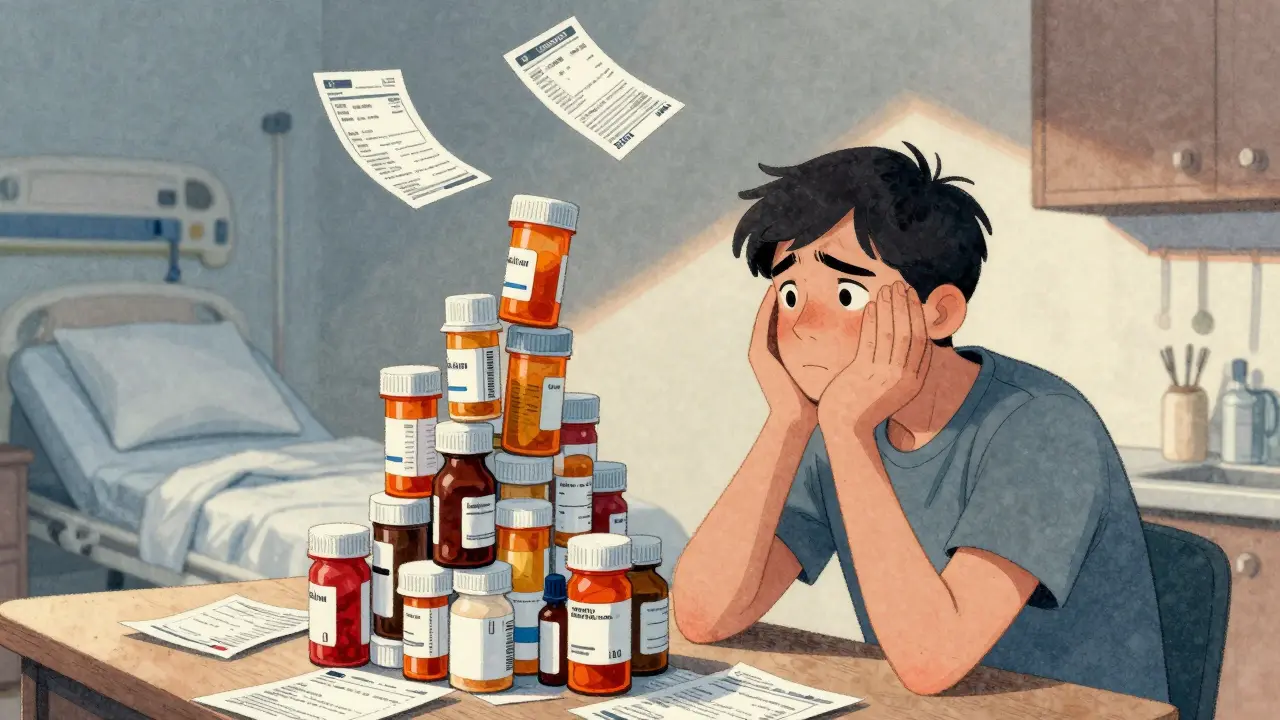
Imagine being offered a treatment that could cure your disease or significantly extend your life, but it costs more than most people earn in a year and comes with side effects that might require hospitalization. This is the reality for millions of patients today. The decision to use expensive medications high-cost pharmaceuticals including biologics, gene therapies, and orphan drugs that often exceed $10,000 per dose isn't just about money-it's a complex calculation involving health outcomes, financial risk, and quality of life.
You’re not alone if you feel overwhelmed by this choice. In 2023, the median cost of the 50 most expensive drugs covered by Medicare Part B, Part D, and Medicaid reached $16,177.96 per dose. That’s not a typo. And yet, many of these drugs offer breakthrough benefits that cheaper alternatives simply can’t match. So, how do you know when the price tag-and the potential side effects-are worth it?
The Real Cost of High-Price Drugs
When we talk about expensive medications, we’re usually referring to three main types: biologics large-molecule drugs derived from living organisms, used to treat autoimmune diseases, cancer, and other chronic conditions, gene therapies treatments that modify a patient's DNA to cure or prevent disease, often administered as a one-time infusion, and orphan drugs medications developed to treat rare diseases affecting fewer than 200,000 people in the United States. As of 2024, 62% of the top 50 most expensive drugs were biologics, 32% were small molecules, and 6% were gene or cellular-based therapies.
But here’s the catch: high price doesn’t always mean high value. A 2024 study published in PMC (NIH) found that 56% of these ultra-expensive drugs were rated by French and German health technology assessment bodies as having low therapeutic benefit. Another 40% received poor effectiveness-safety ratings from Prescrire International. That means nearly two-thirds of the most costly drugs may not deliver proportional health improvements compared to their price.
So why are they so expensive? Development costs play a role-bringing a new drug to market can cost billions-but so does market exclusivity, limited competition, and the fact that many target rare populations where manufacturers can charge premium prices without facing significant market pressure.
Weighing Benefits Against Risks
Let’s get real: every medication has risks. But with expensive ones, those risks often come with higher stakes. For example, CAR-T cell therapies like tisagenlecleucel a gene therapy costing approximately $475,000 per treatment that modifies a patient's own immune cells to attack cancer can cause cytokine release syndrome-a potentially life-threatening reaction requiring intensive care. Yet, for patients with certain blood cancers who’ve exhausted all other options, remission rates have been dramatic. In a 2023 ASCO patient forum, 78% of respondents said the treatment was “worth the cost” despite the risks.
Then there’s hepatitis C. Treatments like Harvoni a combination antiviral medication containing sofosbuvir and ledipasvir, known for achieving high cure rates with minimal side effects carried out-of-pocket costs of over $7,000 in 2016, but they achieved 95% cure rates-compared to 50% with older interferon-based regimens that caused severe flu-like symptoms and required weekly injections. For many, the trade-off was clear.
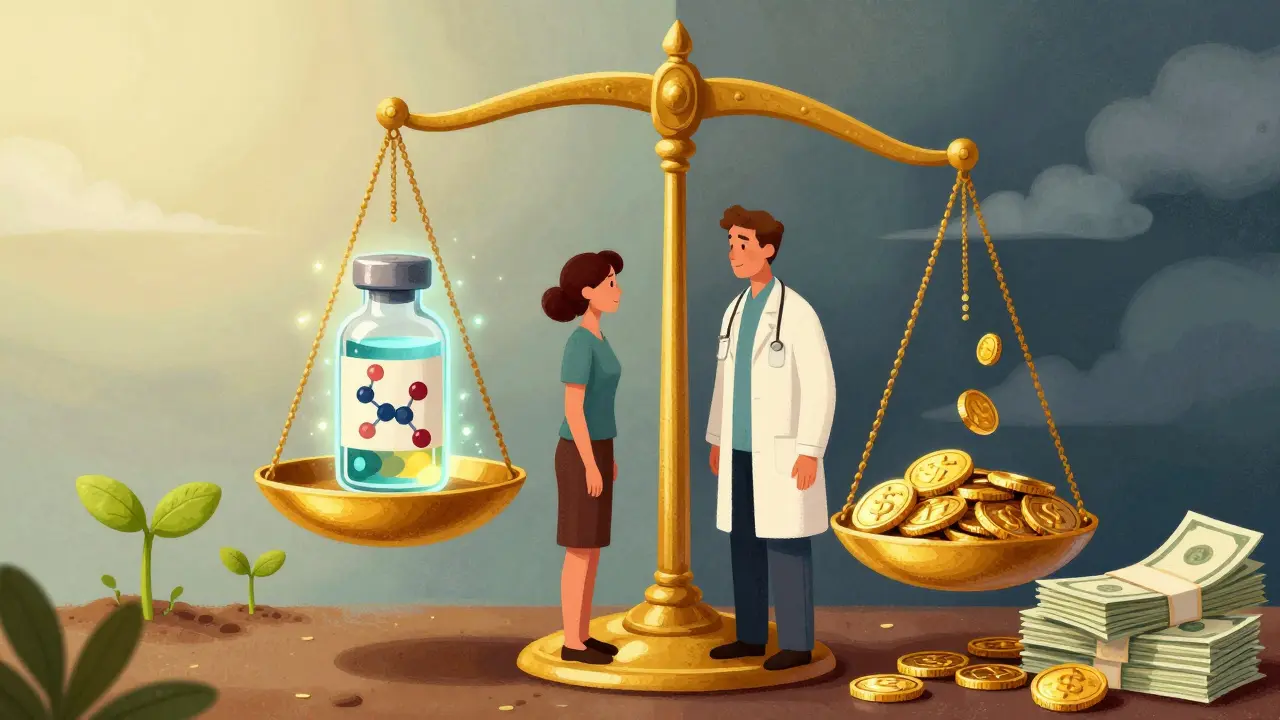
The key question becomes: What’s the incremental benefit? Health economists use something called the Incremental Cost-Effectiveness Ratio (ICER) to measure this. It tells us how much extra we pay for each additional unit of health outcome gained. In the U.S., the informal threshold sits between $50,000 and $150,000 per Quality-Adjusted Life Year (QALY). If a drug falls below that range, it’s generally considered good value-even if it’s pricey.
Navigating Insurance and Financial Assistance
Even if a drug makes clinical sense, affordability remains a huge barrier. Medicare Part D beneficiaries without low-income subsidies spent 2.5 times more out-of-pocket on ultra-expensive drugs than commercially insured patients aged 45-64 in 2019. Out-of-pocket costs ranged from $1,596 for ustekinumab to $5,692 for ruxolitinib per beneficiary.
And let’s be honest: understanding insurance coverage is confusing. The “donut hole”-that gap in Medicare Part D coverage-affected 2.3 million beneficiaries in 2021 alone. According to a 2022 KFF study, it takes patients an average of 6-9 months to fully grasp how their plan works during this phase.
Here’s what you can do:
- Ask about step therapy requirements: Many insurers require trying cheaper alternatives first. Ask your doctor if exceptions apply based on your medical history.
- Prior authorization timelines matter: These processes take 7-14 business days. Start early and follow up regularly.
- Work with specialty pharmacies: They handle complex logistics and often have case managers who spend hours navigating coverage issues.
- Explore manufacturer assistance programs: On average, these cover 40% of out-of-pocket costs for commercially insured patients as of 2023.
- Look into independent foundations: Organizations like the Chronic Disease Fund provided $2.1 billion in assistance in 2022 alone.
Don’t skip doses because of cost. A 2022 Patient Access Tracker survey found that 68% of patients taking drugs costing over $10,000 monthly reported skipping doses due to expense, while 42% described choosing between medication and food. That’s not sustainable-and it’s dangerous.
Comparing Systems Around the World
If you think the U.S. system is tough, wait until you hear how other countries approach this issue. France’s Haute Autorité de Santé (HAS) and Germany’s Institute for Quality and Efficiency in Health Care (IQWiG) systematically evaluate whether new drugs provide meaningful added benefit. Between 2011 and 2020, only 24% of reviewed drugs received the highest benefit rating.
In the UK, NICE uses strict thresholds-£20,000-£30,000 per QALY-to decide which drugs get approved. Take daratumumab, a cancer drug initially rejected in 2016 because its ICER was £120,000 per QALY. After negotiations brought the price down, the ICER dropped to £45,000, and it was accepted. That kind of negotiation rarely happens in the U.S.
As of 2024, 96% of the most expensive drugs remain ineligible for price negotiations under the current Inflation Reduction Act criteria. While the law allows Medicare to negotiate prices starting in 2026, exclusions still leave most high-cost therapies untouched.
| Country | Evaluation Body | Cost Threshold | % Drugs Rejected | Orphan Drug Policy |
|---|---|---|---|---|
| United Kingdom | NICE | £20,000-£30,000/QALY | ~25% | Strict evaluation |
| France | HAS | ASMR Rating System | 76% receive lower ratings | Moderate restrictions |
| Germany | IQWiG | Benefit Assessment | Similar to France | Moderate restrictions |
| United States | No centralized body | $50k-$150k/QALY (informal) | N/A | Highly favorable |

Expert Perspectives on Value
Dr. Peter Bach at Memorial Sloan Kettering Cancer Center created the DrugAbacus tool to assess cancer drugs across six dimensions of value. His findings? Four out of ten newly approved cancer drugs in 2018 offered insufficient value for their price. Meanwhile, Dr. Dan Lucey argues that the estimated $2.6 billion cost to bring a new drug to market justifies high pricing for truly innovative therapies.
Prescrire International consistently rates fewer than 15% of new drugs as offering major therapeutic progress. Their 2023 assessment showed only 7 of 100 new drugs provided meaningful benefit over existing treatments despite high costs. Dr. Aaron Kesselheim of Harvard Medical School has shown through FDA review documents that 32 of 50 novel drugs approved between 2017-2018 showed only marginal clinical benefits compared to existing treatments.
This debate matters because it affects who gets access to life-changing treatments-and who doesn’t.
What You Can Do Right Now
If you’re considering an expensive medication, start by asking your doctor:
- Is this drug significantly better than available alternatives?
- Are there any non-drug interventions I should try first?
- What are the expected side effects, and how manageable are they?
- Does my insurance cover this drug, and what will I owe out-of-pocket?
- Are there patient assistance programs or copay cards available?
Also consider joining support groups or online communities where others share experiences with similar treatments. Reddit threads in r/healthinsurance document cases where patients faced $15,000 monthly out-of-pocket costs for emicizumab despite previous joint damage from less effective treatments. Hearing from others helps put things in perspective.
Finally, keep records. Track every bill, every denied claim, every conversation with your insurer. You’ll need them if you appeal decisions or seek reimbursement later.
How do I know if an expensive medication is worth the cost?
Evaluate whether the drug offers significant improvement over existing treatments, especially in terms of survival, symptom relief, or quality of life. Check if it meets the informal U.S. threshold of $50,000-$150,000 per QALY. Also consider long-term savings from reduced hospitalizations or complications.
Can I negotiate the price of an expensive drug?
Not directly with the manufacturer, but you can ask your doctor to request prior authorization exceptions, explore manufacturer patient assistance programs, or look into foundation grants. Some specialty pharmacies also offer discounted pricing models.
Why are some drugs so much more expensive than others?
Factors include development costs, market exclusivity, rarity of condition treated, lack of generic competition, and regulatory incentives like orphan drug status. Biologics and gene therapies tend to be pricier due to complex manufacturing and limited scalability.
What happens if I can’t afford my medication?
Skipping doses can lead to worsening symptoms, increased emergency room visits, or even permanent damage. Always talk to your healthcare provider before stopping treatment-they may suggest alternative therapies, dosage adjustments, or financial aid options.
Will Medicare ever negotiate prices for expensive drugs?
Yes, starting in 2026 under the Inflation Reduction Act. However, as of 2024, 96% of the most expensive drugs remain excluded from initial negotiations due to eligibility restrictions around age, patent life, and market share.
Are expensive drugs really more effective than cheaper ones?
Sometimes. For certain conditions like hepatitis C or specific cancers, newer drugs show dramatically improved outcomes. But studies show that many expensive drugs offer only marginal benefits over existing treatments. Independent reviews help clarify true value.
What is a QALY and why does it matter?
A Quality-Adjusted Life Year combines both length and quality of life into a single metric. One QALY equals one year of perfect health. It helps compare different treatments objectively. In the U.S., drugs costing less than $150,000 per QALY are typically seen as good value.
How do I find out if a drug has a patient assistance program?
Visit the manufacturer’s website, search databases like NeedyMeds.org, or consult your pharmacist. Most large pharmaceutical companies offer copay assistance cards or direct financial aid for qualifying patients.