
Drug Reaction Timeline Tool
Timeline Analysis
When a patient starts a new medication and suddenly develops a rash, dizziness, or nausea, doctors don’t just assume the drug caused it. They ask: Is this really the drug’s fault? That’s where dechallenge and rechallenge come in - two simple but powerful clinical tools used to figure out if a drug is truly responsible for an unwanted side effect.
What Is Dechallenge?
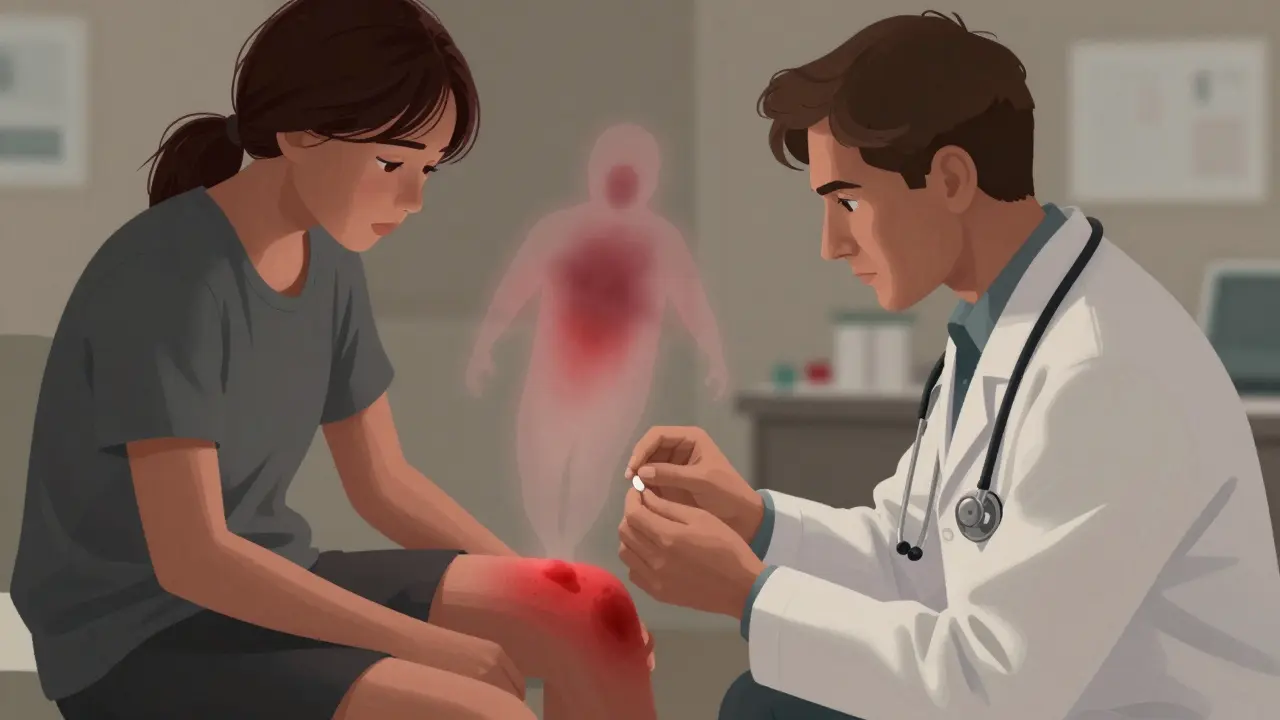
Dechallenge means stopping the drug to see what happens. If the side effect gets better or disappears after you stop taking the medication, that’s called a positive dechallenge. It’s a strong clue the drug was the culprit.For example, someone takes a new antibiotic and develops a severe itchy rash after three days. The doctor tells them to stop the drug. Two days later, the rash starts fading. By day five, it’s mostly gone. That’s a textbook positive dechallenge. The timing matches the drug’s half-life - it clears from the body fast enough for improvement to show up within days.
But if the rash doesn’t change after stopping the drug? That’s a negative dechallenge. It doesn’t prove the drug is safe - maybe the damage is permanent, or another factor is causing it. But it does lower the chance the drug caused the problem.
Dechallenge is used in about 85% of skin-related drug reactions and over 70% of all suspected adverse drug reactions in clinical practice. It’s safe, non-invasive, and often the only step doctors can take without risking the patient’s health.
What Is Rechallenge?
Rechallenge is the next step - and it’s riskier. It means giving the drug back to the patient after the side effect has cleared.If the same reaction comes back - same symptoms, same timing, same location - that’s a positive rechallenge. And it’s the strongest possible proof that the drug caused the reaction.
One well-documented case involved a patient who developed a fixed drug eruption (a recurring rash in the same spot) after taking metronidazole. After stopping the drug, the rash faded. When the doctor, under strict supervision, gave the drug again three months later, the exact same rash returned in the same spot within 48 hours. That’s not coincidence. That’s proof.
Rechallenge is so convincing that, according to WHO-UMC guidelines, it raises the likelihood of drug causality from “probable” to “definite” in 97% of cases where it’s done safely.
Why Rechallenge Is Rarely Done
You might wonder: if it’s so clear, why don’t doctors do it more often?Because some reactions can kill you.
Rechallenge is strictly avoided for life-threatening reactions like Stevens-Johnson Syndrome, toxic epidermal necrolysis, drug-induced liver failure, or anaphylaxis. Even a small chance of recurrence is too dangerous. The FDA says deliberate rechallenge is approved in only 0.3% of serious adverse event investigations.
It’s only considered when:
- The reaction was mild (like a minor rash or headache)
- The drug is essential (no good alternative exists)
- The patient gives fully informed consent
- It’s done in a controlled setting with emergency care on standby
Most of the time, doctors rely on dechallenge alone. In dermatology, 87% of drug reaction assessments use dechallenge data - rechallenge is just not worth the risk.
The Four Pillars of Drug Causality
Dechallenge and rechallenge aren’t used alone. They’re part of a four-part system used worldwide to judge if a drug caused a side effect:- Temporal relationship: Did the reaction happen after the drug was started? If symptoms appeared before the drug, it’s unlikely to be the cause.
- Dechallenge: Did stopping the drug make it better?
- Rechallenge: Did restarting it make it come back?
- Biological plausibility: Does this reaction match what we know about the drug? For example, statins are known to cause muscle pain - that’s plausible. But if someone gets a headache after taking insulin, that’s less likely to be related.
These four pieces together turn suspicion into science. One piece alone isn’t enough. But if all four line up? That’s when regulators take action - like updating drug labels or issuing safety warnings.
How It’s Used in Real-World Medicine
Pharmaceutical companies and health agencies don’t just guess about side effects. They dig into real patient data. In 2023, 67% of global drug manufacturers used structured tools to track dechallenge and rechallenge outcomes in post-market safety reports.Here’s how it works in practice:
- A patient reports a rash after starting a new blood pressure pill.
- The doctor stops the pill and asks the patient to report back in a week.
- At the follow-up, the rash is gone. Dechallenge is positive.
- The doctor checks if the patient has taken this drug before - if so, was there a similar reaction? That’s called a prechallenge.
- The report is sent to the drug company’s pharmacovigilance team.
- If multiple similar cases appear, regulators may investigate further.
Electronic health records now have built-in alerts for potential drug reactions. Some systems even prompt doctors to note dechallenge outcomes automatically. In dermatology clinics, standardized templates ensure no case slips through the cracks.
What’s Changing in 2025
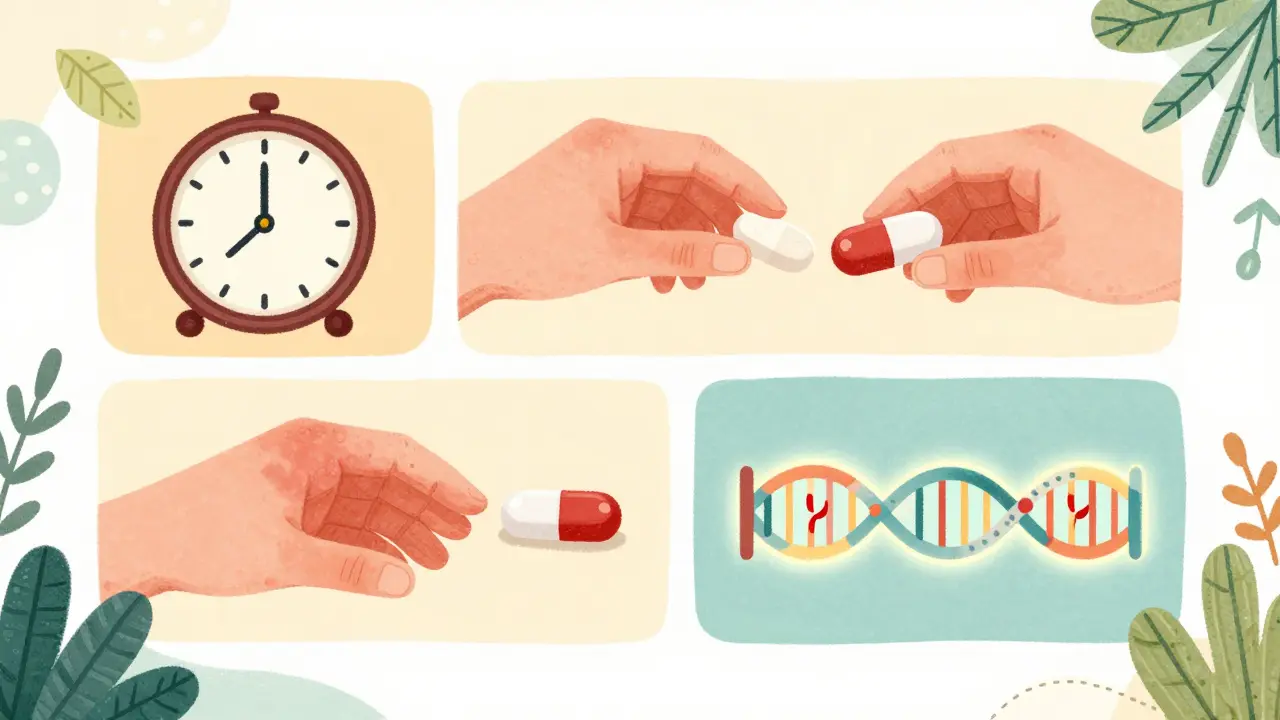
Technology is helping, but not replacing, these classic methods.Wearable sensors now track things like heart rate, skin temperature, and inflammation markers during dechallenge. Instead of relying on a patient’s memory of “the rash got better,” doctors get objective data showing inflammation dropped 60% within 72 hours of stopping the drug.
In labs, researchers are testing blood samples for immune cell reactions to specific drugs. These in vitro tests can predict if someone is likely to react - without ever giving them the drug again. One 2024 study showed 89% accuracy in predicting skin reactions to antibiotics using this method.
Still, experts agree: no algorithm, sensor, or lab test can replace the real-world observation of symptoms disappearing after stopping a drug. As Dr. Elena Rodriguez from the WHO put it in 2024: “No algorithm can substitute for the clinical reality of symptom resolution after drug discontinuation.”
Why This Matters to You
If you’ve ever had a bad reaction to a medication, you’ve experienced the need for dechallenge - even if you didn’t know it.When you tell your doctor, “I got sick after taking this pill,” they’re thinking: Was it the drug? Or was it something else? Your report, combined with a well-documented dechallenge, helps protect other patients.
It’s also why drug labels change. A medication might be approved as safe, but if enough patients report a reaction - and dechallenge confirms it - the label gets updated to warn others.
And if you’re ever told to stop a medication to see if symptoms improve? Don’t ignore it. That’s not just a suggestion - it’s a diagnostic step. Write down when symptoms started, when they got better, and what you stopped taking. That information saves lives.
Common Mistakes and How to Avoid Them
People often mess up dechallenge without realizing it:- Stopping multiple drugs at once. If you’re on five meds and stop them all, you won’t know which one caused the problem. Always stop one at a time - and only under medical supervision.
- Waiting too long to report. If you wait six weeks to tell your doctor about a rash, it’s hard to link it to a drug you took two months ago.
- Self-discontinuing. Quitting a drug on your own might help your rash, but it also makes it impossible for doctors to confirm causality later.
- Assuming all side effects are reversible. Some drugs cause permanent damage. A negative dechallenge doesn’t mean the drug was safe - it might mean the harm is already done.
The key? Be precise. Note the date you started the drug. Note the date symptoms appeared. Note the date you stopped. Note when they improved. That’s the data that matters.
Final Thoughts
Dechallenge and rechallenge aren’t fancy lab tests. They’re simple, human observations - stop the drug, watch what happens. Restart it, watch again.But don’t underestimate them. These steps are the backbone of drug safety worldwide. They’re why we know aspirin can cause stomach bleeding, why certain antibiotics cause tendon tears, and why some blood pressure drugs lead to coughing.
They’re also why you can trust that the warnings on your medicine bottle aren’t random guesses - they’re based on real people, real reactions, and real clinical evidence.
Next time you hear about a drug being pulled from the market or getting a new warning label, remember: someone stopped taking it. Someone got better. And maybe, just maybe, someone got it back - and got worse again. That’s how science finds the truth.
What does a positive dechallenge mean?
A positive dechallenge means the adverse reaction improved or disappeared after stopping the suspected drug. This strongly suggests the drug caused the reaction. For example, if a rash fades within days of stopping an antibiotic, that’s a positive dechallenge.
Is rechallenge safe to do?
Rechallenge is rarely done because it carries serious risks. It’s only considered for mild reactions when no good alternative exists, and only under strict medical supervision with emergency support ready. It’s never done for life-threatening reactions like Stevens-Johnson Syndrome or liver failure.
How long does it take for a dechallenge to show results?
It depends on the drug and the reaction. For drugs with a short half-life, symptoms may improve within 24-72 hours. For others, like antidepressants or blood pressure meds, it can take up to 10-14 days. The key is matching the timeline to the drug’s known elimination rate.
Can dechallenge prove a drug is safe?
No. A negative dechallenge (no improvement after stopping) doesn’t mean the drug is safe. It could mean the reaction is permanent, caused by something else, or too delayed to reverse quickly. Dechallenge only helps link a drug to a reaction - it doesn’t prove safety.
Why do some drug labels warn about reactions even if rechallenge wasn’t done?
Regulators rely on patterns. If dozens of patients report the same reaction after taking a drug, and dechallenge consistently shows improvement, that’s enough to add a warning - even without rechallenge. Rechallenge is the gold standard, but not always required for action.
Can wearable tech replace dechallenge?
No. Wearables can track objective data like skin inflammation or heart rate changes during dechallenge, making it more accurate. But they don’t replace the need to stop the drug and observe symptom resolution. The clinical event - the patient feeling better - is still the core evidence.
Dechallenge and rechallenge are not just medical terms - they’re tools that turn patient stories into life-saving science. They remind us that sometimes, the best way to find out what’s wrong is to take something away - and see what happens.
gerard najera
December 31, 2025 AT 17:20Stop the drug. Watch what happens. Restart it. Watch again. That’s it. No fancy machines. No algorithms. Just observation. That’s science.
Stephen Gikuma
January 2, 2026 AT 00:03They don’t want you to know this, but rechallenge is banned because Big Pharma doesn’t want you proving their drugs are toxic. They’d rather bury the data than admit they poisoned you. The FDA? Just a front for the pill mills.
Donna Peplinskie
January 3, 2026 AT 03:57I just want to say-thank you for explaining this so clearly! As someone who’s had a bad reaction to an antibiotic and was told, ‘It’s probably just stress,’ this made me feel seen. I stopped the drug, and the hives faded in 48 hours-no one ever told me that was a ‘positive dechallenge.’ I didn’t know I was helping science. <3
sharad vyas
January 3, 2026 AT 06:52In my village, we say: if the medicine makes you sick, stop it. If you feel better, it was the medicine. No need for papers or machines. The body tells you. Simple. Human. Real.
Western doctors forget this sometimes. They trust machines more than patients. But the patient is the one who lives with the side effect. Not the lab.
Bill Medley
January 4, 2026 AT 01:38The clinical utility of dechallenge and rechallenge is well-documented within the pharmacovigilance literature. The methodology adheres to the Naranjo algorithm’s foundational principles, and its application remains indispensable in causal attribution despite technological advancements. The integrity of this process is not diminished by automation; rather, it is enhanced through corroboration.
Austin Mac-Anabraba
January 5, 2026 AT 13:08Let’s be honest-this whole system is a glorified placebo test dressed up as science. You stop a drug, wait for the placebo effect to kick in, then call it a ‘positive dechallenge.’ And rechallenge? That’s not proof-it’s a cruel gamble with someone’s life, masked as ‘evidence.’
Doctors are just as superstitious as the rest of us. They want to believe the drug caused it because it gives them a narrative. Reality? Most side effects are random. Coincidence. The human brain is wired to find patterns where none exist.
Phoebe McKenzie
January 6, 2026 AT 07:27Of COURSE rechallenge is rare! Because doctors are too lazy to actually diagnose properly! Why not just test for every possible allergy before prescribing? Why not run a full immune panel? Why do we still rely on ‘oh, you stopped the pill and felt better’? That’s not medicine-that’s guesswork with a clipboard!
And don’t get me started on patients who self-discontinue. You think you’re helping? You’re just making it harder for everyone else. Stop being irresponsible!
Bobby Collins
January 7, 2026 AT 03:17Did you know the government uses dechallenge data to secretly track which drugs make people ‘awake’? Like, if you stop taking antidepressants and suddenly start noticing patterns in the sky? That’s not coincidence. That’s the algorithm. They’re watching. They’re testing. They’re waiting for you to get better… so they can rechallenge you with something worse.
Layla Anna
January 8, 2026 AT 05:43My mom had a rash after her blood pressure med… she stopped it and it vanished in 3 days 😊
Then the doctor said ‘probable reaction’ and switched her to another one… and guess what? Same rash again 😔
Now she’s off all meds and just walks every morning. Feels better than ever 🌿
Maybe the real cure isn’t in a pill…
Heather Josey
January 9, 2026 AT 02:22This is precisely why patient-reported outcomes are the cornerstone of modern pharmacovigilance. The structured documentation of temporal relationships, dechallenge responses, and clinical context enables regulatory bodies to act with precision and urgency. Thank you for highlighting the human element behind the data-this is how we turn anecdotal experience into actionable safety protocols.