
When a new drug hits the market, everyone assumes the worst side effects have already been found. That’s not true. Some of the most dangerous risks only show up after thousands - sometimes millions - of people have taken the medicine. This isn’t a failure of science. It’s a limitation of clinical trials.
Why Clinical Trials Miss Rare Risks
Clinical trials are tightly controlled. They usually involve 1,000 to 5,000 people, carefully selected to meet strict criteria. They exclude older adults with multiple health conditions, pregnant women, and people taking other medications. In real life, patients don’t fit that mold. A drug that looks safe in a trial can behave very differently when used by 100,000 people with diabetes, heart disease, and five other prescriptions.The FDA and EMA require trials to show a drug works better than a placebo or existing treatment. But they don’t require trials to catch rare side effects. If something happens to one in 10,000 people, it’s almost guaranteed to be missed. That’s why safety signals - unexpected patterns of harm - often emerge only after approval.
What Is a Drug Safety Signal?
A drug safety signal isn’t proof of harm. It’s a red flag. According to the Council for International Organizations of Medical Sciences (CIOMS), it’s information suggesting a possible link between a medicine and an adverse event that wasn’t known before - and needs investigation.Think of it like smoke. Smoke doesn’t mean there’s a fire, but if you see it, you check. Signals come from multiple sources: doctors reporting unexpected reactions, patients filing complaints, data from electronic health records, and statistical analysis of millions of reports.
For example, in 2004, a signal emerged linking rosiglitazone (a diabetes drug) to heart attacks. It wasn’t found in trials. It showed up in spontaneous reports and later in large observational studies. The signal triggered a full safety review, leading to restrictions and warning labels.
How Signals Are Found: The Two Paths
There are two main ways safety signals are detected: clinical review and statistical analysis.Clinical signals come from individual case reports. A doctor notices three patients on a new blood pressure drug developing sudden kidney failure. They report it. Another doctor sees the same pattern. Over time, a cluster forms. These reports often include details you can’t get from trials - like what else the patient was taking, how long they’d been on the drug, or whether symptoms improved after stopping it (called dechallenge).
Statistical signals are found by crunching numbers. Regulators like the FDA and EMA use databases with tens of millions of reports. They look for unusual spikes. For example, if 50 people on Drug A report liver injury in a year, but only 2 people on Drug B (a similar drug) do, that’s a signal. Tools like reporting odds ratios (ROR) and Bayesian methods calculate whether the difference is real or just random noise.
But here’s the catch: 60% to 80% of statistical signals turn out to be false alarms. A drug might be linked to a rare condition simply because that condition is commonly reported - not because the drug causes it. That’s why experts stress: never act on one source. Triangulation is key. You need at least three independent lines of evidence before you treat a signal as real.
The Data Behind the Signals
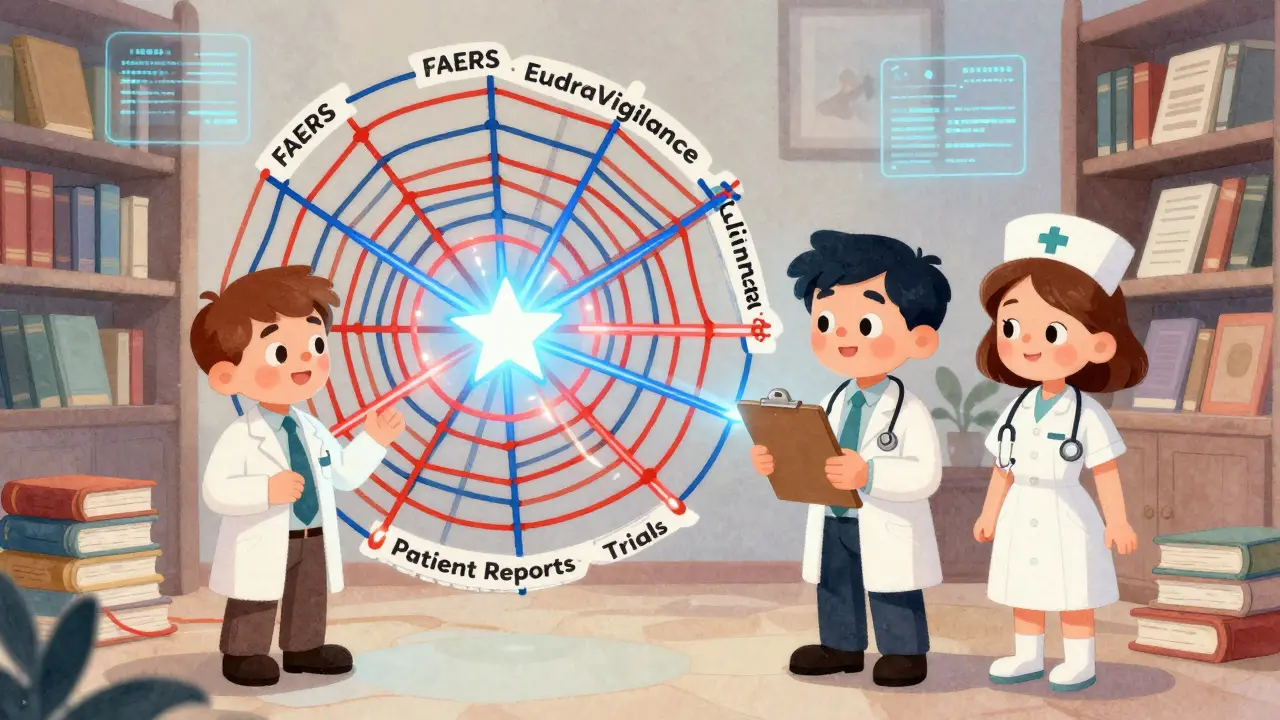
The FDA’s FAERS database has over 30 million reports dating back to 1968. The EMA’s EudraVigilance handles more than 2.5 million reports a year from 31 countries. These aren’t just random forms. They’re structured reports from doctors, pharmacists, and patients.But the data is messy. Only 30% of reports include enough detail to assess causality. Many lack follow-up information. Patients don’t always know what they’re taking. Doctors forget to report mild reactions. And serious events are reported 3.2 times more often than minor ones - creating a skewed picture.
That’s why experts don’t rely on reports alone. They combine them with clinical trial data, epidemiological studies, and even patient registries. A signal that shows up in spontaneous reports, a large observational study, and a published case series is far more credible than one that appears in just one place.
When a Signal Becomes a Risk
Not every signal leads to action. A 2018 study of 117 signals found four things predict whether a drug’s label will change:- Replication across sources - If the same signal shows up in FAERS, EudraVigilance, and a peer-reviewed study, the odds of a label update jump by 4.3 times.
- Plausibility - Does the drug’s chemistry or known mechanism explain the reaction? If yes, the chance of action rises.
- Severity - 87% of signals involving death, hospitalization, or permanent injury led to label changes. Only 32% of non-serious signals did.
- Drug age - New drugs (under 5 years on the market) are 2.3 times more likely to get label updates than older ones. Regulators are more cautious with newer medicines.
Take canagliflozin, a diabetes drug. In 2019, FAERS showed a signal linking it to leg amputations. The reporting odds ratio was 3.5. Alarm bells rang. But when the CREDENCE trial - a large, controlled study - was reviewed, the actual risk increase was only 0.5%. The signal was a statistical fluke, amplified by reporting bias. The label wasn’t changed.
The Human Factor in Detection
Behind every signal is a team of pharmacovigilance specialists. These aren’t just data analysts. They’re clinicians, epidemiologists, and statisticians trained to interpret messy real-world data.The International Society of Pharmacovigilance says professionals need 120 to 160 hours of formal training - 40 hours just on statistics, 30 on clinical assessment. Yet, 73% of safety officers say the biggest frustration is the lack of standardized methods to judge whether a drug caused the reaction.
At the 2022 Drug Information Association meeting, 68% of respondents said poor data quality was their top challenge. Many reports lack basic info: age, dosage, timing, or co-medications. Without that, you can’t tell if the drug caused the event - or if it was a stroke, an infection, or just bad luck.
Technology Is Changing the Game
In 2022, the EMA rolled out AI tools in EudraVigilance. What used to take 14 days to scan now takes 48 hours. The FDA’s Sentinel Initiative 2.0, launched in January 2023, pulls data from 300 million patient records across 150 U.S. healthcare systems. This lets them detect signals almost in real time.AI doesn’t replace humans - it filters noise. It flags patterns so analysts can focus on the ones that matter. Since 2020, AI-powered tools have grown 43% year over year. And the ICH’s new M10 guideline, expected in 2024, will standardize lab data reporting - making it easier to spot drug-induced liver injury, a common hidden risk.
Where the System Still Fails
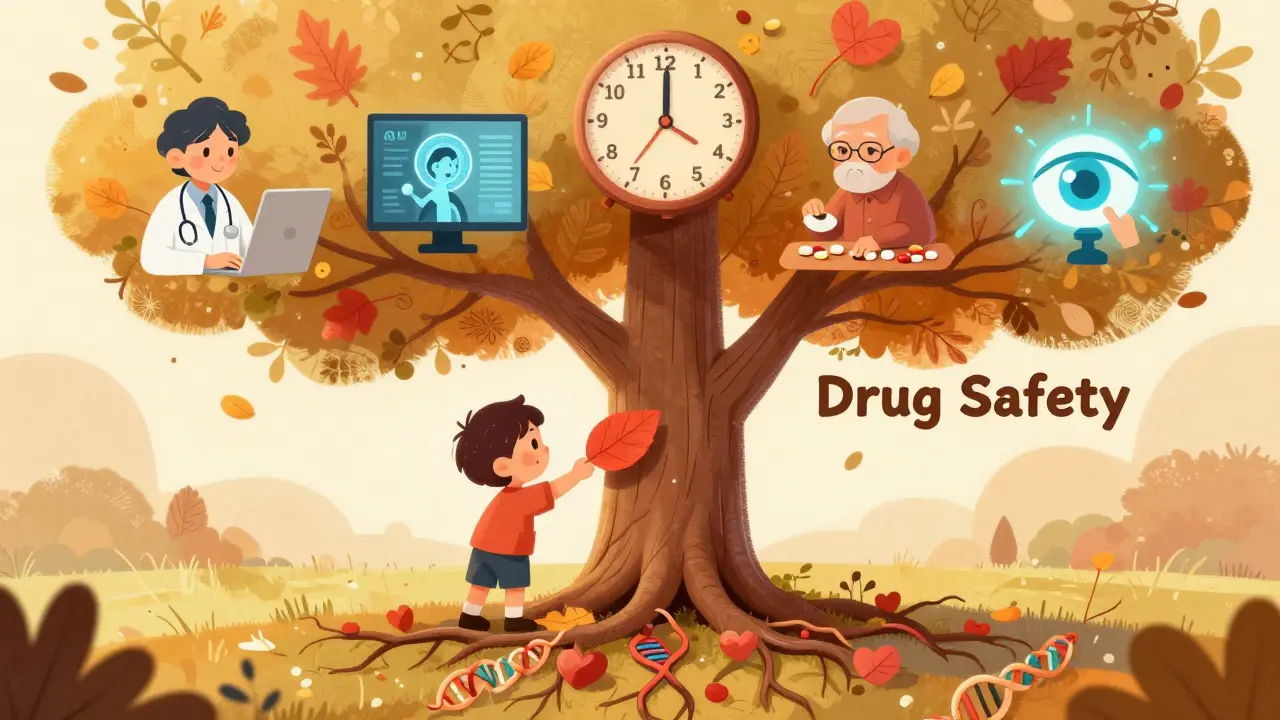
Even with better tools, big gaps remain.Delayed reactions are invisible to current systems. Bisphosphonates - used for osteoporosis - took seven years before the link to jaw bone death was confirmed. Why? Because the damage builds slowly. No one connects a tooth extraction to a drug taken five years earlier.
Polypharmacy is another blind spot. The number of elderly patients taking five or more drugs has increased 400% since 2000. But current signal detection tools aren’t built to untangle interactions between 10 different medications. One drug might seem harmless alone, but deadly with another.
Biologics and new therapies - like gene therapies or monoclonal antibodies - have unique safety profiles. They can trigger immune reactions that don’t show up for months. Traditional signal detection methods aren’t designed for these.
What Happens After a Signal Is Confirmed?
If a signal is validated, regulators can take several steps:- Add a warning to the drug’s prescribing information
- Restrict use to certain patients
- Require special monitoring (like monthly blood tests)
- Remove the drug from the market (rare, but happens - like with cerivastatin in 2001)
The goal isn’t to scare people off a drug. It’s to make sure the benefits still outweigh the risks. Sometimes, a drug with a serious side effect is still worth it - if it’s the only option for a life-threatening condition.
Take dupilumab, a psoriasis and eczema drug. In 2018, a signal emerged linking it to eye surface disease. Ophthalmologists confirmed the pattern. The label was updated. Patients were warned. Treatment didn’t stop - but doctors started checking eyes before prescribing. That’s how safety should work: early, targeted, and practical.
The Future of Drug Safety
By 2027, 65% of high-priority safety signals are expected to come from integrated systems - combining spontaneous reports, electronic health records, wearable data, and even patient apps. This will make detection faster and more accurate.But technology alone won’t fix the problem. The real challenge is culture. Too often, companies treat safety reporting as a regulatory burden, not a core responsibility. And too many doctors still don’t report mild or unusual reactions.
Drug safety isn’t a one-time check. It’s a continuous conversation - between patients, doctors, regulators, and manufacturers. The system works best when everyone participates. A single report from a concerned clinician can save lives. The next signal might be hiding in plain sight.
Tatiana Bandurina
January 22, 2026 AT 18:18They keep acting like clinical trials are some kind of gold standard, but they’re barely scratching the surface. I’ve seen patients on meds that were 'proven safe' develop organ failure months later - and no one connects it back because the trial population was all young, healthy, and on zero other drugs. Real-world use is chaos, and we’re pretending it isn’t.
Regulators are slow. Doctors are overworked. Patients don’t even know what they’re taking half the time. This isn’t a flaw in the system - it’s the system.
And yet, every time a new drug hits, we treat it like a miracle. We’re not just underestimating risk - we’re ignoring the human cost until it’s too late.
Philip House
January 23, 2026 AT 11:03Let’s be real - this whole pharmacovigilance thing is a joke. The FDA doesn’t have enough staff to properly review even 10% of the reports. Meanwhile, the drug companies are burying adverse events in footnotes and calling it 'post-marketing surveillance.'
And don’t get me started on AI tools. You think an algorithm can tell the difference between a drug-induced liver injury and a patient who drank too much whiskey while on the med? Please. We’re automating ignorance.
Real safety isn’t about data points - it’s about listening to the people who actually take the pills. But no one wants to hear that. Too messy. Too human.
Jasmine Bryant
January 24, 2026 AT 22:26I work in a clinic and I see this all the time. A patient comes in with weird symptoms, and I ask what meds they’re on - sometimes they list 8 different prescriptions, and half of them are OTC or supplements.
Then I check FAERS and find zero reports for that combo. Why? Because no one reports it. Doctors think it’s 'just a side effect.' Patients think it's normal aging.
We need better tools, yes - but we also need better education. Patients need to know: if something feels off, report it. Even if it seems minor. That one report might be the first domino.
And yes, I misspelled 'pharmacovigilance' just now. Sorry.
Sarvesh CK
January 25, 2026 AT 10:38It is indeed a profound observation that the current paradigm of drug safety surveillance is fundamentally constrained by the epistemological boundaries of clinical trial design. The reductionist methodology employed in pre-market testing, while statistically rigorous, fails to account for the complex, non-linear interactions inherent in human physiology when subjected to polypharmacy, comorbidities, and environmental variables.
Furthermore, the reliance on spontaneous reporting systems, while noble in intent, suffers from systemic biases - including underreporting of non-severe events, delayed recognition of chronic toxicity, and the absence of standardized causality assessment frameworks.
It is imperative that we transition toward a more integrative, longitudinal, and patient-centric model - one that harmonizes real-world evidence with clinical intuition, rather than treating data as an end in itself.
Technological innovation, while promising, must be tempered with humility. We are not merely processing signals - we are interpreting the silent cries of individuals whose lives have been altered by unintended consequences.
Let us not mistake efficiency for wisdom.
Neil Ellis
January 26, 2026 AT 13:44Man, this is the kind of stuff that makes me proud to be from a country that actually tries to keep people safe. We’ve got systems in place - FAERS, Sentinel, EudraVigilance - that most of the world can’t even dream of.
Yeah, it’s messy. Yeah, it’s slow. But we’re the ones who caught rosiglitazone before it killed more people. We’re the ones who flagged the amputation signal on canagliflozin and actually dug into it.
Other countries? They’re still using fax machines and handwritten forms. We’ve got AI scanning 300 million records. That’s not perfection - that’s progress.
And hey - if you’re mad about delays, blame the lawyers, not the scientists. They’re trying to keep you alive, not make headlines.
Patrick Roth
January 26, 2026 AT 22:28Oh please. You think AI is gonna fix this? The same AI that can’t tell if a tweet is satire? You’re trusting algorithms to catch drug deaths?
And don’t get me started on 'triangulation.' That’s just fancy talk for 'we’re not sure but let’s wait until five people die.'
Real talk: if a drug causes liver damage in one in 10,000 people, and 100,000 people take it, that’s TEN deaths. That’s not a 'signal.' That’s a massacre waiting for paperwork.
Stop pretending this is science. It’s bureaucracy with a lab coat.
Lauren Wall
January 27, 2026 AT 16:44Doctors who don’t report side effects are negligent. End of story.
It’s not hard. It’s not time-consuming. It’s just laziness wrapped in 'I didn’t think it was important.'
People die because of this. Stop making excuses.
Brenda King
January 28, 2026 AT 13:40I’ve been a nurse for 22 years and I’ve seen this play out too many times. A patient on a new drug starts having tremors. We think it’s anxiety. Then they get dizzy. Then they can’t walk. By the time we connect it to the med, it’s been three months.
And yeah - we didn’t report it. Because we thought it was 'just a side effect.'
But here’s the thing - if we’d reported it, someone else might’ve caught it earlier. So I’ve started reporting everything now. Even if it’s just 'mild headache.'
Because maybe, just maybe, that one report is the one that saves a life.
Also - I’m sorry I didn’t use commas. I’m typing on my phone while holding a baby. 😊
arun mehta
January 29, 2026 AT 08:17Dear friends, let us not forget that behind every statistical signal lies a human being - perhaps a grandmother, perhaps a young father, perhaps a child whose body was not yet ready for the chemical assault.
Technology may accelerate detection, but it cannot replace the quiet vigilance of a caring clinician who notices something 'off' in a patient’s eyes.
Let us honor the unsung heroes of pharmacovigilance - the nurses who document, the pharmacists who question, the patients who speak up.
And let us not mistake efficiency for ethics.
With deep respect and hope for a safer future 🙏
Kenji Gaerlan
January 30, 2026 AT 14:53Bro this is just big pharma covering their butts.
They know drugs are risky but they want to sell them anyway.
They make trials so small on purpose so they can say 'we didn’t know.'
Then they charge $100k a year for the drug and act like they’re saints.
It’s all a scam.
Also I think the FDA is run by robots. Or maybe just really tired interns.
Oren Prettyman
February 1, 2026 AT 13:18While the foregoing analysis presents a compelling narrative regarding the structural limitations inherent in contemporary pharmacovigilance frameworks, it remains fundamentally deficient in its failure to address the epistemic hegemony of reductionist biomedical paradigms, which privilege quantifiable outcomes over phenomenological patient experience.
Moreover, the uncritical adoption of algorithmic surveillance tools - ostensibly designed to enhance signal detection - paradoxically reinforces the very epistemological biases they purport to mitigate, by privileging quantifiable data over qualitative clinical insight.
It is therefore incumbent upon regulatory bodies to institute a hermeneutic framework for safety assessment - one that integrates narrative medicine, patient testimony, and ethnographic observation into the core of signal validation protocols.
Without such a paradigmatic shift, we shall continue to mistake correlation for causation, and noise for truth.
shivani acharya
February 1, 2026 AT 20:24Oh so now we’re supposed to trust AI to catch drug deaths? 😂
Let me guess - next they’ll say the algorithm can tell if your grandma’s liver failure was caused by the diabetes pill or just her bad luck.
Meanwhile, the same companies that made this drug are also funding the 'safety studies.'
And the FDA? They get paid by the same pharma lobbyists who wrote the guidelines.
Don’t you see? This isn’t about safety. It’s about profit.
They don’t want to find the risks. They want you to think they’re trying.
And you? You’re still taking the pill because you don’t have a choice.
Wake up. This system is rigged.
And yes, I know what you’re thinking - 'But what if I’m wrong?'
Then why haven’t they released the raw data?
Exactly.