Global Drug Access Estimator
How Regulatory Differences Affect Drug Access
This tool estimates how long it takes for a new drug to become available in the U.S. vs Europe based on key differences between FDA and EMA approval processes. The differences include:
- FDA: Requires more complete data upfront (85% first-time approval rate)
- EMA: Approves faster with conditions (92% first-time approval rate)
- EMA allows "exceptional circumstances" for rare diseases
- REMS (FDA) vs RMPs (EMA) risk management complexity
Results
When a new drug hits the market in the U.S. and Europe, you might assume the information on its label is the same. It’s not. The EMA vs FDA drug labeling differences aren’t just minor wording changes-they affect how doctors prescribe, how patients understand risks, and whether a life-saving medicine reaches people faster in one region than another.
Why EMA and FDA Labels Look Nothing Like Each Other
The European Medicines Agency (EMA) and the U.S. Food and Drug Administration (FDA) both approve drugs, but they operate under completely different legal systems. The FDA answers to U.S. federal law, primarily the Federal Food, Drug, and Cosmetic Act. The EMA works under European Union Regulation (EC) No 726/2004, which means it coordinates with 27 national regulators across the EU. This structural difference shapes everything-from how they interpret clinical data to how they write warnings. One of the biggest surprises? Even when both agencies review the exact same clinical trial data, they often reach different conclusions. A 2019 analysis found that in over half the cases where approval decisions differed, it wasn’t because one agency had more data-it was because they interpreted the strength of evidence differently. The FDA tends to demand stronger proof of benefit before approving a new use. The EMA is more willing to approve based on early signals, especially for serious or rare diseases.What’s Actually Different on the Label?
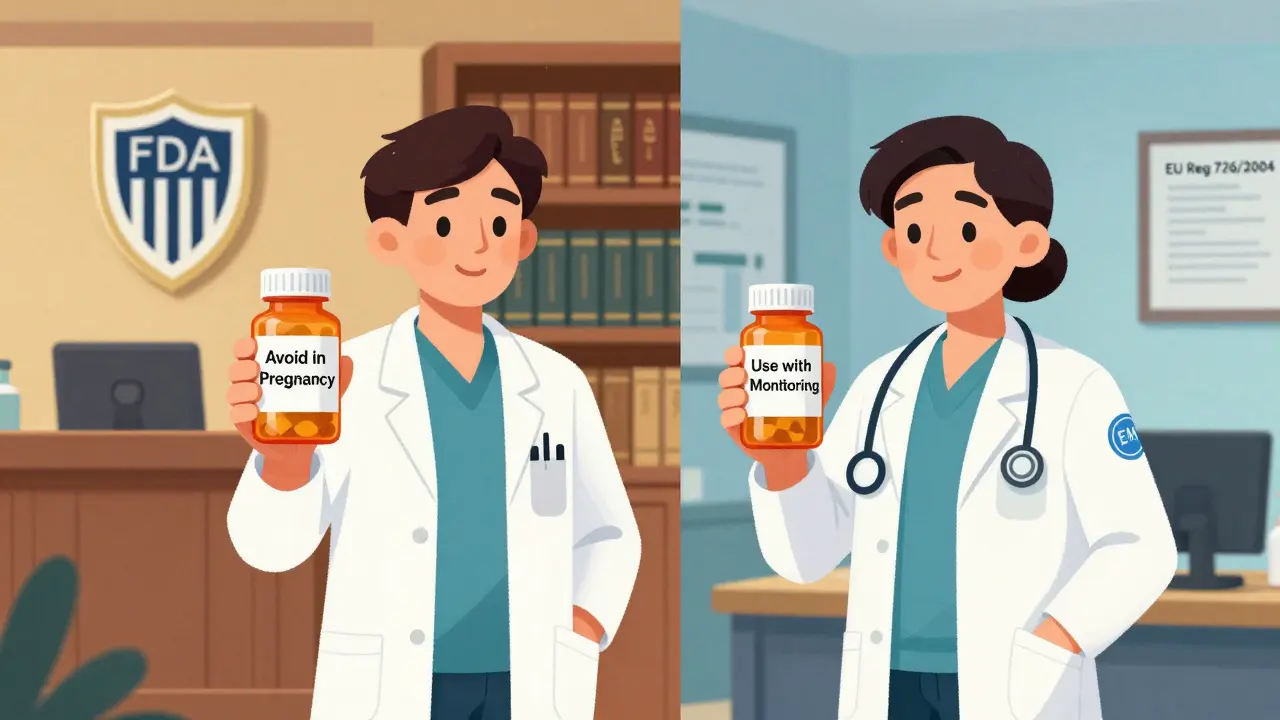
Look closely at the prescribing information, and you’ll see clear gaps. For example:- Pregnancy and breastfeeding warnings: The FDA often uses vague phrases like "use only if potential benefit justifies potential risk." The EMA uses standardized, evidence-based statements. In one study, for two drugs with clear human data, the FDA warned against use while the EMA said use was acceptable under certain conditions.
- Patient-reported outcomes (PROs): If a drug improves how a patient feels-like reducing fatigue or improving sleep-the EMA is far more likely to include that on the label. Between 2006 and 2010, 47% of drugs approved by both agencies had PRO claims from the EMA. Only 19% did from the FDA.
- Indications: A drug approved for metastatic breast cancer in the U.S. might only be approved for early-stage disease in Europe-or vice versa. These differences come from how each agency weighs survival benefit versus quality of life.
Language: A Hidden Barrier
If you think translating a drug label is just about changing words, think again. The EMA requires every label to be translated into all 24 official languages of the European Union. That’s not just English, French, and German-it’s also Maltese, Irish, and Croatian. Each translation must be reviewed and approved by national authorities. This adds months to the approval timeline and increases development costs by 15-20%, according to industry estimates. The FDA? Only English is accepted. That’s simpler for manufacturers-but it also means U.S. labels aren’t designed with global audiences in mind. Companies can’t reuse U.S. labeling for Europe without a full rewrite.Risk Management: REMS vs RMPs
Both agencies want to manage drug risks. But they do it in opposite ways. The FDA uses Risk Evaluation and Mitigation Strategies (REMS). These are strict, legally enforceable programs. For some drugs, REMS require:- Only one pharmacy to distribute the drug
- Doctors to complete special training
- Patients to enroll in a registry

Approval Speed and Post-Marketing Rules
The EMA approves drugs faster in the first round-92% of applications get approved on the first try, compared to 85% for the FDA. Why? The FDA turns down more applications upfront because it requires more complete data before approval. The EMA sometimes approves with conditions, letting companies submit more data after the drug is on the market. That’s where the catch comes in. EMA approvals often come with longer-term obligations. Companies must conduct additional studies, sometimes years after launch. The FDA, on the other hand, tends to require those studies before approval, so once the drug is on the market, there’s less follow-up. For rare diseases, the EMA has a special pathway called "exceptional circumstances." It allows approval even when full clinical data isn’t available-something the FDA doesn’t have. That’s why some orphan drugs reach European patients before American ones.What This Means for Patients and Doctors
These differences aren’t just bureaucratic. They affect real people. A cancer patient in Germany might have access to a drug that’s still under review in the U.S. because the EMA accepted a surrogate endpoint-like tumor shrinkage-as proof of benefit. The FDA might say that’s not enough without proof of longer survival. A pregnant woman in Canada might read an FDA label that says "avoid this drug," but her doctor in France sees an EMA label that says "use with caution and monitor fetal growth." That’s not a contradiction-it’s a difference in risk philosophy. Doctors prescribing off-label or treating patients who travel face confusion. Pharmacies in border regions often have to maintain two sets of labeling. Patients filling prescriptions abroad may get different instructions than they’re used to.Why Harmonization Hasn’t Happened
You’d think 20 years of collaboration through the International Council for Harmonisation (ICH) would have fixed this. But it hasn’t. While ICH guidelines cover manufacturing, clinical trial design, and safety reporting, labeling remains stubbornly different. Why? Because labeling reflects cultural and legal values. The U.S. system prioritizes legal clarity and liability protection. The EU system prioritizes flexibility and access. The FDA’s labeling is designed to protect against lawsuits. The EMA’s is designed to guide clinical use across diverse health systems. Even when both agencies agree on the science, they don’t always agree on how to communicate it. One study of 12 vaccines approved by both agencies found no pattern of increasing alignment over time. That’s a big deal-it means harmonization isn’t happening naturally.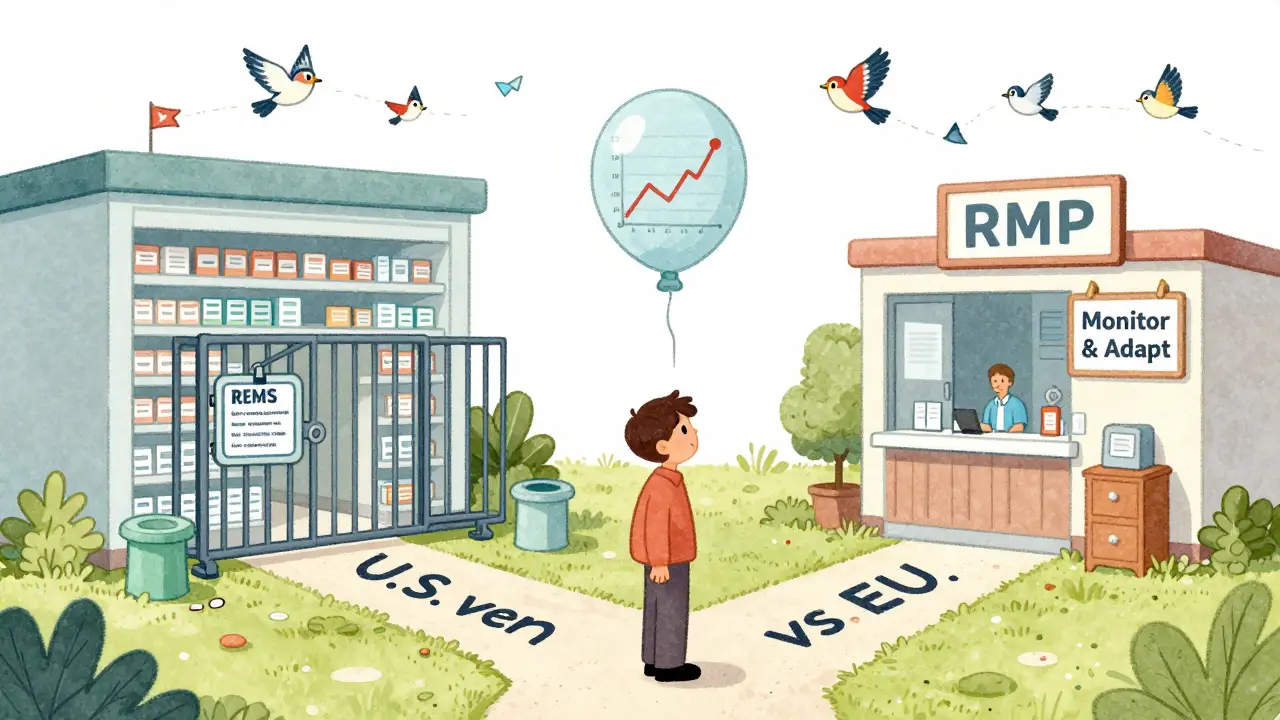
What Companies Are Doing About It
Pharmaceutical companies can’t wait for regulators to agree. They’ve adapted. Most major drugmakers now have dedicated regulatory intelligence teams. These teams track every change in EMA and FDA guidance, compare labeling templates side by side, and build dual submission packages. On average, preparing labels for both agencies takes 30% more time than for one alone. Some companies start with the EMA label because it’s more flexible. Others start with the FDA because it’s more predictable. Either way, they’re spending millions to navigate two systems instead of one.The Bigger Picture: Global Access and Economic Impact
The U.S. and EU together make up 70% of the global pharmaceutical market. Delays in labeling alignment mean drugs take an average of 18 months longer to reach European patients after U.S. approval. That’s billions in lost revenue-and more importantly, delayed treatment for patients. At the same time, the FDA and EMA are working closer than ever. Joint scientific advice sessions have increased by 47% since 2018. Both agencies now share safety data and have signed confidentiality agreements to avoid duplication. But experts agree: full harmonization is unlikely. The legal systems are too different. The risk tolerance is too different. The future? A narrowing gap-not a merge.What You Need to Know
If you’re a patient, doctor, or someone working in healthcare:- Don’t assume a drug label is the same everywhere.
- Check the source of the prescribing information-FDA, EMA, or local authority.
- When treating international patients, ask which country’s labeling they’re familiar with.
- If you’re developing a drug, build labeling strategy into your development plan from day one.
Why do EMA and FDA labels differ even when the clinical data is the same?
Because the agencies interpret evidence differently. The FDA typically demands stronger proof of clinical benefit before approving a new use, while the EMA may approve based on early signals or surrogate endpoints, especially for serious conditions. Their legal frameworks also shape how they weigh risk versus benefit. Even with identical data, one agency might see a clear benefit and the other might see uncertainty.
Can a drug have different approved uses in the U.S. and Europe?
Yes. It’s common. For example, a cancer drug might be approved for advanced-stage disease in the U.S. but only for earlier-stage use in Europe-or vice versa. These differences come from how each agency evaluates the strength of clinical evidence and whether they accept surrogate endpoints as proof of benefit.
Why does the EMA require translations into 24 languages?
The European Union has 24 official languages. Under EU law, all official documents-including drug labels-must be available in every language to ensure equal access across member states. This isn’t just a translation task; each version must be reviewed and approved by national regulators, adding significant time and cost to the approval process.
Are FDA REMS programs more restrictive than EMA RMPs?
Yes. FDA REMS are legally binding and often require specific systems like restricted distribution, mandatory provider training, or patient registries. EMA RMPs are more flexible-they require companies to outline how they’ll monitor safety, but they don’t mandate how it’s done. This gives companies more freedom but also less oversight in practice.
Which agency approves drugs faster?
The EMA approves more applications on the first review cycle (92%) compared to the FDA (85%). The FDA turns down more applications upfront because it requires more complete data before approval. The EMA sometimes approves with conditions, letting companies submit more data after the drug is on the market.
Do these labeling differences affect patient outcomes?
Yes. Patients in Europe may get access to new treatments months or years before U.S. patients. Conversely, U.S. patients might have access to drugs with more detailed safety information. Doctors prescribing to international patients or those traveling abroad must check local labeling to avoid confusion or unsafe use.
Is there any effort to make EMA and FDA labels more similar?
Yes. Both agencies collaborate through ICH and hold joint scientific advice sessions. They share safety data and have signed confidentiality agreements. But because their legal systems and risk philosophies differ, full harmonization is unlikely. The goal now is to narrow gaps-not eliminate them.
Aliza Efraimov
December 29, 2025 AT 01:54This is the most important thing I’ve read all year. I’m a nurse in Texas, and I’ve had patients come back from Europe confused because their ‘same’ drug had totally different instructions. One woman cried because her oncologist in Berlin told her the drug was safe during pregnancy, but her U.S. pharmacy refused to fill it. This isn’t bureaucracy-it’s life or death. Thank you for laying this out so clearly.
I’ve started printing both EMA and FDA labels for every new med I handle. It’s extra work, but I’d rather be safe than sorry.
Also-why do we still act like English is the global language of medicine? That’s not just lazy, it’s dangerous.
Nisha Marwaha
December 30, 2025 AT 20:25From an Indian regulatory affairs perspective, this is textbook. The EMA’s RMP framework is inherently more scalable for emerging markets because it leverages existing pharmacovigilance infrastructure-unlike FDA REMS, which are capital-intensive and require dedicated IT systems. This is why many MNCs prioritize EMA submissions for low-resource settings: lower compliance burden, faster time-to-market, and better alignment with WHO guidelines.
Also, the 24-language mandate? It’s not a cost center-it’s a human rights imperative. Language access is pharmacovigilance. Period.
Paige Shipe
January 1, 2026 AT 12:42Wow. Just wow. I mean, I knew the FDA was overcautious, but this is ridiculous. The EMA is basically letting drugs fly off the shelf without proper data. And then they wonder why people don’t trust pharmaceuticals? It’s not a feature-it’s a flaw. A dangerous, legally irresponsible flaw.
And don’t get me started on the 24 languages. Who even speaks Maltese? This is taxpayer money being flushed down the toilet. We need to fix this, not celebrate it.
Tamar Dunlop
January 3, 2026 AT 05:06As a Canadian clinician who frequently treats patients who have received care in the U.S. or EU, I can attest to the profound clinical dissonance caused by these divergent labeling practices. The philosophical chasm between liability-driven U.S. communication and access-driven EU guidance is not merely procedural-it is existential for the patient navigating two systems.
I have documented cases where patients, upon returning from Europe, discontinued life-sustaining therapy due to the starkly different risk narratives presented in the American label. This is not a regulatory nuance. It is a systemic failure of global health equity.
Harmonization is not the goal. Interoperability is. We must design labeling frameworks that preserve cultural and legal integrity while enabling cross-border clinical clarity.
And yes-I still keep two copies of every label in my office. One for the FDA. One for the world.
David Chase
January 3, 2026 AT 17:13THE FDA IS THE ONLY REAL REGULATOR IN THE WORLD. EMA? A BUNCH OF BUREAUCRATS WITH TOO MUCH TIME ON THEIR HANDS. 🤦♂️🇺🇸
They approve drugs on ‘early signals’??!! That’s how you get another Vioxx situation. We don’t play games with people’s lives here. We demand PROOF. REAL PROOF. Not ‘maybe this works’ vibes.
And 24 languages?!?! Are we paying for Croatian translations for 500 people?!? This is why America leads the world in innovation-we don’t waste time on political correctness. We get the job done.
Also, if you can’t read English, you shouldn’t be taking prescription meds. 😎💊
Nicole K.
January 4, 2026 AT 04:35This is so wrong. The FDA is the gold standard. If you’re approving drugs without full data, you’re just letting people die slowly. And why are you praising the EMA? They’re letting people take drugs that aren’t proven. That’s not helpful-that’s irresponsible. And the translations? That’s just a scam to make companies spend more money. The FDA is right. Always.
Fabian Riewe
January 5, 2026 AT 18:26Man, I’ve been in pharma for 15 years and this still blows my mind. The fact that two agencies can look at the same data and come to different conclusions isn’t chaos-it’s diversity of thought. The FDA’s caution keeps us safe. The EMA’s flexibility saves lives faster. We need both.
And honestly? The language thing? It’s not a bug, it’s a feature. If you’re going to serve millions across cultures, you need to speak their language. Literally.
Companies are spending more, sure-but so are patients getting better care sooner. That’s a win.
Amy Cannon
January 7, 2026 AT 08:37It is, without a shadow of a doubt, a matter of profound regulatory divergence that reflects not merely differing procedural norms but deeply embedded epistemological frameworks governing the epistemic authority of clinical evidence. The FDA, as an entity bound by the Federal Food, Drug, and Cosmetic Act, operates under a positivist paradigm wherein statistical significance, clinical endpoints, and risk-benefit quantification are sacrosanct.
Conversely, the EMA, operating under the supranational mandate of Regulation (EC) No 726/2004, embraces a more pragmatic, context-sensitive hermeneutic approach wherein surrogate endpoints, real-world evidence, and equity of access are weighted with equal, if not greater, epistemic gravity.
The translation burden, while economically nontrivial, constitutes a necessary and ethically non-negotiable commitment to linguistic justice within the European Union’s multilingual polity. To dismiss this as inefficiency is to misunderstand the very foundation of democratic inclusion.
Furthermore, the REMS versus RMP dichotomy reveals not a hierarchy of regulatory superiority, but rather a divergence in governance philosophy: one prioritizing top-down enforcement, the other favoring decentralized, adaptive risk mitigation.
Harmonization, therefore, is not a technical problem-it is a political one. And until we acknowledge that labeling is not merely informational, but ideological, we will continue to stumble in the dark.
Himanshu Singh
January 7, 2026 AT 14:04Really good post! I work in a clinic in Delhi and we get patients who’ve been on US meds and then switch to EU ones. The difference in side effect warnings is wild. One guy stopped his chemo because the US label said ‘risk of heart damage’ and the EU one said ‘monitor cardiac function’. He thought the EU one meant it was safe. 😅
Also, 24 languages? That’s insane but also kind of cool. We need more of this in India too-maybe we should translate into 22 languages instead of just Hindi and English.
Sharleen Luciano
January 8, 2026 AT 11:03How is this even a conversation? The FDA is the only agency that truly understands risk. The EMA’s willingness to approve drugs based on ‘early signals’ is not innovation-it’s negligence dressed up as compassion. And the translations? A performative gesture for bureaucrats who care more about optics than outcomes.
Anyone who praises the EMA’s approach is either naïve or has a financial stake in reducing regulatory barriers. This isn’t about access-it’s about cutting corners. And patients pay the price.
Alex Ronald
January 9, 2026 AT 15:41One thing people forget: the EMA’s conditional approvals aren’t lazy-they’re smart. For rare diseases, waiting for 5-year survival data means patients die waiting. The EMA says ‘approve now, study more later.’ The FDA says ‘wait until we’re 99% sure.’
Both are valid. But for someone with a terminal diagnosis, ‘later’ is a death sentence.
I’ve seen families cry because their kid got the drug in France but not in Ohio. That’s not a system flaw. That’s a moral failure.
Teresa Rodriguez leon
January 11, 2026 AT 07:22I can’t believe people are still defending the EMA. This is why I don’t trust European medicine. They’re too loose. Too emotional. Too… soft. The FDA is the only one that puts patients first by being tough. End of story.
Joe Kwon
January 12, 2026 AT 03:39Great breakdown. I’ve worked on both sides of this, and honestly? The system’s broken-but not because one side is right. It’s broken because we treat regulatory differences like bugs instead of features of two different societies.
The FDA’s REMS? Overbearing, but it works in a litigious culture. The EMA’s RMPs? Flexible, but they rely on trust in public health systems-which doesn’t exist everywhere.
Maybe the real solution isn’t harmonization, but better cross-walking tools. Imagine an app that shows you both labels side by side, with plain-language summaries. Doctors, patients, pharmacists-all could use it.
And yes, I’d love to see the FDA adopt PROs like the EMA. Fatigue matters. Sleep matters. Quality of life isn’t ‘soft’ data-it’s human data.
Lisa Dore
January 13, 2026 AT 13:08I’m a clinical trial coordinator and I’ve seen this up close. A patient from Poland got approved for a drug in 2022 through EMA. Her U.S. doctor didn’t even know it existed until she showed up with the EMA label. We had to scramble to find the FDA version-and it didn’t even mention the same side effect.
It’s not just confusing-it’s dangerous. We need a global label standard. Not to erase differences, but to make them visible. Maybe a QR code on every bottle that links to both EMA and FDA versions? Simple. Smart. Life-saving.
And hey-let’s stop pretending English is enough. My grandma speaks only Spanish. She deserves to understand her meds too.