Estrogen-Warfarin INR Change Estimator
Estrogen can increase or decrease your INR while on warfarin. This tool estimates potential changes based on estrogen type and your current situation.
Estimated INR Change
When you're on warfarin, even small changes in your daily routine can throw off your blood thinning levels. One of the most common but often overlooked triggers? Estrogen. Whether it's from birth control pills, hormone replacement therapy, or menopause treatment, estrogen can make your INR go up or down - and that’s not just a lab number. It’s your risk of bleeding or clotting.
How Estrogen Changes Warfarin’s Effect
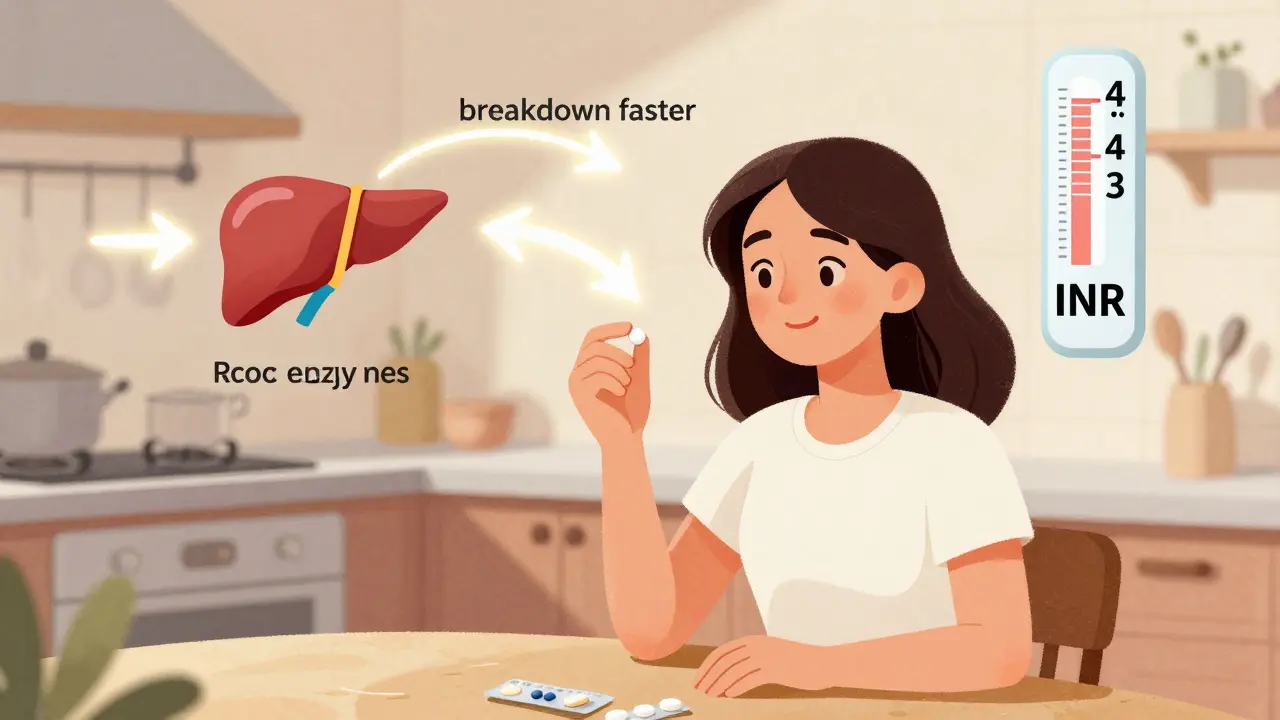
Warfarin doesn’t work the same way for everyone. It’s broken down by enzymes in your liver, mostly CYP2C9, CYP1A2, and CYP3A4. Estrogen compounds - natural estradiol or synthetic ethinyl estradiol - can either speed up or slow down these enzymes. And that’s where things get tricky.Natural estrogen, like estradiol used in menopause therapy, often makes your liver break down warfarin faster. That means less warfarin in your system, which can cause your INR to drop. You might start seeing more clots if this isn’t caught.
But synthetic estrogen - the kind in most birth control pills - does the opposite. It can block those same liver enzymes, especially CYP1A2 and CYP2C19. That leaves more warfarin in your blood. INR climbs. And with an INR over 4.0, your risk of serious bleeding goes up fast.
A 2009 case study in The Annals of Pharmacotherapy tracked a 28-year-old woman on warfarin who started a birth control pill. Her INR jumped from 2.4 to 4.3 in just five days. Her warfarin dose had to be cut from 5 mg to 3.5 mg. That’s not rare. Studies show women on estrogen-based contraceptives are nearly twice as likely to have an INR above 4.0 compared to those not taking estrogen.
Why This Isn’t Always Predictable
You might think: “If estrogen affects warfarin, why don’t all women on birth control have problems?” The answer lies in genetics.Some people have gene variants that change how they process warfarin. The CYP2C9*2 and *3 variants mean your body clears warfarin 30-50% slower. If you have one of these and start estrogen, your INR could spike even more. Then there’s VKORC1 - a gene that controls how sensitive your body is to warfarin. People with the -1639G>A variant need nearly half the normal dose just to stay in range.
Combine that with estrogen’s variable effects, and you’ve got a perfect storm. One woman might need a 20% warfarin reduction after starting HRT. Another might need a 15% increase. There’s no one-size-fits-all.
How Estrogen Compares to Other Drug Interactions
Not all drug interactions are created equal. Some are loud and dangerous. Others are quiet but still risky.Antibiotics like ciprofloxacin or trimethoprim-sulfamethoxazole? They’re known to double or triple your bleeding risk. They block CYP2C9 hard - and the effect is fast and strong. Studies show they raise the chance of major bleeding by 2.5 to 3 times.
SSRIs like fluoxetine? They also increase bleeding risk by about 2.2 times. That’s because they interfere with platelet function and CYP enzymes.
Estrogen? It’s different. Most of the time, it causes INR changes of 0.5 to 1.5 units. That’s not as dramatic as an antibiotic interaction - but it’s enough to matter. In a study of over 15,000 patients, estrogen users had an 80% higher chance of INR >4.0. And that’s the threshold where bleeding risk starts climbing sharply.
Even amiodarone - a heart rhythm drug - causes bigger INR shifts than estrogen, requiring up to a 40% warfarin dose reduction. But estrogen is more common. More women are on it. More people are on warfarin. And that’s why it’s worth paying attention.
What Doctors Really Do When This Happens
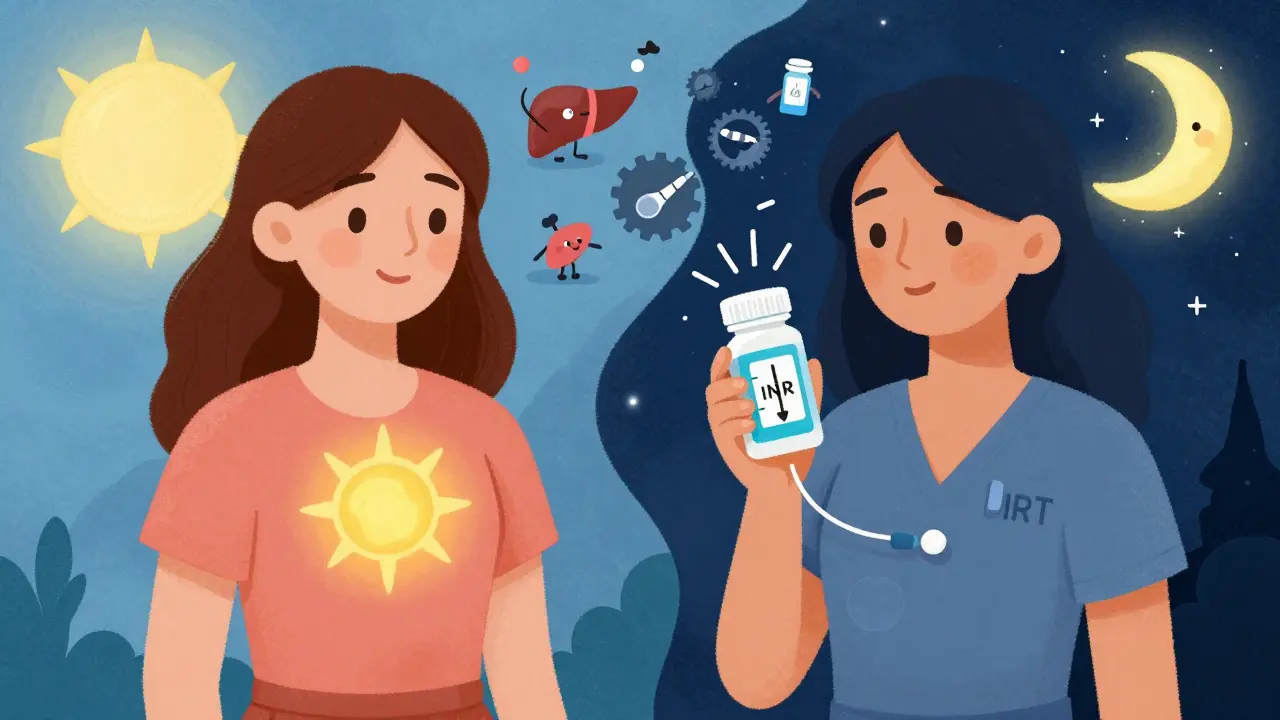
In real clinics, this isn’t theoretical. A 2021 survey of 247 pharmacists found that 68% had managed at least one estrogen-warfarin interaction in the past year. Of those, 42% said dose adjustments were needed - usually between 10% and 25%.Here’s what typically happens:
- When a patient starts estrogen (birth control, HRT, etc.), their INR is checked within 3 to 5 days.
- A second check happens at 7 to 14 days - because effects can lag.
- If INR rises above target, warfarin is reduced by 10-25%.
- If INR drops, warfarin is increased, often by 10-20%.
- For patients with known CYP2C9 or VKORC1 gene variants, dose changes are even more cautious.
The American College of Chest Physicians recommends this monitoring as a Grade 1B - meaning it’s strongly supported by evidence. The same goes for when estrogen is stopped. The body doesn’t reset instantly. INR can swing the other way after discontinuation.
Real Patient Stories
Reddit’s r/Anticoagulants is full of firsthand experiences:- "My INR went from 2.5 to 3.8 within a week of starting HRT. My doctor cut my warfarin by 20%." - ClottingSurvivor89
- "I started birth control and my INR dropped. My hematologist was shocked. She had to increase my dose." - BloodThinnerWarrior
These aren’t outliers. They’re typical. And they show why you can’t assume estrogen always raises INR. The type of estrogen, your genes, your diet, your liver health - they all play a role.

What You Should Do If You’re on Warfarin
If you’re taking warfarin and you’re considering, starting, or stopping estrogen - here’s what to do:- Don’t change anything without talking to your anticoagulation clinic or doctor.
- Ask if you can get tested for CYP2C9 and VKORC1 genes. It’s not routine, but it’s helpful if you’ve had unstable INR before.
- Get your INR checked 3-5 days after starting or stopping estrogen.
- Keep a log of your diet (especially vitamin K-rich foods like kale, spinach, broccoli) and any other new meds - even OTC ones.
- If you’re on birth control, consider whether a non-estrogen option (like a progestin-only pill or IUD) might be safer. Talk to your OB-GYN and hematologist together.
The Bigger Picture: Warfarin vs. DOACs
You might wonder: Why not just switch to a newer blood thinner like apixaban or rivaroxaban? They don’t interact with estrogen the same way. And you’re right - they’re safer in that regard.But here’s the catch: DOACs aren’t for everyone. People with mechanical heart valves, severe kidney disease, or antiphospholipid syndrome still need warfarin. In fact, experts predict over 1.8 million Americans will still be on warfarin in 2030.
That means understanding estrogen interactions isn’t going away. Even with DOACs rising to 68% of prescriptions, warfarin remains essential. And for those who need it, estrogen can still be a silent game-changer.
Final Takeaway: It’s Not About Avoiding Estrogen - It’s About Managing It
You don’t have to give up birth control or hormone therapy if you’re on warfarin. But you do need to be proactive. Estrogen isn’t the enemy. Ignorance is.Most bleeding events from drug interactions are preventable. The key is monitoring, communication, and knowing your own body. If your INR suddenly shifts after starting estrogen - don’t ignore it. Don’t assume it’s just "bad luck." It’s a signal. And when you treat it as one, you stay safe.
Can estrogen make my INR go up or down?
Yes - it can do either. Natural estrogen (like estradiol in HRT) often lowers INR by speeding up warfarin breakdown. Synthetic estrogen (like ethinyl estradiol in birth control) often raises INR by slowing warfarin metabolism. The effect depends on the type of estrogen, your genetics, and other medications.
How soon after starting estrogen should I get my INR checked?
Get your INR checked within 3 to 5 days of starting estrogen, and again at 7 to 14 days. Effects can appear quickly, especially with synthetic estrogen. Waiting longer risks missing a dangerous shift.
Do I need genetic testing if I’m on warfarin and estrogen?
It’s not required, but it’s helpful if you’ve had unstable INR levels before, or if you’re planning long-term estrogen use. Knowing if you have CYP2C9*2, *3, or VKORC1 variants helps your doctor predict how you’ll respond to both warfarin and estrogen.
Can I switch to a non-estrogen birth control if I’m on warfarin?
Yes - and many doctors recommend it. Progestin-only pills, IUDs, or implants don’t affect warfarin metabolism. If you’re having trouble stabilizing your INR, switching to a non-estrogen contraceptive can remove a major source of variability.
Why do some people’s INR drop when they start estrogen?
That usually happens with natural estrogen (like estradiol patches or pills for menopause). It can induce liver enzymes that break down warfarin faster. Less warfarin in your blood = lower INR. This is less common than the rise, but it still happens - especially in people with slower baseline metabolism.
Is this interaction more dangerous for older women?
Not necessarily. While older adults are more sensitive to warfarin overall, estrogen interactions affect all age groups. The biggest risk is in women aged 18-45 who are on both birth control and warfarin - they have the highest rate of INR >4.0. But anyone on estrogen and warfarin should be monitored, regardless of age.
Tildi Fletes
March 2, 2026 AT 22:07Estrogen-warfarin interactions are one of the most underappreciated clinical challenges in anticoagulation management. The variability isn't just genetic-it's pharmacokinetic, dietary, and even microbiome-dependent. A 2021 meta-analysis in Thrombosis and Haemostasis showed that even low-dose transdermal estradiol can reduce INR by 0.7 units on average in CYP2C9 wild-type patients. This isn't anecdotal; it's measurable. Monitoring within 72 hours of initiation is non-negotiable. I've seen patients bleed out because someone assumed "HRT is safe." It's not. It's a pharmacologic variable that demands precision.
Siri Elena
March 4, 2026 AT 01:24Oh wow, a whole essay on something that’s basically "don’t be dumb with your meds." Maybe next time someone can write a 3000-word treatise on why you shouldn’t mix aspirin and warfarin? Oh wait-they did. And nobody read it. This is why we need a pill that doesn’t care what you eat, drink, or put in your uterus. Also, why is everyone still on warfarin? Like, in 2024? Just switch to apixaban. It’s not that hard.
Pankaj Gupta
March 5, 2026 AT 16:33While the pharmacological mechanisms described are accurate, the emphasis on genetic testing may be overstated for routine clinical practice. The cost-benefit ratio of CYP2C9 and VKORC1 screening remains unfavorable in populations without prior instability. More actionable is consistent INR monitoring and patient education on dietary consistency. A 2020 study from the Indian Journal of Medical Research demonstrated that structured counseling on vitamin K intake reduced INR fluctuations by 41% in women on combined hormonal therapy-far more impactful than genetic data in resource-limited settings. Precision medicine is valuable, but not at the expense of accessible, scalable care.
Chris Beckman
March 6, 2026 AT 12:09lol i had this exact problem. started birth control, went to get my inr checked, nurse looked at the machine like it was broken. 4.1. my doc was like "did you start taking estrogen or something?" yeah i did. he cut my dose and i was fine. but like, why is this even a thing? why does my body hate me? also, i read somewhere that vitamin k in kale cancels out warfarin? so i stopped eating kale. now i’m a zombie. worth it.
Betsy Silverman
March 7, 2026 AT 13:33As someone who’s been on warfarin for 12 years and HRT for 8, I can say this: consistency is everything. Same time of day, same meals, same sleep schedule. I don’t even touch spinach on weekends anymore. My INR has been rock solid since I switched from pills to a patch. And yes, I got tested-CYP2C9*3 heterozygote. That info saved me. But honestly? The biggest help was finding a hematologist who actually listened. Most just hand you a chart and say "check back in two weeks." Find the one who asks about your mood, your sleep, your coffee intake. That’s the magic.
Ivan Viktor
March 8, 2026 AT 01:24So estrogen can make your INR go up or down. And this is news because? I’ve been on warfarin since 2010. I know this. The fact that this is being presented as some groundbreaking insight suggests either the author hasn’t read the literature or the audience hasn’t been paying attention. Either way, we’re all just here to scroll.
Justin Rodriguez
March 9, 2026 AT 08:50I’ve managed dozens of cases like this. The real issue isn’t estrogen-it’s communication. Most patients don’t tell their anticoagulation clinic they’ve started a new pill, patch, or IUD. They think it’s "just hormones," not a drug. We need better systems-automated alerts in EHRs when estrogen-containing meds are prescribed alongside warfarin. Not another pamphlet. Not another reminder. A hard stop in the pharmacy system until the prescriber confirms awareness. That’s what actually prevents bleeding.
Raman Kapri
March 9, 2026 AT 14:19This entire post is a Western-centric fantasy. In countries where access to genetic testing is nonexistent, and DOACs are priced out of reach, the solution is not more testing-it’s more monitoring. In rural India, we use weekly INR checks via mobile clinics. We’ve reduced complications by 60% without a single genetic assay. The real problem is not estrogen-it’s the assumption that every patient needs a personalized, high-tech solution. Simplicity saves lives.