Have you ever wondered why a "generic" version of a complex drug isn't called a generic? Or why your doctor might hesitate to switch you from one biologic medication to another that looks identical on paper? The answer lies in how the U.S. Food and Drug Administration (FDA) evaluates these products. Unlike simple chemical drugs, biosimilars are biological medical products that are highly similar to an already approved reference biologic product. They are not rated with stars or letters. Instead, they undergo a rigorous scientific evaluation to prove they are essentially the same as the original drug.
If you are navigating the world of biologics-whether as a patient, a healthcare provider, or someone interested in pharmaceutical economics-understanding this process is crucial. It explains why costs drop, why some drugs can be switched automatically at the pharmacy, and why others require a doctor's specific order. Let’s break down exactly how the FDA determines if a biosimilar is good enough to join the market.
The Core Concept: Biosimilarity, Not Identity
To understand the rating process, we first need to distinguish between generics and biosimilars. A generic drug is a carbon copy of a small-molecule chemical drug. Think of aspirin; it is made in a lab using precise chemical formulas, so every molecule is identical. You can make more of it without worrying about slight variations.
Biosimilars are different. They are produced by living cells-like bacteria, yeast, or mammalian cells. Because they come from life, there is always some natural variation. No two batches of a biologic are exactly identical, even from the same manufacturer. Therefore, the FDA does not look for identity. They look for similarity.
The legal standard, established by the Biologics Price Competition and Innovation Act (BPCIA) of 2009, requires that a biosimilar be "highly similar" to the reference product, with "no clinically meaningful differences" in safety, purity, and potency. This is the golden rule. If a product meets this standard, it gets approved. If it doesn’t, it goes back to the drawing board.
The Stepwise Evaluation Process
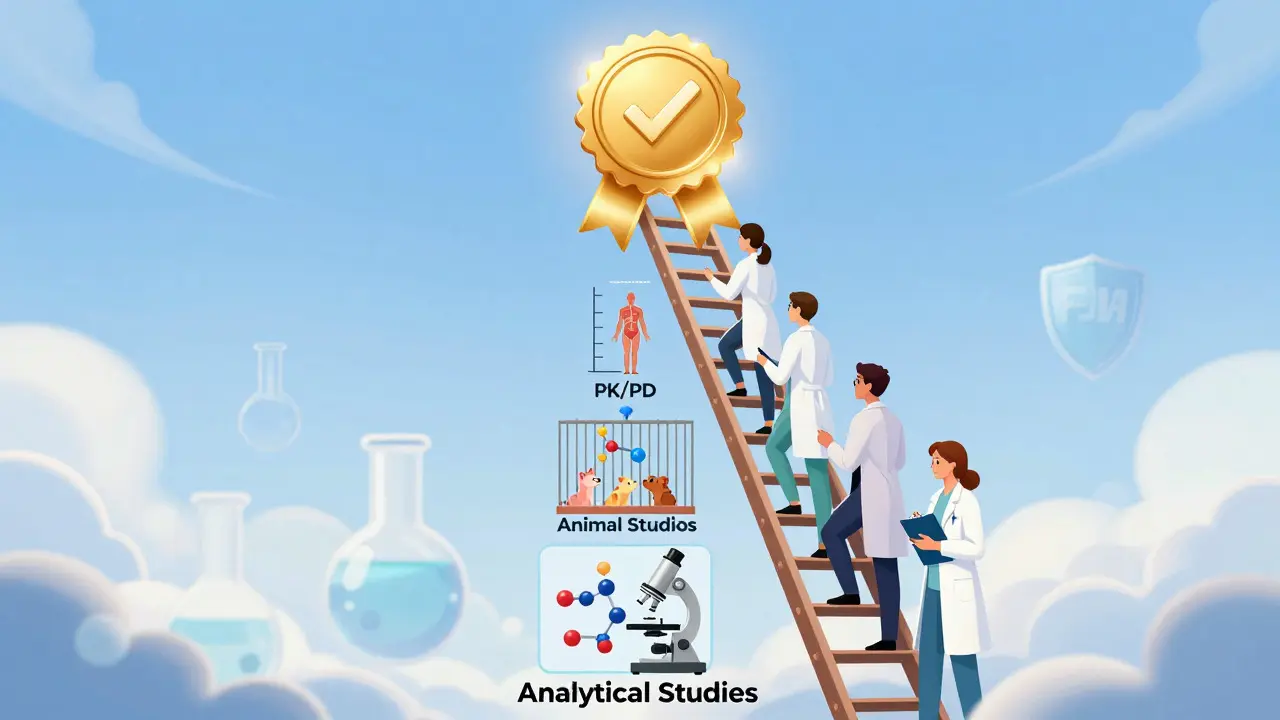
The FDA uses a "totality of evidence" approach. This means they don't rely on just one test. They build a case step-by-step, starting with the most detailed scientific analysis and moving toward human testing only if necessary. Here is how the ladder works:
- Analytical Studies (The Foundation): This is the most critical step. Manufacturers must use state-of-the-art techniques to characterize the molecular structure, purity, and biological activity of both the biosimilar and the reference product. The FDA evaluates up to 300 critical quality attributes. For many attributes, the similarity threshold is extremely high, often requiring 95-99% analytical similarity. If the molecules look almost identical under the microscope and in chemical assays, the FDA may skip later steps.
- Animal Studies: If the analytical data shows high similarity, animal studies might be waived. However, if there are minor differences, the FDA may require toxicity assessments in relevant species to ensure no unexpected reactions occur in living organisms.
- Pharmacokinetic and Pharmacodynamic (PK/PD) Studies: These studies are conducted in humans (healthy volunteers or patients). They measure how the body absorbs, distributes, metabolizes, and excretes the drug (pharmacokinetics) and what the drug does to the body (pharmacodynamics). A standard design involves 50-100 participants per arm. The goal is to show that the biosimilar behaves in the body just like the reference product.
- Clinical Efficacy Studies: Historically, large clinical trials were required. However, recent guidance updates (September 2024) allow manufacturers to potentially eliminate these comparative efficacy studies if the analytical and PK/PD data are strong enough. This is a significant shift that saves time and money while maintaining safety standards.
- Immunogenicity Assessment: This is mandatory for all biosimilars. Since biologics are proteins, the immune system might recognize them as foreign invaders. Manufacturers must run assays over 24-52 weeks to check if the biosimilar triggers an immune response different from the reference product.
The Purple Book: Where Biosimilars Get Listed
Once a biosimilar passes all these hurdles, it needs a place to live publicly. That place is the Purple Book, which is the official FDA listing of all approved biologics, including reference products and biosimilars. As of late 2025, this database contains hundreds of reference biologics and dozens of approved biosimilars.
The Purple Book is more than just a list. It includes critical information such as:
- Licensure dates
- Patent information (mandatory since June 2021)
- Exclusivity periods
- Interchangeability status
This transparency helps doctors, pharmacists, and payers understand the legal and clinical landscape. For example, if a patent dispute is ongoing, it will be reflected here, which affects whether a biosimilar can actually be sold yet, even if it is approved.
Interchangeability: The Higher Bar
Not all biosimilars are created equal in terms of substitution rules. Some receive a special designation: interchangeable. This is a higher standard set by the FDA. To earn this label, a biosimilar must meet all the requirements for biosimilarity plus provide additional data demonstrating that:
- It can be expected to produce the same clinical result as the reference product in any given patient.
- Any risk in switching between the biosimilar and the reference product is not greater than the risk of switching between different lots of the reference product itself.
As of October 2025, only 17 products have achieved interchangeable status. Why so few? Because proving interchangeability requires extra studies, often involving multiple switches between the biosimilar and the reference drug in patients. This adds cost and complexity. However, for states that allow automatic substitution at the pharmacy (similar to generics), this designation is key to getting the drug into patients' hands quickly.
| Feature | Biosimilar | Interchangeable Biosimilar |
|---|---|---|
| High Similarity Required? | Yes | Yes |
| No Clinically Meaningful Differences? | Yes | Yes |
| Switching Safety Data Required? | No | Yes (Multiple Switches) |
| Automatic Pharmacy Substitution? | Depends on State Law | Allowed in Many States |
| Number Approved (as of Oct 2025) | 43 | 17 |
Why the FDA Process Is Considered Stringent
You might hear people say the FDA is tough on biosimilars compared to other agencies. There is truth to this. Dr. Steven Kozlowski, former Director of the Office of Biotechnology Products at the FDA, noted in 2023 that the FDA requires more comprehensive analytical characterization than the European Medicines Agency (EMA).
Here are some hard numbers that illustrate this difference:
- Approval Rates: Europe has approved 118 biosimilars as of 2025, while the U.S. has approved 43.
- Time to Approval: The median time from submission to approval in the U.S. is 3.2 years, compared to 2.1 years in the EU.
- Cost: Analytical characterization alone can cost $120-180 million, accounting for 30-40% of total development costs.
Is this stricter approach better? Patient advocacy groups argue yes. The Cancer Support Community praised the FDA’s rigor, noting that in nine years of post-marketing surveillance, there have been no biosimilar-specific safety signals. Real-world data from the FDA’s Sentinel Initiative shows adverse event rates for biosimilars (0.8 per 10,000 patients) are statistically equivalent to reference products (0.7 per 10,000 patients). The strictness buys confidence.

Recent Changes and Future Outlook
The landscape is shifting. In September 2024, the FDA finalized updated guidance that allows manufacturers to skip comparative efficacy studies in certain cases. This change is expected to save developers $50-100 million per product and cut development timelines by 12-18 months. Additionally, a June 2025 policy change allows for extrapolation of indications based solely on robust analytical data for well-characterized proteins.
These changes aim to address the barriers identified in the FDA’s Biosimilars Action Plan, such as complex manufacturing costs and patent litigation delays. The goal is clear: increase access to affordable biologics without compromising safety. By 2030, the FDA projects biosimilars could reach 30% of the biologics market, generating billions in savings.
However, challenges remain. Complex molecules like antibody-drug conjugates still lack clear guidance. Only three applications for these complex biosimilars have been submitted, with none approved yet. The FDA is working on new guidelines for these advanced products, targeting release by Q3 2026.
What This Means for You
If you are a patient prescribed a biologic, ask your doctor if a biosimilar is available. It could mean lower out-of-pocket costs. If you are a provider, check the Purple Book for interchangeability status to know if you can let the pharmacist handle the substitution. And if you are an investor or industry professional, watch the FDA’s roadmap for AI tools in review and new guidance on complex molecules. The biosimilar market is growing, but it is evolving fast.
Are biosimilars as safe as the original brand-name biologics?
Yes. The FDA requires extensive testing to ensure there are no clinically meaningful differences in safety, purity, or potency. Post-market surveillance data from the FDA’s Sentinel Initiative shows that adverse event rates for biosimilars are statistically equivalent to those of reference products. No unique safety signals have been identified for any approved biosimilar in the U.S. since the pathway began in 2015.
What is the difference between a biosimilar and a generic drug?
A generic drug is an exact chemical copy of a small-molecule drug, like aspirin. A biosimilar is a highly similar version of a complex biological product made from living cells. Because biological products are naturally variable, biosimilars are not identical copies but must demonstrate high similarity and no clinically meaningful differences through rigorous testing.
Can my pharmacist automatically substitute a biosimilar for my prescribed biologic?
It depends on the product and your state laws. Only biosimilars designated as "interchangeable" by the FDA can typically be substituted automatically at the pharmacy without the prescriber's intervention, provided your state allows it. For non-interchangeable biosimils, your doctor usually needs to specifically prescribe that product.
Where can I find a list of all FDA-approved biosimilars?
You can find the official list in the FDA’s Purple Book. This online resource lists all licensed biologics, including reference products and biosimilars. It provides details on licensure dates, patent information, exclusivity periods, and interchangeability status. The database is updated daily and is fully searchable.
Why are there fewer biosimilars approved in the U.S. than in Europe?
The FDA generally requires more comprehensive analytical characterization and sometimes more clinical data than the European Medicines Agency (EMA). This stricter scrutiny leads to longer development times and higher costs for manufacturers. Consequently, fewer products have reached approval in the U.S. (43 as of late 2025) compared to Europe (118), though the gap is narrowing due to recent regulatory streamlining.
How much cheaper are biosimilars compared to reference products?
On average, biosimilars are priced 15-30% lower than their reference products. While this discount is smaller than the typical 80-90% reduction seen with generic chemical drugs, it still represents significant savings for patients and the healthcare system, especially given the high cost of many biologic therapies.
What does "interchangeable" mean for a biosimilar?
Interchangeability is a higher designation granted by the FDA. It means the biosimilar has demonstrated that it can produce the same clinical result as the reference product in any patient and that switching between the two does not increase risk. This designation allows pharmacists to substitute the biosimilar for the reference product at the dispensing level, subject to state laws.
Has the FDA changed its approval process recently?
Yes. In September 2024, the FDA updated its guidance to allow manufacturers to potentially eliminate comparative efficacy studies if analytical and pharmacokinetic/pharmacodynamic data are sufficiently robust. In June 2025, new policies allowed for indication extrapolation based on analytical data alone for certain well-characterized proteins. These changes aim to speed up development and reduce costs.
Marc H
August 8, 2026 AT 05:26Oh, brilliant. Another post explaining why my insurance won't cover the drug that actually works because they want to save pennies on a 'highly similar' version made in a petri dish.
I suppose if I get an allergic reaction because my body decided the new batch was slightly different from the last one, I can just thank the FDA for their rigorous 300-attribute checklist? Please. It’s all about the bottom line, not the patient. But sure, let’s pretend this is science and not corporate greed dressed up in a lab coat.
Chris McQuaid
August 9, 2026 AT 15:26The fundamental misunderstanding here lies in the nature of biological complexity itself. You cannot simply replicate life with chemical precision. The article correctly identifies that biosimilars are not generics, yet the public discourse often conflates the two due to a lack of philosophical rigor regarding molecular identity versus functional similarity.
When we speak of 'similarity,' we are invoking a statistical probability rather than a deterministic fact. This creates an epistemological gap between what the manufacturer claims and what the patient experiences. The FDA's approach is essentially Bayesian; they update their confidence in the product based on accumulating evidence. However, the burden of proof remains asymmetrical. The reference product is assumed safe until proven otherwise, while the biosimilar must prove its safety through an exhaustive gauntlet of testing. This is not necessarily inefficient, but it is inherently biased towards the status quo.
sam howard
August 9, 2026 AT 22:56stop overcomplicating it. its just protein. if it looks right and acts right under a microscope then its fine. the fda is just scared of lawsuits so they make companies spend millions on tests nobody reads. interchangeability is a myth anyway. pharmacists just swap whatever is cheapest and hope for the best. i took a biosimilar once and felt weird for a week. probably placebo but still.
Samuel Hershberger
August 10, 2026 AT 22:41Actually, Sam, that feeling you had might have been real, but it’s important to look at the data before jumping to conclusions. The Sentinel Initiative data mentioned in the post shows adverse event rates are statistically equivalent (0.8 vs 0.7 per 10,000 patients). That’s incredibly reassuring!
It’s great that you’re sharing your experience though. Patient feedback is vital. If you ever feel uncomfortable with a substitution, you always have the right to ask your doctor for the reference product specifically. The system is designed to give you choices, even if it feels overwhelming sometimes. Let’s keep the conversation open and supportive for everyone navigating these complex treatments!
Mathew Stuckey
August 12, 2026 AT 07:07Hey guys! 👋 Just wanted to say thanks for breaking this down. It’s super helpful to know that the FDA is actually checking 300 quality attributes! 😲 That’s way more than I thought. I’ve been worried about switching meds lately, but seeing that the adverse event rates are basically the same makes me feel a lot better. 🙌 Hope everyone stays healthy and informed! 💪✨
John Divers
August 12, 2026 AT 13:31The distinction between biosimilarity and identity is indeed crucial. One might argue that the stringent requirements reflect a necessary caution given the high stakes involved in immunogenicity. However, the disparity in approval numbers between the US and EU suggests that regulatory efficiency varies significantly across jurisdictions. Perhaps a harmonization of standards could benefit global health outcomes without compromising safety protocols.
Ambria St louis
August 13, 2026 AT 13:53This is such an important topic!; and I think many people overlook the sheer amount of work that goes into ensuring these products are safe.;; The fact that the FDA requires immunogenicity assessments over 24-52 weeks is really commendable.; It shows a deep respect for patient well-being.;; We should encourage more transparency in how these decisions are made.; After all, knowledge empowers us to advocate for ourselves and our loved ones.;; Thank you for shedding light on this complex issue!;
Dennis Leeftink
August 15, 2026 AT 10:37you guys are missing the point. the cost is too high. $180 million for analytical characterization is insane. why should patients pay for that when europe does it cheaper and faster. the fda is just protecting big pharma profits by making it hard for competitors to enter. its simple economics. less competition means higher prices. stop pretending its about safety. its about money.
Traci Bobbitt
August 16, 2026 AT 22:20Look, I’m not saying the FDA is perfect, but calling it all a conspiracy ignores the reality of biologics. These aren’t aspirin tablets. They’re living things. You can’t rush the process. And honestly, if you think Europe’s system is better, try getting healthcare there. The US has access to drugs years ahead of them sometimes. Yes, it’s expensive, but ‘interchangeable’ status is key. Only 17 products have it because it’s hard to prove. That’s not bad, that’s rigorous. Trust the science, folks.
Sansaray Jones
August 17, 2026 AT 06:14i guess its just another layer of bureaucracy. as long as it gets approved eventually i dont care how long it takes. just wish they would simplify the language though. 'pharmacokinetic' sounds like a mouthful every time.
Anna Salamon
August 18, 2026 AT 09:37In many European countries, the regulatory framework allows for earlier market entry, which can be beneficial for patient access. However, the U.S. model emphasizes extensive pre-market data collection. Both approaches have merits. It is interesting to see how recent guidance updates in September 2024 aim to streamline the process by allowing manufacturers to skip comparative efficacy studies if analytical data is robust. This shift towards flexibility while maintaining high standards could bridge the gap between innovation and accessibility. Watching how these policies evolve will be fascinating for anyone interested in pharmaceutical economics.