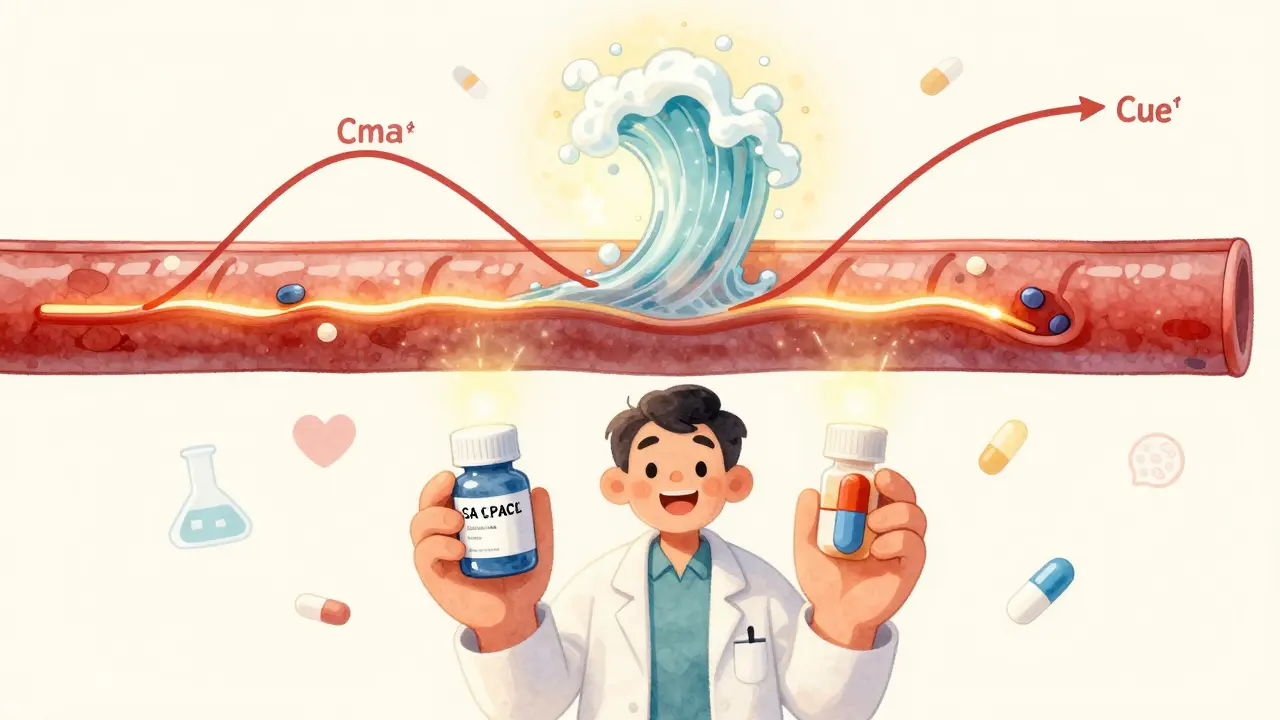
When you pick up a prescription at the pharmacy, you might see a different name on the bottle than what your doctor wrote. That’s because most prescriptions today are filled with generic drugs. They cost less, often a fraction of the price, and are just as safe and effective - if they meet strict absorption standards. But how do we know they work the same way? The answer lies in something called bioequivalence.
What Bioequivalence Really Means
Bioequivalence isn’t about looking the same or tasting the same. It’s about how your body absorbs the medicine. For a generic drug to be approved, it must deliver the same amount of active ingredient into your bloodstream at the same speed as the brand-name version. It’s not enough for the pill to contain the same chemical. It has to behave the same way inside your body.The U.S. Food and Drug Administration (FDA) requires two key measurements to prove this: AUC and Cmax. AUC stands for Area Under the Curve - it tells you how much of the drug gets into your blood over time. Cmax is the highest concentration the drug reaches. Both numbers must fall within a very tight range compared to the brand-name drug.
The rule? The 90% confidence interval for the ratio of generic to brand absorption must stay between 80% and 125%. That doesn’t mean a generic can be 20% weaker or 25% stronger. It means the average absorption across all tested people must be extremely close. In fact, real-world data shows the average difference is just 3.5%. That’s less than the natural variation you’d see if you took the same brand-name pill twice on different days.
How Testing Works
Before a generic drug hits the shelf, manufacturers run clinical studies with 24 to 36 healthy volunteers. Each person takes both the brand-name drug and the generic version, in random order, with a break in between to let the first dose clear out. Blood samples are taken over hours to map out how quickly and how much of the drug enters the bloodstream.The data is analyzed using geometric means - not simple averages - because drug absorption isn’t linear. The FDA looks at whether the confidence interval for both AUC and Cmax fits entirely inside the 80-125% window. If even one point falls outside, the drug is rejected. This isn’t a suggestion. It’s a hard requirement.
Between 1996 and 2007, over 2,000 studies were submitted to the FDA. The results? Nearly 98% of generics had AUC values within 10% of the brand-name drug. That’s not just close - it’s nearly identical. The system works because it’s designed to catch even small deviations before the drug gets to patients.
Dissolution Isn’t the Same as Absorption
You might hear that some generics dissolve slower or faster in a lab test. That’s true. A 2014 study found that over half of the generic drugs tested had different dissolution rates than their brand-name counterparts. For example, one generic version of nifedipine dissolved much slower, while another version of amoxicillin dissolved faster.But here’s the catch: dissolution in a test tube doesn’t always predict what happens in your body. The FDA allows these differences because the real test is what happens in the bloodstream - not in a beaker. As long as the final absorption numbers (AUC and Cmax) meet the 80-125% rule, the drug is approved. That’s why a generic that dissolves slowly can still be just as effective - your body may absorb it over a longer period, but the total amount ends up being the same.
What About the Drugs That Don’t Work?
Some patients swear their generic version doesn’t work as well. They report feeling worse after switching - especially with thyroid meds like levothyroxine or antidepressants like bupropion. These complaints are real, and they’re common enough to show up in online forums and patient surveys.But when you look at the science, the story changes. A 2023 meta-analysis of 47 studies with nearly 10,000 patients found no difference in outcomes between generic and brand-name cardiovascular drugs. The FDA has recorded only 12 cases of possible therapeutic failure among more than 14,000 approved generics between 2008 and 2023. That’s a failure rate of 0.08%.
Why the disconnect? Often, it’s not the drug - it’s the mind. Patients who expect generics to be inferior may notice side effects more or feel less confident in their treatment. That’s the placebo effect in reverse. Sometimes, switching between different generic manufacturers (even if both are FDA-approved) can cause small changes in fillers or coatings that affect how the pill feels or tastes, leading to confusion.
Narrow Therapeutic Index Drugs: The Exception
There are some drugs where even a tiny change in blood levels can be dangerous. These are called narrow therapeutic index (NTI) drugs. Examples include warfarin (a blood thinner), digoxin (for heart failure), and phenytoin (for seizures). For these, the FDA requires tighter standards: the absorption ratio must stay between 90% and 111%.That’s because a 5% drop in warfarin levels might mean a clot forms. A 5% increase could cause dangerous bleeding. So for NTI drugs, the margin for error is razor-thin. Pharmacists are trained to know which generics are approved for substitution here - and which aren’t. The FDA’s Orange Book lists therapeutic equivalence ratings: “A” means interchangeable, “B” means potential issues. Most states allow pharmacists to swap generics automatically - but only if the rating is “A.”
Why Generics Look Different
Ever wonder why your generic pill is a different color or shape? That’s not a mistake - it’s the law. U.S. trademark rules forbid generics from looking exactly like brand-name drugs. So manufacturers change the color, size, or imprint. But none of that affects how the drug works. The active ingredient is identical. The absorption profile is identical. The only difference is the packaging and the price.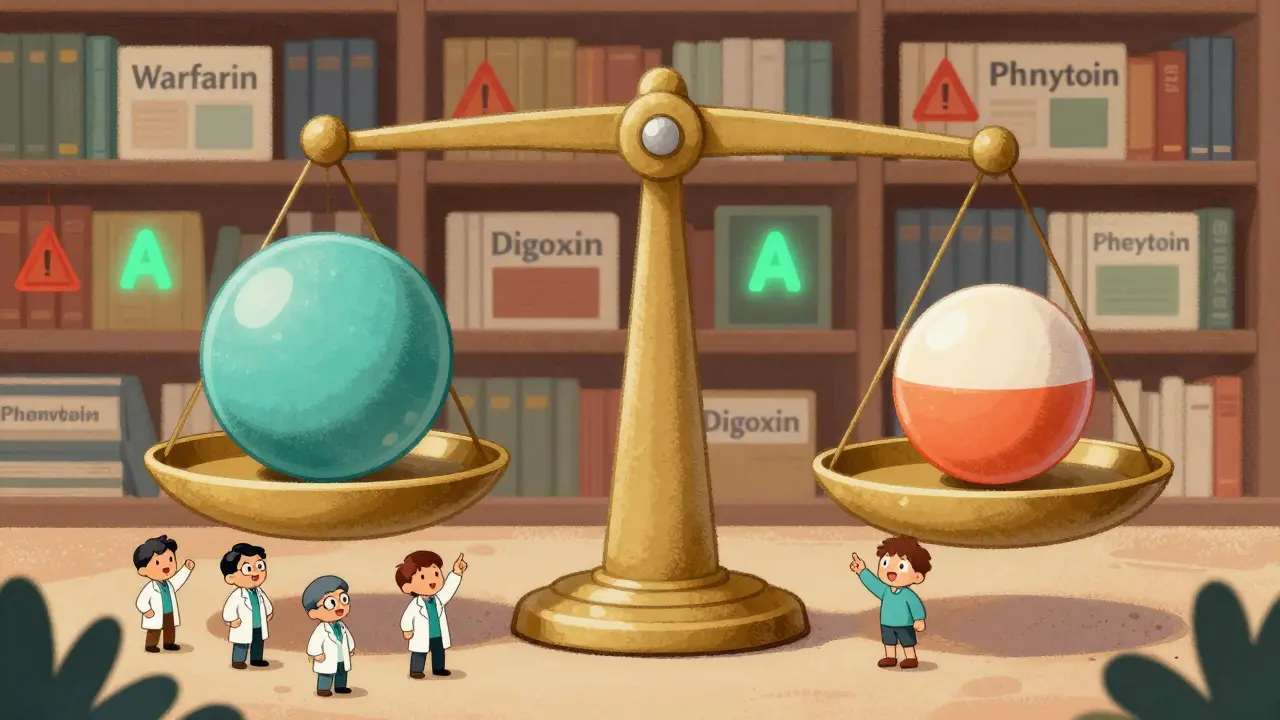
The Bigger Picture
Generics make up 90% of all prescriptions filled in the U.S. but cost only 23% of total drug spending. In 2023, the generic drug market was worth over $135 billion. That’s billions saved every year because of bioequivalence standards. Without them, patients would pay more, insurers would struggle, and access to medicine would shrink.Regulators aren’t standing still. The FDA is now using computer modeling and simulation to predict bioequivalence without always needing human trials. This could speed up approvals for complex drugs like inhalers and topical creams - while still keeping the same safety bar. By 2027, the goal is to review 90% of generic applications in 10 months or less.
Global standards are also aligning. The European Medicines Agency uses the same 80-125% rule. Japan is slightly stricter for some drugs, but the core principle is the same: absorption must be clinically equivalent. This isn’t just American policy - it’s science-backed global practice.
What Patients Should Know
If your doctor prescribes a brand-name drug and you’re switched to a generic, you don’t need to panic. The system is designed to protect you. If you notice a change in how you feel - especially with NTI drugs - talk to your doctor or pharmacist. Don’t assume it’s the generic. It could be stress, diet, sleep, or another medication interacting.Don’t let the shape or color of your pill scare you. What matters is the active ingredient and how your body absorbs it. And when it comes to absorption, the data is clear: generics match brand-name drugs almost perfectly.
Are generic drugs really as effective as brand-name drugs?
Yes, when approved by the FDA, generic drugs are required to have the same active ingredient, strength, dosage form, and absorption rate as the brand-name version. Studies show the average difference in absorption is only about 3.5%, which is less than the natural variation seen when taking the same brand-name drug multiple times.
Why do some people say generics don’t work for them?
Some patients report feeling different after switching, especially with thyroid or antidepressant medications. But large-scale studies show no difference in clinical outcomes. These reports often stem from placebo effects, changes in pill appearance, or switching between different generic manufacturers - not from the drug being less effective. Always talk to your provider if you notice changes.
Can a generic drug be 20% weaker than the brand name?
No. The 80-125% range is not a tolerance for individual pills. It’s a statistical requirement for the entire group of people tested. The average absorption must be nearly identical, and the confidence interval must stay within those bounds. In practice, most generics are within 5% of the brand-name drug’s absorption.
What are narrow therapeutic index drugs, and why do they matter?
These are drugs where even small changes in blood levels can cause serious harm - like warfarin, digoxin, or phenytoin. For these, the FDA requires tighter bioequivalence limits: 90-111% for absorption. Not all generics are approved for substitution with these drugs, and pharmacists are trained to check the FDA’s Orange Book before switching.
Why do generics look different from brand-name drugs?
U.S. trademark laws require generics to look different - different color, shape, or imprint - to avoid confusion with the brand-name version. These changes affect only appearance, not how the drug works. The active ingredient and absorption rate remain identical.
How does the FDA ensure generics stay safe after they’re on the market?
The FDA monitors adverse events through its reporting system and can request additional testing if problems arise. Since 2008, only 12 out of more than 14,000 approved generics have shown potential therapeutic issues - a failure rate of just 0.08%. This shows the system works reliably over time.
What Comes Next
The future of generics is smarter, not stricter. With new modeling tools, the FDA can predict how a drug will behave without always needing human trials. This will speed up access to affordable medicines - especially for complex products like biologics and inhalers. But the core standard won’t change: if it doesn’t absorb the same way, it doesn’t get approved.For patients, the message is simple: trust the system. Generics are not second-rate. They’re science-tested, regulated, and proven. The only real difference? The price tag. And that’s a difference that matters - for millions of people who need medicine, not marketing.
Jodi Harding
January 17, 2026 AT 16:32Generics are literally just as good, and people still act like they’re cursed. I switched my blood pressure med to generic and saved $120/month. My BP is more stable now than when I was on brand. Stop believing the hype.
Chuck Dickson
January 19, 2026 AT 06:50Look, I used to think generics were sketchy too-until my kid needed asthma inhalers and we couldn’t afford the brand. We switched. No issues. Zero. Now I tell everyone: if the FDA says it’s safe, trust the science, not the fear. These drugs aren’t magic-they’re math. And the math checks out.
Danny Gray
January 20, 2026 AT 20:44Interesting how we’re told to trust the system, but the same system lets pharmaceutical companies patent the same molecule over and over to extend monopolies. Generics aren’t the problem-the system that lets brands charge $500 for a pill that costs $2 to make is. Bioequivalence is a distraction. The real issue is corporate greed dressed up as regulation.
Wendy Claughton
January 21, 2026 AT 23:02My grandma takes levothyroxine-switched generics twice last year. She said her energy dipped a little after the second switch. We talked to her pharmacist, who checked the Orange Book and switched her back to the same manufacturer. She’s fine now. Point is: it’s not the generic, it’s the *switching*. Consistency matters, even if the science says they’re identical. 🤍
Robert Cassidy
January 23, 2026 AT 01:32They say 98% are within 10%? That’s still a 20% window of error if you’re on warfarin. And who’s to say the FDA isn’t pressured by Big Pharma to approve these? They used to ban generics outright in the 90s-now they’re pushing them like candy. Something’s off. I don’t trust this.
Tyler Myers
January 24, 2026 AT 06:04THEY’RE NOT THE SAME. I took a generic version of my antidepressant and felt like I was underwater for two weeks. My doctor said "it’s placebo"-but I didn’t believe it before, and I don’t believe it now. The FDA’s numbers are cooked. They’re not testing on real patients, just college kids on spring break. This is a cover-up. #GenericScam
Zoe Brooks
January 25, 2026 AT 12:59My mom’s on digoxin. We always check the Orange Book before she fills it. She gets the same generic every time because her pharmacist knows the brand that works best for her. It’s not about generic vs brand-it’s about consistency. And yeah, the price difference is insane. I’m glad we have this system. 😊
Kristin Dailey
January 27, 2026 AT 00:16USA makes the best generics. Europe? Japan? They’re still playing catch-up. This system is American innovation at its finest. Don’t let anyone tell you otherwise.