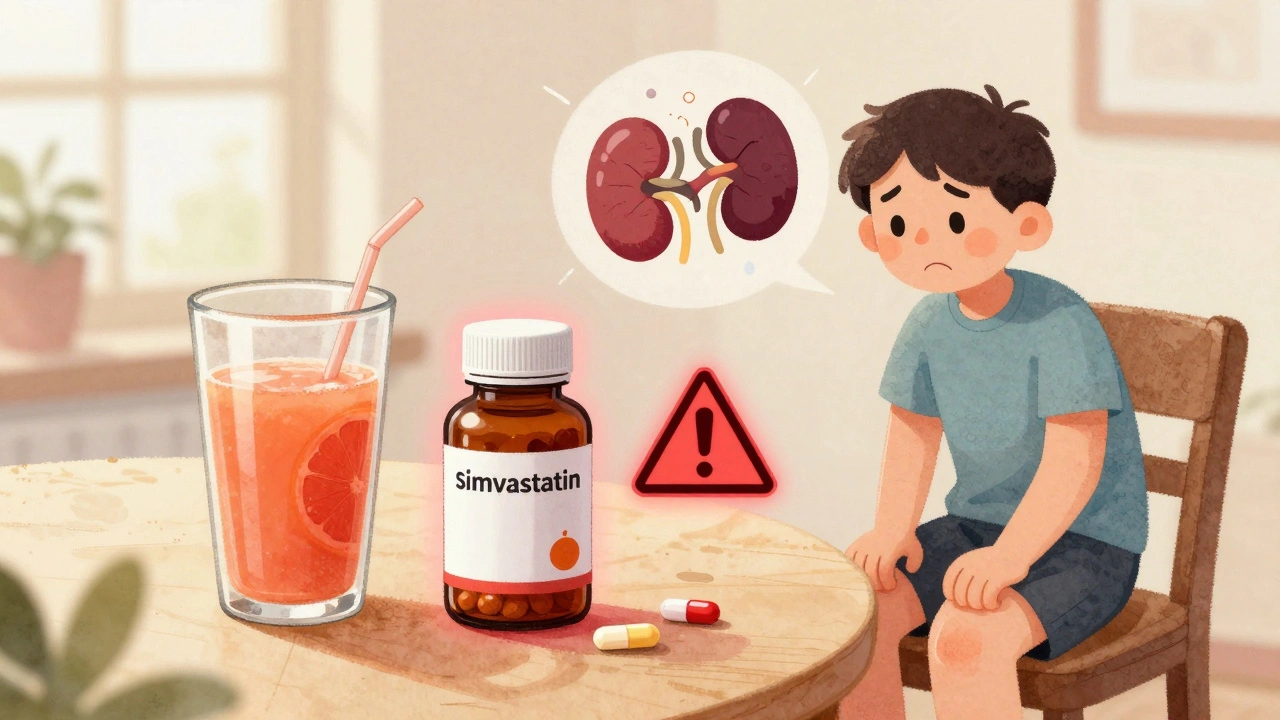
Drinking a glass of grapefruit juice with breakfast might seem harmless - even healthy. But if you're taking simvastatin, that habit could be putting your muscles at serious risk. This isn't just a theoretical concern. It's a well-documented, potentially life-threatening interaction that affects millions of people in the U.S. alone. The problem isn't the grapefruit itself. It's what happens when your body tries to process simvastatin after the juice hits your system.
How Grapefruit Juice Turns Simvastatin Into a Hidden Danger
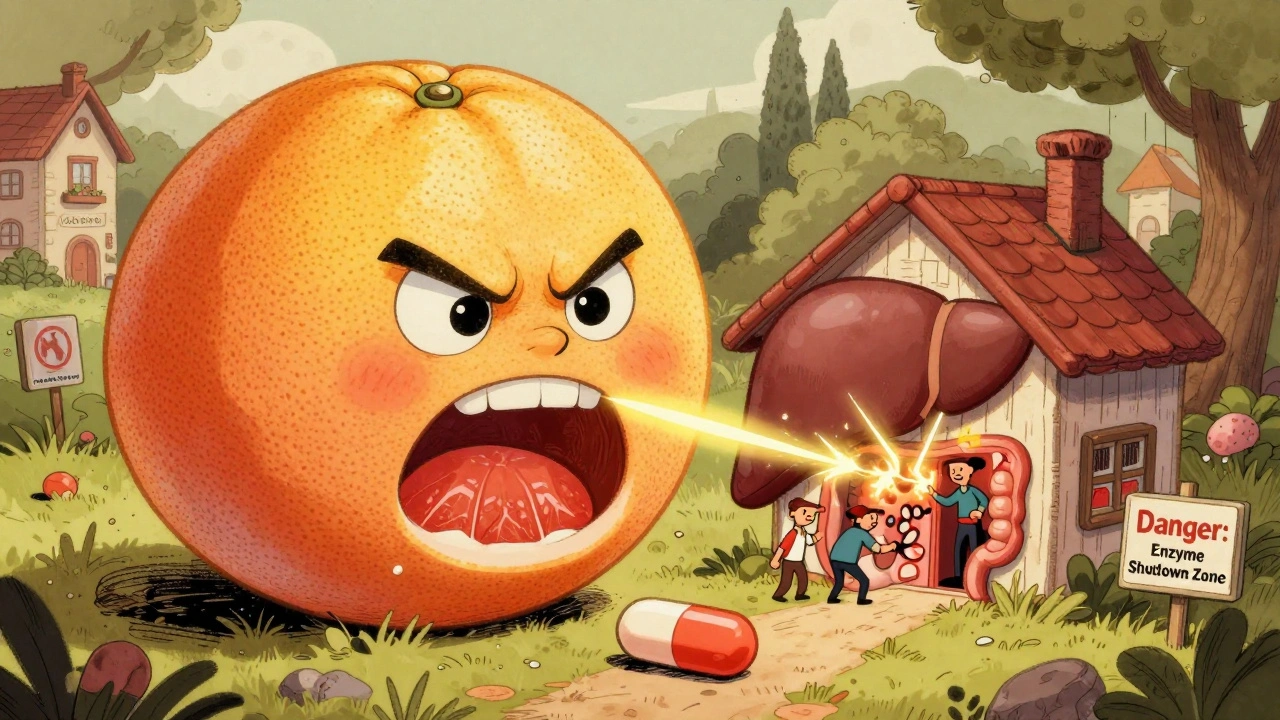
Simvastatin, sold under the brand name Zocor, is one of the most commonly prescribed statins in the United States. About 23 million prescriptions are filled every year. It works by blocking an enzyme in your liver that makes cholesterol. But here's the catch: your body doesn't absorb simvastatin directly into your bloodstream. It has to pass through your intestines first, where an enzyme called CYP3A4 breaks it down so only a safe amount enters your system.
Grapefruit juice doesn't just interfere with this process - it shuts it down. The juice contains chemicals called furanocoumarins, mainly bergamottin and 6',7'-dihydroxybergamottin. These compounds bind to CYP3A4 enzymes in your gut and permanently disable them. That means more simvastatin slips through untouched, flooding your bloodstream. Studies show that drinking just 200 mL of grapefruit juice three times a day can boost simvastatin levels by up to 16 times. That’s not a small bump. That’s a dangerous spike.
Why This Leads to Muscle Damage and Worse
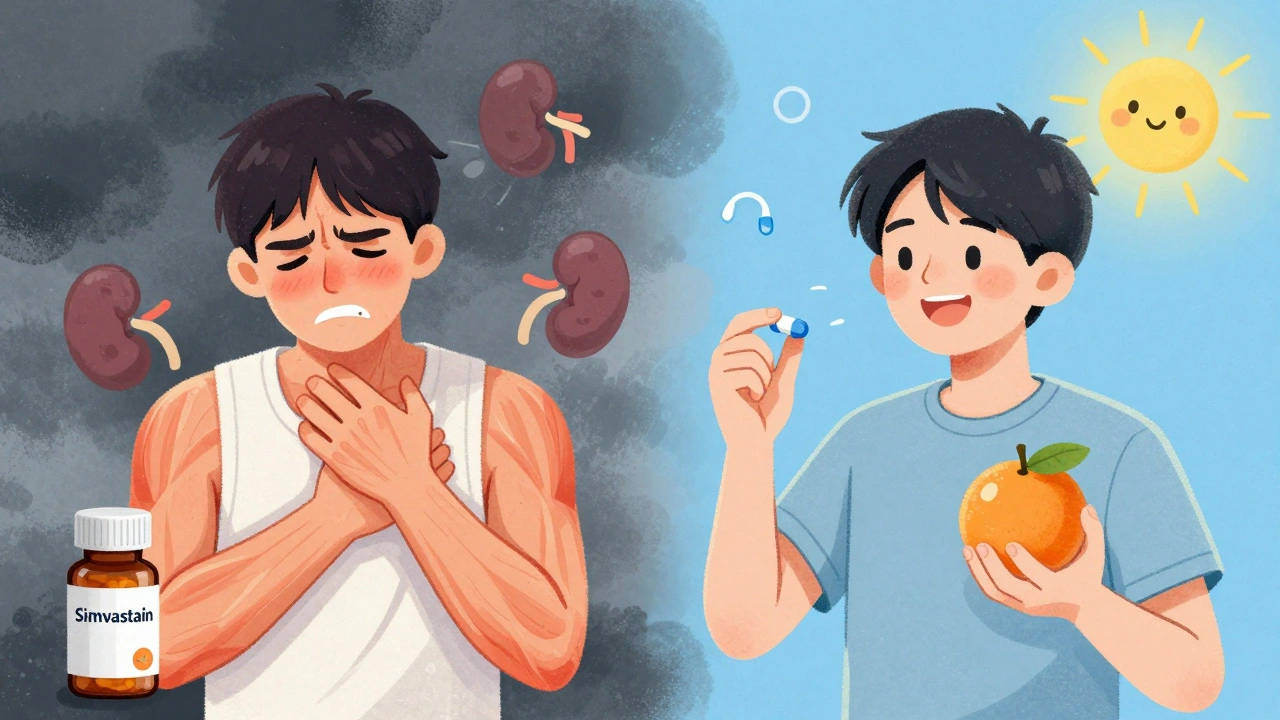
When too much simvastatin circulates in your blood, it doesn’t just lower cholesterol more aggressively. It starts attacking your muscles. The result? Myopathy - a condition marked by muscle pain, weakness, and tenderness. In severe cases, it can progress to rhabdomyolysis, where muscle tissue breaks down and leaks into your bloodstream. This can clog your kidneys, leading to kidney failure, dialysis, or even death.
The risk isn't the same for everyone. Older adults, people with kidney problems, or those taking other medications like amiodarone or certain blood pressure drugs are at higher risk. But even healthy people aren't safe. The FDA warns that we can't predict who will develop these reactions. One person might drink a glass of grapefruit juice daily for years with no issue. Another might get sick after just one serving. That unpredictability is why doctors take this interaction seriously.
How Much Is Too Much?
You might be wondering: Is it okay to have a little? The answer depends on how much you’re drinking. The FDA says consuming more than 1.2 liters of grapefruit juice daily - that’s five 8-ounce glasses - significantly increases the risk. But here’s the twist: even smaller amounts can be risky if you’re on a high dose of simvastatin (40 mg or 80 mg). For people taking 10 mg or 20 mg, moderate consumption (like half a grapefruit or one small glass of juice) may be acceptable - but only if your doctor approves it.
What’s surprising is that the effect doesn’t go away quickly. If you drink grapefruit juice on Monday, your CYP3A4 enzymes are still disabled on Wednesday. It takes 3 to 7 days for your body to make new ones. That means even if you take your simvastatin at night and drink juice in the morning, you’re still at risk. Timing doesn’t fix the problem. Avoiding the juice entirely is the only sure way to prevent it.
Not All Statins Are Created Equal
Here’s something many people don’t know: not every statin reacts the same way with grapefruit. Simvastatin and lovastatin are the worst offenders because they rely heavily on CYP3A4 for metabolism. Atorvastatin (Lipitor) has a moderate interaction - its levels can rise up to 3.3 times with grapefruit juice. But pravastatin (Pravachol) and rosuvastatin (Crestor)? They barely react at all. They use different pathways to break down, so grapefruit juice doesn’t touch them.
This matters because if you’re someone who loves grapefruit and needs a statin, switching might be the smartest move. The American College of Cardiology recommends considering pravastatin or rosuvastatin for patients who regularly consume grapefruit products. It’s not just about avoiding juice - it’s about choosing the right medication from the start. With over 39 million Americans on statins, this switch could prevent thousands of hospitalizations each year.
What Patients Are Getting Wrong
A 2022 Mayo Clinic survey of 1,200 statin users found that 63% thought even a small amount of grapefruit juice was dangerous. Meanwhile, 28% believed they could safely drink more than five glasses a day. Both groups were wrong. The real danger lies in the gray zone - people who think they’re being careful but still consume enough to trigger a reaction.
Many patients don’t realize that grapefruit juice isn’t the only culprit. Fresh grapefruit, grapefruit segments, and even some grapefruit-flavored sodas or candies contain the same harmful compounds. And it’s not just grapefruit - Seville oranges, pomelos, and tangelos can cause the same problem. Regular sweet oranges and tangerines? Safe. Orange juice? No problem.
What Your Doctor Wants You to Do
Most cardiologists and pharmacists follow a simple rule: if you’re on simvastatin, avoid grapefruit juice entirely. That’s the safest advice. But if you’re someone who’s been on a low dose for years without side effects, and you’ve never had muscle pain, your doctor might say it’s okay to have half a grapefruit or a small glass of juice - as long as you monitor yourself closely.
Here’s what you need to watch for:
- Unexplained muscle pain, especially in your thighs or shoulders
- Weakness or fatigue that doesn’t go away
- Dark urine - a sign your kidneys are struggling
- Back or side pain
If you notice any of these, stop the juice and call your doctor immediately. Don’t wait. Don’t assume it’s just soreness from the gym. Statin-related muscle damage can escalate fast.
What’s Changing in the Future
There’s hope on the horizon. Researchers at the University of Florida have developed a new grapefruit hybrid called UF Sweetie that has 87% less of the harmful furanocoumarins. It tastes just as sweet, but it doesn’t interfere with CYP3A4. While it’s not widely available yet, this could be a game-changer for people who love grapefruit but need statins.
Meanwhile, better labeling and patient education are making a difference. The FDA has required warning labels on simvastatin bottles since 2014, and newer guidelines from the American Heart Association now clarify that moderate consumption isn’t a crisis - but it’s not risk-free. The goal isn’t to scare people. It’s to give them clear, science-backed choices.
By 2033, experts predict a 35-40% drop in severe cases of grapefruit-statin toxicity thanks to smarter prescribing, better awareness, and possibly safer fruit options. But until then, the safest choice remains simple: skip the grapefruit juice if you’re on simvastatin. Your muscles - and your kidneys - will thank you.
Can I drink grapefruit juice if I take simvastatin once a day?
No. Even if you take simvastatin once daily, grapefruit juice can still cause dangerous drug buildup. The enzyme inhibition lasts 3 to 7 days, so timing the juice and medication hours apart doesn’t eliminate the risk. Avoid grapefruit juice entirely while on simvastatin.
Is orange juice safe with simvastatin?
Yes. Regular sweet orange juice does not contain furanocoumarins and does not interfere with CYP3A4. You can safely drink orange juice while taking simvastatin. Avoid Seville oranges, pomelos, and tangelos - they can cause the same interaction as grapefruit.
What are the signs of statin-induced muscle damage?
Look for unexplained muscle pain, tenderness, or weakness - especially in the shoulders, thighs, or lower back. Dark urine, extreme fatigue, and reduced urination are signs your kidneys may be affected. If you notice any of these, stop grapefruit juice and contact your doctor immediately.
Can I switch to a different statin to avoid grapefruit juice restrictions?
Yes. Pravastatin and rosuvastatin are not metabolized by CYP3A4, so they don’t interact with grapefruit juice. If you regularly consume grapefruit, talk to your doctor about switching. Many patients find these alternatives just as effective for lowering cholesterol without the dietary restrictions.
How long does it take for grapefruit juice to leave my system?
The effects of grapefruit juice on CYP3A4 enzymes last 3 to 7 days. Even if you stop drinking it, your body needs time to produce new enzymes. That means you should avoid grapefruit juice for at least a week before switching to simvastatin - and continue avoiding it while taking it.
Is it safe to eat grapefruit instead of drinking the juice?
No. Whole grapefruit contains the same furanocoumarins as the juice. Eating the fruit has the same effect on CYP3A4 as drinking the juice. Both should be avoided if you’re taking simvastatin.
Desmond Khoo
December 8, 2025 AT 11:12Just switched to rosuvastatin after reading this - no more grapefruit juice drama 🍊🚫 My muscles finally stopped screaming at 3 a.m. 💪
Wesley Phillips
December 10, 2025 AT 07:11Let’s be real - if you’re still on simvastatin in 2024 and drinking grapefruit juice, you’re not just ignoring medical advice, you’re running a controlled experiment on your own myopathy. The FDA warnings aren’t suggestions. They’re Yelp reviews written in blood.
Kyle Oksten
December 10, 2025 AT 20:40It’s fascinating how we treat pharmaceutical interactions like moral failures rather than biochemical realities. The body doesn’t care about your ‘healthy habits’ - it just processes molecules. Grapefruit juice isn’t evil. It’s just a very efficient enzyme inhibitor. The real tragedy? We’ve turned medicine into a diet trend.
Sam Mathew Cheriyan
December 12, 2025 AT 04:50bro did u know grapefruit juice is a cia experiment? they put the furanocoumarins in it to slow down statins so the gov can monitor ur cholesterol levels… also orange juice is safe but only if it’s not from florida. florida juice has secret additives. ask your pharmacist. they know.
Nancy Carlsen
December 12, 2025 AT 20:13Y’all, I’m 68 and I’ve been on simvastatin for 12 years. I had a little grapefruit every morning until my knee started aching like I’d run a marathon in flip-flops. Switched to oranges and rosuvastatin - felt like a new person. You’re not being ‘extreme’ by listening to your doctor. You’re being smart. 💕
Ted Rosenwasser
December 14, 2025 AT 09:05Anyone who thinks ‘moderate’ grapefruit juice is safe is conflating anecdotal experience with pharmacokinetics. The enzyme inhibition isn’t dose-dependent in the way you think - it’s all-or-nothing. Your body doesn’t ‘build tolerance.’ It just accumulates damage until it breaks. And then you’re in the ER with CK levels higher than your Netflix binge count.
David Brooks
December 15, 2025 AT 06:18I thought I was being careful - just a splash in my smoothie. Then one morning I couldn’t lift my arm to brush my teeth. Turns out I had rhabdo. Three weeks in the hospital. A month of rehab. My doctor said if I’d waited another day, I’d be on dialysis. Don’t be me. Just… don’t.
Kyle Flores
December 15, 2025 AT 16:37big shoutout to the doc who actually took time to explain this to me instead of just saying ‘don’t do it.’ i had no idea pomelos were in the same club as grapefruit. or that the effect lasts days. i used to think it was just about timing. turns out, biology doesn’t care about my schedule. thanks for the clarity.
Ryan Sullivan
December 16, 2025 AT 15:06Statistical outliers are not data points. They are noise. The fact that some individuals ‘tolerate’ grapefruit juice with simvastatin is not evidence of safety - it’s evidence of statistical inevitability. With 23 million prescriptions, even a 0.01% adverse event rate means 2,300 hospitalizations. You’re not special. You’re a variance.
Olivia Hand
December 17, 2025 AT 17:49I’ve been researching this for weeks. The UF Sweetie grapefruit sounds promising - but how do we get it to market? And who’s funding the trials? If this is real, it could be the first time a fruit was genetically modified for patient safety instead of profit. That’s revolutionary.
Louis Llaine
December 19, 2025 AT 16:27So let me get this straight - I can’t have grapefruit juice, but I can drink a whole bottle of grapefruit-flavored vodka? Because that’s totally not the same thing. Right? Right?? 🤔
Jane Quitain
December 20, 2025 AT 07:49just wanted to say thank you for writing this. i was about to start taking simvastatin and i had no clue about any of this. i switched to oranges and pravastatin and i feel so much better already. i’m not scared anymore. you saved me from a nightmare 💛
Ernie Blevins
December 20, 2025 AT 23:39why do people even drink grapefruit juice? it tastes like sour regret and costs more than your rent. just eat an apple. or better yet - don’t eat anything. just take your pill and go back to bed.
Helen Maples
December 21, 2025 AT 20:23Every single person who says ‘my doctor said it’s fine’ - show me the written note. Because no responsible clinician is giving that advice without a signed consent form, baseline CK levels, and monthly follow-ups. If they didn’t document it, they didn’t approve it. Don’t trust hearsay. Trust paperwork.
Ashley Farmer
December 23, 2025 AT 16:25I’m a nurse and I’ve seen three patients with rhabdomyolysis from this exact interaction. One was a 72-year-old who drank grapefruit juice every morning for 20 years. He didn’t even know it was dangerous. He thought ‘natural’ meant ‘safe.’ Please - don’t assume. Ask. Read the bottle. Talk to your pharmacist. You’re worth it.