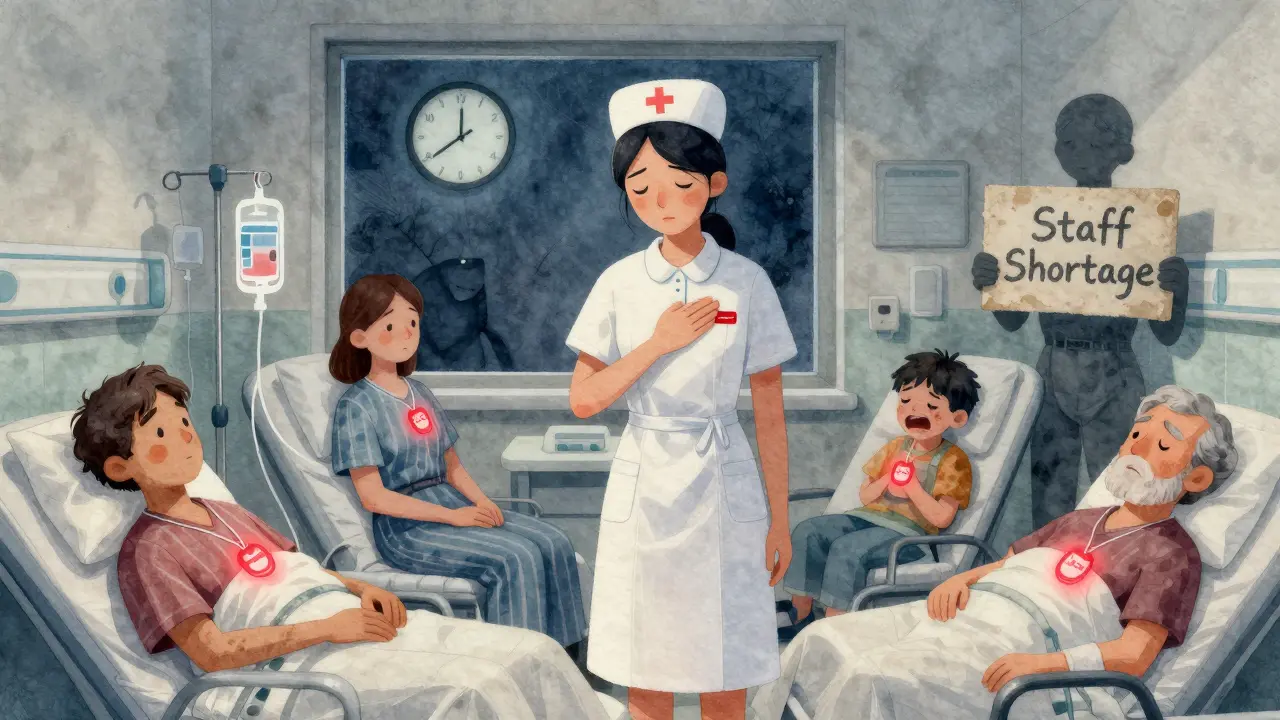
Every day, hospitals and clinics across the U.S. are making impossible choices because they don’t have enough staff. Patients wait hours in emergency rooms. Nurses juggle five or six patients at once. Medications get delayed. Surgeries get canceled. This isn’t a one-off problem-it’s the new normal, and it’s getting worse.
Why Staffing Shortages Are Worse Than Ever
The healthcare system has been bleeding workers for years, but the pandemic turned a slow leak into a flood. By 2025, more than 193,000 nursing jobs are going unfilled every year, and by 2030, the country could be short over half a million registered nurses. That’s not a guess-it’s a projection from the Health Resources and Services Administration, based on real data from hospitals, clinics, and nursing schools.Why is this happening? For starters, nearly half of all nurses are over 50. That means a huge chunk of the workforce is heading into retirement within the next decade. At the same time, nursing schools can’t train enough new nurses because they don’t have enough faculty. In 2024, 8.8% of nursing instructor positions were empty nationwide. That’s over 2,300 qualified applicants turned away last year just because there wasn’t a teacher to take them.
It’s not just nurses. Doctors are leaving too. The Association of American Medical Colleges predicts an 86,000-physician shortage by 2036. Behavioral health providers? Even worse. The Department of Health and Human Services says we’ll be short by thousands in every specialty-therapists, psychiatrists, counselors-all of them.
What Happens When There Aren’t Enough Staff
When hospitals are understaffed, it doesn’t just mean longer shifts for nurses. It means real, measurable harm to patients.Studies show that when a nurse is responsible for more than four patients, mortality rates jump by 7%. In emergency rooms, wait times stretch 22% longer when staffing is low. In rural areas, where shortages are 37% worse than in cities, patients sometimes wait three days just to get seen. One hospital in rural Nevada reported ER waits of up to 72 hours in early 2025.
Medication errors increase. Infections spread. Patients get discharged too early because there’s no one to monitor them. A nurse in Chicago told a Reddit thread in April 2025: “I had three ICU patients last night. One coded. I had to call for help, but the other nurse was already handling four others. We barely made it.” That’s not an outlier. It’s happening every shift, everywhere.
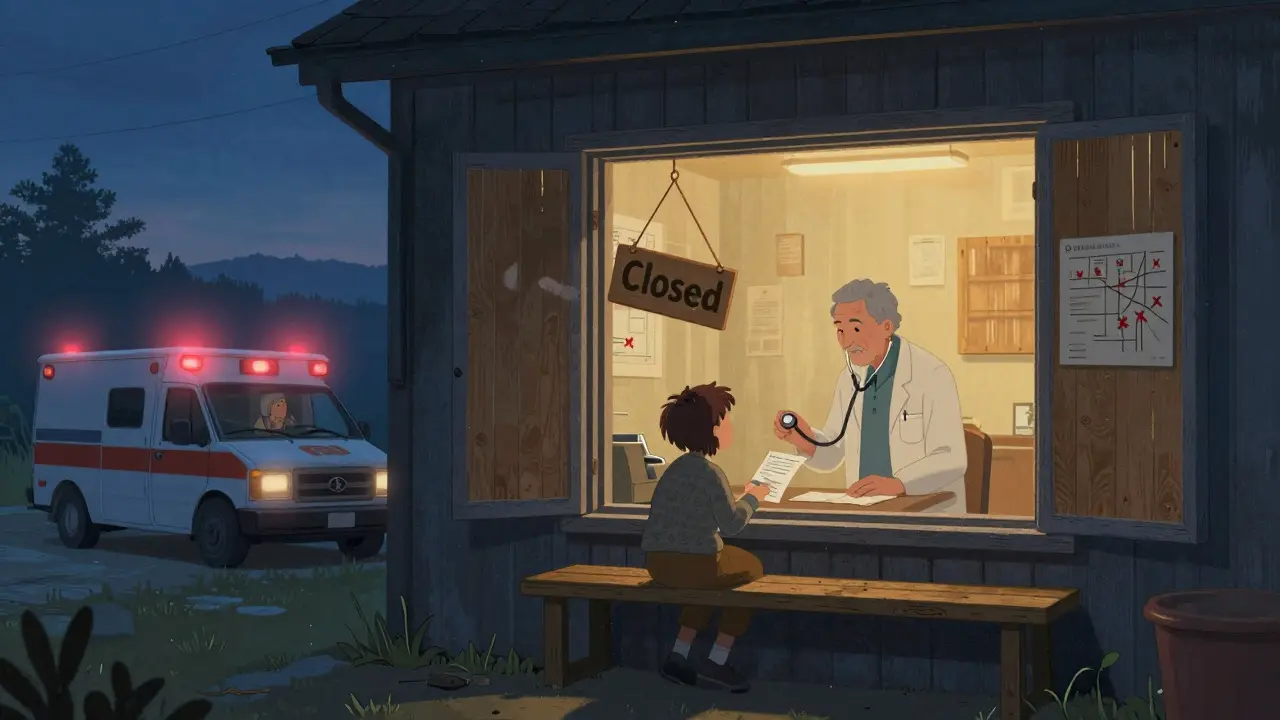
Even simple things get harder. Scheduling a follow-up appointment? Could take weeks. Getting a referral to a specialist? Months. And when clinics can’t hire enough staff, they cut hours-or close entirely. Over 100 rural clinics shut down between 2022 and 2024, according to the Rural Health Information Hub.
The Real Cost: Money, Morale, and Burnout
Hospitals are spending more than ever just to stay open. Travel nurses-temporary staff brought in from other states-are now earning up to $185 an hour in high-demand areas like New York and California. That’s nearly three times what permanent staff make. To fill gaps, hospitals are forced to pay for these high-cost workers, which drives up overall healthcare spending.And it’s not just financial. Staff morale is collapsing. In 2025, 63% of nurses said they’re thinking about quitting. Over 40% said unsafe patient ratios are their main reason. Hospitals are responding with mandatory overtime-68% now require it at least twice a week. Some have even created “code lavender” teams to help overwhelmed staff cope with emotional breakdowns.
It’s not just nurses. Administrators are drowning too. One hospital CEO in Ohio posted on LinkedIn that his facility had to close 12 inpatient beds every week due to lack of staff. That cost $4.2 million a month in lost revenue. He didn’t say it, but everyone knows: when you can’t staff beds, you can’t care for patients. You’re just keeping the lights on.
Who’s Getting Hit the Hardest
This crisis doesn’t affect everyone equally. Rural hospitals are operating at just 67% staffing levels. Urban outpatient clinics? Around 79%. That gap isn’t just about location-it’s about survival. Rural hospitals are more likely to shut down. Rural patients are more likely to die from treatable conditions because they can’t get timely care.Long-term care facilities are in even worse shape. They’re running with 28% fewer nurses than before the pandemic. That means seniors are going longer without help bathing, eating, or turning in bed. Pressure sores, falls, infections-all rise when staff are stretched too thin.
Behavioral health is the silent emergency. There are over 12,400 unfilled mental health provider positions right now. People in crisis can’t get help. Emergency rooms become de facto mental health clinics because there’s nowhere else to go. And they’re not equipped for it.
What’s Being Done-And Why It’s Not Enough
There are solutions being tried. Some states, like California and Massachusetts, have passed laws requiring minimum nurse-to-patient ratios. Massachusetts also offers loan forgiveness to nurses who work in underserved areas. That’s cut their shortage to 8% below the national average.Telehealth has helped in some places. Pilot programs show a 19% drop in ER visits when nurses can triage patients remotely. But setting it up costs $2.3 million per health system-and many clinics can’t afford it. Plus, 68% of hospitals say their electronic health records don’t talk to each other, making telehealth harder to use.
AI tools promise to help with documentation and scheduling. But it takes 8.7 weeks just to train staff to use them. And even then, they’re not magic. They don’t replace people. They just make some tasks a little easier.
The federal government pledged $500 million in April 2025 to expand nursing education. Sounds good-until you realize the American Association of Colleges of Nursing says we need $1.2 billion just to meet demand. That $500 million covers 18% of what’s needed.
What Comes Next
Without major, sustained investment, the shortage will keep growing. The global healthcare worker gap is expected to hit 15 million by 2027. In the U.S., nursing shortages could last until 2035.The good news? We know what works. Fund nursing schools. Pay nurses fairly. Support mental health for staff. Invest in technology that reduces burnout, not just paperwork. And stop treating this like a temporary crisis-it’s a structural collapse.
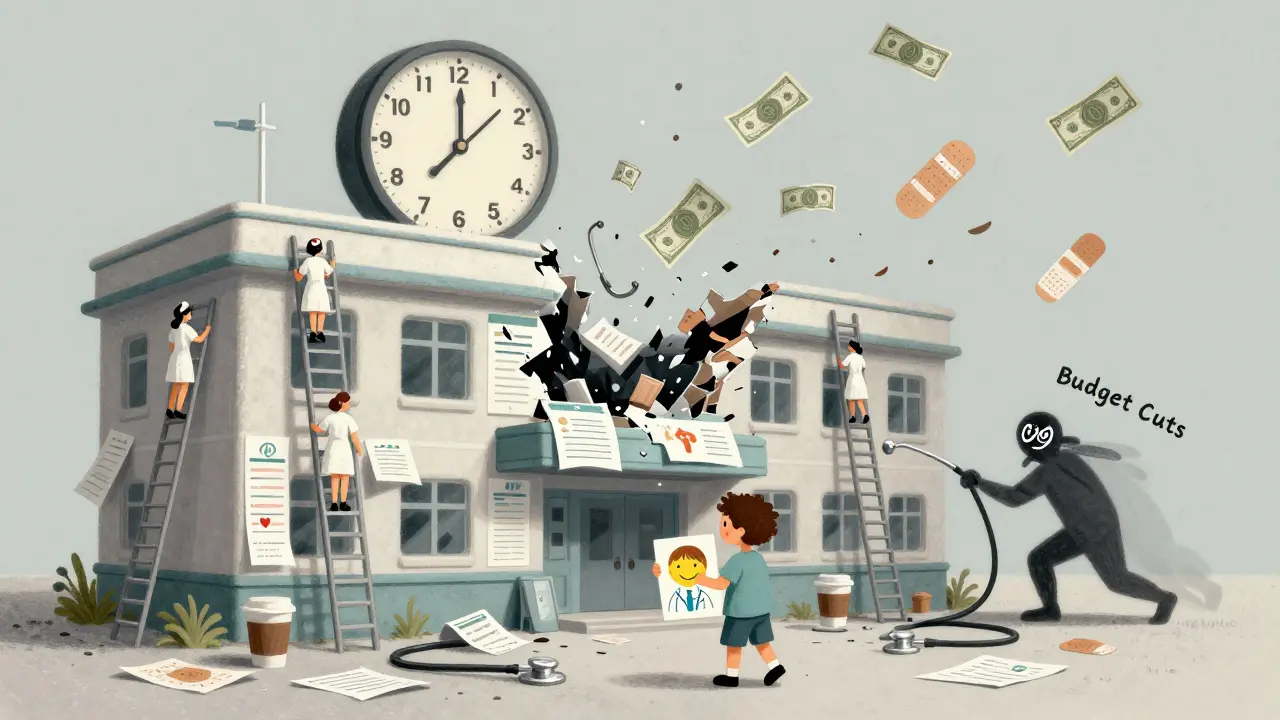
Right now, hospitals and clinics are patching holes with duct tape. But the walls are crumbling. Without real change, the cost won’t just be in dollars. It’ll be in lives.
Why are there so many nurse shortages right now?
The nurse shortage is caused by a mix of factors: a large portion of the current workforce is nearing retirement age (nearly 50% of nurses are over 50), nursing schools can’t train enough new nurses due to faculty shortages, and burnout from pandemic-era workloads has driven many out of the profession. At the same time, demand for care is rising as the population ages.
How do staffing shortages affect patient safety?
When nurses are assigned more than four patients, patient mortality rates increase by 7%. Longer wait times in emergency rooms, delayed medications, missed vital signs, and higher infection rates are all directly linked to understaffing. In extreme cases, patients have died because staff couldn’t respond in time.
Are rural hospitals hit harder than urban ones?
Yes. Rural hospitals have 37% higher staffing vacancies than urban ones. They also struggle to attract and retain staff due to lower pay, fewer resources, and isolation. Many rural clinics have shut down entirely, forcing patients to drive hours for basic care.
Can travel nurses solve the shortage?
Travel nurses fill gaps in the short term, but they’re not a long-term fix. They cost up to 34% more than permanent staff, and their high pay creates resentment among full-time employees. Many hospitals now rely on them for 12% of staffing-but that’s unsustainable and doesn’t address the root causes of the crisis.
What role does technology play in fixing this?
Technology like AI documentation tools and remote monitoring can reduce administrative burden and help stretch staff thinner. But they require training, upfront investment, and compatible systems. Right now, 68% of hospitals can’t make their tech work together. Tech helps-but it doesn’t replace people.
Is the government doing enough to fix this?
No. The federal government allocated $500 million for nursing education in 2025, but experts say $1.2 billion is needed just to meet current demand. State-level programs like loan forgiveness help, but they’re uneven and don’t scale. Without major, sustained funding and policy changes, the shortage will keep getting worse.
What can hospitals do right now to reduce burnout?
Hospitals that succeed in reducing burnout focus on three things: capping patient ratios, offering mental health support, and giving staff real control over their schedules. The Mayo Clinic’s Care Team Redesign program cut nurse turnover by 31% by redesigning workflows and giving nurses more autonomy-not just adding more staff.
How will this shortage affect me as a patient?
You’ll likely face longer waits for appointments, delayed treatments, and possibly reduced access to care, especially in rural areas. Elective procedures may be postponed. Emergency rooms may be overwhelmed. And if you need mental health care, the wait could be months. The system is strained-and that strain directly impacts the care you receive.
Monte Pareek
December 19, 2025 AT 07:36Look I've worked in three different ERs across three states and let me tell you this isn't new it's just louder now
Back in 2018 we were already doing 6:1 ratios and no one blinked
The difference now is social media and nurses posting their shifts
Before it was just us grinding in silence
Now the public sees it and freaks out
But here's the truth the system was already broken before the pandemic
The pandemic just ripped the Band-Aid off
We need more funding for nursing schools not more travel nurse contracts
And stop pretending AI will fix this
AI can't hold a dying patient's hand
AI can't calm down a family screaming because their mom isn't getting pain meds
It's people not algorithms
Stop outsourcing solutions to tech bros
Invest in the humans already doing the work
Connie Zehner
December 20, 2025 AT 05:07OMG I KNEW IT!!!
It's all the government's fault!!
They let illegal immigrants take all the nursing jobs!!
My cousin's neighbor's dog walker said she saw a nurse with a Mexican accent and she didn't even have a license!!
And don't get me started on the woke agenda forcing hospitals to hire trans nurses who can't even lift patients!!
IT'S ALL A CONSPIRACY!!!
anthony funes gomez
December 21, 2025 AT 11:48Consider the epistemological framework of healthcare labor
The commodification of care under late-stage capitalism
Has rendered the nurse not as a caregiver but as a node in a logistical network
Where human dignity is measured in bed turnover rates and cost per patient day
And yet we persist in treating this as a personnel shortage
When it is in fact a moral collapse
We have forgotten that healing requires presence
Not productivity metrics
Not KPIs
Not AI driven scheduling algorithms
But a human being who has the time to sit
And listen
And hold
And that is not something you can outsource
Or automate
Or legislate away
Sahil jassy
December 21, 2025 AT 21:24Been there man
India has same problem
Doctors leave for US Canada UK
People die waiting
But we still smile
And keep going
Not because we want to
But because no one else will
Kathryn Featherstone
December 21, 2025 AT 23:04I'm a nurse in rural Ohio
We lost our ER last year
Now people drive 90 minutes for a chest pain
I see them in the clinic with cyanosis
They say they waited because they didn't want to bother anyone
That breaks me
Not the overtime
Not the pay
But the silence
They think they're being polite
But we're not saving lives
We're just hoping they make it to the next town
Marsha Jentzsch
December 22, 2025 AT 05:23Everyone's blaming the system
But what about the nurses who just quit because they're lazy??
I mean seriously
My cousin's friend's cousin was a nurse
She quit because she didn't want to work weekends
And now the whole system is collapsing??
It's not about staffing
It's about ENTITLEMENT
People think they deserve a 9-5 with benefits and vacation
But this is healthcare
It's not a job
It's a calling
And if you don't have the calling
Then GET OUT
Kitt Eliz
December 22, 2025 AT 08:59Let's talk about systemic resilience
Not just staffing ratios
But community-based care models
Mobile health units
Peer support networks
Integrated behavioral health in primary care
We're still thinking in silos
When the solution is ecosystems
And guess what
It's cheaper
And more humane
And scalable
Stop throwing money at travel nurses
Invest in local infrastructure
Because the next pandemic isn't coming
It's already here
And we're still using 1980s solutions
Janelle Moore
December 23, 2025 AT 05:17Wait
Did you know that the WHO is secretly controlling hospital staffing through satellite drones??
They're using AI to manipulate nurse schedules
And the vaccines were just a cover
So they could make everyone sick and then charge them for care
And the nurses? They're all undercover agents
That's why they're so tired
They're not burned out
They're being mind controlled
By the global elite
Who want us to pay for our own deaths
Erica Vest
December 23, 2025 AT 07:46According to the American Journal of Nursing 2024 data
The national average nurse-to-patient ratio in med-surg units is 1:5.7
Which exceeds the 1:4 threshold linked to increased mortality
Additionally
HRSA reports a 19.3% vacancy rate in nursing faculty positions
Which directly correlates to a 27% decline in nursing school admissions
And the projected deficit of 193k nursing positions annually by 2025
Is not speculative
It is statistically modeled
With 95% confidence intervals
Based on demographic trends
And workforce attrition rates
From 2010 to 2024
Across 47 states
Kelly Mulder
December 24, 2025 AT 05:56One must consider the structural underpinnings of this crisis
Not merely its symptomatic manifestations
For to reduce this phenomenon to mere staffing deficits
Is to engage in a fundamental category error
The healthcare apparatus has been systematically dismantled
By neoliberal policy
And the commodification of human life
As such
The nurse is not a casualty
But a symptom
Of a system that values profit over presence
And efficiency over empathy
And thus
Any solution that does not address capital
Is merely rearranging deck chairs
On the Titanic
Mike Rengifo
December 24, 2025 AT 10:19My mom's a nurse
She works 12s
Hasn't taken a vacation in 3 years
Got a text from her last week
"I cried in the supply closet again"
She didn't say why
I didn't ask
She doesn't need me to fix it
Just to see her
Chris Davidson
December 26, 2025 AT 08:56People are emotional about this
But facts matter
Travel nurses cost more
So hospitals spend more
So insurance premiums rise
So patients pay more
So fewer people get care
It's not a moral issue
It's an economic one
And the market will fix it
Eventually
Kinnaird Lynsey
December 27, 2025 AT 07:44So we're all just supposed to sit here and cry about it
While the CEO gets a $12 million bonus
And the hospital board invests in a new helipad
Because why not
When you can't afford to pay your nurses
But you can afford a landing pad for billionaires
How about we start by firing the people who made this mess
And then rebuild
From the ground up
With actual humans in mind
Henry Marcus
December 28, 2025 AT 23:19They're lying
It's not a shortage
It's a cover-up
The real reason hospitals are understaffed
Is because they're using robots
But they don't want you to know
Because then you'd realize
That your mom's IV drip
Was administered by a machine
That doesn't feel
That doesn't care
That doesn't cry
And that's why she died
Not because of staff
Because of the machines
That the government approved
With the help of Big Pharma
Who own the patents
And the nurses
And the beds
And the truth
Chris porto
December 30, 2025 AT 11:07Maybe we're asking the wrong question
Instead of how do we fix staffing
What if we asked
How do we stop needing so much staffing
Like
What if prevention mattered more
What if nutrition
And housing
And mental health
Were part of the system
Not afterthoughts
What if we treated health
Like a right
Not a product
And stopped pretending
We can fix a broken system
With more overtime