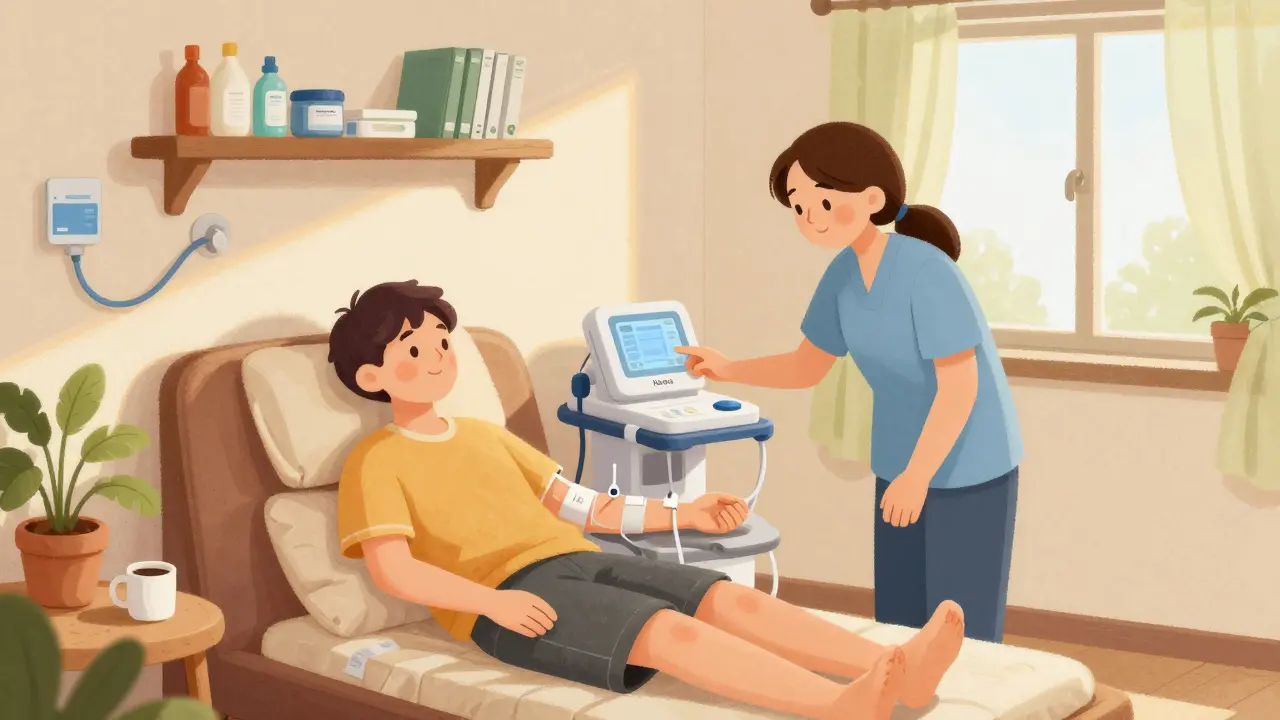
For people living with end-stage renal disease (ESRD), dialysis isn’t just a medical procedure-it’s a daily reality. While most assume dialysis means traveling to a clinic three times a week, a growing number are choosing to do it at home. Home hemodialysis (HHD) gives patients control over when, how long, and how often they treat themselves. But it’s not as simple as plugging in a machine. Success depends on training, schedule choice, and having the right support system. If you’re considering this option, here’s what actually matters.
What Home Hemodialysis Really Means
Home hemodialysis isn’t just dialysis moved from a clinic to your living room. It’s a full-time commitment that requires learning how to handle needles, monitor your fluids, troubleshoot alarms, and respond to emergencies-all without a nurse nearby. The machines used are either traditional units that sit on the floor or portable systems like the NxStage System One, which can fit in a suitcase. Either way, you need a dedicated space: at least 6 feet by 6 feet for storage, the machine, and supplies. You also need a dedicated water line, a drain, and a 20-amp electrical circuit. No shared outlets. No extension cords. Water quality matters too. Monthly cultures, reverse osmosis logs, and chlorine checks aren’t optional-they’re required by law.
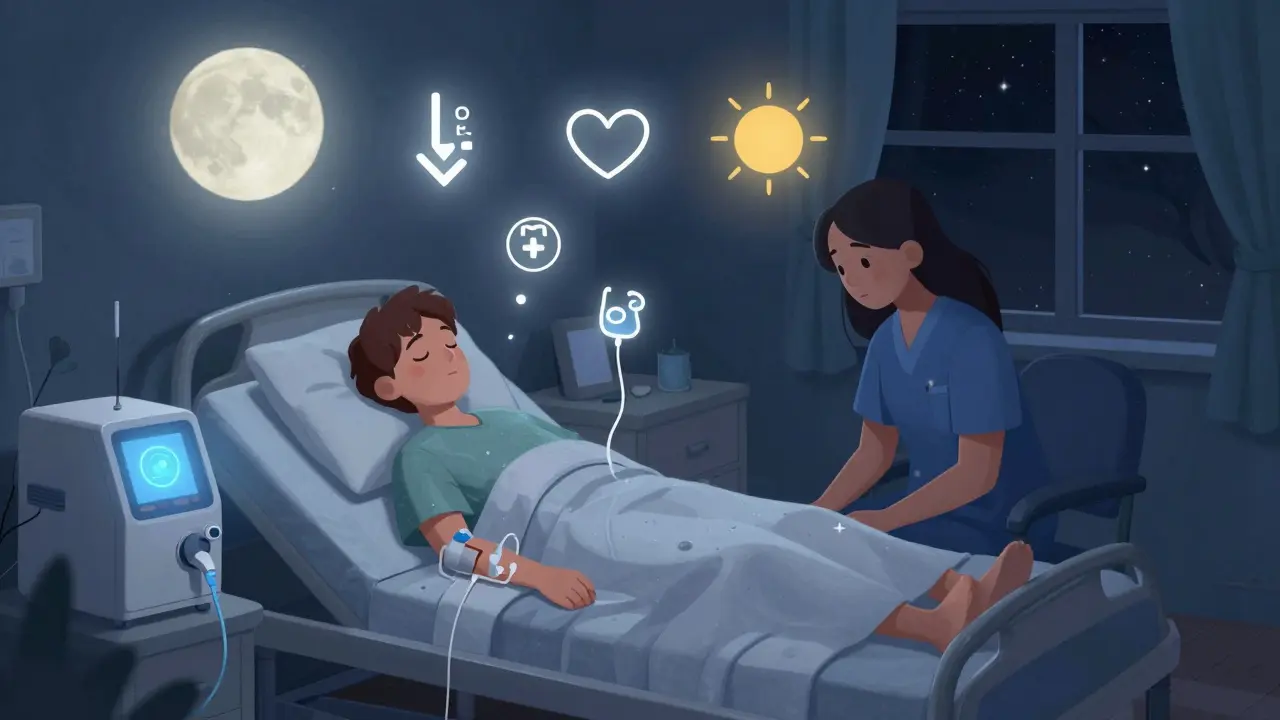
The biggest difference between home and center dialysis? Time. In-center treatments usually last 3-4 hours, three times a week. At home, you can do more frequent sessions. Short daily hemodialysis means 5-7 treatments per week, each lasting 2-3 hours. Nocturnal hemodialysis happens while you sleep-6 to 10 hours, 3-7 nights a week. These longer, more frequent sessions clear toxins more completely. Studies show patients on nocturnal HHD have 42% lower phosphate levels and need 3.2 fewer phosphate binder pills daily. That’s not a small change. It means fewer medications, less bone disease, and better heart health.
Training Isn’t Just a Course-It’s a Process
Training for home hemodialysis isn’t a one-week seminar. It’s a multi-week journey that varies widely. Some programs finish in 3 weeks. Others take 12. The average? Around 4-6 weeks. Why the range? Because it’s not about clocking hours-it’s about proving competence. You’ll need to pass written tests and live demonstrations under staff supervision. You’ll learn how to set up the machine, prime the lines, insert needles into your fistula, and recognize warning signs like low blood pressure or air in the lines.
One of the hardest skills? Self-needling. About 45% of trainees struggle with it. That’s why some centers now use virtual reality simulators. The University of Washington Medical Center, for example, cut training time to 3-4 weeks by letting patients practice needle insertion on a VR model before touching their own body. Their success rate jumped from 78% to 92%. That’s the kind of innovation making a real difference.
Training includes more than just the machine. You’ll learn how to store supplies, order new ones, track your weight and blood pressure, and document every session. You’ll also get a crash course in diet-how to manage sodium, potassium, and fluids when you’re dialyzing more often. Missing a session isn’t just inconvenient. It can lead to fluid overload, high blood pressure, or even heart strain.

Who Can Do It? The Care Partner Rule
You can’t do home hemodialysis alone. Not unless you’re one of the rare exceptions. The Maryland Department of Health and nearly every major provider require a trained care partner to be present during every session. That means your spouse, adult child, or live-in friend must go through the same training. They learn how to handle emergencies, reset alarms, and even perform needle insertion if you’re unable to. This isn’t a suggestion-it’s a safety rule built into the system.
But here’s the hard truth: about 30% of potential candidates don’t have a suitable partner. That’s a huge barrier. People who live alone, have no family nearby, or whose partners can’t commit to the schedule often get pushed back toward in-center dialysis. Some newer machines claim to allow solo treatment, but they’re still limited. The NxStage System One, for example, requires extra devices and training for solo use. Even then, most nephrologists won’t approve it without a strong backup plan.
Dr. Steven Weisbord from the University of Pittsburgh says the biggest predictor of success isn’t technical skill-it’s psychological readiness and social support. If you’re not emotionally prepared to manage this on your own, or if your partner resents the responsibility, the risk of burnout or error goes up sharply.
Schedules That Work-And Why They Matter
Not all home hemodialysis schedules are created equal. The three main types have very different effects on your body.
- Conventional home HD: 3 sessions per week, 3-4 hours each. This is the closest to in-center dialysis. It’s easier to start with but doesn’t offer the same health benefits.
- Short daily HD: 5-7 sessions per week, 2-3 hours each. This is where real improvements happen. A 2021 study in the Clinical Journal of the American Society of Nephrology found patients on this schedule had a 28% lower risk of death compared to in-center patients-even after adjusting for age and other illnesses.
- Nocturnal HD: 3-7 nights per week, 6-10 hours per session. This is the gold standard for clearance. Because it’s slow and gentle, your body handles it better. Phosphate, urea, and other toxins are removed more completely. Blood pressure stabilizes. Heart strain drops. Patients often report feeling more energetic and sleeping better.
One patient, a 58-year-old man from Ohio, switched from in-center to nocturnal HHD after his doctor suggested it. Within three months, he stopped taking three blood pressure medications. His phosphate levels dropped from 6.8 to 3.9. He started hiking again. He didn’t have to take time off work. That’s not magic. It’s science.
Outcomes: Better Survival, Better Life
The data doesn’t lie. Home hemodialysis patients live longer. The U.S. Renal Data System found a 15-20% lower mortality rate for home HD patients compared to those in clinics. The advantage is strongest for those doing frequent or nocturnal treatments. Quality of life is higher too. A 2019 review in the American Journal of Kidney Diseases showed home patients scored 37% higher on quality-of-life surveys. Why? Less travel. Fewer clinic-related stressors. More control over meals and sleep.
But it’s not all smooth sailing. Reddit users on r/kidney reported that 67% of home dialysis patients deal with constant machine alarms. 58% struggle with supply management-running out of tubing, cleaning solutions, or dialysate. 52% say their relationship with their care partner has gotten strained. One woman wrote: “I love that I don’t have to leave the house. But I hate that I can’t go out alone anymore. Every weekend feels like a chore.”
On the flip side, 92% of patients on DaVita’s patient portal say schedule flexibility is the biggest win. 85% report feeling more energetic. Many say they can finally eat what they want without guilt. One man in Texas said he started cooking again-grilled salmon, fresh vegetables, even a little wine. He didn’t think he’d ever enjoy food again.
Barriers and the Road Ahead
Despite the benefits, home hemodialysis remains rare. Only 12% of U.S. dialysis facilities offer training programs. That’s down from 18% in 2016. Why? Two big reasons: cost and staffing. Medicare pays for up to 25 training sessions for home HD, but that still doesn’t cover the time nurses spend coaching, documenting, and following up. A 2022 survey found 71% of nephrologists say lack of training capacity is the main barrier. Another 63% say reimbursement doesn’t match the workload.
But things are changing. The 2025 Medicare changes will tie payments to patient outcomes-not location. That means clinics will get paid more if their home dialysis patients stay healthy. That’s a game-changer. New devices like the WavelinQ endoAVF system (approved in May 2022) are making access easier. Portable machines are getting smarter. Training is becoming more efficient.
If you’re considering home hemodialysis, ask your nephrologist: “Do you have a structured, competency-based training program?” Not just “Can I do it at home?”-but “How will you make sure I’m truly ready?” Centers that focus on skill mastery over time have 30% fewer complications in the first year.
Home hemodialysis isn’t for everyone. But for those who are ready, it’s not just an alternative. It’s a better way to live.
Can I do home hemodialysis without a care partner?
Technically, yes-but only in rare cases with special equipment and approval from your doctor. Most programs require a trained partner to be present during every treatment. Solo dialysis is considered high-risk and is typically only approved for patients with no other options, strong technical skills, and a backup emergency plan. Even then, it’s not common.
How long does home hemodialysis training usually take?
Training typically lasts 4 to 6 weeks, but it can range from 3 to 12 weeks depending on the program and your progress. Some centers use virtual reality simulators to speed up learning, especially for needle insertion. The key isn’t time-it’s competence. You must pass written and hands-on tests before you’re allowed to dialyze at home.
Is home hemodialysis safer than in-center dialysis?
When done correctly, yes. Studies show home hemodialysis patients have a 15-20% lower risk of death compared to those in clinics. Frequent or nocturnal schedules improve blood pressure control, reduce heart strain, and lower phosphate levels. But safety depends on training, equipment, and having a reliable care partner. Poorly managed home dialysis can be riskier than center care.
What space and equipment do I need at home?
You’ll need about 6 feet by 6 feet of clear space for the machine, supplies, and storage. You’ll also need a dedicated 20-amp electrical circuit, a water line with 40-80 psi pressure, and a dedicated drain. Water must be filtered through a reverse osmosis system, and you’ll need to log monthly water and dialysate cultures. The machine itself is either a standard unit or a portable one like the NxStage System One.
Does Medicare cover home hemodialysis training?
Yes. Medicare covers up to 25 training sessions for home hemodialysis, which is more than the 15 sessions covered for peritoneal dialysis. Training includes instruction on machine use, needle insertion, emergency response, and supply management. These sessions are typically held 3-5 hours per week, over several weeks, under the supervision of a trained dialysis staff member.
Jinesh Jain
March 16, 2026 AT 05:25Interesting read. I'm from India and we don't have much access to home dialysis here, but the stats on phosphate levels and heart health are hard to ignore. Makes you wonder why this isn't more widely pushed.
Sabrina Sanches
March 16, 2026 AT 12:50My mom did home HD for 3 years. She went from barely walking to hiking weekends. No more clinic trips. No more feeling like a patient. Just life. 💪
Kathy Leslie
March 16, 2026 AT 23:29I know someone who tried it and quit after two months. Said the alarms drove her crazy. One false alarm at 3 a.m. and she was done. It’s not just physical-it’s mental too.
Kandace Bennett
March 18, 2026 AT 15:18OMG YES!! 🙌 Home dialysis is the future, period. Why are we still stuck in the 1980s with clinic visits? People think it's 'hard'-but it's just different. Once you get used to it, you wonder how you ever lived without control over your own body. 🏡💉 #DialysisRevolution
Tim Schulz
March 19, 2026 AT 10:41Oh wow, so now we're supposed to believe that a 6x6 foot space and a reverse osmosis system is 'simple'? 🤡 I mean, if you've got the luxury of a dedicated electrical circuit and a spouse trained like a paramedic-sure. For the rest of us? It's a full-time job with a side of existential dread. And don't even get me started on the 'care partner' rule. That's not safety. That's emotional hostage-taking.
rakesh sabharwal
March 19, 2026 AT 22:09The data is statistically significant, yes-but it's also cherry-picked. Where are the longitudinal studies on caregiver burnout? The 52% strained relationships? The 67% with constant alarms? This reads like a pharmaceutical whitepaper. Real outcomes aren't measured in phosphate levels-they're measured in tears at 2 a.m. when the machine beeps and you're too tired to fix it.
Dylan Patrick
March 20, 2026 AT 22:22My dad did nocturnal HD for 5 years. He slept. He ate. He didn't die. That's the whole point. You think this is complicated? Try living with fluid overload every other day. This isn't a lifestyle upgrade-it's survival. And yeah, the alarms suck. But so does being dead.
Amisha Patel
March 21, 2026 AT 17:55I'm curious-how many people actually complete training? I've heard stories of people starting, then backing out because they couldn't handle the needle part. Is there data on dropout rates?
douglas martinez
March 22, 2026 AT 21:39Thank you for this thorough and well-researched overview. The emphasis on competency over time is critical. Training should not be a checkbox-it's a clinical competency. I've seen too many patients discharged too early, and the consequences are severe. Consistency, documentation, and supervision are non-negotiable.
Alex MC
March 23, 2026 AT 05:38My wife and I trained together. She did the needle insertion. I handled the logs and the water cultures. We made it work. It wasn’t perfect. But we got to sleep through the night, eat dinner without fear, and take the dog for walks. That’s worth every alarm.
Aaron Leib
March 23, 2026 AT 13:35One thing no one talks about: the quiet dignity of doing this yourself. Not because you’re brave. But because you have to. There’s no applause. No medals. Just a quiet room, a machine, and the choice to keep living. That’s worth more than any statistic.
Ali Hughey
March 24, 2026 AT 00:47Let me guess-this was sponsored by NxStage. 🤔 Reverse osmosis logs? Mandatory water cultures? 20-amp circuits? This is all part of a larger plan to make dialysis patients dependent on proprietary equipment. And don’t tell me about ‘improvements’-the real goal is to lock people into multi-year contracts with corporate providers. Who owns the data from your home machine? Who’s watching your vitals? Who’s selling it? 👁️
Shruti Chaturvedi
March 24, 2026 AT 16:46My cousin in Delhi asked me about this. We don't have home HD here. But if we did, I'd help. No one should feel trapped in a clinic. You don't need a fancy machine. You need someone who cares. That's all.