
Every year, millions of people take prescription drugs. Most benefit without issue. But for some, something goes wrong-a rare side effect, an unexpected reaction, or a dangerous interaction. The FDA doesn’t wait for these problems to become headlines. Instead, it collects every report it can get, from doctors, patients, and drug makers, into one massive database: the FAERS system. This isn’t secret data. It’s public. And if you know how to use it, you can spot safety signals others miss.
What Is FAERS and Why Does It Matter?
FAERS stands for the FDA Adverse Event Reporting System. It’s the main database the U.S. Food and Drug Administration uses to track side effects and safety issues with drugs and biologics after they’re on the market. Think of it as a national early-warning system. Clinical trials involve thousands of people. FAERS tracks millions. That’s the difference between knowing what *might* happen and seeing what *actually* happens in real life. The system has been running since 1969. As of late 2023, it holds around 30 million reports. About 2 million new ones are added each year. Most come from pharmaceutical companies-75%-because they’re legally required to report. The rest come from healthcare providers and patients through the MedWatch program. But here’s the catch: FAERS doesn’t prove a drug caused a problem. It just records that someone reported a problem after taking a drug. That’s why the FDA always says: “FAERS data alone can’t determine if a drug is unsafe.” It’s a starting point, not a verdict.How to Access FAERS: Three Ways to Get the Data
You don’t need special clearance to look at FAERS. The FDA makes it publicly available in three main ways:- FAERS Public Dashboard - The easiest way for beginners. This is a web tool with filters for drugs, symptoms, age, gender, and time. No coding needed. You can see how many reports exist for a drug like metformin and a side effect like pancreatitis, and whether reports are going up or down over time.
- Quarterly Data Extracts - These are raw files in ASCII or XML format. Each file is 1-5 GB. You need software like R, Python, or Excel with plugins to open them. These are for researchers who want to run their own analyses.
- OpenFDA API - For developers. This gives you JSON-formatted data you can pull directly into apps or scripts. You can build tools that monitor drug safety trends automatically.
The Public Dashboard is perfect if you’re a student, patient advocate, or curious clinician. The raw data? That’s for people who know how to clean, filter, and interpret messy datasets.
The FAERS Public Dashboard: Your First Stop
The dashboard is free, easy to use, and updated every quarter. Go to the FDA’s website, find the FAERS Public Dashboard, and you’ll see filters for:- Drug name (search by brand or generic)
- Adverse event (using MedDRA terminology-more on that below)
- Patient age and gender
- Reporter type (doctor, patient, lawyer, etc.)
- Time period (last 3 months, year, or custom range)
Try searching for “lisinopril” and “cough.” You’ll see hundreds of reports. That’s normal. Cough is a known side effect. Now search for “lisinopril” and “angioedema.” Fewer reports-but more serious. That’s the kind of signal that might prompt the FDA to update a drug label.
One user on Reddit said: “I used the dashboard to check if my antidepressant was linked to weight gain. I found 1,200 reports in two years. That’s not rare. I showed it to my doctor.” That’s exactly how it’s meant to be used.
Understanding MedDRA: The Language of Side Effects
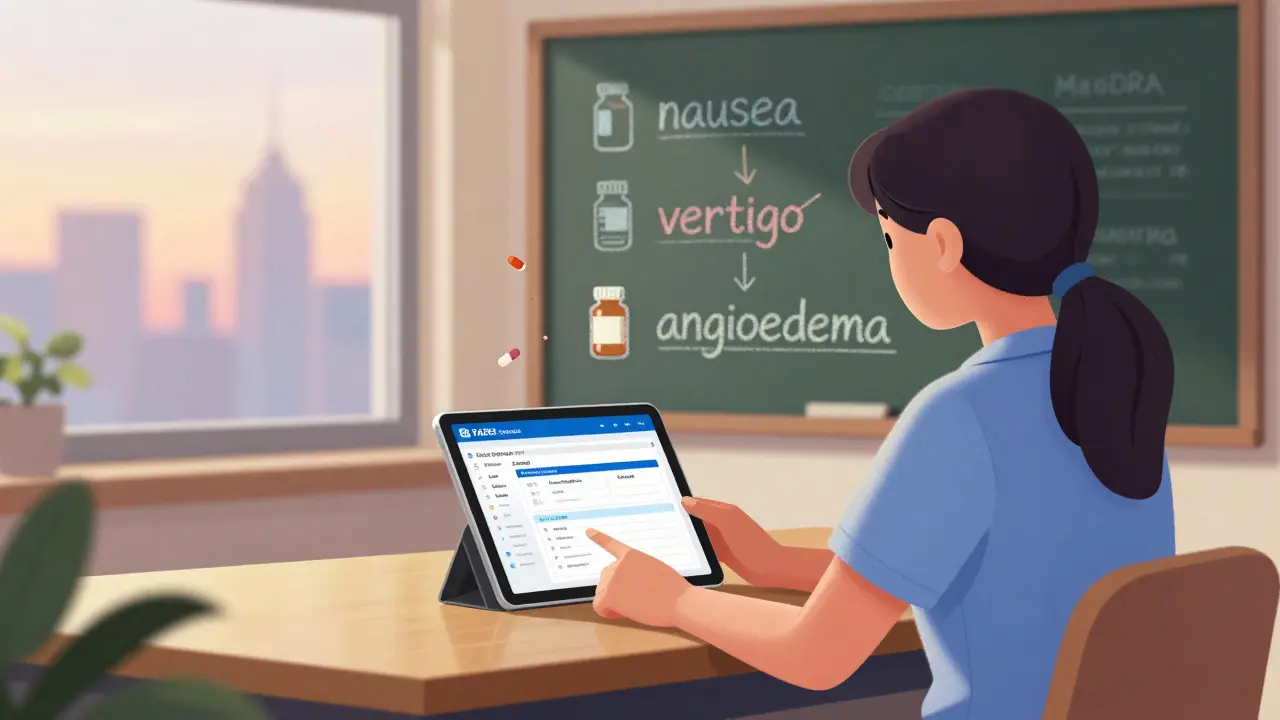
The data isn’t in plain English. It’s coded using MedDRA (Medical Dictionary for Regulatory Activities). This is a standardized system with over 30,000 terms. “Nausea” is one term. “Nausea with vomiting” is another. “Feeling sick to stomach” isn’t in the system-it’s mapped to “nausea.”That’s why beginners get stuck. You might search for “dizziness” but miss reports coded as “lightheadedness” or “vertigo.” The dashboard helps by suggesting related terms, but learning MedDRA takes time. Experts say it takes 40-60 hours to get comfortable with it.
Pro tip: Always check the hierarchy. If you search for “heart attack,” the system will also include related terms like “myocardial infarction” and “acute coronary syndrome.” But if you search for “chest pain,” you might miss serious cardiac events coded under “cardiac arrest.”
Limitations You Can’t Ignore
FAERS is powerful-but flawed. Here’s what you need to know before drawing conclusions:- No denominator - You don’t know how many people took the drug. If 1 million people take Drug A and 50 report nausea, that’s 0.005%. If 10,000 take Drug B and 50 report nausea, that’s 0.5%. FAERS doesn’t tell you that.
- Reporting bias - Serious events get reported more. Patients report side effects from drugs they take themselves. Doctors report hospitalizations. So rare, mild side effects are underreported.
- Incomplete data - About 30% of reports have missing info: no age, no dose, no outcome. Some reports are just one sentence: “Patient felt weird.”
- Not causation - Just because a report says someone took Drug X and then had a stroke doesn’t mean Drug X caused it. Maybe they had high blood pressure. Maybe they were smoking. FAERS doesn’t know.
Dr. David Graham of the FDA put it plainly: “The database is great for finding rare signals, but terrible for proving risk.”
Who Uses FAERS-and How?
The biggest users aren’t patients. They’re:- Academic researchers - 55% of users. They use FAERS to publish studies on drug safety, often comparing multiple drugs or identifying new risks.
- Pharmaceutical companies - 30%. They use FAERS to meet regulatory requirements and monitor their own products. Most use commercial tools that pull FAERS data in, not the public dashboard.
- Patient advocacy groups - 15%. They’ve used FAERS to find hidden risks. One group discovered a link between a common diabetes drug and a rare skin condition affecting 1 in 10,000 users. They shared it with the FDA. The label was updated.
Some universities now teach FAERS use in public health courses. One Johns Hopkins researcher said: “The dashboard lets students see real-world drug safety data for the first time. It’s eye-opening.”
What’s Changing in 2025?
The FDA is making FAERS better. Since January 2024, all drug companies must submit reports using the ICH E2B(R3) standard. That means more detailed data: exact dosages, treatment durations, lab results. By late 2024, the FDA plans to launch a new API that lets developers query the dashboard’s analysis tools directly. In Q3 2025, they’ll add natural language processing so you can type “I got a rash after taking this pill” and the system will map it to the right MedDRA term. The Sentinel Initiative-a federal program-is also linking FAERS with Medicare and private insurance claims data. That could finally solve the denominator problem. Imagine knowing not just how many people reported a side effect, but how many were taking the drug.
How to Get Started (Step by Step)
If you’re new to FAERS, here’s how to begin:- Go to the FAERS Public Dashboard.
- Search for a drug you’re interested in (e.g., “metformin”).
- Filter by adverse event. Start with common ones: nausea, dizziness, fatigue.
- Look at the trend line. Are reports increasing? That’s a red flag.
- Click on a term to see the breakdown by age, gender, and reporter type.
- Compare it to another drug in the same class. Is the side effect more common with one?
- Download the quarterly data if you want to dig deeper (requires basic data skills).
Don’t try to analyze everything at once. Start with one drug. One side effect. One question. That’s how real discoveries happen.
When FAERS Isn’t Enough
FAERS is the best public tool we have-but it’s not perfect. For serious research, you’ll need more:- Electronic health records (EHRs)
- Insurance claims databases
- Pharmacist-reported data
- Global databases like VigiBase (WHO)
Commercial platforms like Oracle Argus or IBM Watson Health combine FAERS with these sources. But they cost $50,000 to $200,000 a year. That’s why FAERS remains vital-it’s free, open, and accessible to anyone with an internet connection.
For most people-students, journalists, patient advocates, even doctors-the Public Dashboard is enough to start asking better questions. And that’s the point.
Common Mistakes to Avoid
People make the same errors over and over:- Assuming correlation = causation - Just because a drug and side effect appear together doesn’t mean one caused the other.
- Ignoring underreporting - If only 10% of side effects get reported, you’re seeing a fraction of the truth.
- Using outdated data - Always check the release date. FAERS updates quarterly. Don’t use data older than 6 months for current analysis.
- Not checking MedDRA codes - Use the FDA’s MedDRA browser to find the exact term you need.
- Overinterpreting small numbers - 5 reports of a rare event might sound alarming. But if 5 million people took the drug, that’s negligible.
When in doubt, ask: “What’s the denominator?” If you can’t answer that, you’re not seeing the full picture.
Mussin Machhour
December 26, 2025 AT 08:49Man, I just used the FAERS dashboard last week to check on my blood pressure med. Found like 800 reports of coughing-turns out it’s super common with ACE inhibitors. Showed it to my doc and we switched me. Best 10 minutes I’ve spent on the internet this year.
sagar patel
December 27, 2025 AT 15:01FAERS is useless without denominator data. You’re just playing with shadows. Real safety analysis requires cohort studies or claims databases. This is anecdotal noise dressed up as science.
Oluwatosin Ayodele
December 28, 2025 AT 06:41You think FAERS is the only game in town? In Nigeria we don’t even have that. Our drug safety reporting is handwritten forms in clinic drawers. Half the time the patient can’t even spell their own name. The FDA’s system is a luxury. And you’re complaining about MedDRA? Get a grip. At least it’s structured.
Winni Victor
December 30, 2025 AT 01:15Oh wow so the government lets us peek into the dark corners of Big Pharma’s secret death logs? How noble. Next they’ll tell us the moon landing was real. I’ve seen the redacted pages. The real numbers are 10x higher. And they scrub anything with ‘suicide’ or ‘sudden cardiac death’ in the narrative. Don’t be fooled by the pretty charts.
Linda B.
December 30, 2025 AT 19:36Of course they want you to use the dashboard. It’s a distraction. The real signals are buried in the quarterly extracts-and only insiders get the full cleaned datasets. The public version? It’s curated like a museum exhibit. They show you the harmless butterflies and hide the venomous spiders.
Christopher King
December 31, 2025 AT 14:10They’re not just hiding data-they’re engineering perception. FAERS is a psychological tool. It makes you feel empowered while keeping you from the real truth: the system is designed to protect corporations, not patients. That’s why they push the dashboard-it’s a placebo for accountability. The moment you start asking why certain drugs get flagged and others don’t? That’s when they silence you. Watch for the pattern: any drug with a generic version gets buried under noise. Any branded drug? They flood the system with ‘benign’ reports. It’s not a database. It’s a propaganda engine.
Bailey Adkison
January 1, 2026 AT 12:36Stop romanticizing this. FAERS is garbage. People report ‘headache’ after taking aspirin because they had a hangover. Doctors report ‘fatigue’ when the patient was just depressed. You think you’re uncovering truth? You’re just aggregating human error and confirmation bias. And don’t get me started on patients who blame every ache on their meds. This isn’t science. It’s crowd-sourced hysteria.
Michael Dillon
January 2, 2026 AT 20:38Yeah but you’re all missing the point. FAERS isn’t about proving causation-it’s about spotting patterns. That’s why it’s gold for researchers. You don’t need to know the denominator to see that 500 people reported a rare skin rash after taking Drug X and only 3 reported it after Drug Y. That’s a signal. You don’t need a PhD to get that. Just curiosity. And a willingness to look past the noise.
Lindsay Hensel
January 4, 2026 AT 04:50As someone who works in global health policy, I appreciate the transparency of FAERS. While imperfect, it represents a monumental step toward patient-centered safety. The fact that a single mother in rural Kansas can access the same data as a Johns Hopkins researcher is profoundly democratic. We must protect and expand this access-not diminish it with cynicism.
Katherine Blumhardt
January 5, 2026 AT 13:00i used faers to check my anxiety med and found 1200 reports of weight gain but then i realized like 30% of them had no age or dose so like... what even is the point?? also i think the system hates me because it kept auto-correcting my search to 'metformin' even though i typed 'sertraline' like 5 times??
Sophie Stallkind
January 7, 2026 AT 01:25The integrity of pharmacovigilance hinges upon the fidelity of reporting systems. FAERS, despite its limitations, remains the most comprehensive public repository of post-marketing adverse event data available to the global community. Its utility lies not in definitive causal inference, but in hypothesis generation for further investigation. To dismiss it is to reject the foundational principle of evidence-based medicine: that observation precedes understanding.
Justin James
January 7, 2026 AT 02:21You think this is just about drugs? Think bigger. FAERS is a front. The real data is being fed into AI models that predict which patients are ‘high-risk’ for lawsuits or insurance denials. Every report you submit gets tagged with a risk score. That’s why they encourage patients to use the dashboard-it’s a trap. They’re harvesting your personal health data to build predictive profiles for insurers and employers. And the MedDRA codes? They’re not for safety. They’re for classification. Once you’re coded as ‘psychiatric adverse event’ or ‘non-compliant patient,’ your future medical access gets restricted. This isn’t transparency. It’s social engineering. The FDA doesn’t want you to find dangerous drugs-they want you to find dangerous people.