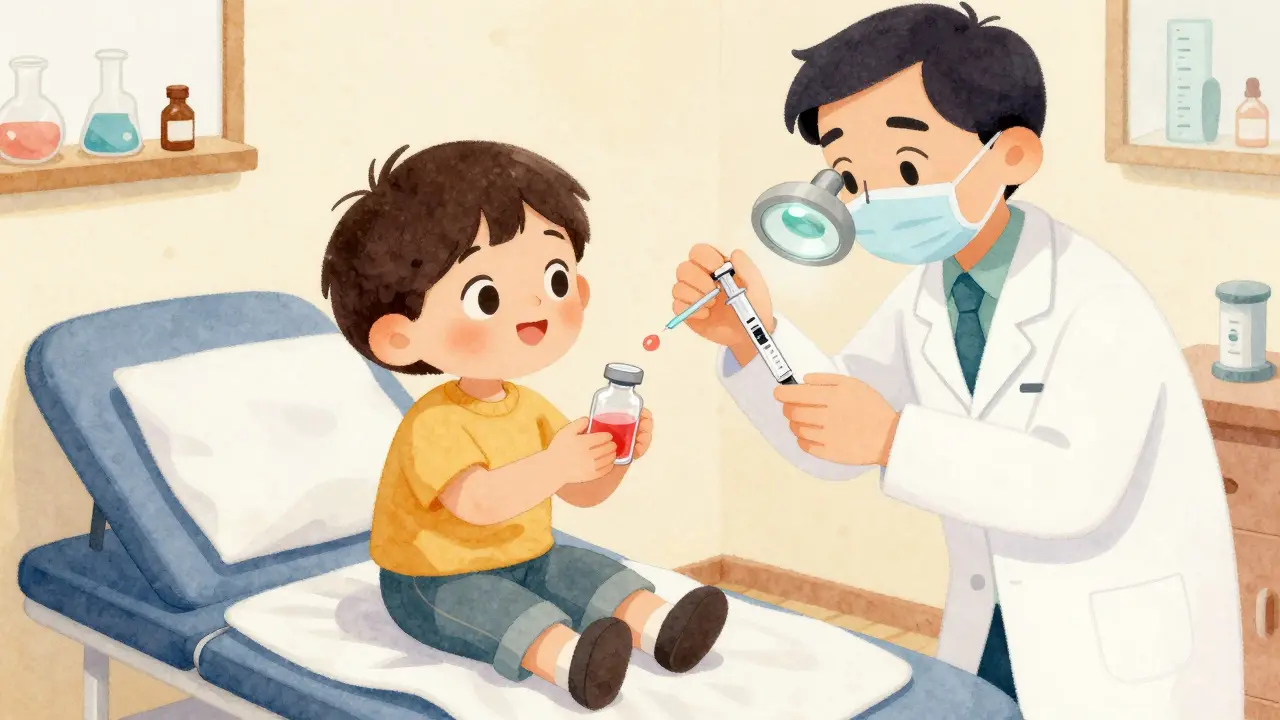
When a child can’t swallow a pill, or a commercial medicine contains ingredients they’re allergic to, compounded medications can be a lifeline. But they’re not magic. They’re custom-made drugs, mixed by pharmacists to fit a child’s exact needs - whether that’s a sugar-free liquid for a diabetic kid, a dye-free version for a sensitive toddler, or a tiny dose of a powerful drug like morphine for a premature baby. The problem? These medications aren’t tested or approved by the FDA. That means no guarantee they’re safe, strong enough, or even clean. And when it comes to kids, mistakes can be deadly.
Why Compounded Medications Are Used for Children
Kids aren’t small adults. Their bodies process medicine differently. Many commercial drugs come in forms that just don’t work for them. A 5-year-old can’t swallow a 100mg tablet. A newborn in the NICU can’t handle preservatives like benzyl alcohol. Some kids gag at the taste of bitter medicine. That’s where compounding comes in. Pharmacists can turn a tablet into a flavored liquid, remove allergens, dilute a high-strength adult dose into a safe pediatric amount, or even make an injectable without harmful additives. These aren’t just conveniences - they’re medical necessities for children with rare conditions, allergies, or complex treatment plans. But here’s the catch: this flexibility comes with risk. Unlike factory-made drugs, compounded ones aren’t checked for purity, strength, or consistency. One batch might be perfect. The next might be too weak, too strong, or contaminated. And in children - especially newborns - even a 10% error in dose can cause serious harm.The Hidden Dangers: Why Compounding Is Risky for Kids
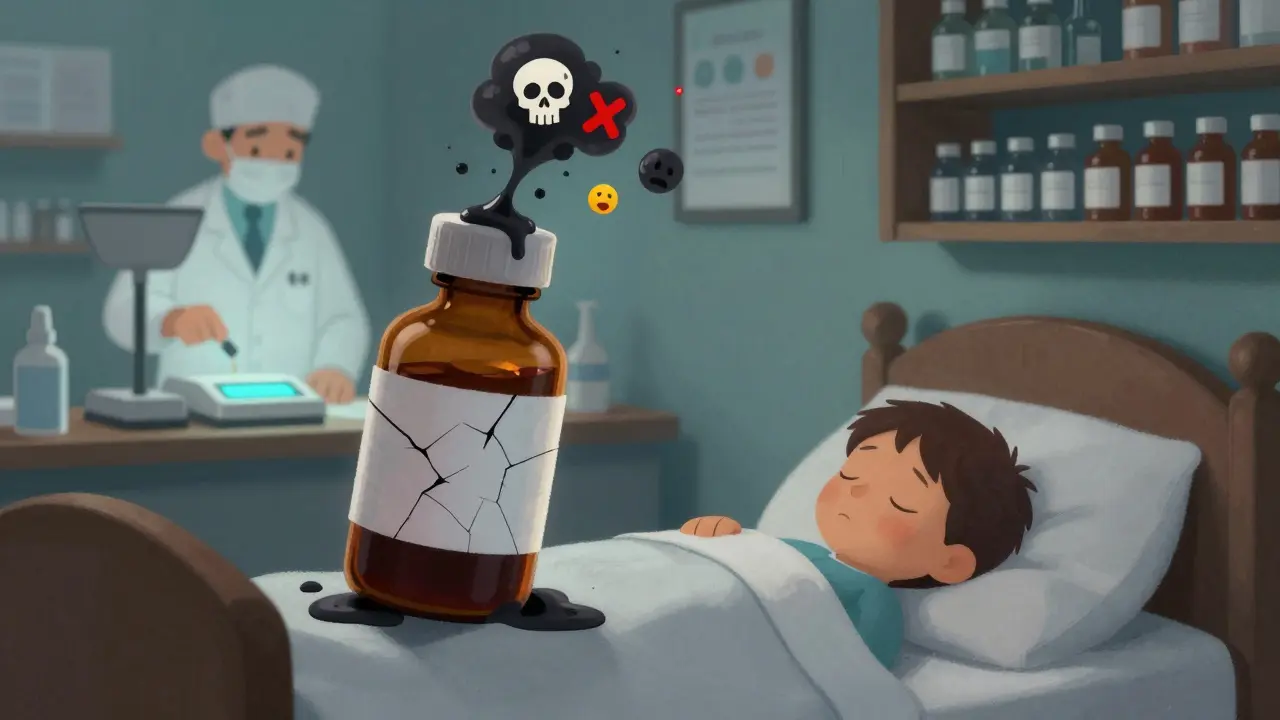
In 2006, a two-year-old named Emily Jerry died after receiving a compounded chemotherapy drug that was 10 times too strong. The error wasn’t due to a doctor’s mistake. It was a pharmacist’s miscalculation. That tragedy led to the creation of the Emily Jerry Foundation, which has spent years pushing for safer compounding practices - especially for kids. Today, the risks haven’t gone away. The Institute for Safe Medication Practices found that between 14% and 31% of pediatric medication errors involve compounded drugs. Most of these are dosing mistakes. Why? Because compounded medications often come in unusual concentrations. A liquid might be labeled as “5 mg/mL” - but if the pharmacist meant “5 mg/5 mL” and didn’t clarify, a parent might give five times the dose. Another big issue: contamination. In 2012, a fungal outbreak from tainted compounded spinal injections killed 64 people and sickened nearly 800. While that wasn’t pediatric-specific, it exposed how easily contamination can happen in compounding labs without strict controls. And now, newer drugs like semaglutide and tirzepatide - originally meant for adults with diabetes or obesity - are being compounded for children. The FDA has logged over 900 adverse events tied to these compounded versions, including 17 deaths. Kids are getting sick from nausea, vomiting, pancreatitis, and dangerously low blood sugar because the doses weren’t properly calculated or tested.How to Know If a Compounded Pharmacy Is Safe
Not all compounding pharmacies are the same. Some follow strict standards. Others cut corners. You need to know which is which. First, check accreditation. Look for the Pharmacy Compounding Accreditation Board (PCAB) or NABP seal. These organizations audit pharmacies for cleanliness, training, and quality control. Only about 1,400 of the 7,200+ compounding pharmacies in the U.S. have PCAB accreditation. That means most don’t meet the highest safety standards. Ask the pharmacy: “Do you use gravimetric analysis?” That’s a fancy term for using a precision scale to measure ingredients by weight, not volume. It’s the gold standard for accuracy. Yet only 7.7% of U.S. hospitals use it for pediatric compounding, mostly because it’s expensive and requires extra training. But if a pharmacy doesn’t use it, they’re relying on syringes and measuring cups - tools that are far more prone to human error. Also, make sure the pharmacy is licensed by your state’s board of pharmacy. The DEA oversees controlled substances, but state boards handle day-to-day inspections. You can usually verify a pharmacy’s license online through your state’s pharmacy board website.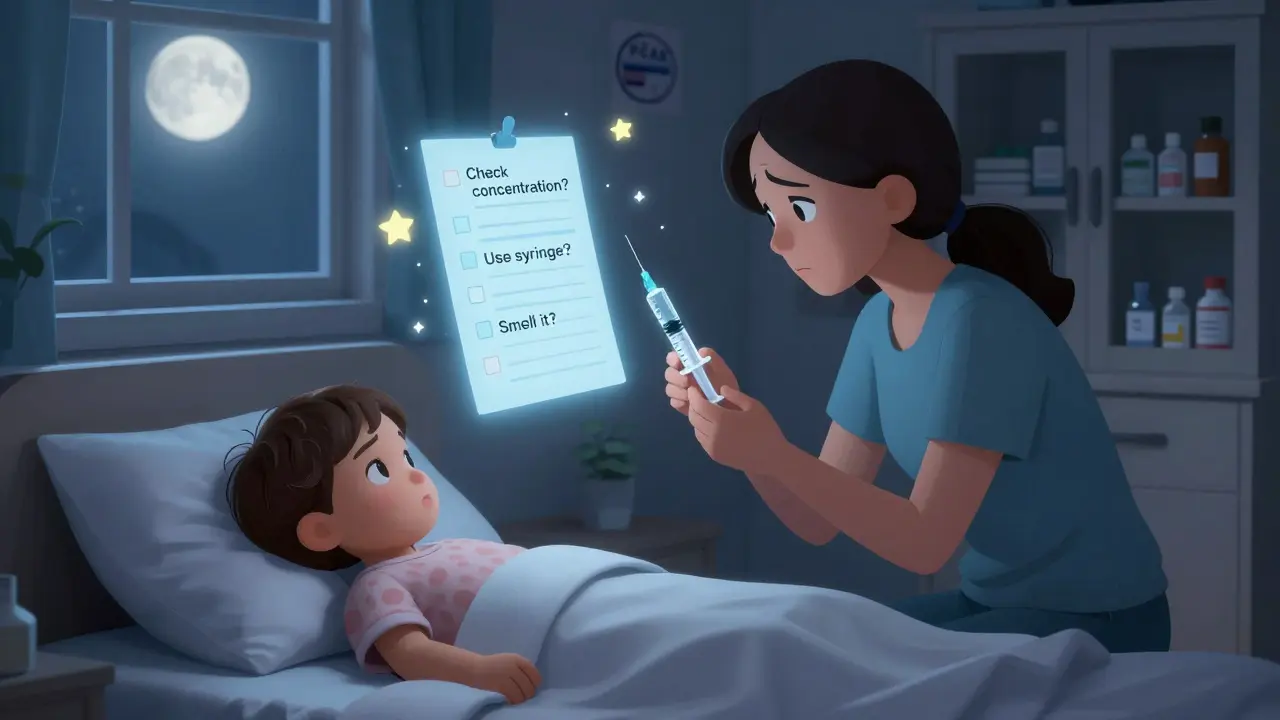
What Parents Must Do Before Giving the Medicine
You’re the last line of defense. No pharmacist or doctor can be with your child 24/7. You have to ask the right questions. 1. Ask for the exact concentration. Don’t accept “it’s the same as the pill.” Ask: “How many milligrams are in each milliliter?” Write it down. If the label says “10 mg/mL,” make sure your syringe is calibrated to that number. A common error is mixing up “mg/mL” with “mg/tsp” - and a teaspoon holds 5 mL. That’s a fivefold overdose risk. 2. Double-check the dose with both the doctor and the pharmacist. If the doctor prescribed 0.2 mL and the pharmacist says it’s 5 mg/mL, do the math: 0.2 mL × 5 mg/mL = 1 mg. Is that what the doctor intended? Call the doctor’s office to confirm. Don’t assume they know what the pharmacy wrote. 3. Check the expiration date and storage instructions. Some compounded liquids last only 14 days in the fridge. Others need to be frozen. If it’s been sitting on the counter for a week, it might be unsafe. Throw it out if you’re unsure. 4. Look at the color and smell. If the liquid looks cloudy, has particles, or smells weird - like vinegar or rotten eggs - don’t give it. That’s a sign of contamination or chemical breakdown. 5. Use the right measuring tool. Never use a kitchen spoon. Use the syringe or dosing cup the pharmacy gave you. If they didn’t give you one, ask for it. A 1 mL syringe is best for small doses. Mark the correct dose with a permanent marker if needed.What to Watch For After Giving the Medicine
Even with perfect dosing, compounded meds can cause unexpected reactions. Kids may not be able to tell you what’s wrong. Watch for:- Unusual vomiting or diarrhea
- Extreme drowsiness or irritability
- Rash, hives, or swelling
- Difficulty breathing
- Seizures or loss of consciousness
Jamie Allan Brown
February 1, 2026 AT 17:03My nephew was on a compounded version of levothyroxine for months before we caught the dose was off by 40%. The pharmacy swore it was correct. We had to get a second opinion, then send the bottle back for testing. Turns out, they used volume measurements instead of gravimetric. No wonder he was lethargic and gaining weight. If you're using compounded meds, demand proof they weigh it - not guess it.
It’s not just about trust. It’s about science. And if your pharmacy can’t explain how they measure, walk out.
Parents need to be the watchdogs. No one else will be.
Nicki Aries
February 3, 2026 AT 08:19I can’t believe this isn’t federal law yet. Gravimetric analysis isn’t optional-it’s basic pharmacology. And yet, 92% of compounding pharmacies skip it because it’s ‘too expensive’? What’s more expensive? A child’s life? Or a $30,000 scale?
My daughter had a severe reaction to a compounded antibiotic. The label said ‘5 mg/mL’-but the pharmacy meant ‘5 mg/5 mL.’ We gave her five times the dose. She ended up in the ER with vomiting and seizures. It took three weeks to recover.
Don’t let your pharmacy cut corners. Demand accreditation. Demand documentation. Demand accountability. And if they hesitate? Find another one. Your kid’s life isn’t a cost-benefit analysis.
Ishmael brown
February 5, 2026 AT 02:18LMAO the FDA doesn’t regulate this? 😂 Of course they don’t. They’re too busy chasing vape pens and banning bubble tea. Meanwhile, kids are getting poisoned by some guy in a basement lab with a syringe and a prayer.
And now we’re supposed to trust ‘PCAB accredited’? LOL. That’s like trusting a Yelp review from a guy who works at the pharmacy.
Here’s the real truth: Big Pharma doesn’t want pediatric compounding regulated because it kills their profit margins. They’d rather you buy their overpriced, overprocessed ‘FDA-approved’ versions that still have 17 allergens in them. It’s all a scam.
They’re all in on it. The pharmacists. The doctors. The ‘accreditation boards.’ Just look at the money trail. You think Emily Jerry’s death changed anything? Nah. It just made the PR team work harder.
Nancy Nino
February 5, 2026 AT 08:07While I appreciate the thoroughness of this post, I must respectfully note that the emotional framing-though understandable-may inadvertently undermine the credibility of the message. The use of tragic anecdotes, while compelling, risks triggering confirmation bias among caregivers who are already anxious. A more neutral, data-driven approach might better serve public health outcomes.
That said, the practical guidance regarding gravimetric analysis, dose verification, and expiration protocols is both accurate and invaluable. I commend the author for including specific, actionable steps rather than vague warnings.
One addition: consider mentioning the role of clinical pharmacists in pediatric units. Many hospitals now employ them specifically to audit compounded formulations. This is a critical layer of safety that outpatient settings often lack.
Angel Fitzpatrick
February 7, 2026 AT 03:59Let me break this down for you: the FDA is a puppet of Big Pharma. They don’t regulate compounding because they’re actively suppressing alternatives to mass-produced drugs. Why? Because compounded meds are cheaper. And cheaper means parents stop buying their $500/month ‘FDA-approved’ nonsense.
And PCAB? That’s a front. The same people who run the FDA sit on their board. They’re not auditing-they’re rubber-stamping. You think they’d let a mom test a batch of her kid’s morphine? Nah. They’d shut down the lab and call it ‘unlicensed.’
But here’s the real conspiracy: the FDA is letting these deaths happen on purpose. Why? To scare parents into buying only their branded drugs. It’s called ‘manufactured fear.’
Emily Jerry? She was a test case. A sacrifice. And now they’re using her name to sell accreditation like it’s a magic shield. It’s not. It’s a tax.
Don’t trust the system. Trust your gut. And if your kid’s medicine smells like vinegar? Burn the bottle. Burn the pharmacy. Burn the whole damn industry.
Lisa Rodriguez
February 7, 2026 AT 15:34My cousin is a pharmacist who works at a PCAB-accredited compounding lab and she says the real issue isn’t the equipment-it’s the staffing. Most places are understaffed, overworked, and underpaid. They’re rushing 20 prescriptions an hour and using syringes because they don’t have time to calibrate the scale.
So yes, gravimetric is better. But if you want real change, push for better pay and staffing ratios for pharmacists. No one’s going to do perfect work when they’re burned out.
Also-don’t forget to check the batch number. If the pharmacy gives you one, call them and ask if it’s been tested. Most won’t know what you’re talking about. That’s your red flag.
And yes, I’ve seen cloudy levothyroxine. It looked like swamp water. I threw it out. No regrets.
Ed Di Cristofaro
February 8, 2026 AT 23:04Y’all are overcomplicating this. If your kid can’t swallow a pill, just crush it and mix it with applesauce. Done. No pharmacy needed. No $200 liquid. No scary labels. Just smash it, stir it, and feed it. Problem solved.
And if the pharmacist says ‘don’t crush it’? They’re just trying to sell you a compounded version so they can make a profit. They don’t care about your kid. They care about their paycheck.
Stop paying for snake oil. Just use your kitchen.
Lilliana Lowe
February 9, 2026 AT 00:16While the author’s intent is laudable, the prose exhibits a regrettable lack of syntactic precision and lexical economy. For instance, the phrase ‘a tiny dose of a powerful drug like morphine for a premature baby’ is both semantically redundant and grammatically imprecise-‘tiny’ is nonquantitative, and ‘powerful’ is a colloquialism that undermines the clinical tone required for such a critical subject.
Furthermore, the use of ‘lifeline’ as a metaphor is melodramatic and unscientific. In academic literature, the term ‘therapeutic alternative’ is preferred.
That said, the practical recommendations regarding gravimetric analysis are accurate and should be universally adopted. However, the omission of ISO 14644-1 cleanroom standards for compounding environments is a glaring oversight. Any facility below Class 7 should be immediately shuttered.
Deep Rank
February 9, 2026 AT 20:57Oh my god I just read this and I’m crying because my daughter had the same thing happen to her with compounded insulin and I didn’t know anything and I trusted the pharmacy because they were so nice and they gave me a free lollipop for my kid and then she went into hypoglycemia and I had to rush her to the hospital and the doctor said it was 30% too strong and the pharmacy said oh we used the same formula as last time and I was like but last time was fine and they said maybe the kid’s body changed and I was like no that’s not how medicine works and now I’m scared to give her anything and I don’t trust anyone anymore and I just want to cry and I hate that this happens to kids and I hate that no one listens and I hate that the government doesn’t care and I hate that pharmacies are just trying to make money and I hate that I didn’t know to ask for the scale and I hate that I feel guilty and I hate that I didn’t save my baby and I hate that this post is so long and I just needed to say this out loud and I’m sorry I’m not making sense but I’m just so tired and I just want someone to tell me I’m not alone
Naomi Walsh
February 11, 2026 AT 08:45Let’s be clear: if you’re using a compounded medication without gravimetric verification, you are not a parent-you are a negligent experiment. The fact that this is even a discussion is a national disgrace. The U.S. healthcare system has descended into a third-world parody of itself, where children are dosed with guesswork because some pharmacy can’t afford a $25,000 scale.
And yet, you’re all surprised when a child dies? No. You’re not surprised. You’re just resigned. That’s the real tragedy.
Stop posting about ‘trust your gut.’ Your gut is not a calibrated spectrophotometer. Your gut is not a QC lab. Your gut is just fear dressed in ignorance.
Accreditation isn’t optional. It’s non-negotiable. And if your pharmacist can’t produce proof of it? You are not entitled to a second opinion. You are entitled to a new pharmacy. Immediately.