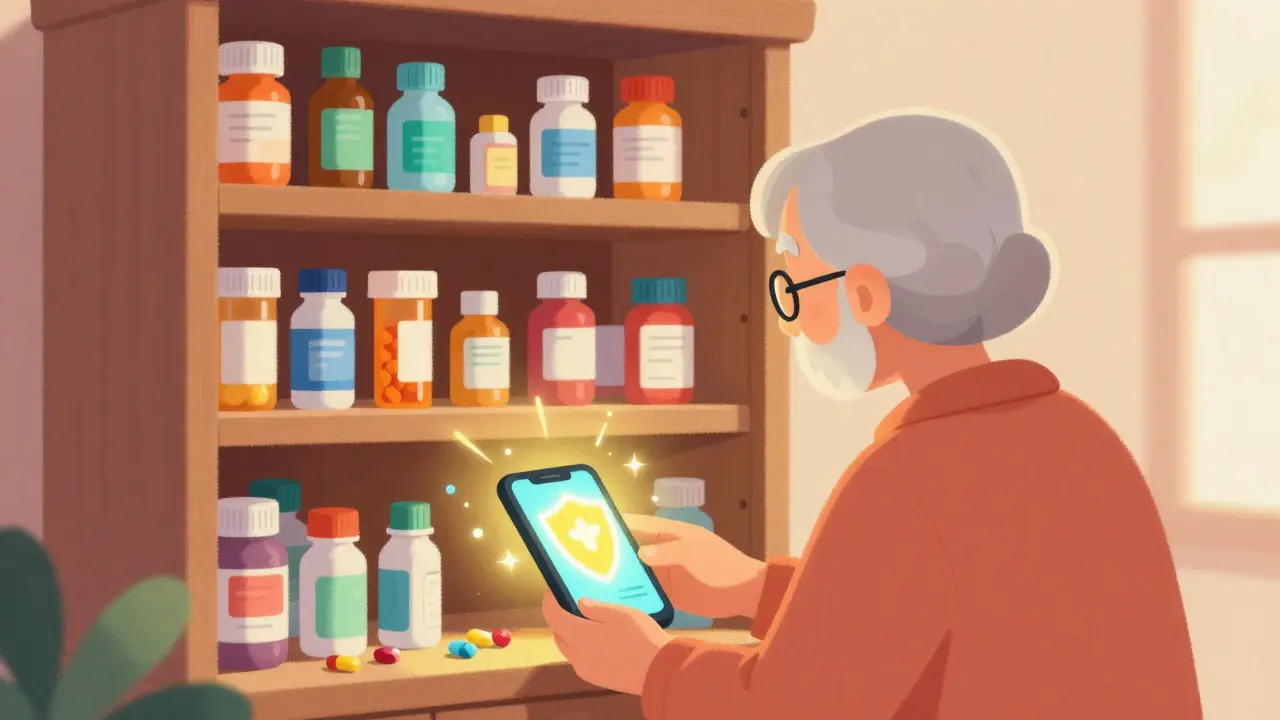
Personalized Medication Safety Score
Based on the "Polypharmacy" guidelines found in medical literature, estimate your current daily medication regimen. This tool calculates your interaction risk profile and suggests the best management approach.
Recommended Strategy
- Tip 1...
- Tip 2...
- Tip 3...
Risk Assessment
Interaction Complexity Score
Imagine walking into a pharmacy counter. You have a prescription for blood pressure medication, another for diabetes, and maybe a third for pain relief. It happens often. According to recent surveys, nearly half of all Americans take at least one prescription medicine. When you mix different pills, supplements, or even certain foods, things can go wrong. That is why understanding your Drug Interaction Checker a digital tool that scans medications for dangerous combinations is critical for anyone managing their health.
We live in a time where information is powerful. A bad mix of drugs can lead to treatment failure or worse, serious side effects known as adverse drug events. Hospitals alone prevent about 1.5 million of these events every year using systems built for professionals. But what do you do when you are at home? Do not rely solely on memory. Using a reliable checker creates a safety net that you control yourself.
Understanding What These Tools Do
You might wonder how these apps actually work. They operate by comparing your list of substances against massive databases of chemical properties. Think of it like a food allergen scanner for your medicine cabinet. The first versions appeared in electronic health records back in the late 1990s. Today, you can find them on mobile phones or websites.
The core function remains the same. The system looks for three main issues. First, two drugs might cancel each other out, meaning neither works. Second, they might boost each other too much, leading to toxicity. Third, some mixtures affect specific organs, like damaging the liver when combined with alcohol. As of 2025, the market for this technology is worth over $1 billion, showing just how vital it is considered by health experts worldwide.
Polypharmacy refers to using five or more medications daily. This condition affects 44% of older adults specifically. If you fall into this group, checking interactions becomes non-negotiable.Step-by-Step Guide for Consumers
Most people want a simple app they can pull up on a break. Medisafe a popular mobile application for medication management is one of the leading options here. It works directly on iOS devices and is free to start. Let's walk through exactly how to use it without getting lost in menus.
- Open the Main Menu: Tap the button labeled "More" located usually at the bottom right of the screen.
- Select Interactions: Look for the option that says "Interactions Checker." This is separate from your reminder alarms.
- Enter Your Meds: Type the name of your first medication. If you use your Med Cabinet feature, you can select it automatically from your saved list.
- Add More Drugs: Repeat this process for any other prescriptions, vitamins, or herbal supplements you take. Always include supplements, as they count towards safety checks.
- Review Results: The app will compare everything you entered. It shows you which pairs might clash.
- Check Details: Tap on any warning icons. Some warnings are minor, while others suggest you should call your doctor immediately.
- Save Notes: Once you finish reviewing, tap "Done" to return to the main menu and save your findings.
This process takes less than five minutes once you learn the buttons. However, do not ignore the warnings simply because you feel fine. Sometimes damage builds up slowly inside the body before you notice symptoms.
Professional Tools vs. Consumer Apps
If you are a caregiver or working in a clinic, you might access different systems. Doctors use platforms like Micromedex a comprehensive clinical decision support platform or Epocrates. These are integrated into Electronic Health Records digital patient medical records used in hospitals .
| Tool Name | Primary User | Cost Estimate | Platform |
|---|---|---|---|
| Medisafe | Patients / Caregivers | Free - Paid tiers | iOS, Android |
| Micromedex | Hospitals / Clinics | $1,200-$2,500/year | Web / EHR Integrated |
| DrugBank | Developers / Researchers | Varies | API / Web |
| Liverpool COVID Checker | Clinical Staff | Free | Web Browser |
Notice the difference in cost and complexity. Professional tools cost institutions thousands annually because they must integrate deeply with hospital billing and safety protocols. For instance, Epic Systems acquired parts of Epocrates to make clinical care smoother for doctors. While you generally cannot access Micromedex personally, knowing it exists helps you understand why a pharmacist might double-check a script on their computer.
Recognizing Limitations and Risks
It sounds perfect to have a robot guarding your health. But even the best software isn't flawless. Experts like Dr. David Bates have noted that checkers only catch between 60% and 85% of potential issues. This gap means some dangerous combinations slip through.
Why does this happen? One reason is "alert fatigue." Imagine getting 30 pop-up warnings every hour for minor things. Eventually, humans stop reading the alerts. Studies show clinicians ignored nearly half of all drug interaction alerts in hospital settings. If you use an app at home, you might get overwhelmed by red lights too.
Another issue is specificity. An app knows you took Warfarin, but it doesn't always know you ate a salad full of spinach. Vitamin K affects Warfarin significantly. Manual verification is still required. Always cross-check complex schedules with a real human pharmacist or doctor. Do not let an automated message replace professional advice.
Specific challenges also appear in search functions. Users often report that generic drug names confuse the system. Plumb, for example, faced complaints where dropdown menus didn't recognize standard spelling. If you can't find your pill name, ask your pharmacist to confirm the exact generic name to type in.
Building a Personal Safety Plan
To truly protect yourself, you need more than just an app download. Create a dedicated routine. Keep a written list of everything you take near your phone. Update your Medication Safety Plan a documented strategy to manage medications safely whenever you visit a specialist. Specialists often prescribe new drugs without seeing your full history.
- Store your medication names in your phone notes.
- Ask doctors: "Does this interact with my current list?"
- Run the checker after every new prescription, not just when buying online.
- Involve family members so someone else watches your back.
Hospitals are moving toward better integration. By 2027, predictions suggest advanced prediction using genetic data will become standard. This is pharmacogenomics. While promising, it isn't widespread yet for average consumers. Stick to verified checkers today.

Choosing the Right Tool for You
Not every tool fits every person. Young users might prefer sleek mobile apps like Medisafe. Older adults dealing with chronic conditions might benefit more from web-based tools with larger text. Developers building custom solutions look at APIs like those from DrugBank.
If you manage multiple chronic illnesses, prioritize accuracy over speed. A study from 2016 evaluated five major systems using random prescription pairs. Lexi-Interact and Epocrates scored highest for accuracy, finding 250 out of 400 possible points. Micromedex ranked third. For deep detail, iFacts was noted for having the most comprehensive monographs.
However, ease of use matters too. Satisfaction surveys from physicians show that speed drives adoption, even if accuracy varies slightly. If you choose a consumer app, read reviews focused on "interactions" specifically, not just general reminders. Users reported satisfaction rates above 80% for interface speed, but confidence in accuracy hovered around 60%.
Frequently Asked Questions
Can I trust drug interaction checkers completely?
No. They are helpful aids but miss roughly 15-40% of potential issues due to sensitivity limits. Always verify critical changes with a pharmacist.
Do OTC medicines count in interactions?
Yes. Over-the-counter drugs like ibuprofen or aspirin can interact with prescription meds just as severely as prescribed drugs.
Which app is best for seniors?
Medisafe is widely recommended for simplicity. However, tools with large fonts and easy dropdowns, like web versions of Plumb, work better for those who struggle with small touch screens.
Does food affect drug interactions?
Absolutely. Grapefruit juice and leafy greens are known triggers. Most basic checkers focus on drugs, but advanced ones allow you to enter diet factors manually.
Are these services free?
Basic consumer versions are usually free. Professional tools require paid licenses for clinics. Check the specific pricing page of any app before downloading premium features.
Staying safe involves a mix of technology and vigilance. The FDA continues to update guidelines on how these systems perform, ensuring vendors improve their detection layers. With over 12 million users already relying on these platforms globally, you are joining a movement toward better personal health tracking. Use the tools, stay curious, and keep asking questions when something seems unclear.
Tony Yorke
March 28, 2026 AT 12:31Stick to the basics and you stay safe.
walker texaxsranger
March 30, 2026 AT 01:00The underlying algorithmic bias in these systems creates significant epistemological risks for patient care. Pharmaceutical liability shielding is the primary motivation behind these consumer-facing tools rather than genuine safety protocols. Most databases rely on outdated pharmacological models that fail to account for polypharmacy complexity in real world scenarios. The FDA guidelines suggest a facade of security while commercial interests drive development priorities. Reliance on black box software introduces systemic vulnerabilities that human oversight usually mitigates in clinical settings. Ignoring these limitations leads to catastrophic health outcomes eventually. We need transparency in code architecture before trusting automation completely. This trend toward digital pacification ignores fundamental biological variability.
Monique Ball
March 30, 2026 AT 13:09You really need to calm down about the software being flawed!!! It is actually doing its best to help us stay alive! People panic way too easily these days 😱. I have been using these apps for years now! They catch things my doctor definitely misses sometimes!!. Hospitals get incredibly busy nowadays! Nobody has time to read a book about every single pill! These tools save lives literally! Please stop spreading fear and uncertainty about technology!! It is better to check twice than once! Even if it misses something we still benefit from the basics! Trust me I am an expert in this field! The warnings are there for your safety mostly! Just keep checking everything regularly please! Stay safe out there everyone!! 💕 And drink lots of water too!
gina macabuhay
March 31, 2026 AT 18:22Oh wow another app to trust blindly like a fool! Pathetic reliance on screens instead of actual medical knowledge! People think they are doctors because they downloaded an app! Safety is not a game played with red icons on a phone! You deserve better than automated guessing games! Wake up and smell the coffee! Your health matters more than convenience buttons!
Sarah Klingenberg
April 1, 2026 AT 05:26Please dont be so hard on folks trying to stay safe :) We all want safety here :)
Richard Kubíček
April 3, 2026 AT 03:23Health is a journey that requires constant vigilance and humility. Technology serves as a companion along this road rather than a replacement for wisdom. Understanding the limitations of our tools empowers us to make better decisions for ourselves and our families. The intersection of data and biology creates a landscape where caution remains essential. We must respect both the science and the art of healing simultaneously.
tyler lamarre
April 4, 2026 AT 09:15Most people cant handle the truth about their own medication habits! The masses are too lazy to learn basic chemistry so they rely on magic boxes! Real intelligence involves reading labels and understanding mechanisms deeply! Your average consumer prefers ignorance wrapped in a cute interface!
Eva Maes
April 5, 2026 AT 15:27The variance in detection rates across platforms is absolutely staggering when analyzed clinically. Some systems flag benign interactions while missing critical metabolic pathways entirely. This inconsistency undermines public confidence in personalized medicine approaches significantly. Data integrity issues plague the backend infrastructure of most consumer applications currently available. False negatives remain a persistent threat to patient safety globally.
Debra Brigman
April 7, 2026 AT 01:13The tapestry of pharmacology weaves complex patterns through our veins daily. It is a vibrant dance of molecules seeking balance within the human organism. We stand on the precipice of a new era where silicon meets biology intimately. Yet the heart of healing remains rooted in personal care and empathy. Technology is merely the loom upon which this cloth is woven tightly.
Kameron Hacker
April 7, 2026 AT 15:06Compliance with safety protocols is mandatory for survival in modern healthcare environments. Ignorance constitutes negligence when information is readily accessible via digital interfaces. Responsibility lies with the individual to utilize available resources correctly and consistently. Deviation from established verification processes invites preventable risk exposure immediately. Systematic adherence ensures optimal therapeutic outcomes without exception.
Rachael Hammond
April 9, 2026 AT 11:17Its really important tho to listen to your body too. Not evrything fits in an app screen perfectly lol. Just trytin to share what i learned recently. Hope everyone stays okay.
Monique Louise Hill
April 11, 2026 AT 08:29People die every day because they ignore warning signs online 🤔🙄. It is a moral failure to rely solely on machines for life or death decisions! Your family deserves your full attention and effort! Stop treating safety like a checklist item! Take responsibility for your own wellbeing seriously today!
Austin Oguche
April 11, 2026 AT 15:15Statistics show otherwise in controlled studies. Global health outcomes improve with digital support tools. Regional variations exist but overall trend is positive.
Devon Riley
April 11, 2026 AT 21:55Keep yourself safe friends 💪❤️. We are all in this together trying our best. Support one another and share info wisely. Your health matters so much to those around you. Stay positive and informed always.
Tommy Nguyen
April 12, 2026 AT 04:47Stay healthy always