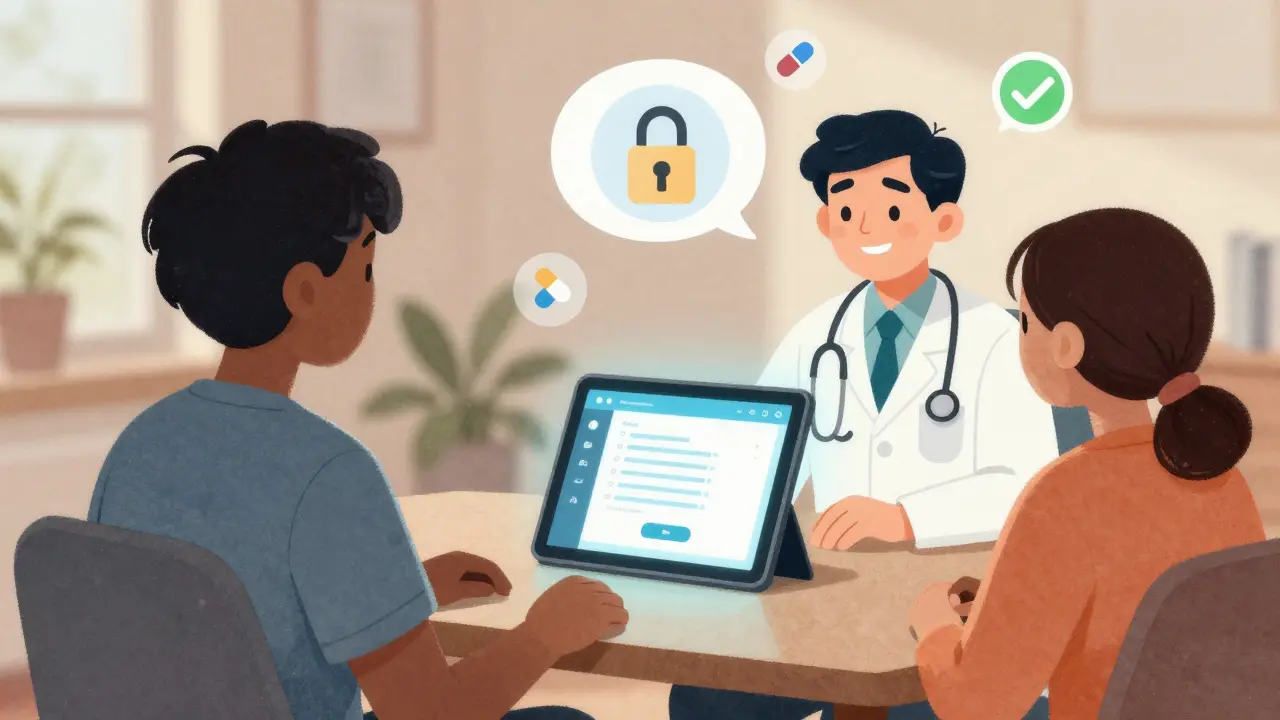
Every year, millions of people call their doctor’s office just to ask a simple question: Is this the right dose?, Can I take this with my other meds?, or Why does this pill make me dizzy? Most of these questions aren’t emergencies. But calling back and forth-waiting on hold, leaving voicemails, getting redirected-is exhausting. And it’s risky. A 2023 study in JAMA Network Open found that 72% of healthcare data breaches happen because people use regular text messages, email, or even WhatsApp to talk about meds. That’s why secure messaging isn’t just convenient-it’s now the safest, smartest way to handle non-urgent medication questions.
What Is Secure Messaging, Really?
Secure messaging is not just a fancy chat app. It’s a HIPAA-compliant system built into your healthcare provider’s patient portal-like Epic’s MyChart, Cerner, or My HealtheVet. These platforms encrypt every message end-to-end, track who sent it and when, and lock access behind multi-factor authentication. Only you and your care team can see it. No one else-not even the tech support team-can read your messages about your blood pressure pills or insulin schedule. Unlike regular texting, secure messaging doesn’t send messages to your phone’s default app. Instead, you get a push notification or email alert that says: “You have a secure message from your provider.” Click it, log in with your username and password (and maybe a code from your phone), and you’re in. All your medication history, allergies, and past messages are right there. That’s the power: you’re not guessing what you took last week-you’re seeing it.When Should You Use It? (And When Not To)
Secure messaging works best for questions that don’t need an instant answer. Think:- “I started taking metformin yesterday and I’m bloated-is that normal?”
- “Can I refill my lisinopril early? I’m going on vacation.”
- “My pill looks different this month. Is this the same drug?”
- “I took two doses by accident. Should I be worried?”
How to Send a Medication Question That Gets Answered Fast
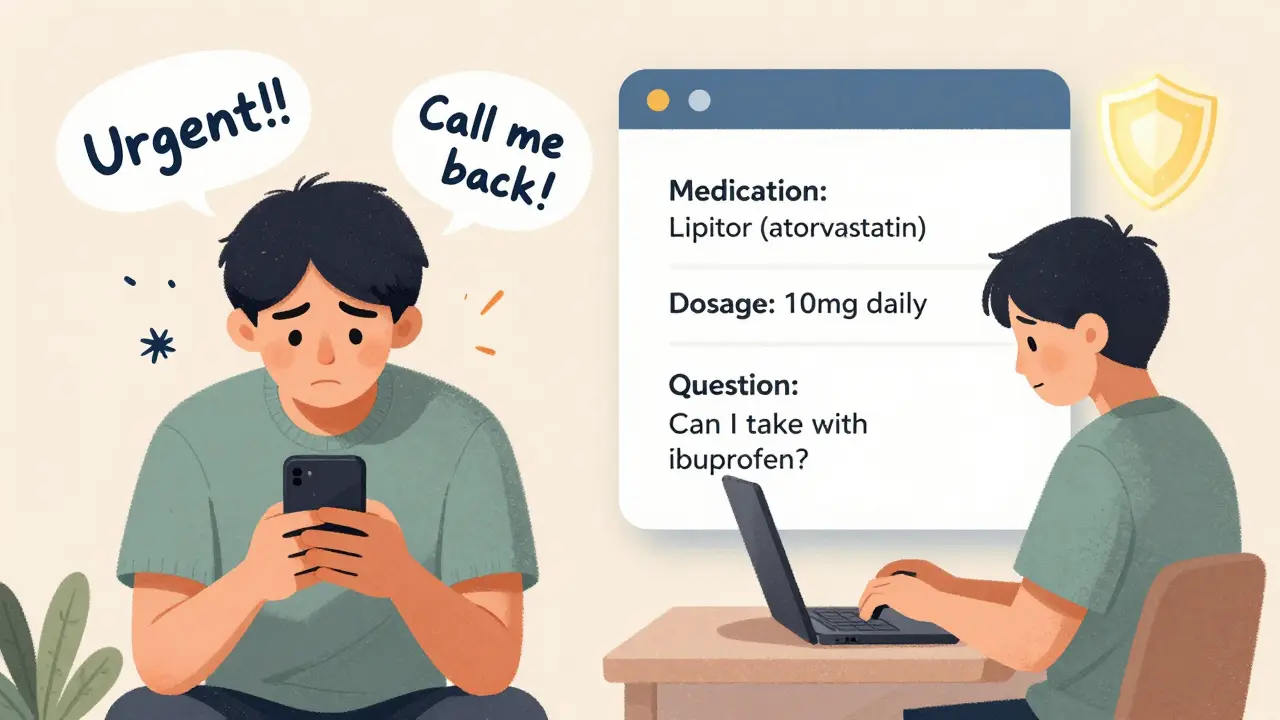
The biggest mistake people make? Sending vague messages like: “Help with my medicine.” That’s like calling a mechanic and saying, “My car’s broken.” Here’s exactly what to include:- Medication name-Use both brand and generic if you know them. Example: “Lipitor (atorvastatin).”
- Dosage and frequency-“10 mg once daily.”
- Specific question-“Can I take this with ibuprofen?” or “I feel nauseous after taking it.”
- Context-“I started this last Tuesday,” or “I skipped it yesterday because I was sick.”
- Attach a photo-If the pill looks different, snap a picture of the label. Most platforms let you upload images directly in the message.
How to Set It Up (Step by Step)
If you’ve never used secure messaging for meds, here’s how to get started:- Log in to your provider’s patient portal-This is usually your hospital’s website or app. Look for “MyChart,” “Patient Gateway,” or “Secure Messaging.”
- Add your medications-Go to “Health Records” > “Medications & Allergies.” Type in every pill, patch, or injection you take-even over-the-counter ones like aspirin or vitamin D. If you’re unsure, check your pharmacy label or ask your pharmacist.
- Select the right category-When you start a new message, choose “Medication” or “Prescriptions” as the subject. This sends it to the pharmacy team, not your general provider.
- Write your message-Use the format above. Be clear. Be complete.
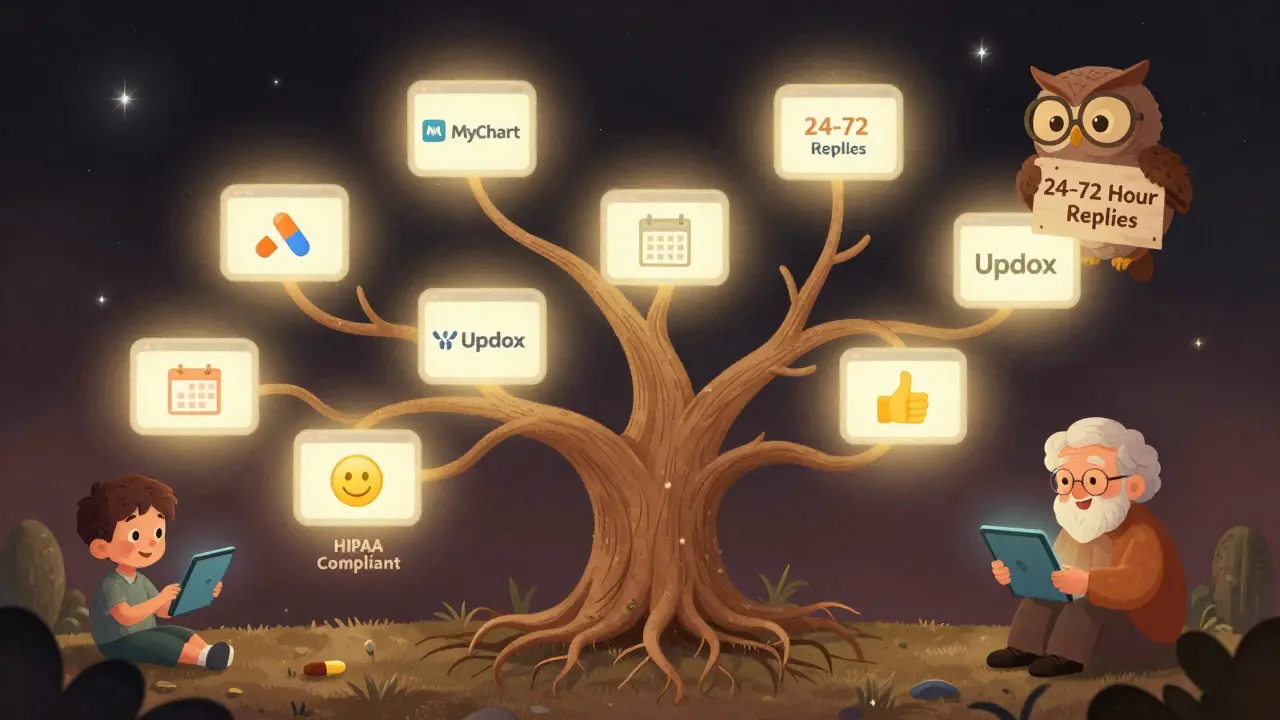
- Send and wait-Most responses come in 24-72 hours. You’ll get a notification inside the app or portal. Don’t check your email-secure messages rarely go there.
Which Platforms Work Best?
Not all secure messaging systems are the same. Here’s what’s out there:| Platform | Market Share (U.S.) | Key Strength | Limitation |
|---|---|---|---|
| Epic MyChart | 55% | One-click refill requests; integrates with pharmacy | Auto-replies for renewals can feel robotic |
| Cerner HealtheIntent | 18% | Strong for large hospital systems | Less intuitive for first-time users |
| Updox | 12% | Direct pharmacy integration-no clinician needed for 68% of refills | Not available in all regions |
| TigerConnect | 8% | Best for complex regimens (e.g., diabetes + heart meds) | Primarily used by hospitals, not clinics |
| My HealtheVet | Used by VA | Specialized categories for meds, appointments, tests | Only for veterans |
What to Avoid
Don’t do these things:- Don’t use personal email or text-Even if your doctor says, “Just text me.” That’s a HIPAA violation-and it puts your data at risk.
- Don’t skip adding your meds-If your list is outdated, your provider can’t give you accurate advice.
- Don’t wait until you’re in pain-Ask about side effects early. The sooner you report them, the sooner they can adjust your treatment.
- Don’t assume it’s instant-This isn’t a chatbot. It’s a real person reading your message. Give them 24-72 hours.
Why This Matters More Than Ever
In 2024, the Joint Commission officially allowed secure texting for medication orders. That’s huge. It means your doctor can now approve refills, change doses, or even write new prescriptions-all within the secure message thread. No faxing. No calling the pharmacy. No delays. And it’s saving money. The Medical Group Management Association found that each secure message costs $8.73 less than a phone call. That adds up to millions saved across the system. But the real win? You’re less stressed. You have a record. You don’t forget what you asked. And your provider has all the context. By 2026, AI will auto-fill your medication history in secure messages, cutting response times by over half. But for now, the best tool you have is still you-being clear, complete, and consistent.Can I use WhatsApp or iMessage to ask about my meds?
No. Neither WhatsApp nor iMessage is HIPAA-compliant. Even if your doctor uses them, it’s against federal law to send protected health information (like medication names or dosages) over those platforms. Always use your provider’s official patient portal. If you’re unsure, ask your clinic which system they use.
What if I don’t have a patient portal account?
Contact your doctor’s office or clinic. They can send you an invitation to set up your portal. Most systems offer free access through a web browser or app. If you’re elderly or don’t use technology, ask if someone at the office can help you set it up-or if they offer a phone-based secure messaging option.
How long does it take to get a reply?
Most responses come within 24 to 72 hours, Monday through Friday. Weekends and holidays may take longer. If your question is urgent, call your provider’s office directly. Secure messaging is for non-urgent issues only. If you haven’t heard back after 3 business days, send a follow-up message-don’t assume it was lost.
Can I ask about over-the-counter meds or supplements?
Yes. Always include OTC drugs, vitamins, and supplements in your secure messages. Things like ibuprofen, fish oil, or melatonin can interact with prescription meds. Your provider needs the full picture to keep you safe.
What if my message gets misclassified as urgent?
If you get a call or text back saying your message was flagged as urgent when it wasn’t, reply with a new message saying, “This was not an emergency. Please route to pharmacy team.” Include your original message ID if possible. You can also call the office to clarify. Most systems now have a “non-urgent” checkbox-make sure you select it.
dana torgersen
January 23, 2026 AT 13:55Okay, so… I just tried this, and I’m not gonna lie-I sent a message saying “help with my med” and got a robotic reply that said “Please use the template.” I felt like a toddler who forgot to tie their shoes. But then I tried again-wrote out the brand, dose, when I started it, and even added a pic of the pill-and BOOM. Got a reply in 18 hours. It’s weird how much clarity changes everything. I’m not proud of my first attempt… but I’m proud of the second.
Andrew Smirnykh
January 24, 2026 AT 14:24Interesting how this mirrors the shift in how we handle personal data overall. We’ve normalized sharing our location, our purchases, even our sleep patterns-but the moment you try to share a medication name, it’s a HIPAA violation? There’s a contradiction here. We trust apps with our most intimate habits, yet we’re terrified of a secure portal. Maybe the problem isn’t the tech-it’s the narrative.
Oladeji Omobolaji
January 25, 2026 AT 17:02Man, this is straight fire. I’m from Nigeria and we don’t have this stuff. My aunt still calls the clinic and waits 3 hours just to ask if her blood pressure pill is the same color. She’s 72. I told her to use WhatsApp. She did. I didn’t say anything. Now I feel bad. This post made me realize we’re not just lazy-we’re unprepared.
Janet King
January 27, 2026 AT 15:32Secure messaging is essential. It reduces errors. It creates an audit trail. It improves patient safety. It aligns with regulatory standards. It reduces administrative burden. It is not optional. It is the standard of care.
Stacy Thomes
January 28, 2026 AT 13:54I used to be the person who called at 7pm on a Tuesday just to ask if my new pill made me sleepy. Now? I type it in MyChart. I feel like a superhero. I saved 3 hours last month. My doctor actually responded with a smiley face. I cried. Not because I was sad-because someone finally listened.
Anna Pryde-Smith
January 29, 2026 AT 17:32So let me get this straight-you’re telling me I can’t text my doctor a picture of my pill? But I can send a naked pic to my ex? I can post my entire medical history on Facebook but can’t send a secure message? This system is broken. Not the patients. The system. And don’t give me that HIPAA nonsense. We’re all just trying not to die here.
Vanessa Barber
January 31, 2026 AT 14:28Yeah, sure. Secure messaging. Right. Next you’ll tell me my doctor’s office doesn’t use Gmail. I’ve been using email for 3 years. My doctor replied once. Said ‘I’m not allowed to respond to email.’ Then he sent me a paper letter. In the mail. Like it’s 1998. This whole thing feels like performative tech.
Dawson Taylor
January 31, 2026 AT 21:16Efficiency in communication reduces clinical error. The data supports this. The infrastructure exists. Adoption is the barrier, not the technology.
Sallie Jane Barnes
February 1, 2026 AT 07:12I’m 68. I don’t know how to log in. I don’t trust apps. But my daughter sat with me for an hour. She helped me add my meds. I sent my first message yesterday. My pharmacist called me back. She said, ‘Good job.’ I felt like I’d graduated college. Thank you for writing this. I’m not tech-savvy. But I’m learning.
Laura Rice
February 2, 2026 AT 06:24OMG I just figured out you can upload a pic of your pill?? I’ve been describing pills for years. ‘It’s a little round white thing with a line on one side’-and they always get it wrong. I sent a pic of my new atorvastatin and the pharmacist said, ‘Yes, that’s the generic, and it’s safe.’ I almost hugged my phone. This is magic. And I didn’t even know it existed until today.
charley lopez
February 3, 2026 AT 01:15The integration of secure messaging platforms with EHRs demonstrates a measurable reduction in medication reconciliation errors. The cost-benefit ratio is favorable, particularly when accounting for downstream adverse drug events. The primary impediment remains user onboarding and cognitive load during initial interface engagement.
Kerry Evans
February 3, 2026 AT 03:24People who don’t use secure messaging are either lazy, reckless, or both. If you can’t be bothered to log into a portal instead of texting your doctor, you’re putting your life at risk. And if your doctor lets you text them? They’re breaking the law. You’re not special. You’re not ‘too busy.’ You’re just irresponsible.
Susannah Green
February 4, 2026 AT 05:41One thing no one mentions: if you have 10+ meds, write them ALL in your profile-even the ones you skip sometimes. I forgot my magnesium and got a reply saying, ‘You’re taking 4 blood pressure meds. Are you sure you’re not overdoing it?’ I didn’t even realize I was. Saved me from a hospital trip. So yes, even the ‘tiny’ pills matter.
Kerry Moore
February 4, 2026 AT 10:12Thank you for this. I’ve been advising my elderly patients on this for years, but few listen. This post is the clearest, most compassionate explanation I’ve seen. I’m sharing it with every patient who’s struggling with phone tag. It’s not just about safety-it’s about dignity. You deserve to be heard without waiting on hold.