
Dark spots on your face or hands don’t just appear out of nowhere. They’re your skin’s reaction to something-sunlight, hormones, inflammation. But not all dark spots are the same. Two of the most common types, melasma and sun damage, look similar but behave completely differently. Treat one like the other, and you could make it worse.
What’s Really Going On Under Your Skin?
Hyperpigmentation means your skin is making too much melanin, the pigment that gives skin its color. It’s not a disease. It’s a signal. But the cause changes everything. Melasma shows up as large, blurry patches-usually on the cheeks, forehead, or upper lip. It’s symmetrical. If it’s on one side of your face, it’s probably not melasma. It mostly affects women, especially those with medium to darker skin tones. Hormones play a big role. Pregnancy, birth control pills, or hormone therapy can trigger it. But here’s the catch: even if you stop the hormone trigger, the spots don’t always fade. UV light, visible light from screens and windows, and even heat can keep it active. Sun damage, or solar lentigines, looks different. These are small, defined spots-like freckles but darker and more stubborn. They show up on areas you’ve exposed to the sun over years: face, hands, shoulders. They’re not linked to hormones. They’re linked to UV radiation damaging melanocytes, the cells that make pigment. The damage builds up slowly. By age 60, about 90% of fair-skinned people have them. The big difference? Melasma is a system-wide reaction. Sun damage is a local injury. That’s why treating them the same way fails.Why Sunscreen Alone Isn’t Enough
You’ve heard it before: wear sunscreen. But if you’re dealing with melasma, standard SPF 30 isn’t cutting it. Most sunscreens block UVB and UVA rays. But melasma responds to visible light-blue and green wavelengths from the sun and LED screens. That light penetrates deeper than UV. Studies show it contributes to 25-30% of melasma cases. Regular sunscreen doesn’t stop it. You need mineral sunscreens with zinc oxide or titanium dioxide-and iron oxides. Iron oxides block visible light. Look for tinted sunscreens. They’re not just for coverage. They’re medical-grade protection. The American Academy of Dermatology says you need SPF 30+ daily, even indoors. Windows don’t block visible light. Your desk by the window? That’s a trigger. For sun damage, broad-spectrum SPF 50+ is enough. But for melasma, you’re playing defense on three fronts: UV, visible light, and heat. Skip any of them, and your treatment won’t stick.Topical Treatments That Actually Work
There are dozens of creams, serums, and lotions advertised for dark spots. But only a few have real clinical backing. Hydroquinone (4%) is still the gold standard. It blocks tyrosinase, the enzyme that makes melanin. Used alone, it helps about 40% of people. But used in a triple combo-hydroquinone + tretinoin + a corticosteroid-it works for 50-70% of melasma patients in 12 weeks. The steroid reduces irritation. Tretinoin speeds up skin turnover, pushing dark cells to the surface so they flake off. But hydroquinone has limits. Use it longer than 3 months, and you risk ochronosis-a rare but permanent blue-black discoloration. That’s why dermatologists rotate it. Use it 3-4 nights a week. Skip a few days. Let your skin breathe. Tretinoin (0.025%-0.1%) is a retinoid. It doesn’t bleach pigment. It renews skin. It makes your skin shed faster, so melanin doesn’t sit and stain. It also boosts the effect of hydroquinone. But it stings. Start with 0.025% every other night. Build up slowly. Irritation is common, especially in the first 4-6 weeks. Vitamin C (10-20% L-ascorbic acid) is an antioxidant. It doesn’t stop melanin production. It neutralizes the oxidized melanin that makes spots look darker. It also blocks tyrosinase. Use it every morning under sunscreen. It’s gentle, brightening, and protects against free radicals from pollution and light. Newer options are gaining ground. Tranexamic acid (5%) applied topically reduces pigmentation by 45% in 12 weeks, with almost no side effects. Cysteamine cream (10%) showed 60% improvement in trials, with less irritation than hydroquinone. Niacinamide (5%) helps regulate melanin transfer between cells. It’s safe for long-term use and works well with other ingredients.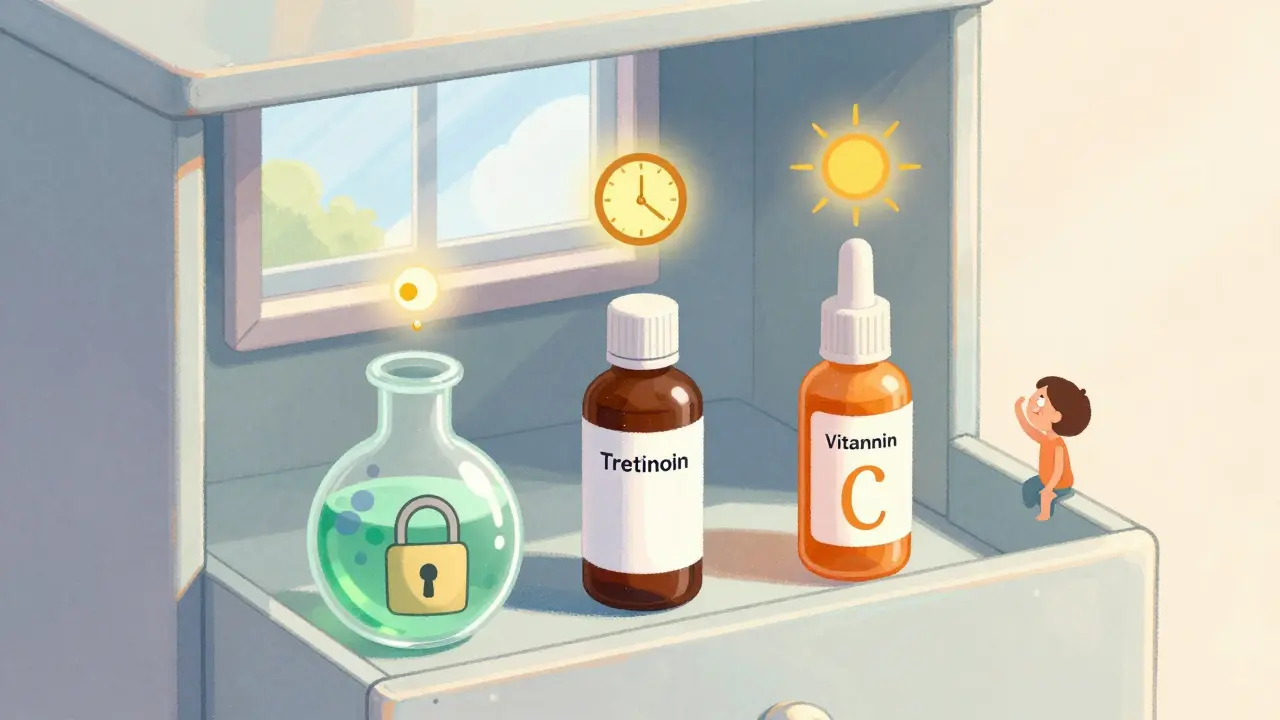
Laser and Light Treatments: Use With Caution
Laser treatments sound powerful. And for sun damage? They’re often perfect. IPL (Intense Pulsed Light) targets melanin with bursts of light. It heats the spot, destroys it, and your skin sheds it in a few days. For solar lentigines, 1-2 sessions give 75-90% improvement. But for melasma? IPL is risky. Heat triggers melanocytes. Instead of fading, the spots can darken. Studies show 30-40% of melasma patients get worse after IPL. That’s why dermatologists wait. They use 8-12 weeks of topical treatment first to calm the melanocytes. Only then do they consider gentle lasers like low-fluence Q-switched Nd:YAG. Chemical peels can help too-glycolic, salicylic, or trichloroacetic acid. But they’re not for everyone. Darker skin tones (Fitzpatrick IV-VI) are more prone to post-inflammatory hyperpigmentation after peels. That’s when the skin responds to trauma by making even more pigment. Only trained professionals should do them, and only after your skin is stable.Why Most People Fail
The biggest reason treatments don’t work? Inconsistent use. A 2023 study found only 35% of patients stick with their topical regimen for the full 12 weeks. Why? Skin gets dry. It stings. They forget. Or they stop when they see a little improvement. Another big mistake? Sunscreen application. Most people use less than half the amount they need. For your face and neck, you need about a quarter teaspoon. Reapply every 2 hours if you’re outside. Sweat, touch, and wiping your face remove it. And then there’s the myth that “once it fades, I’m done.” Melasma comes back. 95% of people see it return within 6 months of stopping treatment. That’s not failure. That’s the nature of the condition. Maintenance is part of the plan. You don’t cure melasma. You manage it.
What About Over-the-Counter Products?
Eighty-five percent of people with melasma try OTC products first. Brightening serums with kojic acid, licorice extract, or arbutin. They’re safer than hydroquinone, but weaker. They might help with mild sun damage. For melasma? Don’t count on them. They’re not strong enough to penetrate deep enough or block multiple triggers. If you’re using OTC products and nothing’s changed after 3 months, see a dermatologist. Prescription topicals work faster and better. And the cost? Monthly prescriptions run $50-$150. Laser sessions are $300-$600. But compared to years of trying random creams, it’s a smarter investment.What’s Next for Treatment?
The field is shifting. The FDA is considering making hydroquinone available over the counter-but with strict safety labeling. That could change access. Research is focusing on personalized treatment. Scientists are looking at genetic markers that predict who responds to which agent. Within five years, your treatment might be guided by a simple skin test. For now, the formula is simple: protect, suppress, maintain.- Protect: Mineral sunscreen with iron oxides, every day, no exceptions.
- Suppress: Prescription topicals-hydroquinone, tretinoin, vitamin C-in a routine that fits your skin.
- Maintain: Keep going. Even when it looks better. Melasma doesn’t vanish. It sleeps. And it wakes up when you least expect it.
There’s no magic bullet. But with the right approach, you can take back control of your skin.
Ian Cheung
January 11, 2026 AT 14:31Finally someone breaks this down without the fluff
My melasma went from 'meh' to 'what the hell' after I started using a tinted zinc sunscreen with iron oxide
Was using some fancy serum for months, didn't do squat
Now I look like I didn't spend 10 years in Florida
Also, yes, your desk by the window is a trap
Michael Marchio
January 13, 2026 AT 00:18Let’s be honest - most people treat hyperpigmentation like it’s a fashion trend they can just ‘try out’ for a month and then give up when their skin feels dry. Hydroquinone isn’t some scary chemical - it’s the only thing that actually works if you use it correctly. The fact that people think OTC serums with ‘licorice extract’ are equivalent to clinical-grade treatment is why dermatologists are overworked. You wouldn’t use a Band-Aid on a broken femur. Why are you treating melasma like it’s a pimple?
Jake Kelly
January 13, 2026 AT 20:50Really appreciate this breakdown. I’ve been using tretinoin for 6 months and it stings like crazy at first, but now my skin feels smoother and the spots are fading slowly. The key is patience. I used to think I was failing because it wasn’t gone in 2 weeks. Turns out, this is a marathon. Also, the iron oxide sunscreen tip? Game changer. I didn’t realize windows let in that kind of light.
Ashlee Montgomery
January 15, 2026 AT 01:18It’s interesting how the skin responds to internal and external triggers as one system. Melasma isn’t just a surface issue - it’s hormonal, environmental, and psychological. The stress of dealing with it can make it worse. I’ve noticed my patches flare up after sleepless nights or during high-stress work periods. Treatment isn’t just about creams - it’s about lifestyle. The body doesn’t separate these things. Why do we treat skin like it’s separate from the rest of us?
lisa Bajram
January 15, 2026 AT 20:24OH MY GOSH YES!!! I was using some $80 serum from Sephora that said ‘brightens’ and it did NOTHING - then I went to my derm and got the triple combo (hydroquinone + tretinoin + corticosteroid) and within 8 weeks? My cheeks actually looked even!! And the tinted sunscreen with iron oxide? I wear it like makeup now - it’s my secret weapon!! Also, never thought about heat being a trigger - I live in Texas and my AC is my best friend now!! Don’t listen to the OTC gurus - this is science, not a TikTok trend!!
anthony martinez
January 16, 2026 AT 06:56So let me get this straight - you’re telling me I’ve been wasting money on ‘brightening’ toners because I didn’t know that visible light from my laptop contributes to melasma? Wow. I guess my 12-hour workdays in front of the screen were just a melanin factory. Thanks for the enlightenment. Now I’ll just sit in a dark room and apply zinc oxide every 90 minutes. Sounds like a dream.
Jake Nunez
January 17, 2026 AT 19:14I’m from the South and I’ve got sun damage all over my hands. IPL worked like magic - two sessions, gone. But I tried it on my cheek patch and it got darker. So I stopped. Now I’m doing the hydroquinone + sunscreen thing. It’s boring. It’s slow. But it’s working. Don’t be like me - don’t try lasers first. Let your skin chill out.
Christine Milne
January 18, 2026 AT 09:12While I appreciate the attempt at medical accuracy, the author's casual tone undermines the clinical rigor required for dermatological discourse. The assertion that 'melasma is a system-wide reaction' is imprecise; it is, in fact, a complex dysregulation of melanocytic activity mediated by estrogen receptors and UV-induced oxidative stress - not a 'signal.' Furthermore, the recommendation to use 'iron oxides' is not universally supported by peer-reviewed literature, and the FDA has not endorsed such formulations for melasma. This post reads like a marketing blog disguised as science.
Ritwik Bose
January 19, 2026 AT 23:22Thank you for this. In India, many women use turmeric and lemon juice for dark spots - it burns the skin and makes it worse. I showed this to my sister and she finally stopped using home remedies. The part about visible light? So true. We sit under ceiling fans and near windows all day, thinking we’re safe. The sunscreen advice is gold. I now use a tinted one with SPF 50 and never skip it, even on cloudy days. 🙏
Paul Bear
January 21, 2026 AT 10:45Let’s address the elephant in the room: 95% of melasma recurrence is due to non-adherence, not treatment failure. The author correctly identifies the triad of protection, suppression, and maintenance - but fails to emphasize that compliance is the only variable that matters. The pharmacokinetics of hydroquinone require strict cycling to avoid ochronosis, and tretinoin must be titrated to minimize irritation-induced PIH. Furthermore, the use of niacinamide is not merely ‘helpful’ - it modulates melanosome transfer via PAR-2 inhibition, which is a mechanistically validated pathway. This is not ‘magic.’ It’s dermatopharmacology. And yes - you need a quarter teaspoon. Not a pea. Not a dime. A quarter teaspoon.
Jaqueline santos bau
January 22, 2026 AT 10:18Wait - so I’ve been fighting this for 7 years and I didn’t know my laptop was making my spots worse? I just thought I was ugly. I cried when I read this. I’ve spent thousands on creams, facials, lasers - and I didn’t even know I needed a TINTED sunscreen? I feel like I’ve been living in a lie. I’m going to buy one today. And I’m going to cry again when I see the difference. This changed everything.