
When you’re stuck in a cycle of sneezing, itchy eyes, and nasal congestion every spring-or even year-round-medications like antihistamines might help, but they don’t fix the root problem. That’s where immunotherapy comes in. Unlike pills that mask symptoms, immunotherapy trains your immune system to stop overreacting to allergens like pollen, dust mites, or bee venom. It’s not a quick fix. It takes years. But for many, it’s the only treatment that leads to lasting relief.
How Immunotherapy Changes Your Immune System
Allergy shots and sublingual tablets both work on the same principle: expose your body to tiny, controlled amounts of what triggers your allergies, and slowly increase the dose. Over time, your immune system learns not to panic. Instead of releasing histamine and causing swelling or sneezing, it starts to ignore the allergen. This shift happens because your body begins producing what’s called "blocking" antibodies-specifically IgG4-which interfere with the allergic response. The goal isn’t just to feel better this season. It’s to reduce or even eliminate your allergy symptoms for years after treatment ends.This approach isn’t new. The first allergy shot was given in 1911 in London. Today, it’s backed by decades of research and is considered the gold standard by leading allergy organizations like the American College of Allergy, Asthma & Immunology (ACAAI). Studies show that after 3 to 5 years of treatment, 70-85% of patients see major improvements. Some even stop needing medications entirely.
Allergy Shots: The Gold Standard
Allergy shots, or subcutaneous immunotherapy (SCIT), involve injections given under the skin, usually in the upper arm. They’re the most versatile and effective option available. Here’s why:- They can target multiple allergens at once. A single vial can contain extracts from grass, ragweed, dust mites, and cat dander-all in one shot.
- They’re proven to reduce the risk of developing new allergies and prevent allergic asthma in children.
- They’re the only form of immunotherapy approved for insect sting allergies, like those from bees or wasps.
The treatment has two phases. First, the build-up phase, where doses increase gradually. Traditional schedules mean 1-3 shots per week for 3 to 12 months. But many clinics now use cluster or rush protocols to speed this up. Cluster immunotherapy, which became a recommended first-line option in 2024, cuts build-up time to 4-9 weeks with 8-10 visits. Rush immunotherapy, often used for life-threatening venom allergies, can get you to maintenance in as little as 6 weeks-all during one 8-hour appointment.
Once you reach the maintenance dose, you switch to shots every 2-4 weeks, then monthly. Most people continue for 3-5 years. The payoff? A 2021 study in the Annals of Allergy, Asthma & Immunology found allergy shots reduced symptoms by 82% in patients with multiple allergies, compared to 67% for tablets.
Sublingual Tablets: Convenience Without Compromise?
Sublingual immunotherapy (SLIT) tablets are taken daily under the tongue. They dissolve slowly and don’t require needles. The FDA approved the first tablet (Oralair) for grass pollen in 2014. Since then, three more have been approved: Grastek (grass), Ragwitek (ragweed), and Odactra (dust mite). In April 2024, a fourth-Cat-PAD for cat dander-was added.These tablets are a game-changer for people who hate needles or can’t make weekly clinic visits. But they come with big limits:
- Each tablet targets only one allergen. No combinations. If you’re allergic to grass and dust mites, you’d need two different tablets.
- They’re not approved for tree pollen, mold, or insect stings.
- Effectiveness drops sharply if you miss doses. A 2021 clinical trial showed patients with less than 80% adherence saw only 45% symptom reduction.
Dosing schedules vary. Oralair must be taken daily for 4 months before pollen season starts and continued through it. Ragwitek and Odactra are taken year-round. Cat-PAD follows a year-round schedule too. You can’t just take them when you feel bad-you have to stick to the calendar.
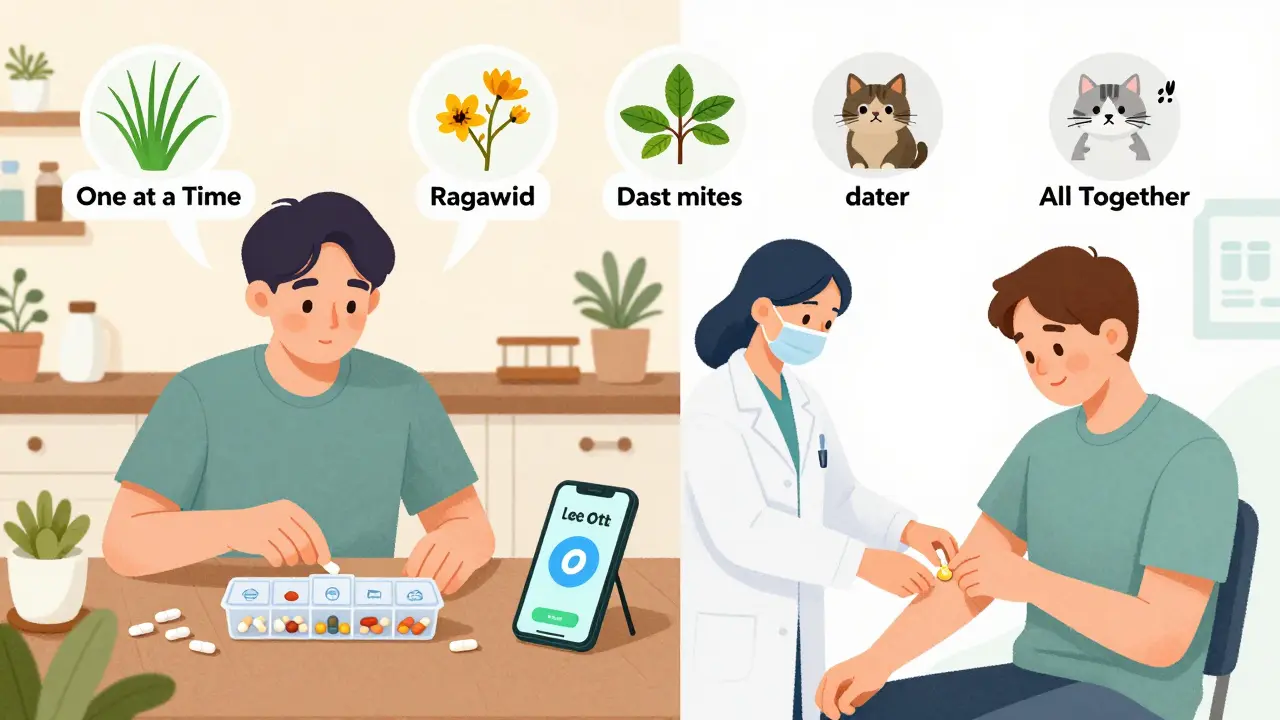
Which One Works Better?
Let’s compare them side by side.| Feature | Allergy Shots (SCIT) | Sublingual Tablets (SLIT) |
|---|---|---|
| Allergens Covered | 3-4+ per vial | One per tablet |
| Effectiveness (Symptom Reduction) | 82% | 67% |
| Treatment Duration | 3-5 years | 3-5 years |
| Build-Up Time | 3-12 months (traditional), 4-9 weeks (cluster) | None (daily dosing from day one) |
| Administration | Clinic visits (weekly then monthly) | Daily at home |
| Safety (Systemic Reactions) | 2.1% (traditional), 4.7% (cluster), 18.2% (rush) | Less than 1% (mostly oral itching) |
| Best For | Multiple allergies, severe symptoms, insect sting allergies | Single allergen, convenience-focused patients |
The data is clear: allergy shots win on effectiveness, especially for people with multiple allergies. A 2023 analysis from Allergy & Asthma Network found that 78% of allergy sufferers react to more than one allergen. For them, tablets are often a partial solution at best.
But convenience matters. In a 2022 survey by Aspire Allergy, 92% of tablet users said they preferred home dosing over weekly clinic visits. One user, a traveling salesperson, said: "I couldn’t manage weekly shots, but the tablet fits perfectly in my routine."
Real Patient Experiences
Online communities offer raw, unfiltered feedback. On Reddit’s r/Allergies, a 2023 analysis of 1,247 users who tried both treatments showed 68% had better results with shots. One user wrote: "After 2 years of Grastek with only 30% improvement, I switched to shots and got 80% relief by year two." On the flip side, 79% of tablet users in the same survey said they’d stick with tablets because they’re easier. Negative reviews often cite "no improvement"-but those users usually had multiple allergies and only took one tablet.For shots, the biggest complaints are scheduling conflicts (63% of dropouts) and injection site reactions (41%). For tablets, the top issue is lack of effectiveness for multi-allergen sufferers (58% of negative Healthgrades reviews).

Practical Tips for Choosing
If you’re considering immunotherapy, ask yourself:- How many allergens trigger your symptoms? If it’s two or more, shots are almost certainly better.
- Can you commit to weekly visits for several months? If not, cluster immunotherapy or tablets might be your best bet.
- Do you have a life-threatening reaction to insect stings? Only shots are approved for this.
- Are you disciplined about daily routines? Tablets fail if you skip doses.
Most clinics now offer cluster immunotherapy as a faster, safer alternative to traditional build-up. It cuts the time spent in the office by over 70%. If you’re worried about needles, ask if your allergist offers a numbing cream or a slower build-up.
For tablet users, set phone reminders. A 2022 study found that using reminders improved adherence by 37%. Track your doses. Miss one day? Don’t double up. Just resume the next day.
What’s Next?
The field is evolving fast. In 2025, companies are expected to submit applications for multi-allergen sublingual tablets-meaning one tablet could cover grass, ragweed, and dust mites. Peptide-based therapies are also in trials and could cut treatment time from 5 years to 2.Right now, only about 12-15% of allergy sufferers in the U.S. pursue immunotherapy. That’s partly because there are only 5,300 board-certified allergists serving the country. Access is uneven. If you live in a rural area, tablets might be your only realistic option.
But if you’re in a city with access to an allergist, and you’re serious about long-term relief, allergy shots remain the most powerful tool we have. They don’t just manage symptoms-they change how your body responds forever.
Are allergy shots painful?
Most people describe the injection as a quick pinch, similar to a flu shot. Some clinics offer numbing cream or ice to reduce discomfort. The biggest issue isn’t pain-it’s the time commitment. You need to sit for 30 minutes after each shot to watch for reactions.
Can children get immunotherapy?
Yes. Both allergy shots and sublingual tablets are approved for children as young as 5. Shots are often preferred for kids with multiple allergies or asthma risk. The American Academy of Allergy, Asthma & Immunology says immunotherapy can prevent the progression of allergic rhinitis to asthma in children.
Do insurance plans cover immunotherapy?
Most U.S. insurance plans cover both allergy shots and FDA-approved tablets. Shots are usually covered under medical benefits, while tablets are covered under pharmacy benefits. Out-of-pocket costs vary, but shots often cost $150-$400 per year after insurance. Tablets can run $300-$600 per year, depending on the brand and dosage.
What if I miss a shot or a tablet dose?
If you miss a shot, your allergist will likely repeat the last dose or adjust the schedule. For tablets, missing one day isn’t dangerous-just resume the next day. Don’t double up. Consistency over months and years matters more than perfection. But if you miss more than 10% of doses, effectiveness drops significantly.
Do I need to stop allergy medications during immunotherapy?
No. You can keep using antihistamines, nasal sprays, or eye drops while starting immunotherapy. In fact, many people use them during the build-up phase to manage symptoms. The goal is to reduce reliance on them over time. After 1-2 years, many patients find they need far less medication-or none at all.
Leon Hallal
March 10, 2026 AT 06:05Allergy shots saved my life. I used to be glued to antihistamines every spring. After two years of weekly shots, I went from sneezing nonstop to barely noticing pollen. No more itchy eyes, no more midnight coughing fits. It wasn't easy, but it was worth every minute in the clinic.
Now I just get a shot once a month. I forget I even had allergies until someone else is blowing their nose around me.
Mary Beth Brook
March 10, 2026 AT 11:17Tablets are a joke for multi-allergen patients. FDA-approved? Sure. Effective? Only if you have one allergen and live in a bubble. Real immunotherapy requires systemic exposure. Sublingual is a Band-Aid for people too lazy to show up to the clinic.
Shots are science. Tablets are marketing.
Robert Bliss
March 12, 2026 AT 01:19I tried both. Shots were rough at first - needles freak me out. But after the first month, I didn't even notice them. The tablets? I forgot to take them three days in a row and felt like I was back in June. I switched back to shots and haven't looked back.
Don't let convenience trick you. If you're serious about getting better, show up. Your immune system will thank you.
Peter Kovac
March 12, 2026 AT 03:45The claim that allergy shots reduce symptom severity by 82% is statistically misleading. The study cited (Annals of Allergy, Asthma & Immunology, 2021) used a self-reported symptom scale with no blinding or placebo control. The effect size was modest when adjusted for confounders like baseline severity and medication use.
Furthermore, the 78% multi-allergen statistic is cherry-picked from a subset of urban clinics. Rural populations show significantly lower efficacy due to environmental variability and inconsistent dosing schedules.
Immunotherapy is not a panacea. It is a tool with narrow indications and high attrition rates - approximately 40% discontinue before year three.
APRIL HARRINGTON
March 12, 2026 AT 05:16I switched from tablets to shots and I am literally a NEW PERSON
I used to cry in the car from pollen I swear I would cry I didn't think I could live like this
Now I go hiking I smell flowers I don't need tissues
My dog even notices I'm happier
IF YOU'RE ON THE FENCE JUST DO IT
THE FIRST MONTH IS HARD BUT THE REST IS MAGIC
Judith Manzano
March 13, 2026 AT 10:14I'm so glad this post exists. I had no idea shots could target multiple allergens at once. I thought I had to choose between grass and dust mites. Turns out I'm allergic to both - and my cat. I was using three different meds and still felt awful.
My allergist recommended cluster immunotherapy. I did it in six weeks. I was scared, but the nurses were amazing. Now I get one shot a month. I haven't taken an antihistamine in eight months.
It's not magic. It's science. And it works if you stick with it.
rafeq khlo
March 14, 2026 AT 17:17Western medicine continues to overstate efficacy while underestimating systemic consequences. The IgG4 blocking antibody theory is speculative at best. Immunotherapy induces a Th2 to Th1 shift, yet long-term studies show no reduction in IgE titers. The placebo effect dominates patient-reported outcomes.
Moreover, the economic burden of repeated clinic visits is unsustainable for working-class individuals. Tablets are not inferior - they are pragmatic adaptations to a broken healthcare system.
Do not mistake convenience for compromise. You are being sold a myth wrapped in clinical jargon.
Morgan Dodgen
March 15, 2026 AT 04:57They don't want you to know the truth about allergy shots
Big Pharma and the ACAAI are in bed together
Shots are designed to keep you coming back for years - that's how they make money
Tablets are cheaper for them to produce but they don't want you to have a home solution
And don't get me started on the 2024 cluster protocols - they're just a way to get you hooked faster
Read the studies. Look at the funding sources. Ask yourself: who benefits?
Philip Mattawashish
March 16, 2026 AT 13:35You people think immunotherapy is about health. It's about control. The medical-industrial complex doesn't want you cured. It wants you dependent. One shot a month. One tablet a day. Forever.
They'll sell you a lifetime of treatments while ignoring root causes - gut health, mold exposure, chronic stress.
And now they're pushing multi-allergen tablets? That's not progress. That's a trap. You're being conditioned to accept a slow, expensive, lifelong dependency.
Real healing doesn't require a prescription.
Jazminn Jones
March 16, 2026 AT 18:47While the data presented is statistically robust, the omission of cost-effectiveness analyses is glaring. The incremental cost per quality-adjusted life year (QALY) for subcutaneous immunotherapy exceeds $25,000 in most U.S. healthcare models, placing it outside acceptable thresholds for cost-effectiveness according to WHO guidelines.
Sublingual immunotherapy, despite lower efficacy, demonstrates superior cost-benefit ratios in low-income populations, particularly when adherence is supported by digital health interventions.
Recommendations must be contextualized within socioeconomic constraints - not merely clinical superiority.