SSRI Hyponatremia Risk Calculator
This tool helps assess hyponatremia risk for older adults taking SSRIs. The risk depends on the specific SSRI, use of thiazide diuretics, and baseline sodium levels. All values should be confirmed by your healthcare provider.
Hyponatremia Risk Assessment
Risk Level
Recommendation
Key Findings
Every year, more older adults are prescribed SSRIs for depression or anxiety. In fact, nearly one in five Americans over 65 are taking one of these medications. That’s not surprising-depression is common in later life, and SSRIs are often seen as safe and effective. But here’s the problem most people don’t talk about: these same drugs can quietly raise the risk of dangerously low sodium levels-and that’s what leads to falls, confusion, and sometimes hospitalization.
Why SSRIs Are Risky for Older Adults
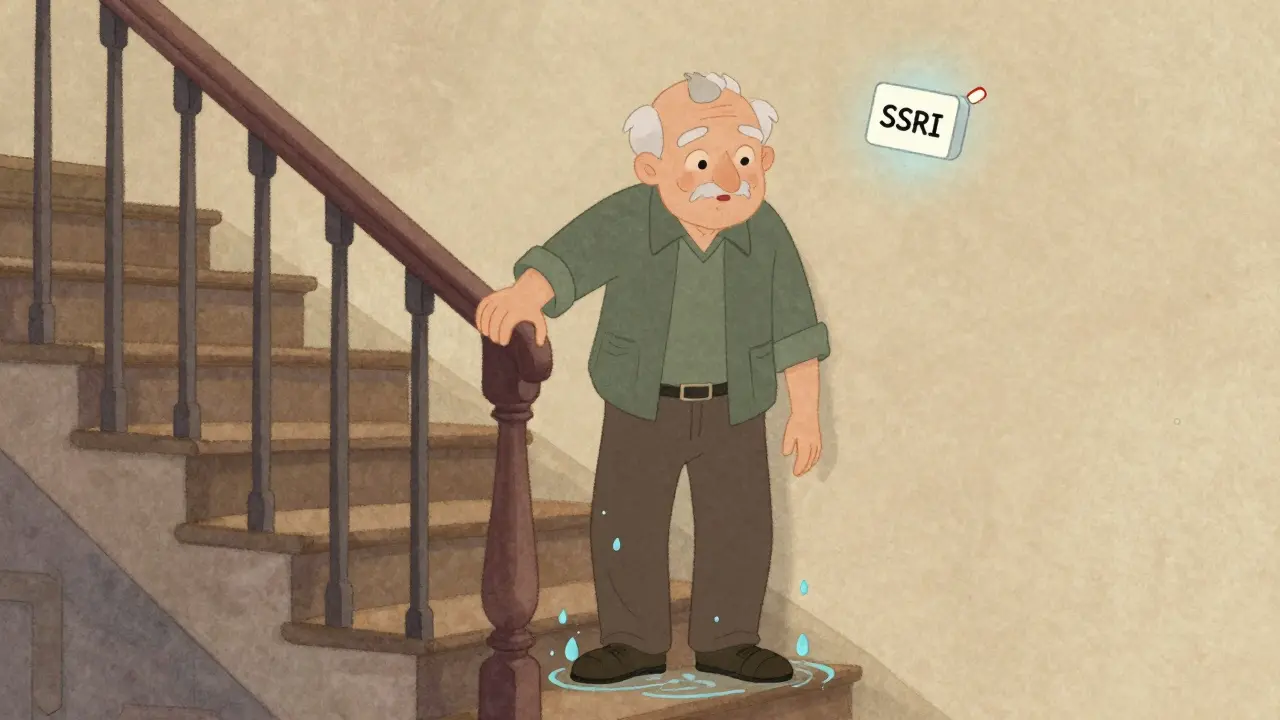
SSRIs work by increasing serotonin in the brain, which helps lift mood. But serotonin doesn’t just affect the brain. It also signals the kidneys to hold onto water. In older adults, this can trigger a condition called SIADH-syndrome of inappropriate antidiuretic hormone secretion. That means the body keeps drinking in water, diluting the sodium in the blood. When sodium drops below 135 mmol/L, you’ve got hyponatremia. The numbers don’t lie. Studies show older adults on SSRIs are more than twice as likely to develop hyponatremia compared to those not taking these drugs. And it’s not rare: about 6 out of every 100 seniors on SSRIs will develop it. Most cases show up within the first two to four weeks after starting the medication-or after a dose increase. That’s why timing matters. What makes older adults so vulnerable? Their bodies change. They have less total body water. Their kidneys don’t filter as well. Their hormones don’t respond the same way. Even a small shift in fluid balance can tip them into trouble.The Silent Link Between Low Sodium and Falls
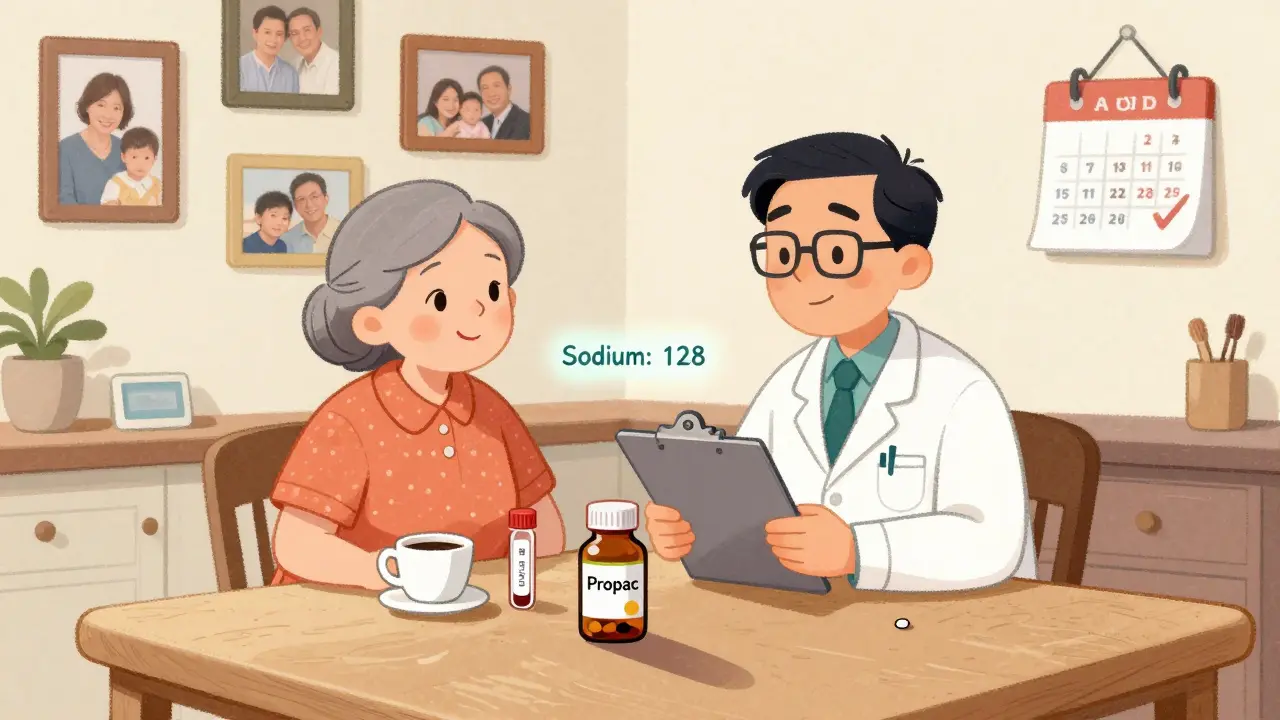
Hyponatremia doesn’t always cause obvious symptoms like nausea or seizures. In older adults, it often shows up as something subtler: dizziness, weakness, trouble walking, or feeling confused. These aren’t just "getting older" symptoms. They’re red flags. When sodium drops, brain cells swell slightly. That affects balance, coordination, and judgment. A person might stumble on a step they’ve walked a hundred times. They might get up to go to the bathroom and fall because they felt lightheaded. These aren’t accidents-they’re medical events triggered by a chemical imbalance. While studies haven’t yet put an exact number on how many falls are caused directly by SSRI-induced hyponatremia, clinicians see the pattern. A patient falls, fractures a hip, and when they’re tested, their sodium is 128. No head injury. No slippery floor. Just low sodium. And that sodium drop? It came from the antidepressant they started three weeks ago.Who’s at Highest Risk?
Not everyone on SSRIs gets hyponatremia. But some people are far more vulnerable:- People with low baseline sodium (below 140 mmol/L) before starting the drug
- Those with low body weight (BMI under 25)
- Women-the risk is slightly higher, though the reason isn’t fully clear
- People taking thiazide diuretics (like hydrochlorothiazide) for high blood pressure-this combo is especially dangerous
Which SSRIs Are Riskiest?
Not all SSRIs are created equal. Some carry much higher risks than others.- Fluoxetine (Prozac) has the highest risk among SSRIs-nearly 3.6 times more likely to cause hyponatremia than other SSRIs.
- Paroxetine (Paxil) and sertraline (Zoloft) also carry moderate to high risk.
- Citalopram (Celexa) and escitalopram (Lexapro) are slightly safer, but still risky.
What Are the Safer Alternatives?
If hyponatremia is your biggest concern, there are antidepressants with much lower risk:- Mirtazapine (Remeron) is the safest option. Multiple studies show almost no link to low sodium. It’s not an SSRI, but it works well for depression and sleep issues in older adults.
- Bupropion (Wellbutrin) doesn’t affect serotonin the same way, so it doesn’t trigger SIADH. It’s also less likely to cause weight gain or sexual side effects.
- Psychotherapy like CBT (cognitive behavioral therapy) is just as effective as medication for mild to moderate depression in seniors-and carries zero risk of hyponatremia.
What Should You Do Before Starting an SSRI?
You don’t have to avoid SSRIs entirely. But you need to be smart about it. Before starting:- Get a baseline blood test for sodium. Don’t assume it’s normal.
- Review all your medications. Are you on a thiazide diuretic? That’s a major red flag.
- Ask: "Is there a safer alternative?" Mirtazapine or bupropion might be better choices.
- Ask about non-drug options. Therapy, exercise, sunlight exposure-all help with depression without side effects.
- Get your sodium checked again at two weeks. That’s when levels usually drop.
- Watch for symptoms: dizziness, confusion, feeling off-balance, nausea, headaches.
- If you feel different-especially if you’re walking slower or stumbling-tell your doctor immediately.
Why Monitoring Alone Isn’t Enough
Here’s the frustrating part: some studies show that checking sodium levels regularly doesn’t always prevent hospitalizations. Why? Because finding the problem isn’t the same as fixing it. A 2023 study found that even when doctors caught hyponatremia early, many didn’t know what to do next. They didn’t stop the SSRI. They didn’t adjust the diuretic. They didn’t educate the patient. So the sodium kept dropping. That’s why protocols matter. Clinics that follow a full system-baseline test, two-week follow-up, medication review, patient education-see a 22% drop in emergency visits for hyponatremia. It’s not magic. It’s consistency.
What to Do If Hyponatremia Happens
If your sodium is low:- Mild (125-134 mmol/L): Stop the SSRI. Cut back on fluids. Recheck sodium in 48 hours.
- Severe (below 125 mmol/L): Go to the hospital. Correction must be slow-too fast can cause brain damage.
The Bigger Picture
More seniors are taking antidepressants than ever. Medicare spending on SSRIs jumped 34% between 2015 and 2022. But with that rise comes a hidden cost: hyponatremia-related hospitalizations now cost over $1.2 billion a year in the U.S. alone. The FDA updated SSRI labels in 2022 to warn about this risk. But warnings on a pill bottle aren’t enough. We need action: better screening, smarter prescribing, and more education for patients and doctors. New tools are coming. Hospitals are using AI systems that flag high-risk combinations-like an SSRI plus a diuretic-and automatically remind doctors to test sodium. Early results show a 19% drop in risky prescriptions. But until those systems are everywhere, the responsibility falls on you and your doctor. Don’t let depression go untreated. But don’t treat it with a drug that might put you at risk for a fall that changes your life.Final Advice: Ask These Questions
If you or a loved one is considering an SSRI:- "What’s my current sodium level?"
- "Am I on a diuretic? Can we switch to something safer?"
- "Is there a non-SSRI option with lower hyponatremia risk?"
- "Will you check my sodium again in two weeks?"
- "What symptoms should I watch for that mean I need to call you?"
Susan Arlene
January 5, 2026 AT 21:18Vinayak Naik
January 6, 2026 AT 05:06Ashley S
January 7, 2026 AT 17:45Jeane Hendrix
January 8, 2026 AT 18:51Katelyn Slack
January 9, 2026 AT 16:19Harshit Kansal
January 10, 2026 AT 18:42Kiran Plaha
January 12, 2026 AT 02:25Matt Beck
January 13, 2026 AT 05:22Indra Triawan
January 15, 2026 AT 02:35Lily Lilyy
January 16, 2026 AT 23:06Joann Absi
January 18, 2026 AT 13:46Mukesh Pareek
January 19, 2026 AT 16:32Rachel Wermager
January 19, 2026 AT 21:34Tom Swinton
January 20, 2026 AT 01:44