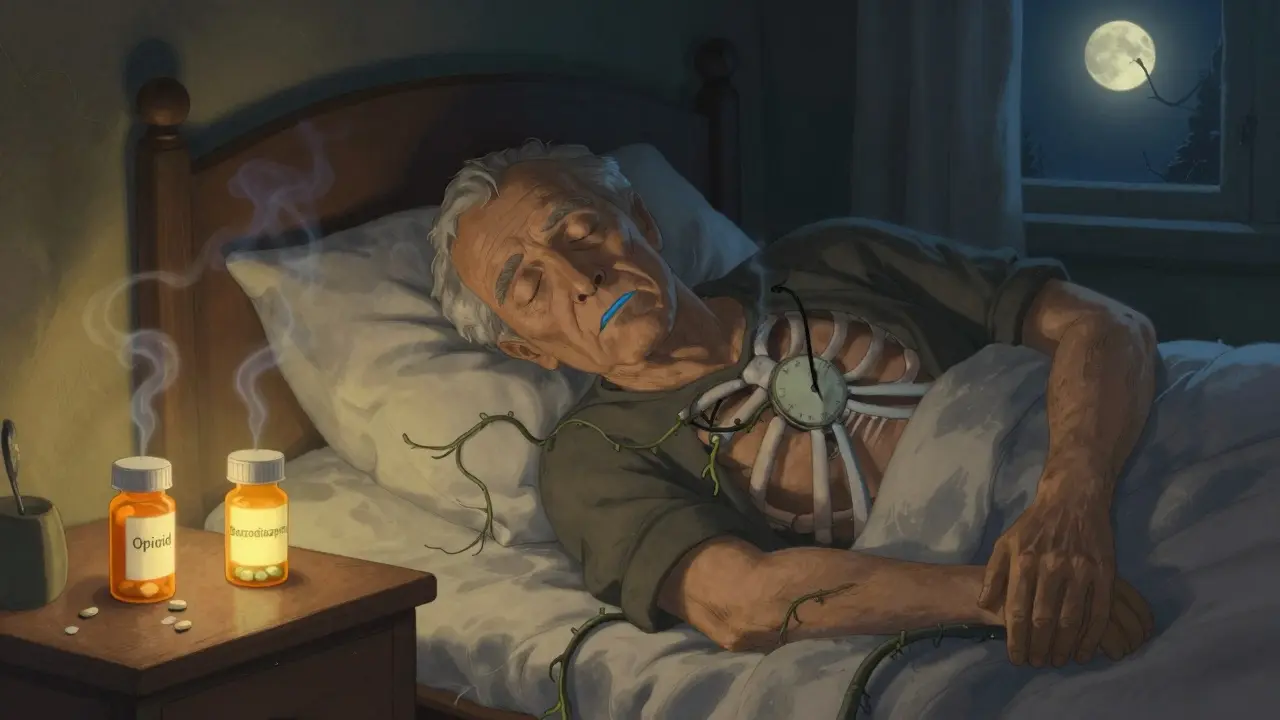
When you take opioids and benzodiazepines together, you’re not just doubling down on sedation-you’re putting your breathing at serious risk. This isn’t theoretical. It’s happening every day in homes, clinics, and emergency rooms across North America. In 2020, 16% of opioid-related overdose deaths involved benzodiazepines. That’s more than 1,000 people in the U.S. alone who died because two commonly prescribed medications, taken as directed, turned deadly when combined.
How These Drugs Work Together to Slow Your Breathing
Opioids like oxycodone, hydrocodone, and fentanyl work by binding to mu-opioid receptors in your brainstem-the area that controls automatic breathing. They dial down your body’s drive to inhale, especially when you’re asleep or relaxed. Benzodiazepines like alprazolam, lorazepam, and diazepam do something similar but through a different path: they boost GABA, a calming neurotransmitter that suppresses nerve activity in the same respiratory centers. The problem isn’t that each drug is dangerous on its own. It’s that when they’re taken together, they don’t just add up-they multiply. Studies show that people taking both drugs experience 85% more hypoxia (low blood oxygen) than those taking opioids alone. One clinical trial found that 85% of patients on both drugs dropped their oxygen saturation below 90%, compared to just 45% on opioids by themselves. That’s not a small difference. It’s the difference between feeling drowsy and stopping breathing entirely. Even worse, the interaction isn’t just about brain chemistry. Both drugs also relax the muscles in your upper airway. This can cause obstructive apnea-where your throat collapses while you sleep-making breathing even harder. For someone already breathing slowly from opioid effects, this is a recipe for respiratory arrest.The Hidden Danger: Tolerance Doesn’t Protect You
Many people assume that if they’ve been on opioids for months or years, their body has adapted. They think, “I’ve been taking pain meds for years-I can handle this.” That’s a deadly misconception. Research from the Annals of Palliative Medicine makes this clear: “Tolerance to respiratory depression from opioids does not mean tolerance to benzodiazepines.” A person who can take 80 mg of oxycodone daily without stopping breathing might die from just 1 mg of alprazolam when taken with it. Their body never learned how to compensate for the GABA boost. The brainstem doesn’t build resistance to both drugs at the same rate. And that’s why even experienced opioid users are at high risk. This is why the FDA issued a boxed warning in 2019-the strongest kind of alert-stating that combining these drugs can cause “extreme sleepiness, slowed or difficult breathing, coma, or death.” The warning wasn’t just a suggestion. It was a legal requirement added to the labels of every opioid and benzodiazepine product sold in the U.S.Who’s Most at Risk-and Why
It’s not just people using drugs recreationally. The biggest danger is among older adults and those with chronic conditions. The American Geriatrics Society lists this combination as potentially inappropriate for seniors in their Beers Criteria, because aging reduces liver and kidney function, slows drug clearance, and increases sensitivity to CNS depressants. A 70-year-old on oxycodone for back pain and lorazepam for anxiety is far more vulnerable than a 30-year-old taking the same doses. People with sleep apnea, COPD, or obesity are also at higher risk. Their breathing is already compromised. Adding these drugs is like turning down the air supply on a leaky tire. And it’s not rare. A 2021 study in JAMA Network Open found that 15% of Medicare Part D patients on long-term opioids were also prescribed benzodiazepines. In 4.3% of cases, the combination involved high-risk drugs-extended-release opioids with long-acting benzodiazepines. These are the prescriptions that linger in the system for days, building up silently until something triggers a collapse: a night of poor sleep, a cold that causes congestion, or even just lying down too quickly.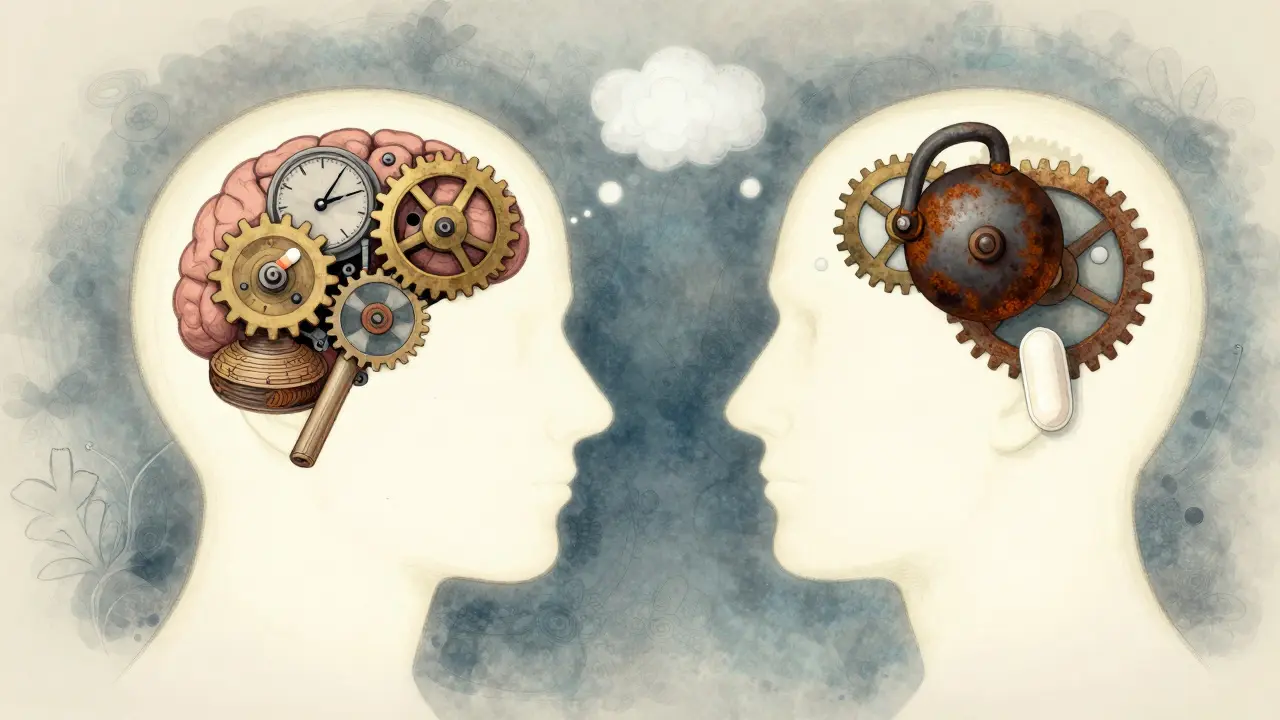
What Happens During an Overdose
An overdose from this combination doesn’t always look like a movie scene. There’s no screaming or thrashing. It’s quiet. The person becomes extremely drowsy, then hard to wake. Their breathing gets shallow-maybe 6 breaths per minute instead of 12-20. Their lips turn blue. Their pulse slows. They may slur their words, stumble, or seem confused. In many cases, they’re found unconscious hours later. By then, their brain has been starved of oxygen long enough to cause permanent damage-or death. Emergency responders report that naloxone, the opioid reversal drug, often doesn’t fully work in these cases because benzodiazepines aren’t affected by it. Even if the opioid is reversed, the GABA-driven respiratory depression continues. That’s why having rescue equipment-like a bag-valve mask or oxygen-available is critical. But most people don’t have this at home. And many doctors don’t warn patients about it.Prescribing Practices Are Changing-But Not Fast Enough
The CDC’s 2022 Clinical Practice Guideline says clearly: “Avoid prescribing benzodiazepines concurrently with opioids whenever possible.” That’s not a suggestion. It’s a standard of care. Many health systems now use electronic alerts to flag risky combinations. One study showed these alerts reduced inappropriate co-prescribing by 27.3% in a major hospital network. That’s progress. But it’s still happening. In 2020, over 7,800 Americans died from overdoses involving both drugs. That’s nearly 22 a day. Some exceptions exist. In hospice or palliative care, where the goal is comfort, not longevity, the risks may be weighed differently. But even then, doses are kept low, and monitoring is continuous. For most people-those managing chronic pain, anxiety, or insomnia-there are safer alternatives. For pain, consider physical therapy, NSAIDs, or non-opioid nerve medications. For anxiety, SSRIs, CBT, or mindfulness practices have proven effective without the breathing risk.
Kathy Scaman
January 28, 2026 AT 06:58My grandma was on oxycodone for her back and lorazepam for anxiety. She never said a word about the combo being risky. I found her unconscious one morning. Naloxone didn’t wake her up. They told me later it was the benzo that did it. I wish someone had warned us.
Now I carry Narcan in my purse. Just in case.
Anna Lou Chen
January 28, 2026 AT 18:21Let’s deconstruct the pharmacological hegemony here. The Cartesian dualism of CNS depression is being weaponized by Big Pharma to pathologize polypharmacy as ‘dangerous’-when in reality, it’s a symptom of a medical-industrial complex that reduces human suffering to chemical equations.
The GABAergic-opioid synergism isn’t a flaw-it’s an emergent property of neurochemical interplay that our reductionist regulatory frameworks refuse to acknowledge. We’re not ‘at risk’-we’re being policed into pharmacological purity.
Why not ask why we’re prescribed these in the first place? Trauma. Poverty. Chronic pain without social support. The drugs aren’t the problem. The system is.
Mindee Coulter
January 29, 2026 AT 05:24My dad took both for years. He never even knew it was a problem until his doctor pulled him off the benzo cold turkey and he had a panic attack so bad he called 911.
Turns out he didn’t need the Xanax at all. Just better sleep hygiene and therapy. He’s been off it for 2 years now and says he’s never felt clearer.
Don’t be scared. Be informed.
Colin Pierce
January 30, 2026 AT 22:12As a nurse who’s seen this play out in the ER too many times, I can tell you: the 85% hypoxia stat is real.
One patient, 68, on long-acting oxycodone and diazepam for ‘anxiety and back pain.’ He was fine until he got a cold. Congestion + slowed breathing = stopped breathing while sleeping.
Naloxone didn’t help. We had to bag him for 45 minutes. Brain damage avoided by luck.
If you’re on both, talk to your doctor. Not tomorrow. Today.
Mark Alan
February 1, 2026 AT 18:26THIS IS WHY AMERICA IS FALLING APART 🇺🇸😭
Doctors prescribing this like it’s candy. No wonder we’re all zombies. Take your pain meds and chill pills and just die already. I’m not even mad. I’m just disappointed.
Also, I carry Narcan. I’m the hero this country doesn’t deserve.
Ambrose Curtis
February 2, 2026 AT 03:21look i get it i used to take vicodin and xanax for years cause i thought it helped me sleep
but one night i woke up gasping like a fish outta water and my lips were blue and i just… stared at the ceiling
that’s when i knew
i didn’t need the xanax
the pain was bad but the sleep was worse
cut the benzo. got therapy. now i sleep better without it
your body doesn’t need two depressants to cope
just one honest conversation with your doc
Chris Urdilas
February 2, 2026 AT 19:45Oh wow. So the solution to the opioid crisis is… don’t take the other drug that’s literally prescribed by the same doctor who gave you the opioid?
Brilliant. Why didn’t we think of that?
Meanwhile, 15% of Medicare patients are still on both. So yeah, let’s just blame the patients for not reading the 37-page consent form they signed while in pain.
Maybe the real problem is that doctors are overworked, underpaid, and incentivized to write scripts, not have conversations.
But sure. Let’s just tell people to ‘ask their doctor.’ Like that’s a real option when you can’t get an appointment for 6 weeks.
Mel MJPS
February 3, 2026 AT 16:28My sister’s on methadone and clonazepam for chronic pain and PTSD. She’s terrified to bring it up with her doctor because she thinks he’ll think she’s ‘addicted’ or ‘needy.’
She’s not. She’s just trying to survive.
If you’re a provider reading this-please, talk to your patients like humans. Not cases.
We’re scared. We just need someone to listen.
Lance Long
February 5, 2026 AT 12:08You’re not alone. I was on both for 5 years. Thought I was managing. Turns out I was just surviving.
My turning point? I passed out on the couch and my dog started barking like crazy. I woke up choking. Couldn’t breathe. My dog saved me.
I started tapering. Took 8 months. Harder than quitting smoking.
But now? I sleep better. I think clearer. I laugh more.
You can do this. One step at a time. I’m rooting for you.
Timothy Davis
February 6, 2026 AT 16:2316% of opioid deaths involve benzos? That’s statistically insignificant compared to the 70% involving fentanyl. You’re cherry-picking data to scare people.
Also, ‘tolerance doesn’t protect you’? Says who? The FDA? The CDC? They’re not neuroscientists.
Real research shows that chronic opioid users develop partial tolerance to respiratory depression. Benzos don’t override that-they augment it. Big difference.
Stop sensationalizing. People need facts, not fear porn.
fiona vaz
February 8, 2026 AT 12:14I’m a therapist who works with chronic pain patients. So many of them were prescribed benzos because no one knew how to treat their anxiety without it.
But CBT? Mindfulness? Even just walking outside for 20 minutes a day? It helps.
You don’t need a pill to feel safe.
It’s not easy. But it’s possible.
And you deserve to be heard, not just medicated.
Sue Latham
February 8, 2026 AT 16:31Wow. Someone finally wrote something that doesn’t sound like a pharmaceutical ad.
Most doctors don’t even know this combo is dangerous. I had mine prescribed by a PA who didn’t know what GABA was.
Also, ‘ask your doctor’ is such a rich person’s phrase. My doctor doesn’t answer emails. He sees 40 patients an hour.
But hey, I guess I’m just supposed to ‘be responsible’ while he gets paid to prescribe.
Thanks for the info. Now I’m scared. And confused. And alone.
John Rose
February 10, 2026 AT 15:32Thank you for this. I’m a medical student and this is exactly what we’re taught-but rarely seen in practice. The disconnect between guidelines and real-world prescribing is staggering.
I’ve seen patients on 120mg oxycodone and 4mg diazepam daily. No monitoring. No follow-up. Just a refill every month.
It’s not negligence. It’s systemic failure.
But this post? It’s a step toward change. I’ll be sharing it with my classmates.