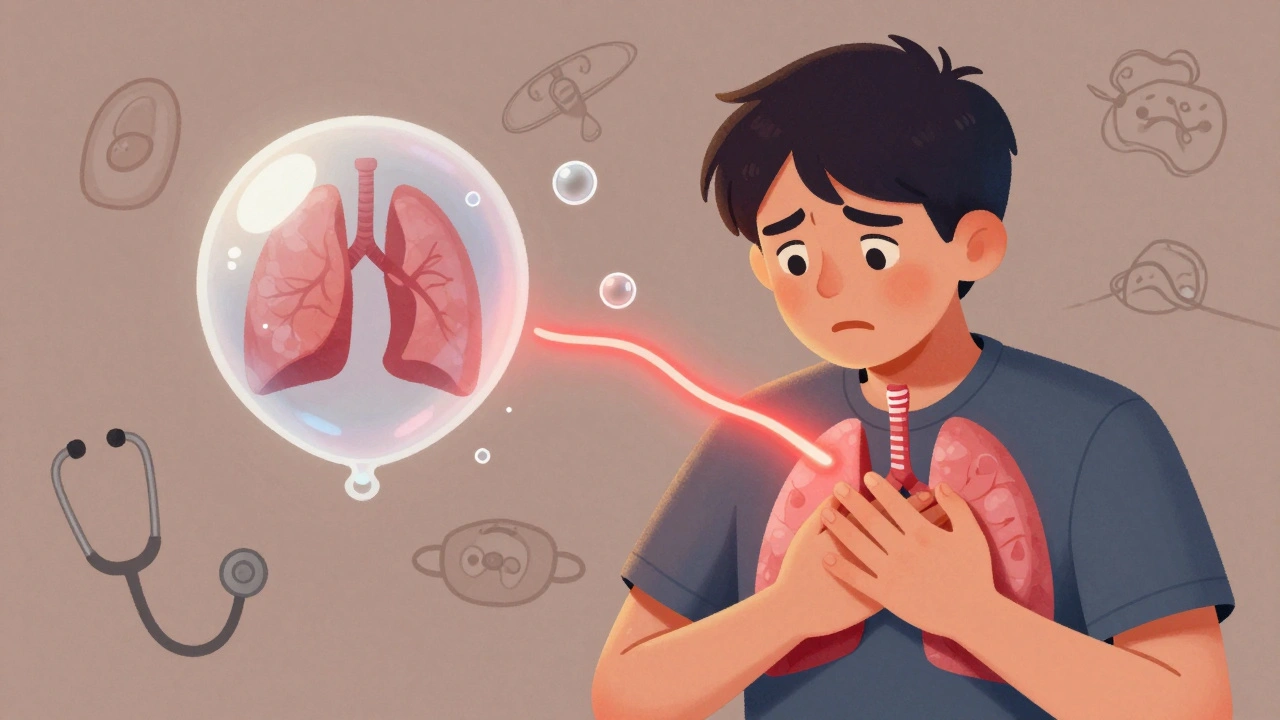
What Exactly Is a Collapsed Lung?
A collapsed lung, or pneumothorax, happens when air leaks out of the lung and gets trapped between the lung and the chest wall. This air builds up pressure, squeezing the lung like a balloon losing its shape. The lung can’t expand properly when you breathe, so you struggle to get enough air. It’s not just a minor annoyance-it’s a medical emergency that can turn deadly in minutes if not handled right.
This isn’t something that happens to just one kind of person. It can strike someone young and healthy with no history of lung problems, or someone older with chronic lung disease. The good news? If you know the signs and act fast, the chances of recovery are very high.
How to Spot a Collapsed Lung-Symptoms You Can’t Ignore
The symptoms of pneumothorax are sharp, sudden, and hard to mistake. Most people describe it like this: one moment you’re fine, the next you feel a stabbing pain in your chest that gets worse every time you breathe in or cough. It’s not a dull ache-it’s a knife-like stab, usually on one side only.
That pain often shoots up into your shoulder on the same side. In fact, studies show over 90% of patients report this shoulder radiation. It’s a key clue doctors look for.
Right after the pain, shortness of breath hits. You might feel like you can’t catch your breath, even when sitting still. If the collapse is small (less than 15% of the lung), you might only notice it when climbing stairs or walking fast. But if it’s bigger-over 30%-you’ll feel out of breath even at rest. Oxygen levels can drop below 90%, which your body notices immediately.
Other physical signs include:
- Quiet or absent breathing sounds on the affected side
- A hollow, drum-like sound when the chest is tapped (hyperresonance)
- Less vibration felt when placing your hand on the chest while someone speaks (decreased tactile fremitus)
If you’re seeing these signs, don’t wait. The worst-case scenario is tension pneumothorax-a life-threatening twist where the air keeps building up, pushing the heart and other organs to one side. This can cause your heart rate to spike above 130 beats per minute, your blood pressure to crash below 90, and your skin to turn blue. Tracheal deviation (windpipe shifting) is a late sign and shouldn’t be waited for.
When Every Second Counts: Emergency Care Protocols
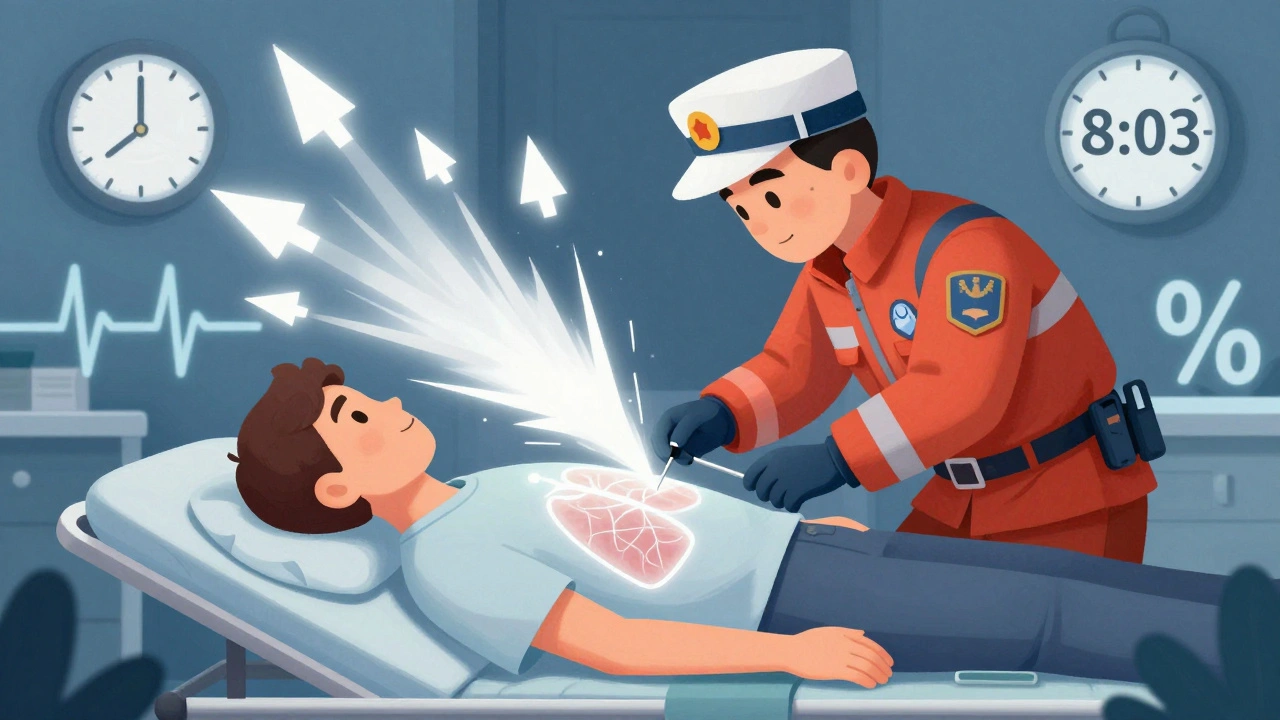
If someone has signs of tension pneumothorax-low blood pressure, high heart rate, trouble breathing, and bluish skin-there’s no time for X-rays or waiting rooms. The rule is simple: act immediately. Emergency teams are trained to perform needle decompression right then and there. A needle is inserted into the chest to release the trapped air. This isn’t optional-it’s life-saving. Delaying it by even a few minutes can be fatal.
For non-tension cases, the clock still ticks. If a patient has oxygen levels below 92% or is struggling to breathe, a chest tube needs to be placed within 30 minutes. The goal isn’t just to fix the leak-it’s to restore lung function before the body starts shutting down.
Imaging is important, but not if it delays care. A chest X-ray is the standard first test-it catches 85-94% of cases. But in trauma patients lying on their backs, X-rays miss up to 60% of pneumothoraces. That’s why many ERs now use ultrasound. With a trained operator, ultrasound can spot a collapsed lung with over 94% accuracy in under a minute. The “lung point” sign-a spot where lung movement stops and air begins-is a telltale marker.
The fastest emergency departments now diagnose and treat simple pneumothorax in under 25 minutes. For tension cases, it’s under 10 minutes. That speed saves lives.
How Is It Diagnosed? Tools, Tests, and What They Reveal
Doctors don’t guess-they measure. Chest X-ray is still the go-to first step. But it’s not perfect. In upright patients, it’s reliable. In trauma victims lying flat, it’s often useless. That’s why many hospitals now combine X-ray with ultrasound.
CT scans are the gold standard. They can detect as little as 50 milliliters of air-tiny leaks an X-ray would miss. But CTs aren’t used for everyone. They involve radiation (1-7 mSv), take longer, and aren’t always available in the ER. So they’re reserved for unclear cases or when planning surgery.
Blood tests help too. Arterial blood gas analysis often shows low oxygen (PaO2 <80 mmHg) and low carbon dioxide (PaCO2 <35 mmHg), meaning the person is breathing too fast to keep up. This isn’t just a lab result-it’s a sign the body is in distress.
On X-ray, doctors measure the rim of air between the lung and chest wall. If it’s more than 2 centimeters, that means about half the lung has collapsed. That’s the trigger for intervention. Smaller ones might be watched.
Treatment Options-From Watching to Surgery
Not every collapsed lung needs a tube or surgery. For small, first-time cases in healthy people, doctors may just give oxygen and watch. Breathing pure oxygen speeds up the body’s ability to reabsorb the air. Studies show 82% of these cases heal on their own within two weeks.
If the collapse is bigger, they might try needle aspiration. A thin tube is inserted to suck out the air. It works about 65% of the time. If that fails, or if the patient is unstable, a chest tube is placed. This is a bigger procedure-usually a 28F tube left in for a few days. It works in 92% of cases, but comes with risks: infection, bleeding, or fluid buildup after the lung re-expands.
For people who’ve had two or more collapses, surgery is often the best choice. Video-assisted thoracoscopic surgery (VATS) is minimally invasive. Surgeons use small cameras and tools to seal the leak and remove weak spots in the lung lining. Success rates are 95% at one year. Recovery takes 2-4 days in the hospital, and costs around $18,500 in the U.S.-but it cuts recurrence risk from 40% down to 3-5%.
For those with chronic lung disease like COPD, the stakes are higher. Their one-year death rate after pneumothorax is 16.2%. That’s why even small leaks in these patients are treated aggressively.
Recovery, Recurrence, and What You Must Do After
Most people recover fully. But the fear of it happening again is real. About 1 in 3 people who have a first spontaneous pneumothorax will have another within two years. The risk jumps to 62% after a second episode on the same side.
Some factors make recurrence more likely:
- Smoking: If you smoke more than 10 pack-years, your risk is over 20 times higher
- Being tall and thin: Height over 70 inches raises risk by more than three times
- Being male: Men are nearly seven times more likely than women to get it
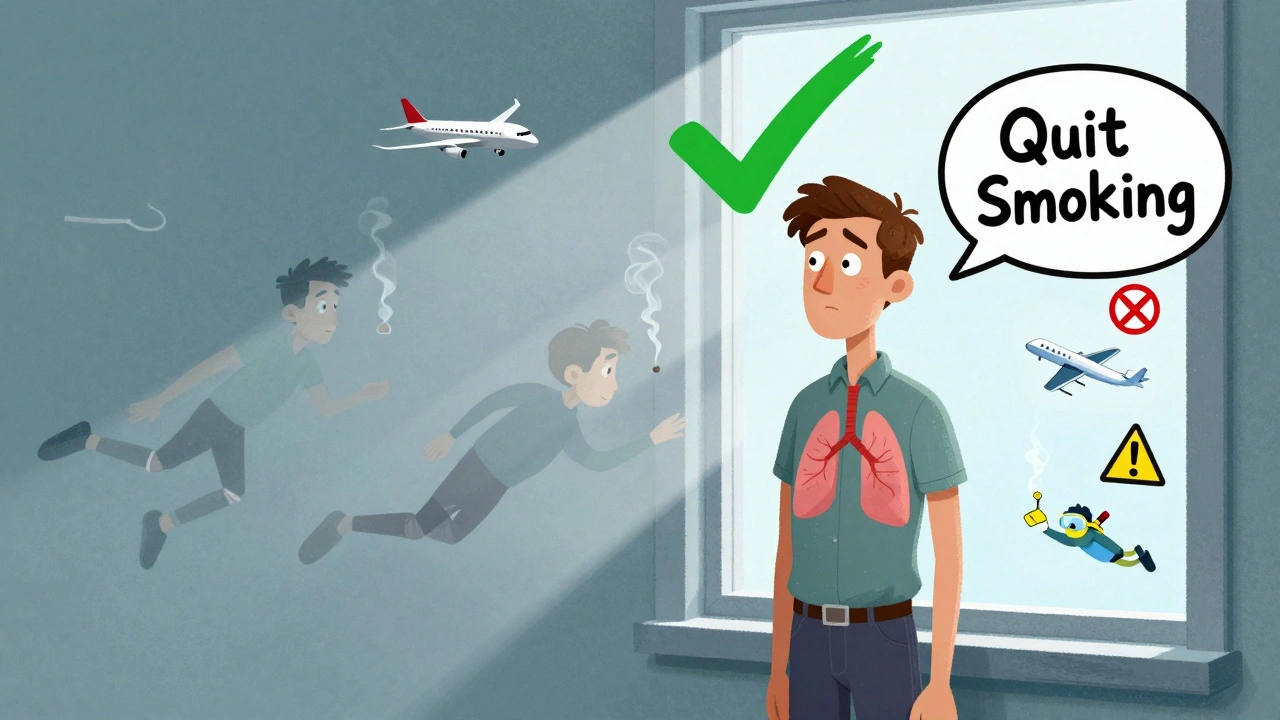
The single most effective way to prevent recurrence? Quit smoking. Studies show quitting cuts your risk by 77% in the first year. No other intervention comes close.
Other important rules after recovery:
- Avoid flying for 2-3 weeks after the lung has fully healed. Changes in cabin pressure can cause the leak to return.
- Never scuba dive unless you’ve had surgery to prevent recurrence. The risk of another collapse underwater is over 12%.
- Get a follow-up chest X-ray at 4-6 weeks. About 8% of people develop delayed complications if they don’t.
Know the warning signs of a return: sudden sharp chest pain, inability to speak in full sentences, or turning blue. If you feel any of these, call emergency services immediately. Don’t drive yourself. Don’t wait.
What to Do If You Think It’s Happening
If you or someone else suddenly has sharp chest pain and trouble breathing, don’t assume it’s heartburn, a pulled muscle, or anxiety. Pneumothorax doesn’t wait for a doctor’s appointment. It needs help now.
Here’s what to do:
- Stop what you’re doing. Sit down. Stay calm.
- Call emergency services immediately. Say: “I think I have a collapsed lung.”
- Don’t try to breathe deeply. Take slow, shallow breaths.
- If the person is losing consciousness, turning blue, or has no pulse, start CPR if you’re trained.
- Do not give them anything to eat, drink, or take by mouth.
Time is everything. The longer you wait, the higher the chance of complications. Every 30-minute delay increases risk by over 7%.
Regan Mears
December 11, 2025 AT 13:41This post is a lifesaver. I had a spontaneous pneumothorax last year-no warning, just a stabbing pain while walking the dog. I thought it was a pulled muscle. Turns out, my lung was 40% collapsed. If I hadn’t rushed to the ER, I might not be here. Don’t ignore chest pain. Even if you’re young and fit. Your body doesn’t lie.
Ben Greening
December 12, 2025 AT 02:37The clinical description of hyperresonance and decreased tactile fremitus is accurate and well-articulated. It is imperative that first responders and primary care providers remain vigilant for these subtle physical exam findings, particularly in atypical presentations.
Eddie Bennett
December 12, 2025 AT 18:30I’m a paramedic and I’ve seen this too many times. People wait. They think it’s heartburn. Or anxiety. Or they’re just out of shape. Then they show up blue and gasping. We do needle decompression in the field now-no waiting. I’ve watched people go from ‘I’m fine’ to ‘I can’t breathe’ in under 90 seconds. This isn’t drama. It’s physics. Air in the wrong place = lung squished. Period.
Michaux Hyatt
December 13, 2025 AT 12:25For anyone reading this and thinking ‘it won’t happen to me’-I get it. I thought that too. But I was 22, 6’2”, and ran marathons. One day I bent over to tie my shoe and felt like someone stabbed me in the side. Turns out, I had a bleb rupture. No smoking, no trauma, no reason. Ultrasound saved me. My ER doc had it on the screen in 40 seconds. Don’t wait for the textbook symptoms. If something feels wrong in your chest, get checked. Seriously.
Rebecca Dong
December 14, 2025 AT 04:48Wait… so you’re telling me the government doesn’t want us to know about this? Why is ultrasound so fast but not used everywhere? Coincidence that this happened right after the new CDC guidelines? I’ve seen videos of needles being inserted in parking lots. Who’s really controlling the ERs? Are they hiding the real cure? I’m not crazy-I’ve researched. This is a cover-up. 🤔
Nikki Smellie
December 15, 2025 AT 21:17Dear Author, I am writing to express my profound concern regarding the potential misuse of ultrasound technology in emergency pneumothorax diagnosis. While your article is commendable in its technical accuracy, I must insist that the use of portable ultrasound devices may violate the 1978 FDA Medical Device Amendments Act, Section 510(k), as these devices are not yet universally registered under Class II certification. Furthermore, the term ‘lung point’ is not recognized by the International Classification of Diseases (ICD-11) and may lead to diagnostic misclassification. Please consider revising your article to align with global regulatory standards. Sincerely, Dr. Nikki Smellie, M.D., Ph.D., F.A.C.S. 📋
Neelam Kumari
December 16, 2025 AT 03:04Wow. So the ‘expert’ advice is ‘go to ER’? That’s it? No wonder people die in this country. In India, we use turmeric paste and chanting. It’s cheaper, no radiation, and your soul gets healed too. You people think medicine is about machines. We know it’s about energy. 🙄
Queenie Chan
December 17, 2025 AT 16:57It’s wild how the body turns into a pressurized balloon you didn’t know you were holding. One second you’re breathing like normal, the next it’s like your ribcage is trying to swallow your lung. The shoulder pain? That’s the real red flag-it doesn’t make sense unless you’ve felt it. I remember thinking, ‘Why does my shoulder hate me?’ Turns out, my lung was staging a rebellion. And ultrasound? That little handheld wizard with the gel and the green glow? It’s the unsung hero of the ER. I’m not a doctor, but I’ve seen it work. And I’ll never ignore a sharp side pain again.
Monica Evan
December 18, 2025 AT 03:45Just had this happen to my cousin-he’s 19, plays basketball, never smoked. Went to urgent care, they said ‘muscle strain.’ He went back 8 hours later barely able to talk. Chest tube inserted. He’s fine now but terrified. Don’t let anyone brush this off. Even if you’re young. Even if you think it’s nothing. And if you’re in a rural area? Call 911. Don’t wait for a doctor’s appointment. Your lung doesn’t care about your schedule. 💔
Jim Irish
December 19, 2025 AT 05:50Early recognition saves lives. Ultrasound is increasingly replacing X-ray in trauma settings. Needle decompression remains the gold standard for tension pneumothorax. Time is critical.
Mia Kingsley
December 20, 2025 AT 17:55Okay but what if it’s just a panic attack?? I had this once and I was like ‘oh my god I’m dying’ but it was just my anxiety and I took a selfie and posted it and got 200 likes and then I felt better. So maybe we’re overreacting? Like what if the whole pneumothorax thing is just a medical scam to sell chest tubes?? 😭
Katherine Liu-Bevan
December 22, 2025 AT 06:58For those unfamiliar with the lung point sign: it’s the transition zone on ultrasound where the visceral pleura reappears as the lung inflates. Its presence confirms pneumothorax with high specificity. When combined with absent lung sliding, sensitivity exceeds 90%. This is now standard in advanced trauma life support protocols. If your facility doesn’t use it, ask why.
Lisa Stringfellow
December 22, 2025 AT 07:12So you’re saying if you don’t get to the ER in 10 minutes, you die? That’s so dramatic. Who even has time for that? I’ve got a Zoom meeting at 3. Maybe I’ll just take a nap and hope it goes away. Also, why do they always use needles? Can’t they just… let it heal naturally? I read once that lungs are like balloons and they can just… re-inflate. Right? 🤷♀️
Kristi Pope
December 23, 2025 AT 06:05This is exactly the kind of info we need out there. I’m a nurse and I’ve watched people delay care because they didn’t want to ‘bother’ anyone. Don’t be that person. Your life isn’t a burden. If your chest feels like it’s being crushed by a brick, go. Now. And if you’re scared? Bring someone. Or call 911. We’ve all been there. You’re not alone. 💪❤️