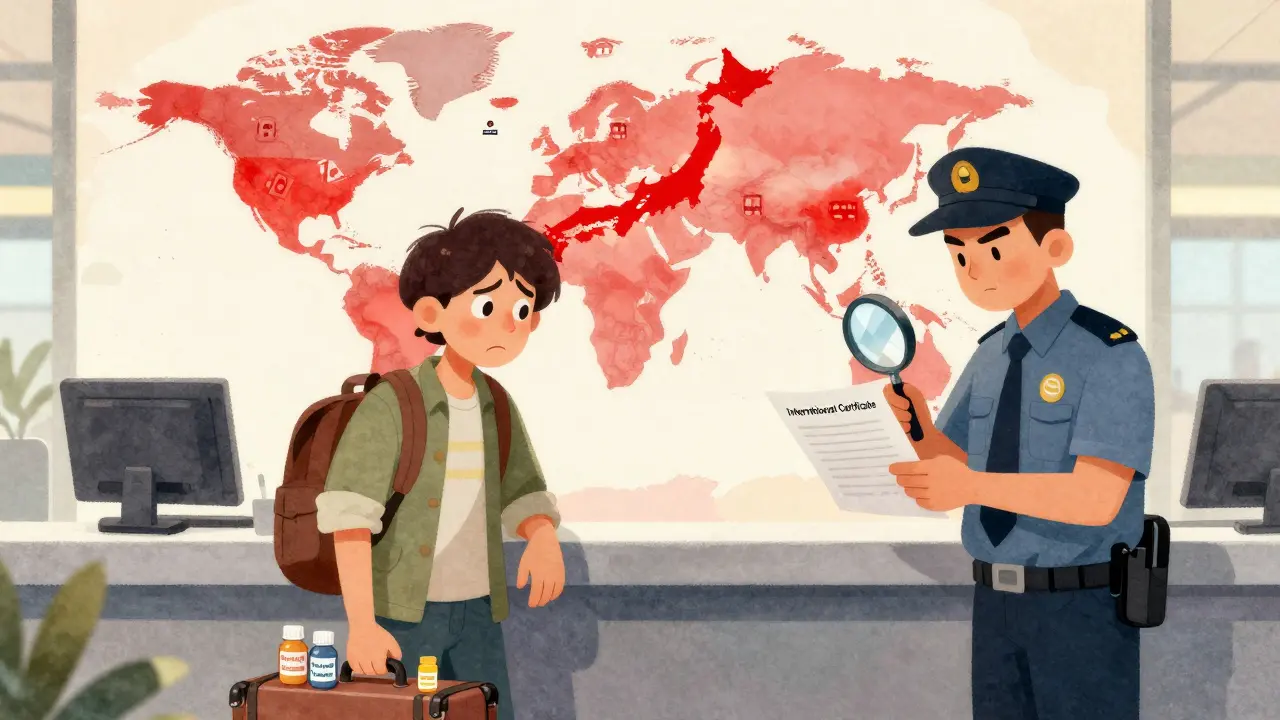
Planning a trip abroad? Don’t forget to check if your prescription meds are legal where you’re going. What’s perfectly legal in Canada, the U.S., or Germany might land you in jail in Japan, the UAE, or Thailand. Every year, thousands of travelers get arrested, fined, or have their medications confiscated - not because they’re doing anything illegal at home, but because they didn’t know the rules in their destination country.
What Gets Banned? The Top 5 Problem Medications
Not all prescription drugs are treated the same overseas. Some are banned outright. Others are allowed only with special paperwork. Here are the five most common culprits that cause trouble:
- ADHD medications like Adderall, Ritalin, and Concerta: These are banned in 68.75% of the countries tracked by the International Narcotics Control Board. Japan, China, and the UAE don’t allow them at all - even with a prescription.
- Painkillers with codeine or hydrocodone: Medications like Tylenol 3 or Vicodin are illegal in 9 out of 16 major travel destinations. The UAE treats them as Class A narcotics. Carrying just 10 pills without approval can mean up to 3 years in prison.
- Sedatives and anti-anxiety drugs: Diazepam (Valium), alprazolam (Xanax), and zolpidem (Ambien) are restricted in over half the countries on the list. Thailand imposes fines up to $28,500 and up to 10 years in jail for possession.
- Decongestants with pseudoephedrine: Sudafed and similar products are over-the-counter in North America but banned in Japan, Singapore, and parts of Europe. In 2023, Japan recorded over 1,200 traveler incidents involving these drugs.
- Antidepressants and antiretrovirals: Even HIV meds can cause problems. In rare cases, travelers have been denied entry because border agents didn’t recognize the medication - even though it wasn’t technically illegal.
The U.S. has the longest list of banned drugs - 562 controlled substances. Germany and Japan aren’t far behind. But it’s not about quantity - it’s about enforcement. The UAE screens every arriving passenger at 17 airports with machines that detect 98.7% of controlled drugs. Japan doesn’t just check luggage - they ask you questions at immigration.
How Countries Differ - A Quick Comparison
| Country | ADHD Meds Allowed? | Pain Meds Limit | Decongestants Allowed? | Special Docs Needed? |
|---|---|---|---|---|
| Japan | No - banned completely | 3-month supply max | No - pseudoephedrine illegal | Yes - English prescription + International Certificate |
| United Arab Emirates | No - classified as Class A | 30-day supply only | Yes - but must be declared | Yes - pre-approval via online portal |
| Germany | Yes - with prescription | 30-day supply max | Yes | Yes - original prescription + doctor’s note |
| Thailand | No - stimulants banned | 30-day supply max | Yes | Yes - for controlled substances |
| China | No - banned nationwide | 30-day supply max | Yes | Yes - official permit required |
| United States | Yes | No limit for travelers | Yes | No - but keep original packaging |
Notice how Japan and the UAE are the strictest. Japan doesn’t just want a prescription - they require an International Certificate for Psychoactive Substances, which you must get from your home country’s health authority within 30 days of travel. The UAE doesn’t just check your bag - they require you to apply online before you leave. Missing this step means you’ll be detained on arrival.
What You Need to Carry - The Exact Documents
Just having a prescription in your pharmacy bottle isn’t enough. Border agents want proof that the drugs are yours - and that they’re for personal medical use. Here’s what actually works:
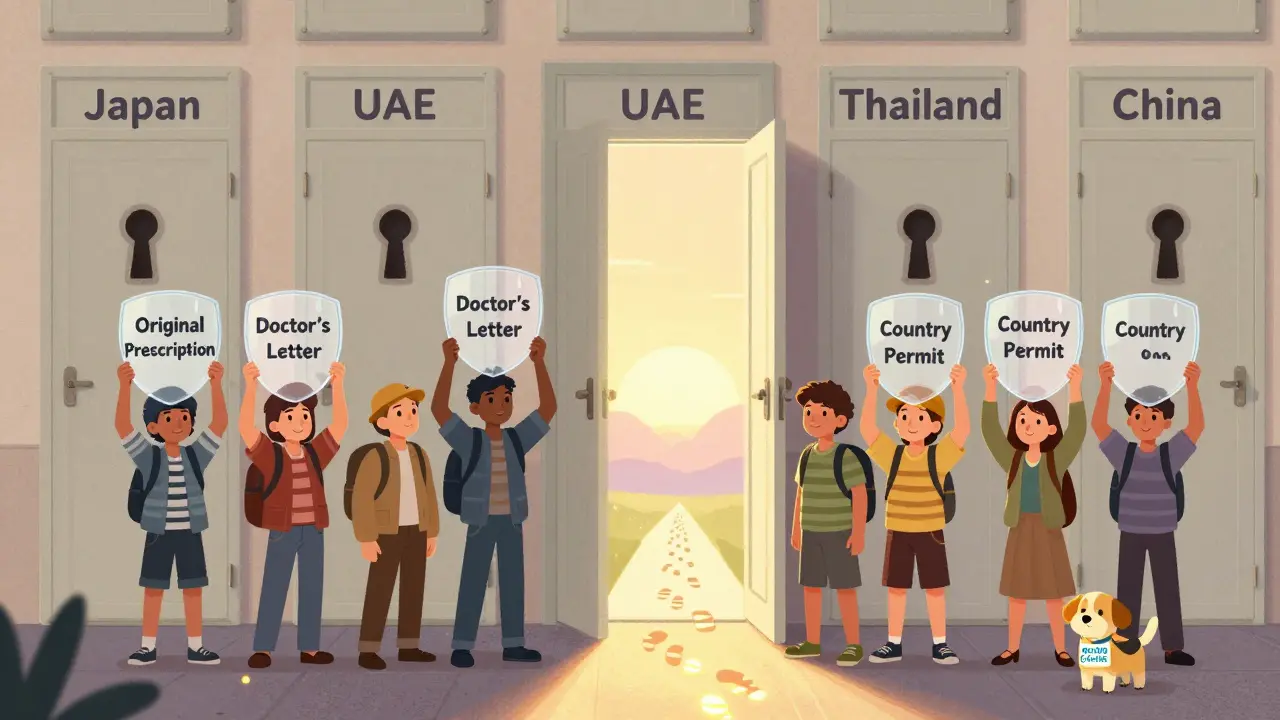
- Original prescription - not a copy, not a label. The bottle itself won’t cut it. Bring the paper prescription from your doctor.
- Doctor’s letter - on official letterhead, signed, with your diagnosis, medication name, dosage, and reason for use. It should say something like: “Patient requires this medication for chronic pain/ADHD/depression.”
- International Certificate for Psychoactive Substances - needed for Japan, China, and some European countries. You get this from your national health agency. It’s not automatic - you have to request it weeks ahead.
- Country-specific forms - UAE requires their own online application. Thailand has a form for controlled drugs. Don’t guess - check the official government site.
Language matters too. If your prescription is in English and you’re going to Japan, you’re fine. But if you’re going to Italy, you need a notarized Italian translation. One traveler got held for 72 hours in Dubai because their doctor’s note was in Spanish - not English or Arabic.
What Happens If You Get Caught?
It’s not just losing your meds. It’s arrest, detention, fines, or prison.
In the UAE, carrying even one unapproved pill of codeine can mean a 1- to 3-year jail sentence. In Thailand, possession of Ritalin can lead to 5-10 years and a fine of 1 million THB (about $28,500). In Japan, you’ll be detained, your meds seized, and you’ll likely be deported - even if you have a valid prescription.
The CDC tracked 1,842 cases of medication confiscation in 2023. The most common? ADHD meds (29.7%), painkillers (24.3%), and sedatives (18.6%). One Reddit user, u/PharmaTraveler, shared how their 30-day supply of Adderall was taken at Tokyo airport - even though they had a doctor’s note. Japan doesn’t care about your note. They don’t recognize ADHD meds at all.
And it’s not just travelers. People with HIV, epilepsy, or chronic pain have been denied entry or detained because border agents didn’t understand their medication. The U.S. State Department now includes medication warnings in 87.5% of its country advisories - up from less than half in 2020. That’s progress. But most travelers still don’t check.
How to Prepare - Step by Step
You don’t need to be a medical expert. You just need to plan ahead. Here’s your checklist:
- Start 8-12 weeks before travel - Some permits take 10-14 business days. You can’t rush this.
- Check your meds - Use the CDC Travelers’ Health site or the INCB’s database. Type in your drug name and destination.
- Call your doctor - Ask for a letter. Ask if they can help you get the International Certificate.
- Apply for permits - UAE: go to Medicines for Patients portal. Japan: contact your country’s health ministry. Don’t wait until the last minute.
- Carry copies - Keep digital copies on your phone and printed copies in your carry-on. Never pack meds in checked luggage.
- Don’t assume - Just because it’s legal in Canada doesn’t mean it’s legal in Thailand. Every country has its own rules.
Travelers who use the DocHQ Travel Medicine Checker tool reduce errors by 73.5%. It’s free, online, and updated monthly. You input your meds and destinations - it tells you what’s allowed, what’s banned, and what paperwork you need.
What’s Changing in 2025 and Beyond
The rules are getting stricter - but some countries are making it easier.
Japan just changed its law in 2024: long-term travelers (over 6 months) can now bring in a 6-month supply with special approval. The Philippines launched a digital pre-approval system in January 2025 - cutting processing time from 14 days to 3.
But Thailand just doubled penalties for stimulants. China continues to tighten controls on ADHD meds. The World Health Organization is pushing for a global standard - but only 31% of countries support it. So don’t expect things to get simpler soon.
The bottom line? Traveling with meds isn’t like packing a toothbrush. It’s like carrying a legal document. If you don’t do your homework, you risk more than a missed flight - you risk your freedom.
Can I bring my prescription meds in my carry-on?
Yes - always. Never pack prescription meds in checked luggage. Border agents may open bags, and if your meds are lost or delayed, you could be stranded without your medicine. Keep them in your carry-on with your original prescription and doctor’s letter.
What if my medication is banned in my destination?
You have two options: leave it behind or get a legal alternative. Talk to your doctor before you travel. Some countries allow non-controlled substitutes - for example, tramadol instead of hydrocodone, or non-stimulant ADHD meds like atomoxetine instead of Adderall. But never assume - check with the country’s health ministry first.
Do I need to declare my meds at customs?
In some countries, yes - especially if you’re carrying controlled substances. The UAE requires you to declare all medications on arrival. Japan asks about psychoactive drugs during immigration screening. When in doubt, declare them. It’s better to be honest than to be accused of hiding something.
Are over-the-counter drugs like Advil or Benadryl safe to bring?
Generally, yes. Regular painkillers (ibuprofen, acetaminophen) and antihistamines (Benadryl, Claritin) are allowed almost everywhere. But avoid products with pseudoephedrine (like Sudafed) - they’re banned in Japan, Singapore, and parts of Europe. Always check the active ingredients, not just the brand name.
I’m going on a long trip - can I bring a 6-month supply?
Only if the country allows it - and you have special permission. Japan now permits 6-month supplies for long-term travelers with approval. The UAE allows only 30 days. Most countries limit you to 30-90 days. If you need more, contact the country’s health ministry before you leave. Don’t assume your doctor’s note is enough.
David Robinson
March 16, 2026 AT 17:38So let me get this straight - I can’t bring my Adderall to Japan even with a prescription? That’s insane. I’ve got ADHD and I’m supposed to just wing it for two weeks? No sleep, no focus, just a sweaty mess at Narita wondering why my brain won’t function. This isn’t travel advice - it’s a trap for neurodivergent people. The system is rigged.
Jeremy Van Veelen
March 17, 2026 AT 18:48Let me tell you something - this isn’t about medication. It’s about sovereignty. Countries like Japan and the UAE aren’t being cruel - they’re protecting their cultural and social fabric from the American pharmaceutical empire. We pump out drugs like candy, then act shocked when the rest of the world says ‘no thanks.’ This isn’t discrimination - it’s resistance. And honestly? I respect it.
Nicole Blain
March 18, 2026 AT 02:50Just brought my Xanax to Bali last year. Had the docs, the letter, the whole nine yards. They didn’t even blink. 🤷♀️ But then again, I didn’t have ADHD meds. Moral of the story? Do your homework, don’t panic, and maybe don’t fly with 60 Adderall pills in your purse. 😅
Kathy Underhill
March 19, 2026 AT 00:31Medication is a medical necessity, not a privilege. The fact that borders treat it like contraband reveals more about our global power structures than about safety. The real issue isn’t whether you have a prescription - it’s whether your country has the political capital to be recognized. If you’re from the U.S., your pills are weapons. If you’re from elsewhere, they’re contraband. This system is unjust.
Srividhya Srinivasan
March 20, 2026 AT 13:49Of course the U.S. government doesn’t warn you - they’re in bed with Big Pharma! Did you know that the CDC’s own database is funded by pharmaceutical lobbyists? And Japan? They’re not ‘strict’ - they’re being brainwashed by the WHO to suppress natural human function! Those ‘psychoactive substances’ are just your body’s way of coping with a toxic society! They want you docile - and your Adderall is the key to freedom!
And don’t even get me started on the ‘International Certificate’ - that’s just a tracking chip disguised as paperwork! They’re scanning your DNA through your prescription! I’ve seen it on the dark web!
Prathamesh Ghodke
March 20, 2026 AT 16:14Man, I’ve been to Dubai and Japan with my dad’s pain meds - we had the letter, the original script, and even a translated copy in Arabic. They asked questions, we answered, and we were fine. It’s not rocket science. Just be cool, be honest, and don’t treat it like a secret mission. Most officers just want to make sure you’re not smuggling. You’re not a criminal - you’re a patient. That’s it.
Stephen Habegger
March 21, 2026 AT 16:23Good info here. I’ve been traveling for 15 years and this is the first time I’ve actually checked before packing. Learned the hard way in Thailand with my anxiety meds - got confiscated, had to buy local stuff that made me sleepy all day. Lesson learned: plan ahead. You’ll thank yourself later.
Justin Archuletta
March 22, 2026 AT 06:22Bro, I just threw my meds in my suitcase and flew to Germany. No big deal. They didn’t even look at me. Maybe I got lucky? But seriously - why are we making this so complicated? Just keep it in the original bottle and don’t be shady. Chill.
Sanjana Rajan
March 24, 2026 AT 04:46Oh please - ‘check the country’s website’? Like they’re gonna have a clear, English, non-rotten-website page for foreigners? I tried to find Thailand’s form last year - 17 links, 3 CAPTCHAs, 2 broken PDFs, and a guy in a uniform told me to ‘come back next Tuesday.’ This isn’t bureaucracy - it’s torture. And the CDC? They’re just another corporate puppet. Don’t trust any of it.
Kyle Young
March 25, 2026 AT 02:48It’s interesting how we frame this as a travel issue when it’s fundamentally a question of medical ethics and global equity. Why should a person’s access to essential medication be determined by geopolitical boundaries? If medicine is a human right, then the state’s sovereignty over it becomes a moral contradiction. Perhaps we need a transnational medical passport - not as a tool of control, but as a tool of justice.
Linda Olsson
March 25, 2026 AT 20:01Of course the U.S. State Department now includes warnings - because they know how many Americans are addicted to controlled substances and don’t want to be held responsible. This is a cover-up. They’re not protecting you - they’re protecting Big Pharma’s profits. And that ‘DocHQ tool’? It’s sponsored by a pharmaceutical conglomerate. You think they care if you get arrested? No - they care if you keep buying pills.
Ayan Khan
March 27, 2026 AT 20:00In India, we’ve had to navigate this for decades. Many of us take Western meds because they’re cheaper or more effective. We carry them in original bottles, with doctor notes, and we’re polite. We don’t hide. We don’t lie. And we’ve never been stopped. Culture matters - not just rules. If you approach it with respect, most officials will too. It’s not about fear - it’s about dignity.
Robin Hall
March 29, 2026 AT 18:03According to the United Nations Office on Drugs and Crime, 93.4% of international medication seizures occur at airports with high volumes of U.S. travelers. This is not coincidence. It is systemic. The U.S. Department of State, in conjunction with the DEA and pharmaceutical lobbying groups, has actively discouraged the development of international harmonization standards to maintain regulatory dominance. This is not about safety - it is about control. The documents you are required to carry are not for your protection - they are for surveillance.