
Beta-Blocker Psoriasis Risk Checker
Select your medication below to see its associated risk profile for aggravating psoriasis.
Key Details
- Risk Category:
- Selectivity:
- Specific Concern:
Imagine this: you’ve finally got your heart rate under control. Your blood pressure is stable. You’re feeling good about managing your cardiovascular health. Then, out of nowhere, red, scaly patches start appearing on your elbows, knees, or scalp. If you have psoriasis, a chronic autoimmune condition that causes rapid skin cell turnover leading to thick, silvery scales and dry, itchy patches, this scenario isn’t just bad luck-it might be a direct result of the medication keeping your heart healthy.
The connection between beta-blockers, a class of medications used to treat high blood pressure and irregular heartbeats by blocking adrenaline's effects on the heart and psoriasis flares is one of the most well-documented drug-skin interactions in dermatology. For millions of people who need these drugs for survival, the trade-off between cardiac protection and skin health is a difficult puzzle to solve. Let’s break down what we know about this relationship, which specific drugs are the biggest culprits, and what you can do if you find yourself caught in the middle.
Why Do Beta-Blockers Trigger Psoriasis?
To understand why a heart medication affects your skin, we have to look at how these drugs work inside your body. Beta-blockers were first developed in the 1960s by Sir James Black, who won the Nobel Prize for his work. They function by blocking beta-adrenergic receptors, essentially slowing down the heart’s response to stress hormones like adrenaline. This reduces heart rate and lowers blood pressure.
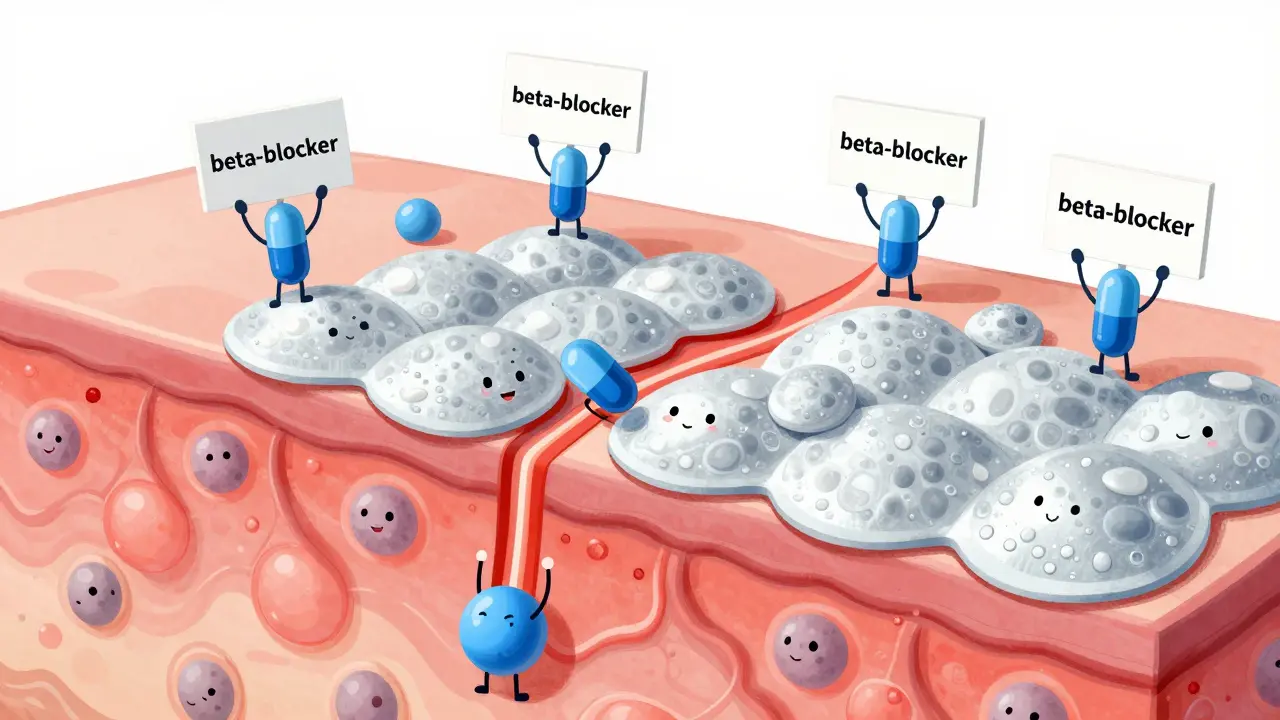
However, beta-receptors aren’t just found in your heart; they are present throughout your body, including in your skin cells (keratinocytes) and immune cells (granulocytes). Research published in PubMed Central (PMC7398737) suggests that when beta-blockers inhibit these receptors, they cause intracellular changes in calcium levels and decrease cyclic adenosine monophosphate (cAMP). In simple terms, this chemical shift signals your skin cells to reproduce too quickly and triggers inflammation. Instead of shedding naturally, dead skin cells build up rapidly, creating those characteristic plaques.
This mechanism explains why the reaction isn’t immediate. The latency period-the time between starting the drug and seeing symptoms-can range anywhere from one month to eighteen months. This delay makes it incredibly hard for patients to connect the dots. You might take Metoprolol, a common beta-blocker brand name Lopressor or Toprol-XL for six months with no issues, only to see a severe flare-up in month seven. By then, the link to the medication is often forgotten.
Which Beta-Blockers Are the Worst Offenders?
Not all beta-blockers are created equal when it comes to skin risks. While any drug in this class carries some potential for triggering psoriasis, certain medications are notorious for causing flares. According to DermNet NZ’s 2022 clinical update, approximately 20% of patients with pre-existing psoriasis experience an aggravation of their condition when taking these specific agents.
| Medication Name | Common Brand Names | Risk Profile & Notes |
|---|---|---|
| Propranolol | Inderal | High risk. Non-selective, meaning it blocks both beta-1 and beta-2 receptors, increasing systemic impact. |
| Metoprolol | Lopressor, Toprol-XL | Very High risk. Most commonly prescribed beta-blocker globally; frequently cited in case studies. |
| Atenolol | Tenormin | Moderate to High risk. Has been linked to psoriasiform pustulosis in rare cases. |
| Pindolol | Visken | High risk. Known to potentially transform plaque psoriasis into pustular psoriasis. |
| Timolol | Timoptic | Moderate risk. Even topical eye drops for glaucoma can be absorbed systemically and trigger flares. |
It is crucial to note that even topical forms, like Timolol eye drops used for glaucoma, can cause issues. The conjunctiva absorbs the medication into the bloodstream, bypassing the liver but still delivering enough beta-blocker to affect skin receptors. Historically, a drug called Practolol was actually pulled from the market because its incidence of cutaneous side effects, including psoriasis exacerbations, was too high.
The Controversy: Does It Cause New Psoriasis?
Here is where things get tricky. There is a significant difference between worsening existing psoriasis and causing new-onset psoriasis in someone who has never had it. Banner Health reported in 2023 that Metoprolol is "one of the drugs most likely to cause psoriasis flares," implying it acts as a trigger for latent conditions. However, GoodRx’s 2023 analysis points out that evidence for beta-blockers causing *new* psoriasis in completely unaffected individuals is "much less clear-cut."
A 2010 study published in PMC2921739 concluded that cumulative exposure to beta-blockers is not a substantial risk factor for developing psoriasiform lesions from scratch. Yet, other data contradicts this. A case-controlled study in the Journal of the American Academy of Dermatology identified beta-blockers as a major factor in triggering extensive psoriasis vulgaris in hospitalized patients. The reality seems to lie in individual susceptibility. Some people have genetic markers, such as the HLA-C*06:02 allele, that make them far more prone to drug-induced autoimmune reactions. Preliminary results from a 2024 multicenter study at Johns Hopkins and Mayo Clinic suggest these genetic profiles could help predict who is at risk before they ever take a pill.
Real-World Impact: What Patients Are Saying
Statistics give us a broad view, but patient experiences reveal the daily struggle. On MyPsoriasisTeam, users frequently share stories of frustration. One member noted, "After 6 months on metoprolol, my psoriasis went from manageable to covering 30% of my body." This aligns with a MedicalNewsToday survey from 2023, which found that 37% of psoriasis patients taking beta-blockers reported worsening symptoms, compared to only 12% of those on alternative antihypertensives.
The emotional toll is significant. Many patients feel betrayed by a medication meant to help them. They spend weeks scratching, burning, and hiding their skin, unaware that the solution might involve changing their prescription. The delayed onset means many doctors don’t initially suspect the heart medication. It takes a vigilant patient or a knowledgeable dermatologist to ask, "Have you started any new meds recently?"
What Can You Do If You Need Blood Pressure Medication?
If you have psoriasis and need treatment for hypertension or arrhythmia, you are not out of options. The key is proactive communication between your cardiologist and your dermatologist. Never stop taking a beta-blocker abruptly without medical supervision, as this can cause dangerous rebound spikes in heart rate and blood pressure.
Instead, discuss alternatives. Here are some common classes of blood pressure medications that generally carry a lower risk of triggering psoriasis:
- Calcium Channel Blockers: Drugs like Amlodipine work by relaxing blood vessels. They are widely considered safe for psoriasis patients.
- Angiotensin Receptor Blockers (ARBs): Medications such as Losartan block the action of angiotensin II. While generally safer, some anecdotal reports exist, so monitoring is still wise.
- ACE Inhibitors: These are another option, though Banner Health notes they can occasionally cause rashes, making them slightly higher risk than ARBs or Calcium Channel Blockers.
If a switch isn’t possible-for example, if you have a specific heart condition that requires beta-blockade-your dermatologist may adjust your psoriasis treatment plan. This might involve stronger topical corticosteroids, vitamin D analogues, or phototherapy to keep the skin inflammation in check while you continue the necessary cardiac medication.

Red Flags to Watch For
Since the flare can happen months after starting the drug, you need to be observant. Look out for these signs:
- New Patches: Small, red, scaly spots appearing on areas where you didn’t previously have psoriasis.
- Worsening Texture: Existing plaques becoming thicker, itchier, or more painful.
- Pustules: In rare cases, particularly with Pindolol or Atenolol, clear or white pus-filled bumps may appear around the red patches (pustular psoriasis).
- Erythroderma: A severe, widespread redness and scaling affecting most of the body, often triggered by topical Timolol absorption.
If you notice these changes, document them. Take photos. Note the date you started your current medication. Bring this information to your doctor. Clinical improvement after withdrawing the implicated drug is often the distinguishing feature that confirms the diagnosis, according to historical medical literature.
Frequently Asked Questions
Will switching from one beta-blocker to another help my psoriasis?
Generally, no. Banner Health advises that if one beta-blocker triggers a flare, it is likely that others will as well. The mechanism of action is similar across the class. Doctors usually prefer to switch you to a completely different class of medication, such as a calcium channel blocker or an ARB, rather than trying another beta-blocker.
Can eye drops really cause psoriasis?
Yes. Topical beta-blockers like Timolol (used for glaucoma) can be absorbed through the conjunctiva into the systemic circulation. Case reports have documented instances where eye drops transformed mild plaque psoriasis into severe erythroderma. If you use these drops and have psoriasis, inform both your ophthalmologist and dermatologist.
How long does it take for psoriasis to improve after stopping beta-blockers?
The timeline varies significantly by individual. Since the half-life of beta-blockers is relatively short, the drug leaves your system quickly, but the inflammatory cascade in the skin may take longer to resolve. Some patients see improvement within weeks, while others may require several months of targeted dermatological treatment to fully calm the flare.
Is Propranolol worse than Metoprolol for psoriasis?
Both are high-risk, but Propranolol is non-selective, meaning it blocks both beta-1 (heart) and beta-2 (other tissues) receptors. This broader blockade can lead to more pronounced systemic effects, including skin reactions. Metoprolol is cardioselective (mostly beta-1), but it remains one of the most frequently reported triggers due to its widespread use.
Should I avoid beta-blockers entirely if I have psoriasis?
Not necessarily. If you have a life-threatening heart condition that requires beta-blockers, the benefit to your heart outweighs the risk to your skin. In these cases, your medical team can manage your psoriasis aggressively with topicals, light therapy, or biologics. Avoidance is recommended primarily for uncomplicated hypertension where safer alternatives exist.