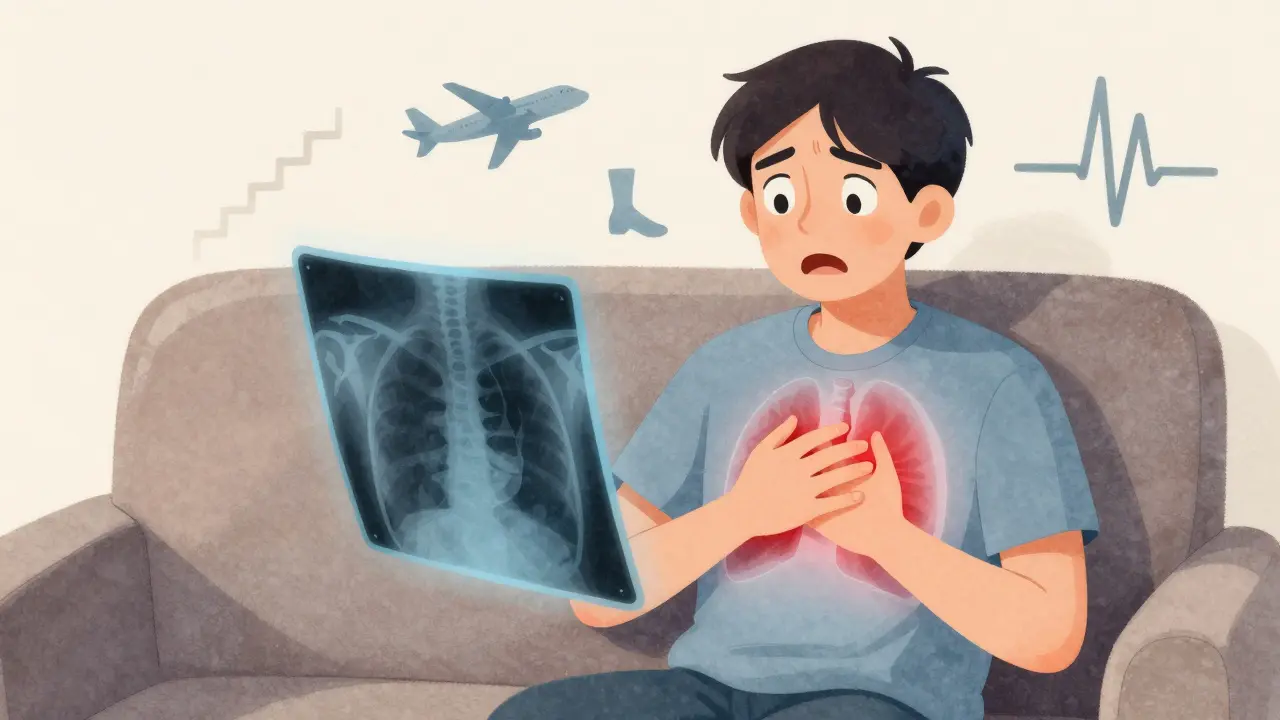
A sudden gasp for air while sitting still. Breathing harder than usual climbing stairs. That feeling you can’t catch your breath - even when you’re not out of shape. If this happened to you and no one could explain why, you might be staring at a pulmonary embolism.
Pulmonary embolism (PE) isn’t just another case of asthma or anxiety. It’s a blood clot blocking blood flow in your lungs. And it kills around 100,000 people in the U.S. every year. Many of those deaths happen because the symptoms look like something else. The most common sign? Sudden shortness of breath. It shows up in 85% of cases, according to the National Institutes of Health. That’s more than chest pain, more than coughing, more than dizziness. It’s the red flag that should never be ignored.
Why Does a Blood Clot Cause Sudden Breathlessness?
Your lungs are where oxygen gets into your blood. When a clot blocks even one of the main arteries there, that flow stops. Oxygen can’t get through. Your body panics. Your heart beats faster. Your breathing becomes shallow and quick. You feel like you’re suffocating - even if you’re sitting on the couch watching TV.
The size of the clot matters. A small clot might just make you feel winded after climbing a flight of stairs. A large one, blocking the main artery, can cause collapse. About 92% of people with massive PE have severe shortness of breath even at rest. And here’s the twist: you might not feel chest pain. Or you might think it’s a heart attack. But in PE, the pain is often sharp and gets worse when you breathe in deeply. That’s called pleuritic pain. It’s a key clue.
What Else Should You Watch For?
Shortness of breath doesn’t come alone. Look for these signs together:
- Coughing - especially if you’re coughing up blood (hemoptysis). This happens in about 23% of cases.
- One swollen leg - usually the calf. Deep vein thrombosis (DVT) in the leg is where 70% of these clots start. If one leg is noticeably bigger, warmer, or tender, that’s a major red flag.
- Rapid heartbeat - over 100 beats per minute. Not from exercise. Not from caffeine. Just out of nowhere.
- Fast breathing - more than 20 breaths per minute while resting.
- Fainting or near-fainting. This happens in about 14% of cases. It’s a sign the clot is large enough to strain your heart.
Some people think they’re just out of shape. Others blame stress. But if these symptoms come on suddenly - especially if you’ve been sitting for hours on a flight, recently had surgery, or have a history of blood clots - don’t wait. Get checked.
How Doctors Diagnose Pulmonary Embolism
There’s no single test that catches PE every time. But doctors use a smart, step-by-step system.
First, they use a scoring tool - either the Wells Criteria or the Geneva Score. These tools ask questions like: Do you have leg swelling? Did you recently have surgery? Are you on hormone therapy? Do you have cancer? The answers help estimate how likely PE is. If the score says low risk, they move to the next step.
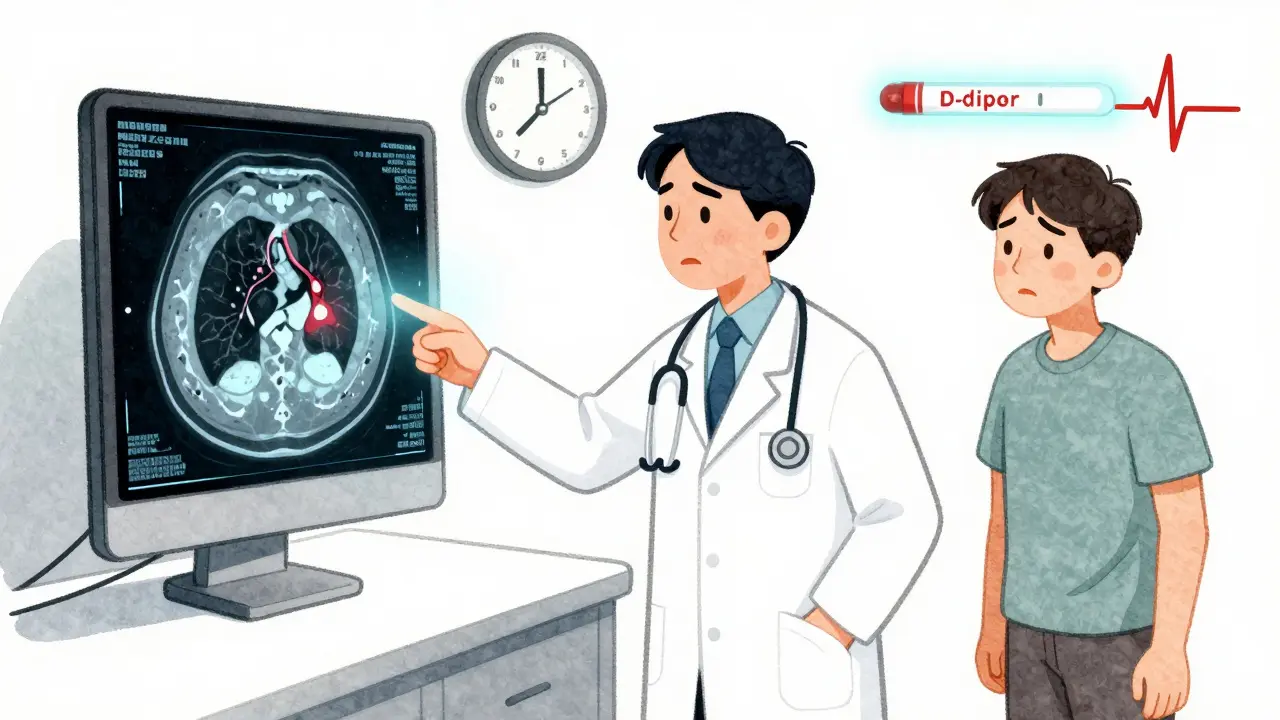
That step is a D-dimer blood test. This test looks for fragments of broken-down clots. If the result is normal and your risk score is low, PE is almost certainly ruled out. The test is 97% accurate at ruling out PE in low-risk people. But here’s the catch: it’s not perfect. In people over 50, the test becomes less reliable. And if you have cancer, the D-dimer can be high even without a clot. That’s why doctors don’t rely on it alone.
If the D-dimer is high or your risk is moderate to high, they order a CT pulmonary angiography (CTPA). This is the gold standard. A CT scan with contrast dye shows exactly where the clot is. It catches 95% of PEs. It’s fast. It’s accurate. And it’s what most emergency rooms use today.
For people who can’t have contrast dye - maybe because of kidney problems or allergies - doctors use a ventilation/perfusion (V/Q) scan. It’s less common, but still effective. It shows which parts of the lung are getting air but not blood. That mismatch points to a clot.
And if you’re unstable - fainting, low blood pressure, racing heart - doctors skip the waiting game. They do an ultrasound of your heart right at your bedside. If they see your right ventricle is swollen and struggling, it’s almost certainly a massive PE. Time is critical. They start treatment immediately.
What Makes Diagnosis So Hard?
Many patients visit their doctor multiple times before getting the right diagnosis. A 2022 survey in Australia found 68% of PE patients were misdiagnosed at least once. Common mistakes? Asthma. Pneumonia. Anxiety. Even a pulled muscle.
One patient on a health forum described shortness of breath for three weeks. Her doctor said it was stress. She finally collapsed in the grocery store. A scan showed a massive clot. Another person said doctors dismissed her until she passed out. That’s not rare. It happens because PE doesn’t have a single signature symptom. It’s a chameleon.
Also, D-dimer results can be misleading. If you wait too long to get tested - more than 24 hours after symptoms start - the test becomes less reliable. False negatives rise by 12% every 12 hours. That’s why timing matters.
New Tools Are Changing the Game
Things are getting better. In 2023, the American College of Chest Physicians updated guidelines to use age-adjusted D-dimer levels. Instead of one cutoff for everyone, the limit now increases with age. For someone 75, the threshold is 175 ng/mL. This cuts down on unnecessary CT scans by over a third - without missing more clots.
Artificial intelligence is stepping in too. A tool called PE-Flow can analyze CT scans and flag clots with 93.7% accuracy. It’s not replacing doctors, but it’s helping them spot small clots they might miss.
Hospitals are also forming Pulmonary Embolism Response Teams (PERT). These are teams of specialists - radiologists, hematologists, intensivists - who jump in when a PE is suspected. They don’t wait. They act fast. Hospitals with PERTs have cut death rates from 8.2% to 3.1%.
Who’s at Highest Risk?
You don’t have to be old or sick to get PE. But some people are more vulnerable:
- People who’ve had a previous clot - 33% will have another within 10 years.
- Cancer patients - their risk is 4.7 times higher.
- Those who’ve had recent surgery or long hospital stays.
- People on birth control or hormone therapy.
- Long-haul travelers - sitting still for more than 4 hours increases risk.
- Pregnant women and those in the first six weeks after giving birth.
Even if you’re young and healthy, if you’ve been sitting for hours - on a plane, in a car, at a desk - and then suddenly can’t catch your breath, don’t brush it off. It could be your body screaming for help.
What Happens After Diagnosis?
Once PE is confirmed, treatment starts fast. Blood thinners - like heparin or warfarin - are the first line. They don’t dissolve the clot. They stop it from growing. Your body naturally breaks it down over weeks or months.
For massive PEs that cause shock, doctors may use clot-busting drugs or even surgery. These are high-risk interventions, but they save lives.
Recovery isn’t instant. Many people feel tired for months. Some develop long-term lung damage. That’s why follow-up care matters. And why knowing your risk factors matters - because PE can come back.
Final Thought: Don’t Wait for the Worst
Pulmonary embolism doesn’t always announce itself with a heart attack or collapse. Sometimes, it starts with something small: a little more breathlessness than usual. A leg that feels heavy. A cough that won’t quit.
If you’ve got sudden shortness of breath - especially if you’re at risk - don’t wait. Don’t assume it’s anxiety. Don’t wait for a second opinion. Go to the ER. Get a D-dimer. Get a CT scan. You might be saving your own life.
Can you have a pulmonary embolism without knowing it?
Yes, but it’s rare. Small clots in the outer edges of the lungs may cause no symptoms at all. These are often found by accident during a CT scan for another reason. But if a clot is large enough to block significant blood flow, symptoms like shortness of breath, chest pain, or rapid heartbeat almost always appear. If you feel fine, you likely don’t have a dangerous PE.
Can a chest X-ray detect a pulmonary embolism?
No. A chest X-ray looks at the lungs, heart, and bones - not blood vessels. It might show signs that something’s wrong - like a faster heart rate or a slightly swollen right side of the heart - but it won’t show the clot itself. That’s why doctors don’t use it to diagnose PE. It’s used to rule out pneumonia or other conditions that mimic PE.
Is pulmonary embolism the same as a heart attack?
No. A heart attack happens when a clot blocks blood flow to the heart muscle. A pulmonary embolism blocks blood flow to the lungs. Both are caused by clots, but they affect different organs. Chest pain can feel similar, but PE pain usually gets worse when you breathe in. Heart attack pain often radiates to the arm or jaw and is more constant.
How long does it take to recover from a pulmonary embolism?
Recovery varies. Most people feel better in a few weeks, but full recovery can take months. Blood thinners are usually taken for at least 3 months. Some need them longer, especially if they have ongoing risk factors like cancer. Fatigue, shortness of breath during activity, and mild chest discomfort can linger. Regular follow-up with a doctor is key.
Can you prevent pulmonary embolism?
Yes, in many cases. Stay active - especially after surgery or long flights. Drink water. Avoid sitting still for hours. Wear compression socks if you’re at risk. If you’ve had a previous clot, your doctor may prescribe long-term blood thinners. For high-risk patients, like those with cancer, doctors may use preventive injections. Prevention is far easier than treatment.