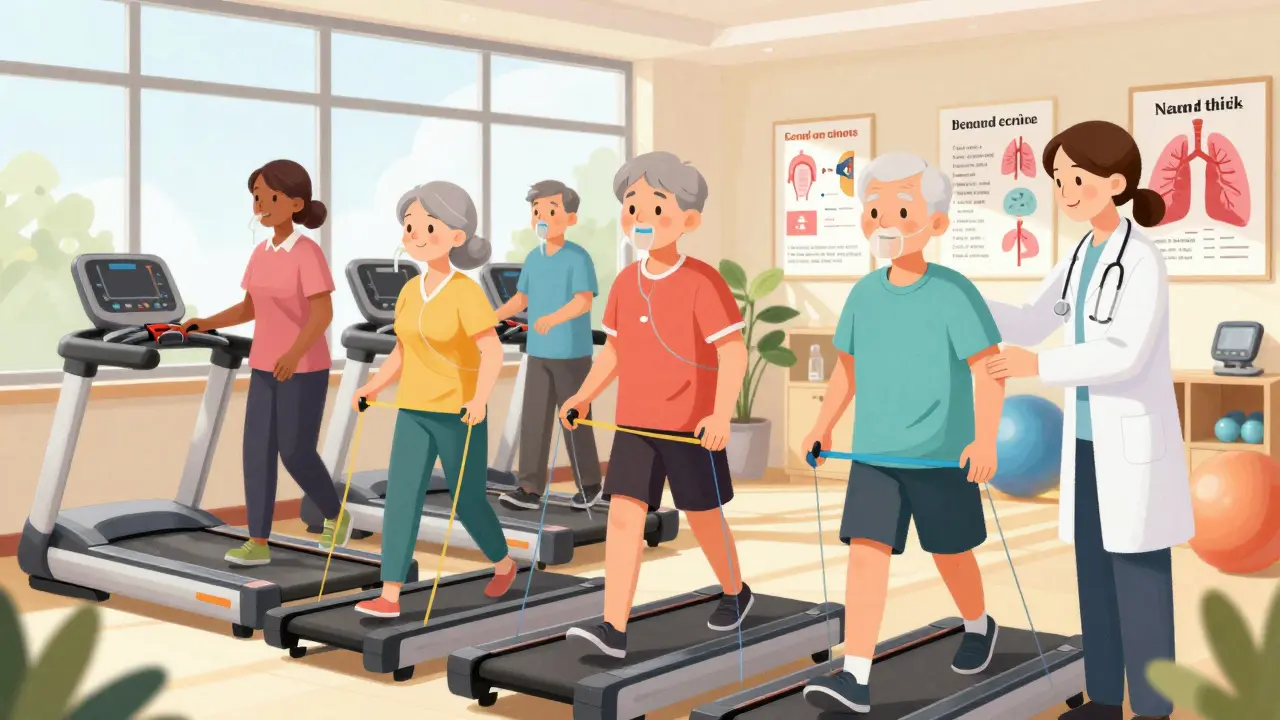
When you have a chronic lung disease like COPD, interstitial lung disease, or pulmonary hypertension, simple tasks - walking to the mailbox, carrying groceries, even getting dressed - can leave you breathless and exhausted. Medications help, but they don’t fix the bigger problem: your body has lost its strength, your confidence has faded, and daily life feels like a constant uphill battle. That’s where pulmonary rehabilitation comes in. It’s not a magic cure. It’s not a one-time fix. But for people living with chronic lung disease, it’s one of the most effective, evidence-backed tools available to reclaim control over their lives.
What Exactly Is Pulmonary Rehabilitation?
Pulmonary rehabilitation (PR) is a structured, personalized program designed to help people with chronic respiratory conditions improve their physical ability, manage symptoms, and feel better emotionally. It’s not just about breathing exercises. It’s a full-package approach built around three core pillars: exercise, education, and support.
According to the 2023 guidelines from the American Thoracic Society and European Respiratory Society, PR is defined as a comprehensive intervention that starts with a thorough assessment and then tailors therapy to the individual. This isn’t a one-size-fits-all program. It’s built around your specific needs, your limits, and your goals. Whether you’re struggling to walk across the room or just want to stop relying on oxygen during daily chores, PR is designed to help you get there.
The Four Core Components of Pulmonary Rehabilitation
A real, high-quality pulmonary rehab program includes four essential parts:
- Structured Exercise Training - This isn’t a gym membership. It’s a carefully planned, supervised routine that builds your endurance and strength. Aerobic exercises like walking on a treadmill or using a stationary bike are done at 60-80% of your maximum capacity. Resistance training targets your legs, arms, and core using light weights or resistance bands. Most programs start with 20-30 minutes of aerobic work and 2-3 sets of 8-15 reps for strength. For people who are severely deconditioned, neuromuscular electrical stimulation may be used to help activate muscles that have gone quiet from lack of use.
- Self-Management Education - You need to understand your disease. PR teaches you how your lungs work (or don’t work), how your medications really affect you, how to recognize the early signs of a flare-up, and what to do when things get worse. You learn breathing techniques, how to use oxygen safely, and how to avoid triggers like smoke or cold air.
- Comprehensive Assessment - Before you start, you’ll be tested. Spirometry measures how well your lungs move air. The 6-minute walk test tracks how far you can walk in six minutes - a simple but powerful indicator of your overall function. Questionnaires like the St. George’s Respiratory Questionnaire measure your quality of life. These aren’t just for paperwork. They help your team design a program that actually works for you.
- Outcomes Measurement - Progress matters. At the end of the program, you’ll be tested again. Did your walking distance improve? Did you stop needing oxygen during daily tasks? Did you feel less anxious or depressed? These numbers show if the program worked - and if it didn’t, your team adjusts.
Who Can Benefit From Pulmonary Rehabilitation?
PR was first developed for people with COPD, but it’s now recommended for anyone with a chronic lung condition that limits their daily life. That includes:
- Chronic Obstructive Pulmonary Disease (COPD) - All stages, from moderate to severe
- Interstitial Lung Disease (ILD) - Scarring in the lungs that makes breathing hard
- Pulmonary Hypertension - High blood pressure in the lungs
- Bronchiectasis - Damaged airways that collect mucus
- Cystic Fibrosis
- Before and after lung transplant
The European Respiratory Society says PR should be offered to anyone with chronic lung disease who has symptoms or functional limits - no matter how mild their lung function test results are. If you’re tired, short of breath, or avoiding activities because you’re afraid of how you’ll feel, you’re likely a candidate.

How Effective Is It? The Numbers Don’t Lie
More than 10,000 people across 127 clinical trials have been studied. The results are clear:
- On average, people improve their 6-minute walk distance by 38.5 meters - enough to go from needing to stop halfway to the mailbox to walking all the way without pausing.
- Dyspnea (shortness of breath) scores drop by 0.8 points on the Medical Research Council scale - a difference patients notice in daily life.
- Quality of life improves by 8.7 points on the St. George’s Respiratory Questionnaire - a change that translates to less anxiety, better sleep, and more social engagement.
Compared to just taking medications, PR delivers much stronger results. For example, while bronchodilators might improve exercise capacity by 0.41 effect size, PR boosts it by 0.91. For dyspnea, PR’s effect size is 0.82 - nearly double that of drugs alone.
One real-world case from the Cleveland Clinic involved a 68-year-old man with severe COPD. After 12 weeks of PR, his walking distance jumped from 182 meters to 327 meters. He went from needing help to shop for groceries to doing it alone - for the first time in five years.
Where and How Is PR Delivered?
Most programs run in outpatient clinics - about 78% of them in the U.S. But options are expanding:
- Outpatient Clinics - The most common setting. Supervised by respiratory therapists, physical therapists, and nurses.
- Hospital-Based Programs - Often linked to pulmonary or cardiac rehab departments.
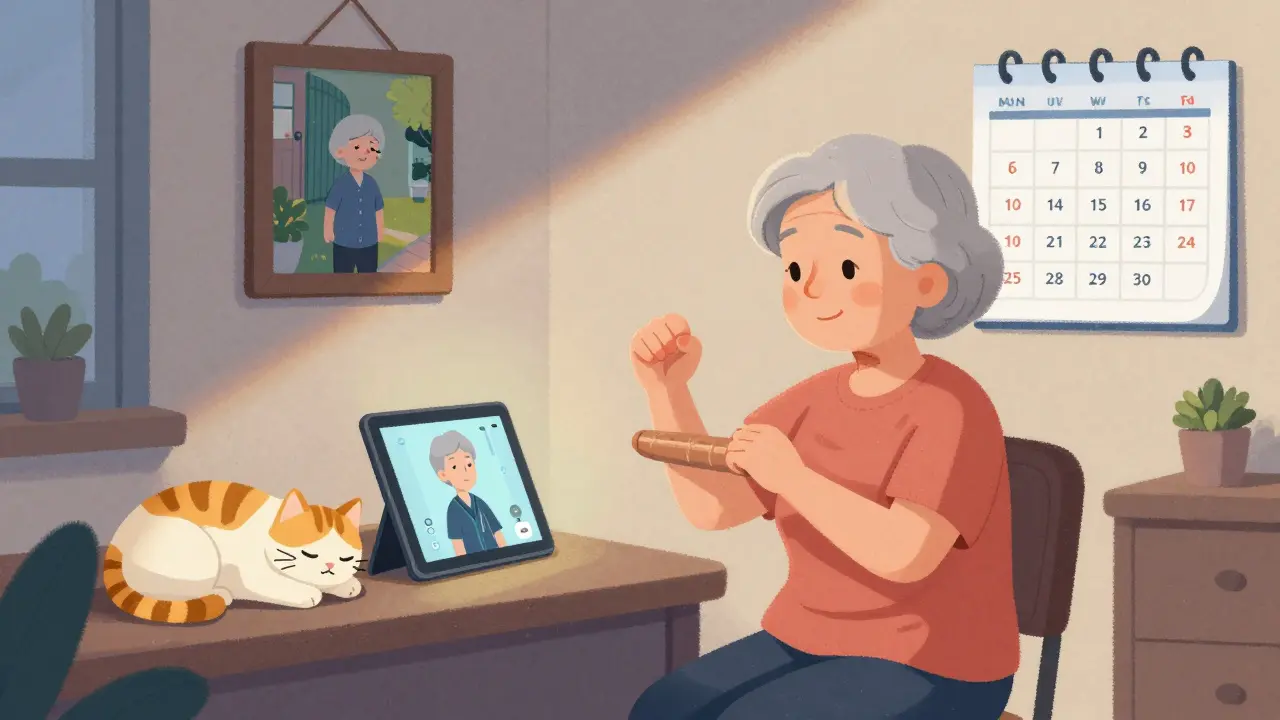
- Home-Based Programs - 5% of programs. Usually for people who can’t travel. May include telehealth check-ins.
- Telehealth - Now a validated option. A 2023 JAMA study showed remote PR delivered nearly identical results to in-person sessions for walking distance and breathlessness. This is a game-changer for rural areas or people with mobility issues.
Most programs last 6 to 12 weeks, with sessions 2-3 times per week, each lasting 60-90 minutes. But some run longer - up to 24 months - especially for people with complex needs.
Why Don’t More People Do It?
Here’s the hard truth: only about 3.2% of eligible COPD patients in the U.S. complete a full pulmonary rehab program. Why?
- Access - Only 57% of U.S. counties have a certified PR program. In rural areas, driving 50 miles for a session isn’t realistic.
- Referral - Doctors don’t always know to refer patients. A 2021 study found only 10-15% of eligible COPD patients in the U.S. are even offered PR.
- Cost and Coverage - Medicare covers 36 sessions per year (about $4,500 total), but you need a doctor’s certification. Some programs charge copays. And even with coverage, many programs lose money because reimbursement covers only 68% of actual costs.
- Adherence - Average attendance is 78%. Life gets in the way. Bad weather. Fatigue. Transportation issues. Family responsibilities.
Canada’s participation rate is around 18%. The UK’s is 12%. The problem isn’t lack of evidence - it’s lack of system support.
What Do Patients Really Say?
Real stories matter more than statistics.
A 2022 study of 127 PR participants found that 89% said their most meaningful improvement was being able to “walk to the mailbox without stopping.” That’s it. Not running a marathon. Not lifting heavy weights. Just being able to do a simple chore without gasping.
On Reddit’s r/COPD forum, one user wrote: “After 8 weeks of PR, I went from needing oxygen at 1L to being off oxygen completely during daily activities.” Another said, “I stopped avoiding visitors because I was too tired to talk. Now I sit on the porch and watch the birds.”
Survey data shows:
- 82% felt more independent
- 76% felt emotionally better
- 89% understood their disease better
These aren’t vague improvements. They’re life-changing shifts in daily reality.
How to Get Started
If you think you might benefit:
- Ask your doctor - Say, “I’m having trouble with daily tasks because of my breathing. Is pulmonary rehab an option for me?”
- Check local programs - Use the American Lung Association’s Lung HelpLine at 1-800-LUNGUSA. They fielded over 42,000 PR-related calls in 2023.
- Be persistent - If your doctor says no, ask why. If it’s “not covered,” ask for a referral anyway. Sometimes, a second opinion opens the door.
- Consider telehealth - If travel is an issue, ask if a remote program is available. Studies show it works just as well.
What to Expect After the Program
PR isn’t a finish line - it’s a starting point. The gains you make are real, but they fade without maintenance. Most programs end with a plan: keep walking, keep doing strength exercises, keep using your breathing techniques. Some offer maintenance sessions. Others connect you to community groups or home exercise plans.
Long-term studies show people who stick with activity after PR have fewer hospital visits and live longer. One 2023 analysis found PR reduced all-cause mortality by 18.2% in COPD patients after hospital discharge.
The goal isn’t to be “cured.” It’s to be stronger, calmer, and more in control - even if your lungs still have damage. You don’t need perfect lungs to live well. You just need the right tools.
Is pulmonary rehabilitation only for people with COPD?
No. While it was originally developed for COPD, pulmonary rehabilitation is now recommended for anyone with a chronic lung disease that causes symptoms or limits daily function. This includes interstitial lung disease, pulmonary hypertension, bronchiectasis, cystic fibrosis, and even people before or after lung transplant. The key factor isn’t the diagnosis - it’s whether breathing problems are affecting your ability to live your life.
How long does pulmonary rehabilitation take?
Most programs last between 6 and 12 weeks, with sessions held 2 to 3 times per week. Each session typically runs 60 to 90 minutes. Some programs may be shorter (as little as 2 weeks) or longer (up to 24 months), depending on the patient’s needs and goals. The standard 6-12 week model is based on evidence showing this is enough time to build strength, learn skills, and see measurable improvements in exercise capacity and quality of life.
Is pulmonary rehab covered by insurance?
In the U.S., Medicare covers up to 36 sessions of pulmonary rehabilitation per year, but you need a doctor’s referral and certification that it’s medically necessary. Private insurers vary - some cover it fully, others partially. Many programs charge a copay. The big issue isn’t whether it’s covered - it’s that many eligible patients never get referred. Even with coverage, only about 3% of people with COPD in the U.S. complete a full program.
Can I do pulmonary rehab at home?
Yes. While traditional programs are done in clinics, home-based pulmonary rehab is now a validated option. A 2023 study in JAMA Network Open found that telehealth PR delivered results nearly identical to in-person programs for walking distance and breathlessness. Home programs usually include exercise plans, video check-ins, and phone coaching. They’re especially helpful for people in rural areas, those with mobility issues, or those who can’t travel safely. However, they work best when combined with some level of professional oversight - not just a handout of exercises.
What if I’m too weak to exercise?
That’s exactly why pulmonary rehab exists. Programs are tailored to your current ability. If you can barely walk 50 feet, you’ll start there. Trainers use low-intensity exercises, breathing techniques, and sometimes neuromuscular electrical stimulation to gently reactivate muscles that have weakened from inactivity. Progress is slow but steady. The goal isn’t to be strong on day one - it’s to get stronger over time, safely and sustainably.
Aisling Maguire
March 1, 2026 AT 09:29just did my first PR session last week and honestly? i thought i was gonna hate it. turns out, walking on a treadmill while someone tells you to breathe through your nose and not your mouth is weirdly empowering? like, who knew being told to slow down could make you feel less like a broken vacuum cleaner?
Full Scale Webmaster
March 3, 2026 AT 08:39okay but let’s be real here - pulmonary rehab is just the healthcare industry’s way of making you pay for a fancy gym membership while pretending it’s medicine. i’ve seen these programs charge $200 a session and then bill medicare for 36 sessions. meanwhile, the guy running the class is a CNA with a clipboard and a playlist of 90s country. the data looks good on paper, sure - 38.5 meters? cool. but tell me how many people actually stick with it after the 12 weeks end? like, 10%? 15%? and then they’re back to breathing like they just ran a marathon to the fridge. this isn’t treatment, it’s a bureaucratic performance art piece wrapped in a nebulizer.
Sophia Rafiq
March 4, 2026 AT 06:01Martin Halpin
March 5, 2026 AT 03:13you know what’s funny? everyone here is acting like this is some revolutionary breakthrough. back in 2010, i was doing this exact same thing in a basement in dublin. same exercises, same breathing techniques, same stupid paper handouts. the only thing that changed is the price tag and the PowerPoint slides. and now we’re treating it like it’s the first time anyone’s ever tried to get someone to walk without collapsing? also - why is no one talking about how these programs are designed for people who still have a car and a family member to drive them? what about the 70-year-old widow in rural west virginia who can’t afford gas and has no one to call? this isn’t healthcare. it’s a luxury service with a medical stamp on it.
Lisa Fremder
March 6, 2026 AT 13:21americans are so soft. we got this fancy rehab program because we’re too lazy to just walk outside. in my country, people with lung issues still work the fields, haul wood, climb stairs - no one’s giving them a 90-minute supervised bike session. you think this is helping? it’s just making them dependent on a system that’ll drop them the second their insurance changes. stop coddling people. build resilience. not a rehab center.
Justin Ransburg
March 7, 2026 AT 22:48I want to say thank you to the author for this incredibly detailed and compassionate breakdown. As someone who works in patient advocacy, I’ve seen firsthand how many people are turned away simply because they don’t know where to start. The stats you shared - especially the 89% who said walking to the mailbox was their biggest win - hit me hard. This isn’t about performance metrics. It’s about dignity. And if we can get even half of those eligible into a program, we’re not just improving lung function - we’re restoring humanity. Keep pushing for access. Keep advocating. You’re not just writing an article. You’re lighting a path.
Brandon Vasquez
March 8, 2026 AT 10:20my dad did pr after his last hospital stay. he was scared. thought he’d be judged for being slow. instead, the group was full of people just like him - tired, quiet, trying not to cry. one guy had a pacemaker. another was on oxygen 24/7. they all cheered when someone improved by 5 meters. no one was competing. everyone was just trying to breathe a little easier. the program didn’t fix his lungs. but it gave him back his mornings. that’s worth more than any stat.
Miranda Anderson
March 10, 2026 AT 03:02the thing no one talks about is how emotionally draining it is to be told you need to "exercise more" when every breath feels like a chore. pr doesn’t just give you exercises - it gives you permission to be tired without being weak. i used to feel guilty for sitting down. now i know it’s not laziness - it’s physiology. and learning that changed everything. also - the breathing coach who told me to imagine blowing out a candle from across the room? that’s the moment i stopped hating my lungs. weird, right? but it worked.
bill cook
March 12, 2026 AT 00:27you all are missing the point. this isn’t about walking farther. it’s about the system. why does medicare only cover 36 sessions? why are rural counties left out? why do doctors not refer unless you beg? this isn’t a health solution - it’s a funding failure. we’re treating symptoms while ignoring the infrastructure collapse. someone needs to sue the american thoracic society for giving us hope while leaving us stranded.