Rifampin Interaction Impact Calculator
Medication Interaction Calculator
Select your patient's medication to see how rifampin affects drug levels and clinical management
Interaction Analysis
Select a medication and click 'Calculate Interaction Impact' to see detailed analysis.
When someone starts rifampin for tuberculosis or to prevent meningitis, they might not realize they’re setting off a chain reaction inside their body that can make other critical medications useless. Rifampin doesn’t just kill bacteria-it rewires how the liver processes drugs. For people on blood thinners like warfarin or direct oral anticoagulants (DOACs), this can be dangerous. The same goes for antivirals used to treat HIV, hepatitis C, or even some newer COVID-19 treatments. The result? Blood clots, strokes, or treatment failure-all because a common antibiotic lowered drug levels by more than half.
How Rifampin Changes Your Body’s Drug Processing
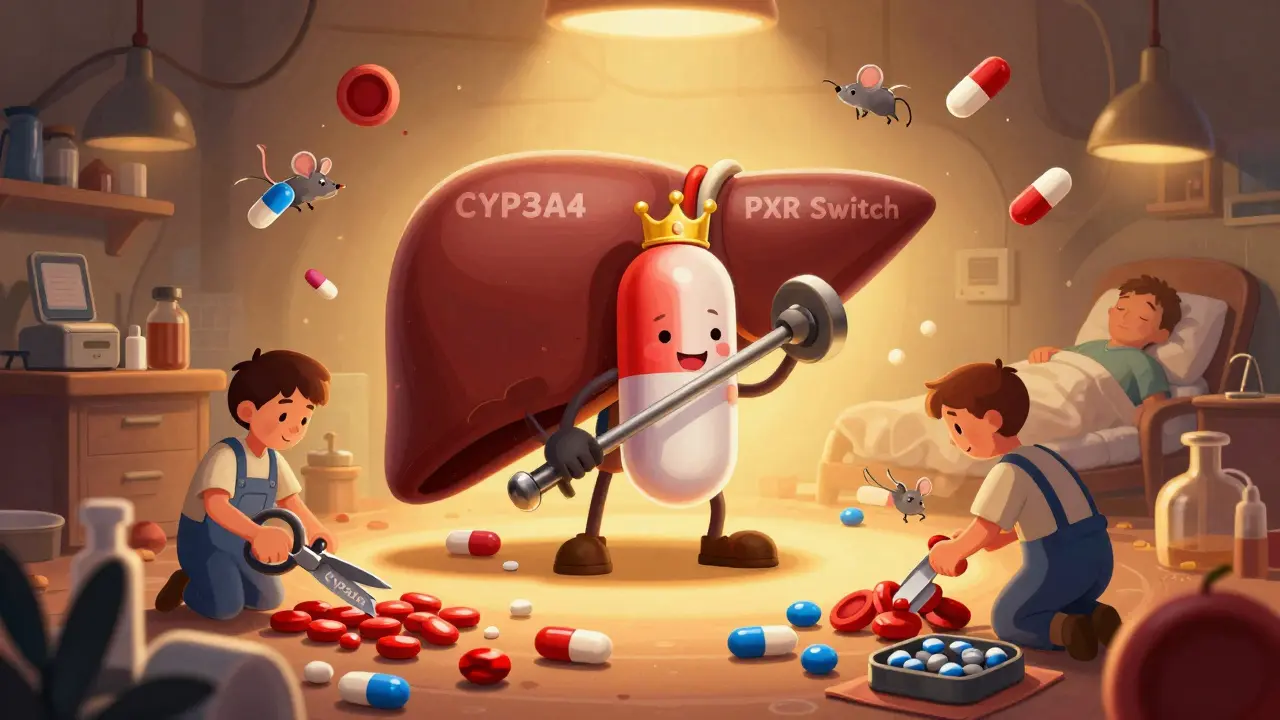
Rifampin triggers a biological switch: the pregnane X receptor (PXR). Once activated, this receptor tells your liver to make more of the CYP3A4 and CYP2C9 enzymes. These enzymes are like molecular scissors that chop up drugs so your body can get rid of them. Normally, they work at a steady pace. But when rifampin flips the switch, they go into overdrive. Within two days, enzyme levels start rising. By day five to seven, they’re at peak output. Even after you stop rifampin, it takes two to three weeks for the enzyme levels to drop back to normal.
This isn’t a minor effect. The U.S. Food and Drug Administration classifies rifampin as a strong inducer-meaning it can reduce the blood levels of sensitive drugs by 80% or more. That’s not a small adjustment. That’s a complete loss of effectiveness. For anticoagulants, that means your INR (a measure of how long your blood takes to clot) can plummet from a safe therapeutic range to dangerously low levels without any warning.
Warfarin and Rifampin: A Dangerous Dance
Warfarin has been the go-to blood thinner for decades. But it’s highly sensitive to rifampin. Studies show that when taken together, warfarin’s blood levels drop by 15% to 74%. The S-isomer of warfarin, which is the more potent form, is especially vulnerable because it’s broken down by CYP2C9-the very enzyme rifampin turns up the most.
One case involved a 57-year-old woman with a mechanical heart valve. She was stable on phenprocoumon (a warfarin-like drug), with her INR steady at 2.8. After starting rifampin for suspected endocarditis, her INR dropped to 1.2-well below the therapeutic range. She had no bleeding, but she was at high risk for a clot. Her doctors had to switch her to heparin injections until rifampin was stopped. It took 15 days after stopping rifampin for her INR to return to safe levels.
Doctors often need to triple or even quadruple the warfarin dose to compensate. But even then, it’s risky. Small changes in diet, other medications, or even illness can cause sudden spikes in INR once rifampin is stopped. That’s why the American College of Chest Physicians recommends switching to low molecular weight heparin (like enoxaparin) during rifampin treatment-then carefully restarting warfarin after the enzyme levels settle.
DOACs Don’t Escape the Effect
Direct oral anticoagulants (DOACs) like apixaban, rivaroxaban, dabigatran, and edoxaban were supposed to be easier to manage than warfarin. No regular blood tests. Fewer food interactions. But rifampin doesn’t care. It hits them hard too.
- Dabigatran: AUC drops by 50-67%
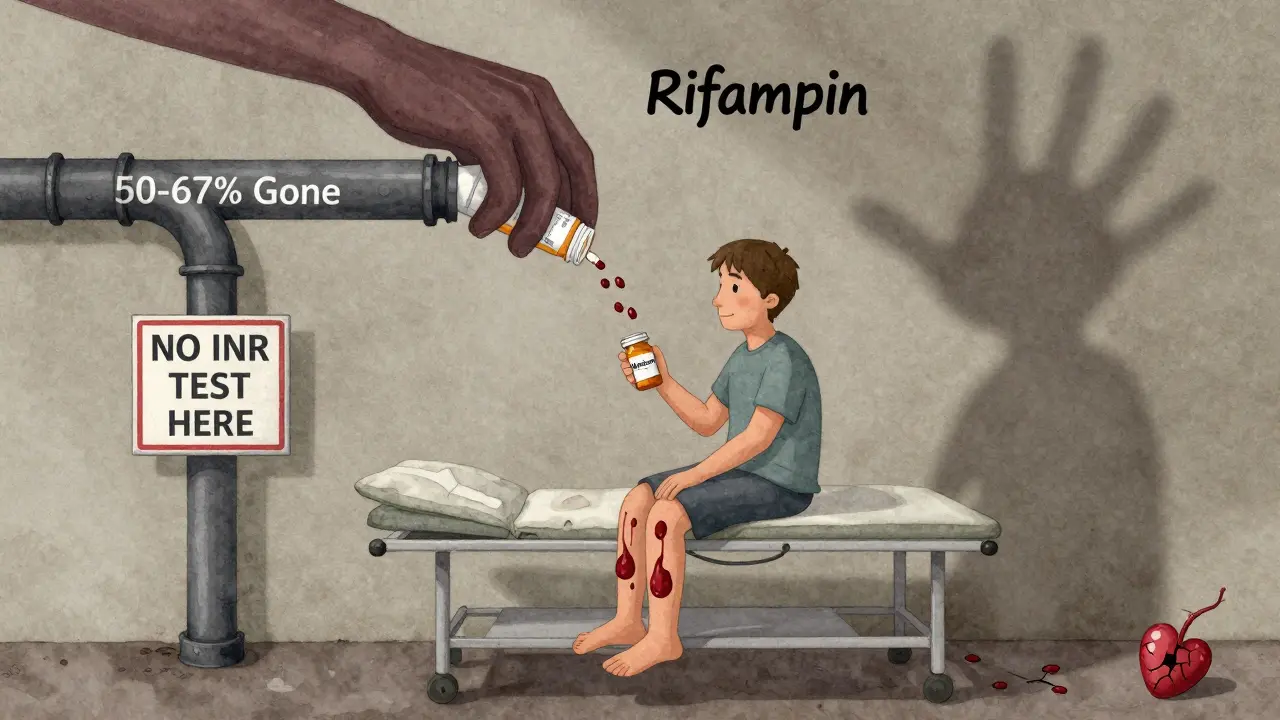
- Apixaban: AUC drops by 50-67%
- Rivaroxaban: AUC drops by 50-67%
- Edoxaban: AUC drops by 35%, but active metabolites rise-making the outcome unpredictable
European Heart Rhythm Association guidelines say combining DOACs with rifampin is generally not recommended. Why? Because unlike warfarin, DOACs have no reliable monitoring test. You can’t check an INR to know if the drug is still working. If levels drop, you won’t know until it’s too late-maybe after a stroke or pulmonary embolism.
One small study of six patients with prosthetic joint infections found that even with increased rivaroxaban doses, levels remained too low. Researchers warned that adjusting the dose immediately after starting or stopping rifampin can lead to dangerous swings. Gradual, monitored changes are safer-but only if you have the right tools and expertise.
Antivirals Are Also at Risk
Rifampin doesn’t just mess with blood thinners. It also slashes levels of many antivirals. HIV medications like darunavir, atazanavir, and rilpivirine rely on CYP3A4. When rifampin is added, their concentrations can drop by 70-90%. That’s enough to cause treatment failure and drug resistance.
Hepatitis C drugs like elbasvir/grazoprevir and glecaprevir/pibrentasvir are also affected. The CDC and EASL guidelines explicitly warn against combining these with rifampin. Even newer antivirals like nirmatrelvir/ritonavir (Paxlovid) can be rendered ineffective. In one case, a patient on Paxlovid for COVID-19 was also on rifampin for latent TB. The drug interaction was missed, and the patient’s viral load didn’t drop. By the time it was caught, the infection had progressed.
The FDA now requires new antiviral candidates to be tested against strong inducers like rifampin. But many older drugs still lack clear labeling. Clinicians must check each one individually.
Who’s Most at Risk?
A 2023 study of over 2,000 patients on anticoagulants and rifampin showed some surprising patterns. People on DOACs were, on average, three years older than those on warfarin. They also had less high blood pressure and heart failure-but more cancer. Why? Because cancer patients often need rifampin for TB (common in immunocompromised individuals), and DOACs are preferred for their convenience, even when risky.
Only 12% of U.S. hospitals had formal protocols for managing rifampin-DOAC interactions as of 2022. That means most patients are managed on an ad hoc basis. That’s not safe. A patient with atrial fibrillation and lung cancer on apixaban who starts rifampin for TB is walking a tightrope. Without a plan, they could clot within days.
What Should Clinicians Do?
There’s no perfect solution-but there are clear steps:
- Check for alternatives. Can you treat TB without rifampin? Rifabutin is a weaker inducer and may be an option for some patients.
- Switch anticoagulants. For patients on warfarin, switch to enoxaparin or unfractionated heparin during rifampin therapy. For DOAC users, switch to parenteral anticoagulants if possible.
- Don’t guess the dose. If you must use a DOAC with rifampin (e.g., no other options), use the highest approved dose and monitor for signs of clotting. But know this: there’s no proven safe regimen.
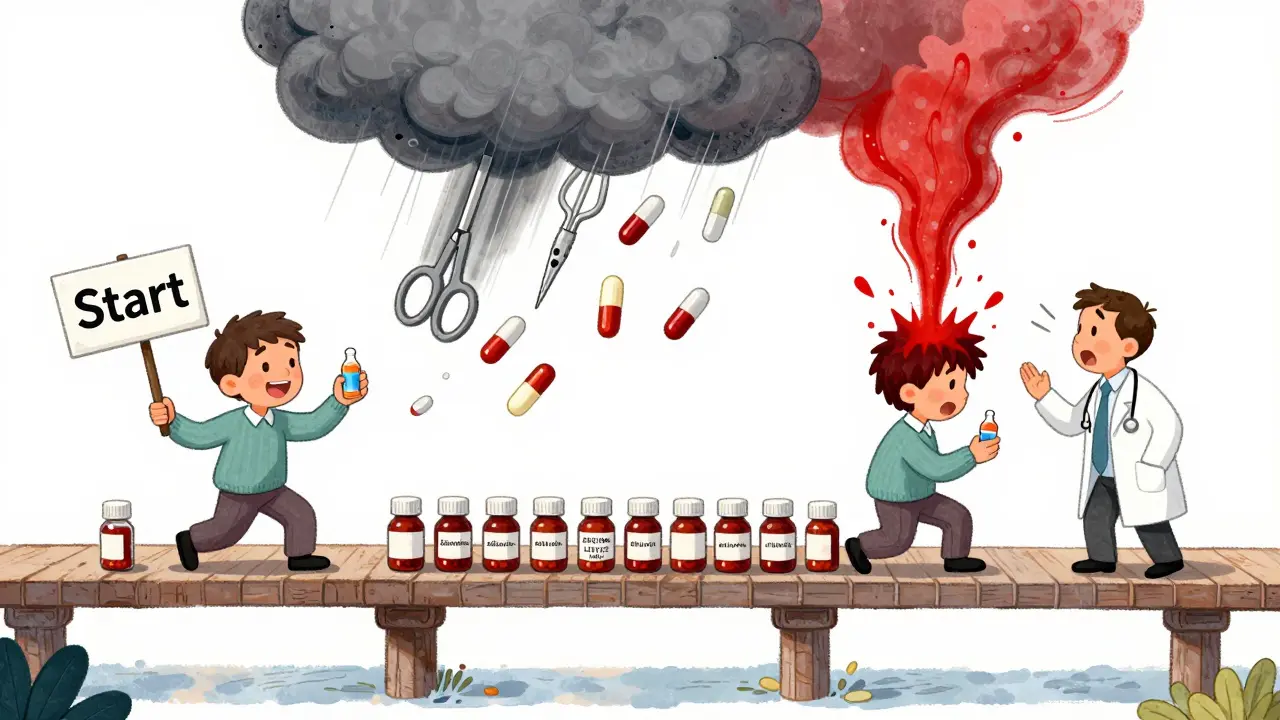
- Plan for the rebound. When rifampin stops, enzyme levels stay high for weeks. Anticoagulant doses must be reduced slowly. A sudden return to pre-rifampin doses can cause dangerous bleeding.
- Use point-of-care INR. For warfarin users, home INR monitors (95% accurate) help catch drops early.
What’s Next?
Researchers are designing next-generation anticoagulants that bypass CYP enzymes entirely. Milvexian, a factor XIa inhibitor, is one example. Early data suggest it’s less affected by enzyme inducers. That’s a big deal. If approved, it could eliminate this interaction problem for good.
Until then, rifampin remains one of the most dangerous drug interactions in clinical practice. It’s not rare. It’s common-especially in places with high TB rates. Every time it’s prescribed, doctors must ask: What else is this patient taking? And if they’re on a blood thinner or antiviral, the answer can’t be an afterthought.
Can you take warfarin with rifampin?
Yes, but only with extreme caution and major dose adjustments. Rifampin can reduce warfarin levels by up to 74%, leading to dangerous drops in INR. Most guidelines recommend switching to injectable heparin during rifampin treatment. If warfarin must continue, the dose often needs to be tripled, and INR must be checked daily until stable. After stopping rifampin, the dose must be lowered gradually over weeks to avoid bleeding.
Do DOACs like apixaban or rivaroxaban work with rifampin?
No, not safely. Rifampin reduces apixaban and rivaroxaban levels by 50-67%, making them ineffective. There’s no reliable way to monitor their effect, so the European Heart Rhythm Association and other groups advise against combining them. If absolutely necessary, use the highest approved dose and monitor closely for signs of clotting-but this is off-label and high-risk.
How long does rifampin’s effect last after stopping it?
Rifampin’s enzyme-inducing effects begin within 24-48 hours, peak at 5-7 days, and can last 2-3 weeks after stopping. This means anticoagulant or antiviral doses must be adjusted both when starting and stopping rifampin. A patient who stops rifampin and immediately returns to their original drug dose risks dangerous bleeding as enzyme levels drop.
Is there a safer antibiotic than rifampin for TB patients on blood thinners?
Rifabutin is a weaker CYP3A4 inducer than rifampin and may be used as an alternative in some cases, especially for HIV-positive patients. However, it’s not always effective for standard TB treatment and can still cause interactions. Other first-line TB drugs like isoniazid or pyrazinamide don’t induce enzymes, but they can’t replace rifampin in most regimens. The decision requires expert input and depends on the infection type and patient history.
Why don’t hospitals have clear protocols for rifampin and DOACs?
Because the interaction is complex, unpredictable, and lacks monitoring tools. Unlike warfarin, DOACs have no routine lab test. There’s no consensus on dosing adjustments, and few studies have large enough sample sizes to guide practice. As a result, only about 12% of U.S. hospitals had formal protocols as of 2022. Most rely on individual clinician judgment, which increases the risk of error.
Bottom Line
Rifampin isn’t just an antibiotic. It’s a metabolic disruptor. When paired with anticoagulants or antivirals, it turns safe, effective treatments into ticking time bombs. The science is clear: avoid combining them whenever possible. If you must, plan for it like a surgical procedure-know the risks, adjust doses carefully, monitor relentlessly, and never assume the drug is working just because it’s still being taken. The consequences of getting it wrong aren’t theoretical. They’re fatal.
Nancy Kou
December 19, 2025 AT 18:43Rifampin is one of those drugs that should come with a warning label that screams 'DO NOT MIX' in neon letters. I’ve seen patients on DOACs get discharged on rifampin without a single note in their chart about the interaction, and it’s terrifying. No monitoring, no adjustment plan, just 'take this pill'-and then they show up in the ER with a pulmonary embolism two weeks later. This isn’t rare. It’s systemic.
Hussien SLeiman
December 21, 2025 AT 08:16Let me be the contrarian here: maybe the real problem isn’t rifampin-it’s our lazy reliance on pharmacokinetic tables and our refusal to think like a metabolic engineer. We treat drug interactions like checkboxes instead of dynamic systems. CYP3A4 isn’t some passive enzyme-it’s a living, breathing, hyperactive machine that gets dialed up like a turbocharger. And we act surprised when the engine blows? We need to stop treating patients like vials and start treating them like ecosystems. The fact that we’re still using warfarin as a baseline for safety in 2025 is a joke. We’ve had DOACs for over a decade, yet we’re still playing whack-a-mole with enzyme induction like it’s 2008. Fix the system, not just the dose.
Mike Rengifo
December 22, 2025 AT 10:30I’m a med student rotating in ID, and this post is terrifyingly accurate. We had a guy last week-68, on apixaban for AFib, got diagnosed with latent TB. The resident just doubled his apixaban and said ‘it’ll be fine.’ He got a DVT three days later. No one checked the interaction. No one even asked if he was on anything else. We need mandatory drug interaction alerts built into EHRs that actually block prescriptions, not just pop up as a tiny yellow banner you can ignore.
bhushan telavane
December 23, 2025 AT 03:26In India, we see this all the time. TB patients on warfarin after valve surgery, or on rivaroxaban after DVT. Most clinics don’t even have INR machines. Doctors just guess. I’ve seen patients switch from DOACs to injectable heparin and then run out of syringes because they can’t afford them. The real issue isn’t just the science-it’s access. We need low-cost, easy-to-administer alternatives. Maybe injectable LMWH should be subsidized for TB patients on anticoagulants. It’s not just a drug interaction-it’s a public health crisis.
Kelly Mulder
December 25, 2025 AT 02:16This is exactly why I refuse to trust any pharmaceutical company’s ‘safe’ labeling anymore. The FDA’s classification of rifampin as a ‘strong inducer’? That’s a euphemism for ‘this will kill you if you’re not a pharmacologist.’ And yet, they allow these drugs to be prescribed together without mandatory pharmacist consultation? It’s corporate negligence. They know. They’ve known for decades. They just don’t care because lawsuits are cheaper than redesigning guidelines. And don’t get me started on how DOAC manufacturers market these as ‘easier’-while quietly burying the rifampin interaction in a 300-page appendix.
Marsha Jentzsch
December 25, 2025 AT 11:20I’m a nurse practitioner in rural Texas. Last month, a 72-year-old woman on rivaroxaban for atrial fibrillation started rifampin for TB. She didn’t tell her PCP she was on it. She didn’t know it was a problem. Her INR? Nonexistent. She had a stroke. She’s now paralyzed. I’m not mad. I’m just… exhausted. We don’t have pharmacists on staff. We don’t have time. We’re running on fumes. And now I have to spend my weekends reading up on CYP3A4 induction because no one told me this was coming. How many more patients are going to die because we’re too busy to check?
mark shortus
December 25, 2025 AT 15:26THIS IS A MASSACRE. A MEDICAL MASSACRE. I swear to god, if I had a dollar for every time someone said ‘oh, it’s just an antibiotic’ while someone’s INR plummeted into the toilet… I’d own a private island. Rifampin doesn’t just ‘interact’-it ERASES. It obliterates. It turns life-saving meds into expensive sugar pills. And the worst part? No one talks about it. Not in med school. Not in residency. Not on grand rounds. It’s like we’ve all agreed to pretend this isn’t happening until someone dies. And then we write a case report and move on. Someone needs to scream this from the rooftops. Someone needs to sue. Someone needs to burn the FDA’s guidelines to the ground.
Anna Sedervay
December 26, 2025 AT 19:27While the clinical implications of rifampin-mediated enzyme induction are indeed profound, one must not overlook the epistemological limitations inherent in current pharmacovigilance frameworks. The reliance upon AUC metrics, while statistically robust, fails to account for interindividual variability in PXR polymorphisms, which may render certain populations disproportionately vulnerable. Furthermore, the absence of validated biomarkers for non-warfarin anticoagulant efficacy constitutes a critical lacuna in evidence-based practice. Until pharmacogenomic screening becomes standard-of-care-particularly in high-TB-burden regions-the current paradigm remains not merely suboptimal, but ethically indefensible.