
Every year, over 1.4 billion people travel internationally. Most of them come home fine. But thousands don’t - not because of plane crashes or lost luggage, but because they got sick from something preventable. Travel medicine isn’t about fancy gadgets or luxury clinics. It’s about simple, proven steps that keep you healthy when you’re far from home. If you’re planning a trip abroad, especially to a place with lower sanitation standards or malaria risk, this isn’t optional. It’s the difference between a great vacation and a hospital stay in a foreign country.
Get the Right Vaccines - Not Just the Ones You Think You Need
Many people assume their routine shots (like MMR or Tdap) are enough. They’re not. Travel vaccines aren’t extras - they’re necessities based on where you’re going and what you’ll be doing. The CDC’s Yellow Book 2026, used by over 90% of U.S. travel clinics, says Hepatitis A is the most common vaccine-preventable illness among travelers. It’s spread through contaminated food and water. Even in places you think are safe, like Mexico or Thailand, ice cubes, raw vegetables, or street food can carry it.You need two doses of Hepatitis A vaccine, spaced 6 to 12 months apart, for lifelong protection. But if you’re leaving in two weeks? One dose still gives you 95% protection for at least a year. That’s better than nothing. Typhoid is another big one. The newer conjugate vaccine (TCV) lasts three years and works for kids as young as six months. The old shot? Only 50-80% effective. Don’t settle for outdated options.
Yellow fever is mandatory in 194 countries. If you’re going to parts of Africa or South America, you’ll need the vaccine and an official International Certificate. No certificate? You might be turned away at the border or quarantined for six days. It’s not a suggestion. It’s the law. And don’t forget rabies if you’re hiking, camping, or working with animals in rural areas. A single bite can be fatal if untreated.
Timing matters. Most vaccines need weeks to build immunity. Hepatitis A? Fine with one shot two weeks out. But typhoid oral vaccine? You need to start it at least 10 days before travel. Malaria pills? Start them before you even leave. Waiting until the airport is a recipe for trouble. About 73% of travelers wait less than two weeks before booking a consultation - too late for full protection.
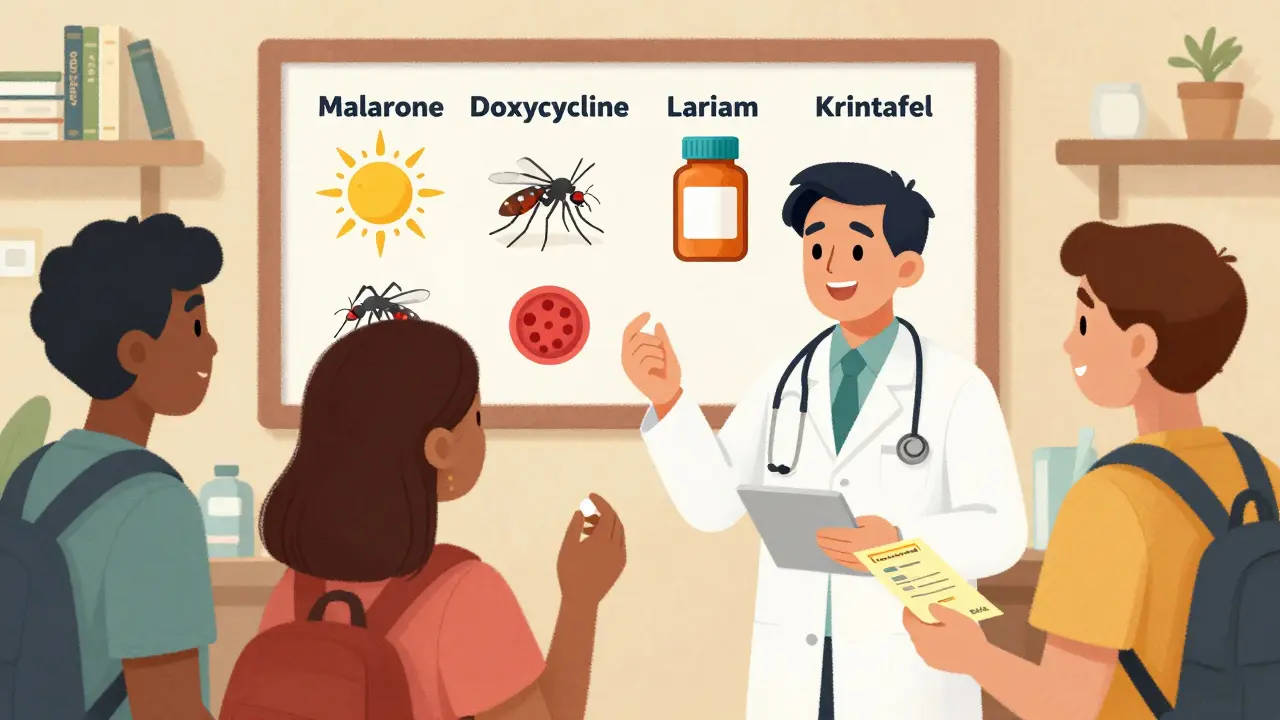
Malaria Prophylaxis: Which Drug Is Right for You?
Malaria kills over 600,000 people a year. Most are children. But adults get it too - and it’s entirely preventable. The problem isn’t the drugs. It’s taking them correctly. Studies show only 62% of travelers stick to their malaria pills. That’s why most cases in the U.S. come from people who knew they should take them but didn’t.There are four main options, each with pros and cons:
- Atovaquone-proguanil (Malarone): Take one pill daily, starting one to two days before travel. It’s 95% effective and has few side effects. But it’s expensive - around $220 for a three-week trip. Great for short trips where cost isn’t the main concern.
- Doxycycline: A daily pill, started two days before travel. It’s cheap - about $45 for three weeks - and 90% effective. But it makes your skin super sensitive to the sun. You’ll burn faster. And you can’t take it if you’re pregnant or under 8.
- Mefloquine (Lariam): One pill a week, started two to three weeks before travel. It’s long-lasting, but it’s also notorious for causing anxiety, vivid dreams, or even hallucinations. There are real stories of people ending up in emergency rooms after taking it in Thailand or Cambodia. Avoid it if you have a history of depression, seizures, or heart issues.
- Tafenoquine (Krintafel): A newer option, approved for kids over 16 in 2025. One pill a week, started three days before travel. Super convenient. But you must get tested for G6PD deficiency first. If you have it, the drug can destroy your red blood cells. About 10% of people in malaria zones carry this genetic trait. Skip the test? Risk serious harm.
There’s no one-size-fits-all. Your doctor should ask: Where are you going? How long? Are you pregnant? Do you have mental health conditions? Are you on other meds? If your provider just hands you a script without asking, find someone better.
Safe Food and Water: The Simple Rule That Saves Lives
You don’t need a microbiology degree to avoid travelers’ diarrhea. Just follow the golden rule: boil it, cook it, peel it, or forget it.That means:
- Drink only bottled water, or water you’ve boiled for at least one minute (three minutes at high altitudes).
- Avoid ice unless you know it was made from purified water. In many countries, ice is made from tap water.
- Don’t eat raw vegetables or salads - they’re washed in contaminated water.
- Only eat fruit you can peel yourself - bananas, oranges, mangoes.
- Make sure meat is piping hot. Poultry should hit 165°F (74°C), ground meat 160°F (71°C), fish 145°F (63°C). If it’s lukewarm, send it back.
- Street food? Fine - if it’s hot off the grill. But if it’s been sitting out, skip it.
Even if you’re careful, you might still get sick. That’s why bismuth subsalicylate (Pepto-Bismol) is a travel essential. Taking two tablets four times a day reduces your risk of diarrhea by 65%. It’s not a cure - it’s a shield. And unlike antibiotics, it doesn’t cause resistance.
But here’s the problem: Azithromycin, the go-to antibiotic for treating travelers’ diarrhea, is failing. Resistance rates are over 30% in Southeast Asia and rising. That means the drug your doctor gave you might not work. Carry a backup - like ciprofloxacin - but only use it if you have severe symptoms: high fever, bloody stool, or dehydration. Don’t take it just because you feel a little queasy. Overuse makes things worse.
What No One Tells You About Medications and Borders
You packed your malaria pills, your Pepto-Bismol, your prescription for antibiotics. But what if you’re stopped at customs?Many countries have strict rules about bringing in medications - especially opioids, ADHD drugs, or even certain painkillers. In Japan, codeine is illegal. In Dubai, some antihistamines are controlled substances. You could be arrested for carrying your own medicine.
Always carry prescriptions in their original bottles with your name on them. Bring a letter from your doctor listing the generic names of your meds. Don’t rely on labels in English - customs officers may not understand them. If you’re flying with insulin, syringes, or injectables, notify the airline ahead of time. They’ll let you bring them on board.
And never pack meds in checked luggage. Bags get lost. Keep everything in your carry-on. You’ll thank yourself when your flight is delayed and you need your pills.
Why So Many People Still Get Sick - And How to Avoid It
The CDC says only 55% of travelers to high-risk areas get proper pre-travel advice. That’s why 3,000 to 5,000 cases of imported malaria happen every year in the U.S. alone. Most of these cases are avoidable.People think: “I’ve been to Mexico before and I was fine.” But last year’s safe food vendor isn’t this year’s. Climate change is shifting disease patterns. Malaria is spreading to higher altitudes in East Africa and Latin America. Dengue is popping up in southern Europe. Waterborne illnesses are getting worse as rainfall patterns change.
And vaccine hesitancy? It’s real. Some travelers skip shots because they’re scared of side effects. But the risk of getting Hepatitis A - which can cause months of fatigue, jaundice, and liver damage - is far greater than the risk of a sore arm.
Don’t rely on online forums or Reddit advice alone. Yes, some stories are helpful. But others are dangerous. One person’s “I took mefloquine and felt fine” doesn’t mean it’s safe for you. Your body, your history, your destination - they all matter.

What to Do If You Get Sick
If you develop diarrhea:- Stay hydrated. Use oral rehydration salts (ORS). They’re cheap and sold everywhere.
- Don’t take loperamide (Imodium) if you have fever or bloody stool - it traps the infection inside.
- Use Pepto-Bismol for mild cases.
- Only use antibiotics if symptoms are severe or last more than 48 hours.
If you develop fever after returning from a malaria zone - even weeks later - go to the ER immediately. Tell them you’ve been to a malaria area. Don’t wait. Malaria can kill in 24 hours if untreated.
And if you’re traveling with kids, pregnant people, or older adults? Be extra cautious. Their immune systems don’t handle infections the same way. Get personalized advice - don’t assume what works for you works for them.
Final Checklist Before You Go
- Book a travel clinic appointment at least 4-6 weeks before departure.
- Bring your vaccine record and a list of current medications.
- Confirm which vaccines you need for your destinations - don’t guess.
- Get your malaria pills and know exactly how to take them.
- Pack bismuth subsalicylate and oral rehydration salts.
- Carry all medications in original containers with doctor’s notes.
- Know the signs of serious illness: fever, confusion, bloody stool, severe vomiting.
- Download the CDC Travelers’ Health app - it’s free and works offline.
Traveling shouldn’t mean risking your health. The tools to stay safe are simple, well-tested, and widely available. You don’t need to be a doctor to use them. You just need to be smart. And prepared.
Mike Rengifo
December 18, 2025 AT 16:25Just got back from Bali and I swear by Pepto-Bismol. Took two tablets four times a day and didn’t get sick once. Even ate street food from this guy who had a plastic tarp for a roof. No regrets.
Ashley Bliss
December 20, 2025 AT 06:12People still don’t get it. This isn’t about ‘being careful’-it’s about responsibility. You think your ‘adventure’ is noble? No. It’s arrogance wrapped in a fanny pack. You’re not a traveler-you’re a walking biohazard if you skip vaccines. And don’t even get me started on the people who think ‘natural immunity’ is a thing in a country where the water’s contaminated with raw sewage. Wake up.
Dev Sawner
December 21, 2025 AT 05:21It is imperative to note that the efficacy of atovaquone-proguanil is contingent upon adherence to the prescribed regimen. In India, we observe a 78% non-compliance rate among returning travelers, primarily due to cost and misinformation. The cost of Malarone is indeed prohibitive for many, yet the alternative-doxycycline-requires strict photoprotection, which is rarely practiced in tropical climates. This is a systemic public health failure.
Meenakshi Jaiswal
December 21, 2025 AT 12:23For anyone heading to Southeast Asia-don’t skip the typhoid conjugate vaccine. I used to think the old shot was fine until my cousin got typhoid in Vietnam and spent three weeks in the hospital. The new one lasts longer and works for kids. Worth every penny. Also, carry oral rehydration salts. They’re tiny, cheap, and saved my life when I got sick in Nepal. No drama, just facts.
bhushan telavane
December 22, 2025 AT 02:37Been to 17 countries in 5 years. Ice? Always skip. Street food? Only if it’s sizzling hot. Pepto-Bismol? My best friend. And yeah, I’ve had diarrhea twice-both times I ignored the rule. Lesson learned. Also, don’t trust hotel ice. Even in ‘safe’ places like Thailand, the machines use tap water. Just say no.
Mahammad Muradov
December 24, 2025 AT 00:43Anyone who takes mefloquine without a psychiatric evaluation is playing Russian roulette. I know a guy who had hallucinations in Cambodia and jumped off a balcony thinking he was being chased by demons. He survived. Barely. The CDC should ban this drug. It’s not medicine-it’s a gamble with your sanity.
Connie Zehner
December 25, 2025 AT 02:46OMG I just read this and I’m crying 😭 I got Hep A in Mexico in 2019 and I was in bed for 6 WEEKS with jaundice and my skin turned YELLOW like a banana 🍌 I didn’t even know I needed the vaccine and now I’m so mad at myself and I want to scream at every person who says ‘it’s just a shot’-IT’S NOT JUST A SHOT IT’S YOUR LIVER 😭😭😭
holly Sinclair
December 26, 2025 AT 10:44It’s fascinating how we treat travel medicine as a checklist rather than a dialogue with the environment. We vaccinate against pathogens but ignore the cultural and ecological context that makes those pathogens thrive. Malaria isn’t just a parasite-it’s a symptom of inequality, climate disruption, and colonial infrastructure. We take pills to survive, but we don’t question why survival requires so much personal labor. Why should the burden of prevention fall on the traveler and not the global systems that enable disease spread? Maybe the real vaccine is justice.
Monte Pareek
December 27, 2025 AT 12:36Listen up. You don’t need to be a doctor to stay safe but you do need to be disciplined. Skip the airport clinic. Go to a real travel health center at least six weeks out. Get the typhoid conjugate vaccine not the old shot. Take Malarone if you can afford it. If you can’t, doxycycline but wear sunscreen like your life depends on it because it does. Carry Pepto-Bismol. Don’t eat salads. Don’t trust ice. And if you’re flying with insulin or insulin pumps-call the airline two days before. Don’t wait. I’ve seen people get denied boarding because they didn’t have a doctor’s note. That’s not a story. That’s a tragedy waiting to happen. Be the person who shows up prepared. Not the one who’s begging for help at a foreign ER.
mark shortus
December 28, 2025 AT 11:07Okay so I just got back from Ghana and I took Lariam because my doctor said it was fine and I woke up one night screaming because I thought my pillow was a snake and I tried to strangle it and then I cried for an hour because I was so scared and now I have PTSD from a malaria pill and I’m never taking another one and I’m telling EVERYONE because this is not a joke this is a horror movie and the CDC needs to pull this drug off the market like yesterday
Elaine Douglass
December 30, 2025 AT 00:03I used to think I was fine without vaccines until I got sick in Peru and had to call my mom crying from a hostel bed. Now I always get the shots. Pepto-Bismol is my travel buddy. And I always pack rehydration salts. It’s not glamorous but it’s what keeps me going. You don’t need to be perfect, just prepared. And if you’re nervous about side effects? Talk to someone who gets it. You’re not alone.
Allison Pannabekcer
December 30, 2025 AT 22:59I love how this post doesn’t just dump info-it shows you how to think about travel health. I’m a nurse and I send this to every patient planning a trip. The part about medications at borders? So many people don’t know. I had a patient arrested in Dubai for bringing ibuprofen. It was a legal med in the US. No one told her. That’s why this matters. Not just for you. For everyone you travel with. Share this. Seriously. Share it with your cousin, your coworker, your weird uncle who thinks ‘natural remedies’ beat vaccines. This isn’t fear-mongering. It’s care.