
Trimethoprim Hyperkalemia Risk Calculator
This tool helps you assess your risk of dangerous potassium elevation when taking trimethoprim-based antibiotics (Bactrim, Septra). Based on data from the article, certain factors significantly increase your risk.
When you take an antibiotic like Bactrim or Septra - common brands for trimethoprim-sulfamethoxazole (TMP-SMX) - you might not think about your potassium levels. But for many people, especially those over 65 or with kidney issues, this widely used drug can push potassium dangerously high, leading to heart rhythm problems, muscle weakness, or even sudden cardiac arrest. The risk isn’t rare. It’s built into how the drug works in the body - and it’s often overlooked by doctors and patients alike.
How Trimethoprim Tricks Your Kidneys
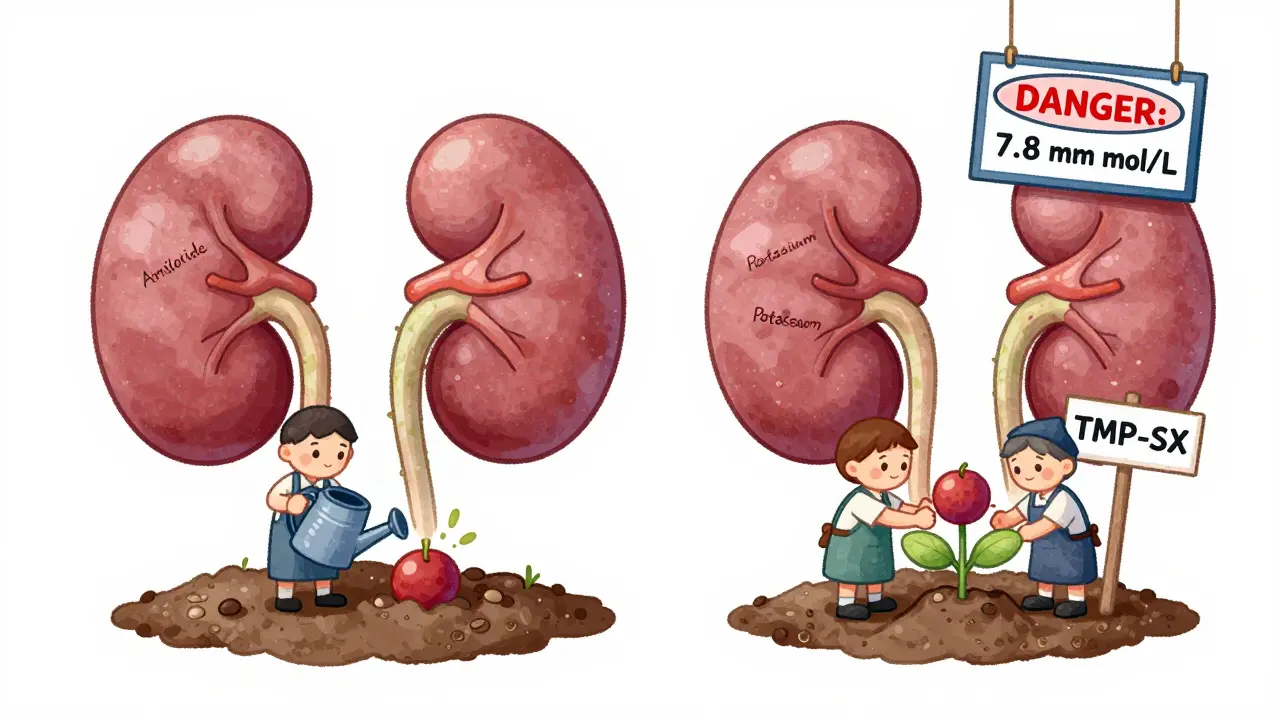
Trimethoprim isn’t just an antibiotic. It acts like a hidden diuretic - one that saves potassium instead of flushing it out. This happens in the tiny filtering units of your kidneys, called nephrons. There, trimethoprim blocks sodium channels in the distal tubule, the same way the drug amiloride does. When sodium can’t be reabsorbed properly, the electrical signal that pushes potassium into urine gets weaker. The result? Your body holds onto potassium instead of getting rid of it.
This isn’t a slow, gradual effect. Studies show serum potassium can rise by 0.5 to 1.5 mmol/L within just 48 to 72 hours of starting the drug. For someone with normal potassium at 4.2 mmol/L, that’s enough to jump into the danger zone - above 5.5 mmol/L. And when levels hit 6.0 or higher, the heart can start misfiring. A 2023 case report described an 80-year-old woman who went into cardiac arrest after only three days of low-dose TMP-SMX, even though her kidneys looked fine. Her potassium hit 7.8 mmol/L. Normal is 3.5 to 5.0.
Who’s at Highest Risk?
The danger isn’t equal for everyone. Certain groups face much higher chances of life-threatening hyperkalemia:
- People on ACE inhibitors or ARBs - drugs like lisinopril, losartan, or valsartan. These already reduce potassium excretion. Add trimethoprim, and the effect multiplies. A 2014 JAMA study found TMP-SMX raised hospitalization risk for hyperkalemia by 6.7 times compared to amoxicillin in this group.
- Older adults (65+) - kidney function naturally declines with age. Even if creatinine looks normal, the kidneys can’t handle the drug load. Nearly 30% of TMP-SMX prescriptions go to this group.
- Those with chronic kidney disease (eGFR under 60) - trimethoprim builds up in the body because the kidneys can’t clear it. Peak levels can be more than twice as high in these patients.
- Diabetics - high blood sugar and kidney damage go hand in hand, and both worsen potassium retention.
One 2020 study found that patients with diabetes, kidney disease stage 3+, and on an ACEI/ARB had a 32.1% chance of developing hyperkalemia from TMP-SMX - compared to just 4.3% in similar patients on other antibiotics.
Why Doctors Still Prescribe It
Despite the risks, TMP-SMX is still one of the most common antibiotics in the U.S., with over 14 million prescriptions each year. It’s cheap, effective, and works well for urinary tract infections, sinus infections, and preventing pneumonia in people with weakened immune systems.
But here’s the catch: it’s often chosen without checking potassium levels first. A 2023 survey found only 41.7% of primary care doctors routinely test potassium before prescribing TMP-SMX to patients on blood pressure meds. Emergency room doctors were even lower - just 32.4%. Meanwhile, nephrologists (kidney specialists) check it almost 90% of the time.
Part of the problem is familiarity. TMP-SMX has been around since the 1970s. Many doctors learned to use it without thinking about potassium. But the data now is clear: this isn’t a theoretical risk. Between 2010 and 2020, the FDA recorded 43 deaths linked to TMP-SMX-induced hyperkalemia - 68% of them in people over 65.
What Happens When Potassium Goes Too High
High potassium doesn’t always cause obvious symptoms. Some people feel nothing until their heart starts skipping beats. Others get muscle weakness, tingling in hands or feet, or nausea. But the real danger is silent - until it’s too late.
When potassium hits 6.0 mmol/L or higher, ECG changes appear: tall, peaked T-waves, widened QRS complexes, and eventually a sine wave pattern - a sign the heart is about to stop. Emergency treatment is urgent: calcium gluconate to stabilize the heart, insulin and glucose to pull potassium into cells, and sometimes dialysis to remove it.
A 2021 review of 37 severe cases found that 43% of patients needed emergency interventions. Most cases peaked within 2.3 days of starting the drug. That’s why monitoring at 48-72 hours is critical.
Alternatives That Don’t Raise Potassium
For most infections, there are safer options:
- Nitrofurantoin - the top choice for uncomplicated UTIs in older adults or those on ACEIs/ARBs. No significant potassium risk.
- Fosfomycin - single-dose treatment for UTIs, no effect on potassium.
- Cephalexin - a first-generation cephalosporin, often used for skin and respiratory infections.
- Doxycycline - good for sinus and respiratory infections, no known hyperkalemia risk.
The Infectious Diseases Society of America recommends these alternatives for UTIs in high-risk patients. For Pneumocystis pneumonia (PCP) in HIV or transplant patients, TMP-SMX is still first-line - but only if potassium is monitored closely. There’s no good substitute for PCP prevention in severely immunocompromised people.

What You Should Do - If You’re Prescribed TMP-SMX
If your doctor prescribes Bactrim or Septra, ask these questions:
- Have you checked my potassium level before this prescription?
- Am I on an ACE inhibitor, ARB, or potassium-sparing diuretic?
- Do I have kidney disease or diabetes?
- Can we test my potassium again in 3 days?
For high-risk patients, guidelines from the American Society of Health-System Pharmacists say:
- Check potassium before starting TMP-SMX.
- Test again at 48-72 hours.
- Stop the drug if potassium is above 5.5 mmol/L.
- Avoid it entirely if baseline potassium is over 5.0 mmol/L or eGFR is under 30 mL/min.
Hospitals that added electronic alerts before prescribing TMP-SMX to patients on ACEIs/ARBs cut hyperkalemia cases by over half. That’s proof that simple checks save lives.
Why This Risk Is Still Under-Recognized
The FDA added hyperkalemia to TMP-SMX’s boxed warning in 2019 - the strongest possible alert. But warnings alone don’t change practice. Many doctors still don’t test potassium. Many patients don’t know to ask.
Even worse, some assume that if their creatinine is normal, their kidneys are fine. But creatinine doesn’t tell the full story - especially in older adults or those with low muscle mass. Two people can have the same creatinine, but very different kidney function. That’s why eGFR (estimated glomerular filtration rate) matters more.
There’s also a false sense of security with low doses. A single 160/800 mg tablet for UTI prevention might seem harmless. But as one Reddit post from a physician noted: “I had a 72-year-old on lisinopril develop K+ 6.8 after 3 days of Bactrim - normal creatinine, no symptoms. She needed emergency dialysis.”
The Bigger Picture
Trimethoprim isn’t going away. It’s too useful for life-threatening infections. But we need to treat it like a potassium-sparing diuretic - not just an antibiotic. That means changing habits: checking potassium before prescribing, using safer alternatives when possible, and educating patients.
The future is moving in the right direction. A new tool called the TMP-HyperK Score uses age, baseline potassium, kidney function, and medication use to predict risk with 88.7% accuracy. Hospitals are starting to build alerts into their systems. Pharmacists are stepping in to flag risky prescriptions.
For now, if you’re taking TMP-SMX and you’re over 65, on blood pressure meds, or have kidney disease - don’t wait for symptoms. Ask for a simple blood test. It takes five minutes. It could save your life.
Vanessa Drummond
February 25, 2026 AT 09:55I got prescribed Bactrim for a UTI last year and felt like my arms were turning to jelly. Thought I was just tired. Turns out my K+ was 6.1. ER. IV calcium. Scared the hell out of me. Why the hell don’t they test this before handing out antibiotics like candy? 🤯
Nick Hamby
February 25, 2026 AT 21:41It is profoundly concerning that a medication with such a well-documented, physiologically predictable mechanism of harm continues to be prescribed without routine biochemical screening. The pharmacological action of trimethoprim on the epithelial sodium channels in the distal nephron is not speculative-it is reproducible, quantifiable, and clinically significant. To neglect potassium monitoring in patients on renin-angiotensin system inhibitors is not merely an oversight; it is a systemic failure of risk mitigation. We must treat this not as an edge case, but as a standard-of-care imperative.
kirti juneja
February 27, 2026 AT 05:37OMG this is wild! I’m from India and we use Bactrim like it’s water-no tests, no questions. My uncle got admitted after 4 days on it for a cough. His K+ was 7.3. He’s fine now, but dude… why do we act like antibiotics are candy? 🍬🩺 Let’s get smart, folks. Blood test = 5 mins. Life saved = priceless.
Haley Gumm
February 27, 2026 AT 06:27So let me get this straight-doctors are still prescribing a drug that’s been linked to 43 deaths since 2010, and they don’t even check potassium? Wow. That’s not negligence. That’s malpractice with a side of laziness. Also, ‘normal creatinine’? Please. Creatinine is a joke in elderly patients. We need mandatory alerts. Like, now.
Gabrielle Conroy
February 28, 2026 AT 22:54YES YES YES!!! 🙌 This is SO important!! I’m a nurse and I’ve seen this happen TWICE. One guy went into cardiac arrest on day 2. His K+ was 7.8!! 😱 He didn’t even feel weird! Just said he was ‘a little tired.’ Please, if you’re on lisinopril or have kidney issues-ASK for a K+ test BEFORE taking Bactrim!! It’s literally a 5-minute blood draw. Don’t wait for symptoms!! ❤️🩺
Christopher Wiedenhaupt
March 1, 2026 AT 18:16It is worth noting that trimethoprim’s mechanism of action mimics that of amiloride, a potassium-sparing diuretic. Consequently, its use in patients with compromised renal function or concomitant use of ACE inhibitors constitutes a pharmacodynamic synergy that elevates serum potassium beyond safe thresholds. The absence of routine monitoring reflects a concerning gap in clinical education.
Brandice Valentino
March 2, 2026 AT 01:18Okay but like… Bactrim? Really? I mean, I get it’s cheap and all but… why not just use something that doesn’t make you a walking time bomb? I mean, come on. We have like 10 other antibiotics. Pick one that doesn’t try to kill you. 🤦♀️
Larry Zerpa
March 2, 2026 AT 02:14Let’s be clear: this isn’t about ‘risk.’ It’s about incompetence. The FDA warned about this in 2019. The data has been out since the 80s. The mechanism is textbook. If your doctor prescribes TMP-SMX without checking K+, they’re either lazy, uneducated, or both. And if you’re over 65? You’re not a patient-you’re a liability. Stop trusting doctors. Test yourself. Demand labs. Or die quietly. Your choice.
Holley T
March 2, 2026 AT 09:09Okay, I get that this is scary, but let’s not overreact. I mean, sure, some people have bad reactions, but that’s true for every drug. Penicillin kills people too. And honestly, TMP-SMX is still the best option for a lot of infections-especially in places where we can’t afford fancy antibiotics. You can’t just stop prescribing it because a few people got unlucky. What about the guy with a bad sinus infection who can’t afford to miss work? We need balance. Not fear. And also, potassium levels fluctuate. One test doesn’t mean anything. You need trends. And frankly, most doctors don’t have time to run 5 tests on every patient. It’s not laziness-it’s resource constraints.
Ashley Johnson
March 3, 2026 AT 20:22This is all a big pharma scam. They want you to take blood tests so they can charge you more. The real reason they don’t test potassium is because they don’t want you to know that Bactrim is just a cover for something bigger. They’re using it to track your electrolytes so they can sell you more meds. Also, I heard the FDA got paid off. And your doctor? They’re in on it. Ask yourself: why does your phone track you? Why does your smart fridge track your milk? Same thing. They want your K+ data. It’s all connected. 👁️👁️
Lillian Knezek
March 4, 2026 AT 23:01I knew it!! I knew it!! I told my sister not to take Bactrim and she did anyway. She got sick and now she’s on dialysis. I told her! I told her! The government doesn’t want you to know this! They’re hiding the truth! They know this kills people and they don’t care!! 😭 I’m so angry!! I’m going to start a petition!!
Maranda Najar
March 6, 2026 AT 17:20The tragedy of trimethoprim-induced hyperkalemia is not merely clinical-it is existential. We live in an age where algorithms optimize ad clicks, yet a drug capable of inducing lethal arrhythmias is dispensed without a single laboratory confirmation. The patient is not a subject of care; they are a transactional unit. The physician, a cog in a machine that prioritizes speed over scrutiny. And we wonder why mortality rates rise. This is not a medical oversight. It is a moral collapse dressed in white coats.
Christopher Brown
March 8, 2026 AT 14:16USA needs to stop being soft. If you can’t handle a simple blood test, don’t take antibiotics. This isn’t Europe. We don’t coddle people. Test. Or don’t take it. Simple. Stop whining.