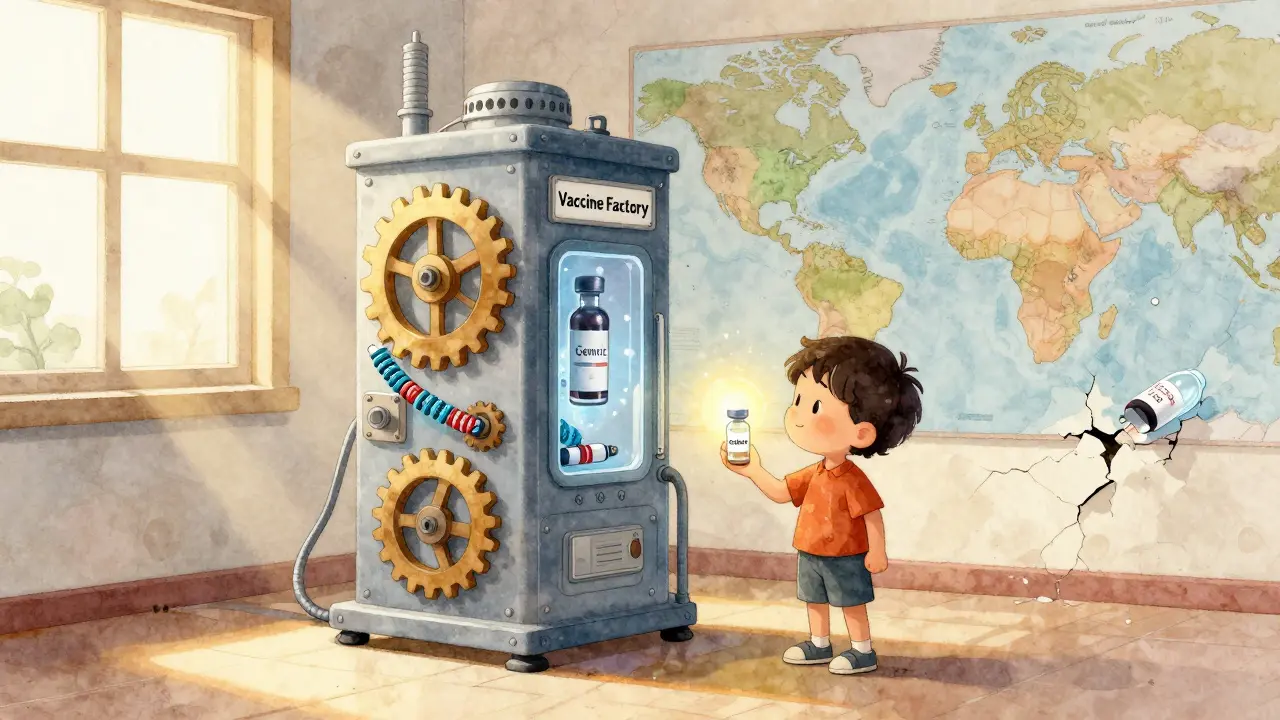
When people talk about vaccine generics, they’re imagining something simple: cheaper versions of life-saving shots, just like how generic pills make antibiotics or blood pressure meds affordable. But vaccines aren’t pills. They’re not chemicals you can copy with a few lab tests. They’re living systems - complex, fragile, and built with precision that can’t be replicated by just following a recipe. This difference is why, despite decades of progress in generic drugs, vaccine access around the world remains deeply unequal.
Why There’s No Such Thing as a True Generic Vaccine
Generic drugs work because they’re chemically identical to the original. You can test them in a lab, measure their concentration in the blood, and prove they behave the same way. Vaccines? Not so much. They’re made from biological materials - viruses, proteins, mRNA, or live attenuated organisms - and each step of production changes the final product. Even tiny shifts in temperature, timing, or raw materials can alter how well the vaccine works.
The U.S. FDA doesn’t have an abbreviated approval path for vaccines like it does for pills. Instead, every new vaccine maker must submit a full Biological License Application. That means starting from scratch: proving safety, testing immune response, validating every batch. There’s no shortcut. The Bill & Melinda Gates Foundation says it plainly: “There’s no ‘generics’ vaccine market as there is for drugs.” It’s not a regulatory oversight - it’s a biological reality.
Who Makes Vaccines, and Where?
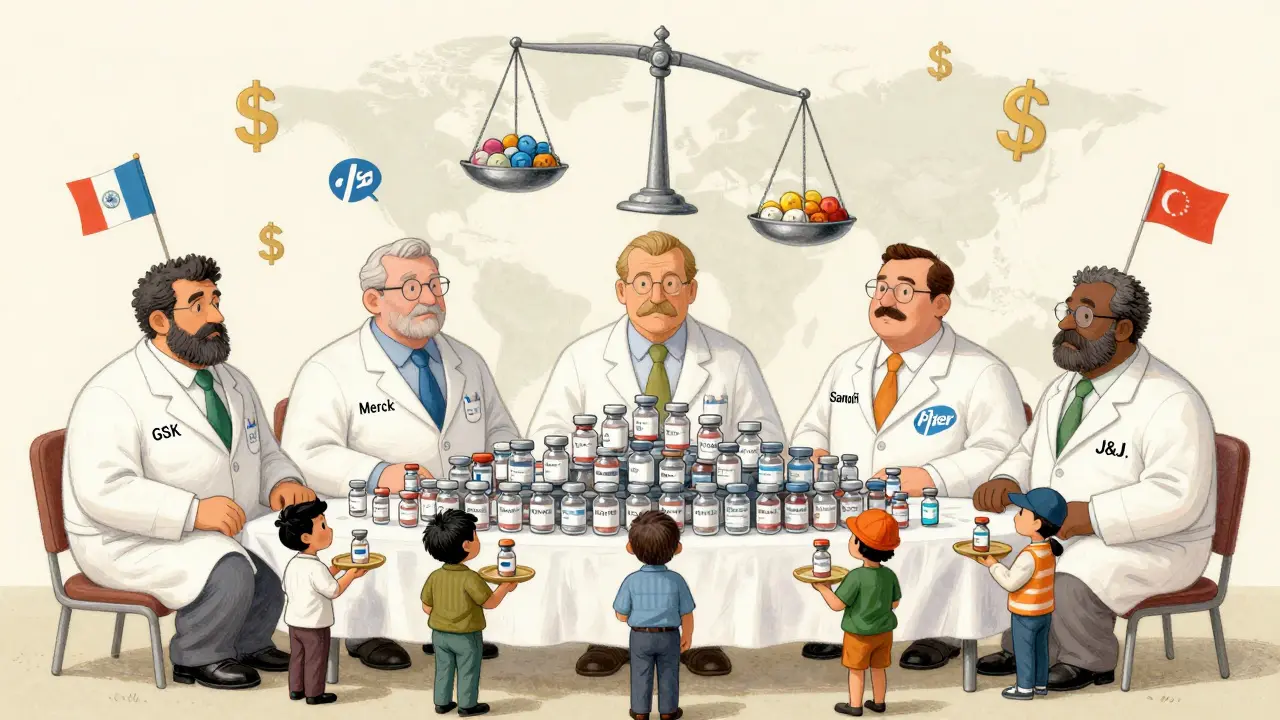
Just five companies - GSK, Merck, Sanofi, Pfizer, and Johnson & Johnson - controlled about 70% of the global vaccine market in 2020, worth $38 billion. But behind that concentration is a surprising truth: most doses are actually made in just a few countries.
India leads the world in vaccine volume. The Serum Institute of India alone produces 1.5 billion doses a year across 11 facilities. It supplies 60% of all vaccines used by the WHO - including 90% of the world’s measles shots and 70% of DPT vaccines. Yet, even this massive output couldn’t meet demand during the pandemic. When India’s second wave hit in April 2021, exports halted. Global supply dropped by nearly half.
Africa, despite supplying 60% of global vaccine production by volume, imports 99% of its own vaccines. That’s not a typo. African nations produce almost nothing for themselves. The continent has fewer than 2% of its own vaccine manufacturing capacity. Meanwhile, India exports 70% of its generics, mostly to wealthy countries with strict regulatory systems - not to the places that need them most.
The Hidden Cost of Complexity
Building a vaccine plant isn’t like building a pill factory. It requires biosafety level 2 or 3 labs, ultra-cold storage (-70°C for mRNA vaccines), and highly specialized materials. Only five to seven companies worldwide make the lipid nanoparticles needed for mRNA shots. If one supplier faces a shortage, the whole chain breaks.
It takes 5 to 7 years and $200 million to $500 million to build a single vaccine production line. Technology transfer - giving another country the know-how - takes 18 to 24 months even with expert support. The WHO’s mRNA hub in South Africa, set up with help from BioNTech, took 18 months just to get started. And when it finally began production in September 2023, it could only make 100 million doses a year. That’s less than 1% of global needs.
Indian manufacturers like the Serum Institute produce the AstraZeneca vaccine for $3-$4 per dose - far below the $15-$20 charged by Western companies. But even that low price barely covers costs. The margins are razor-thin because of infrastructure, quality control, and the sheer scale of investment required. No private company will risk that kind of capital without guaranteed returns.
Who Gets Left Behind?
During the pandemic, high-income countries - just 16% of the global population - bought up 86% of the first billion doses. In April 2021, 83% of all COVID-19 vaccines delivered to Africa through COVAX went to just 10 countries. Twenty-three African nations had vaccinated less than 2% of their people.
It wasn’t just about supply. Distribution failed too. Health workers in the Democratic Republic of Congo received doses that would expire in two weeks - with no refrigerated transport to deliver them. In many places, vaccines sat unused because the cold chain broke before they reached clinics.
And when supply did arrive, it often came with strings attached. Gavi, the Vaccine Alliance, reported that pneumococcal vaccine prices stayed above $10 per dose for low-income countries - despite promises of discounted pricing. Meanwhile, India’s export ban during its 2021 surge showed how fragile global reliance on one producer can be. The U.S. also restricted exports of critical raw materials, threatening to cut global production by 50%.
Can Local Production Fix This?
The African Union wants to get to 60% self-sufficiency by 2040. That will take $4 billion and a decade of investment. The WHO’s technology transfer hubs - in South Africa, Indonesia, and Thailand - are trying to build capacity, but they’re small. They can’t compete with the scale of Pfizer or Moderna.
Even India, the world’s vaccine factory, imports 70% of its vaccine raw materials from China. That’s a vulnerability. When China restricted exports during the pandemic, India’s production slowed. No country can be truly independent if it depends on foreign inputs.
The U.S. FDA’s 2025 pilot program to fast-track generic drug manufacturing in the U.S. shows how deeply countries now fear overreliance on foreign supply chains. But vaccines aren’t drugs. You can’t just move a pill line to Ohio. You need new labs, new training, new suppliers - and years of patience.
The Real Barrier Isn’t Technology - It’s Incentive
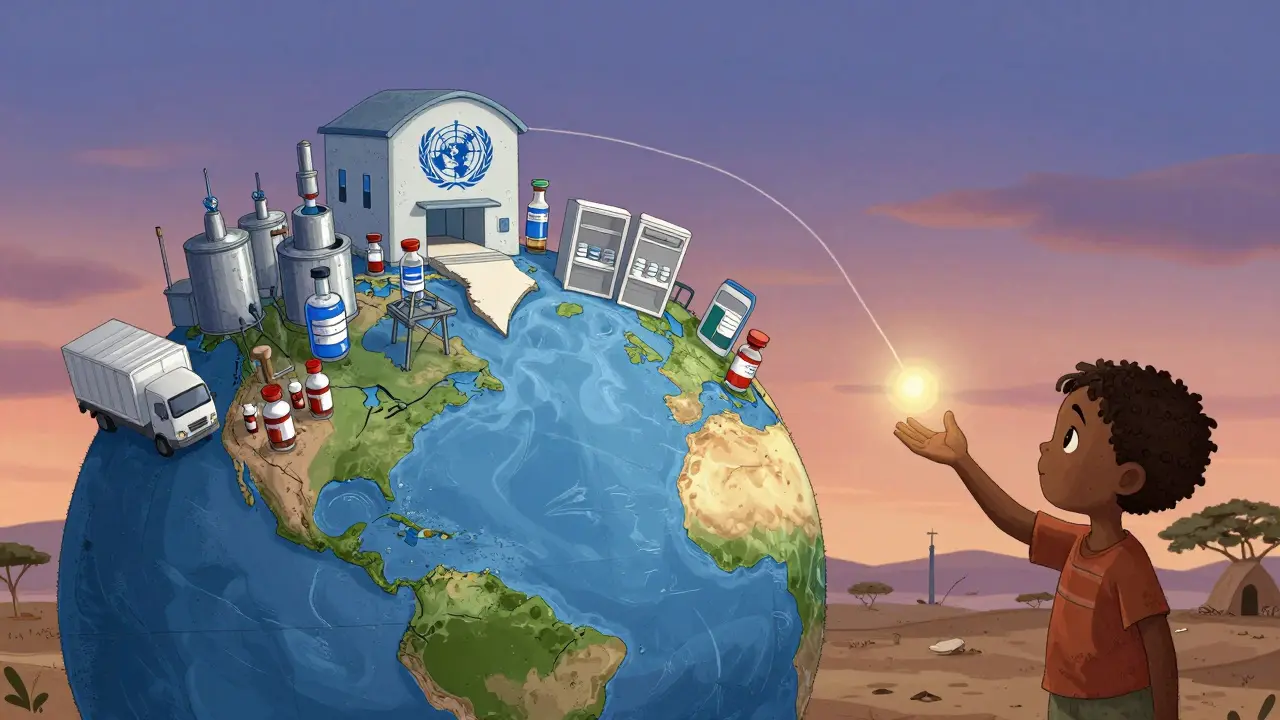
Experts agree: the tools to expand vaccine production exist. The problem is who pays for it. Private companies won’t build factories for low-margin markets. Governments won’t fund them without guaranteed demand. NGOs can’t cover the cost of $500 million plants.
Dr. Nahathai Thitisawakulchai of the WHO says technology transfer is essential - but only if it’s organized properly. Dr. Jayaprakash Muliyil points out that India is the backbone of global health supply chains - yet it’s treated as a supplier, not a partner. Dr. Lucica Ditiu of the Stop TB Partnership warns that any country with the capacity will prioritize its own people first.
That’s the unspoken truth: vaccine equity isn’t a technical problem. It’s a political and economic one. We know how to make vaccines. We know how to build factories. But we don’t have a system that ensures those factories serve the people who need them most.
What Comes Next?
By 2025, low- and middle-income countries will still be 70% dependent on imported vaccines, according to Gavi. That’s not progress - that’s a system stuck in place. The WHO’s hubs, India’s capacity, and Africa’s ambitions are real. But without binding global agreements on pricing, technology sharing, and raw material access, they’ll remain islands in a sea of need.
There’s no magic bullet. No shortcut. No generic version of equity. The only path forward is to treat vaccine production not as a market, but as a public good - funded, shared, and protected like clean water or vaccines.
Joe Prism
March 6, 2026 AT 22:01It's like trying to clone a symphony by writing down the sheet music. The orchestra, the acoustics, the mood - all of it matters.
Ferdinand Aton
March 7, 2026 AT 01:48Amina Aminkhuslen
March 7, 2026 AT 02:06Someone’s making bank while kids in the Congo sit with expired vials. Wake up.
amber carrillo
March 7, 2026 AT 11:14Tim Hnatko
March 7, 2026 AT 21:35That’s not innovation. That’s survival. And we’re treating it like a logistics puzzle.
Aaron Pace
March 8, 2026 AT 02:55And then when it needs its own shots? We shut it down. This isn’t capitalism. This is colonialism with a patent.
Joey Pearson
March 8, 2026 AT 19:37Let’s fund local factories. Let’s share the IP. Let’s stop pretending this is about science and not about power.
Roland Silber
March 9, 2026 AT 12:15Imagine if we spent half that time training engineers instead of debating regulatory paperwork. We’d have 10 more hubs by now.
Patrick Jackson
March 9, 2026 AT 20:25We have the tools. We have the knowledge. We even have the money. But we refuse to see each other as people - just as markets.
And that’s the real pandemic.