Most people think warts are just a nuisance - ugly, rough bumps on the skin that won’t go away. But behind every wart is a real virus: human papillomavirus, or HPV. It’s not just about looks. Warts can hurt, spread, and stick around for years if you don’t treat them right. The good news? You have real options. Not all treatments work the same, and not all warts need the same fix. Whether you’re dealing with a plantar wart on your heel, a flat wart on your face, or a common wart on your finger, understanding how HPV works and what actually removes it can save you time, money, and frustration.
What Causes Viral Warts?
Viral warts aren’t caused by dirt or bad hygiene. They’re caused by infection with specific strains of HPV. There are over 100 types of HPV, but only a handful cause skin warts. HPV types 1, 2, and 4 are the usual suspects behind common warts on fingers and hands. Type 3 and 10 show up as flat warts - often on kids’ faces or legs. Plantar warts, the painful ones on the soles of your feet, are mostly from types 1, 2, 4, 60, and 63. These viruses enter through tiny cuts or scrapes, especially in warm, moist places like locker rooms, pools, or shared showers.
Once inside, HPV tricks your skin cells into multiplying fast. That’s what creates the thick, raised bump you see. Your immune system usually catches on eventually - which is why about 60 to 70% of warts disappear on their own within two years. But waiting isn’t always practical. Warts can multiply. They can spread to other parts of your body. And if they’re on your feet, walking becomes painful. That’s why most people look for treatment.
Topical Treatments: Salicylic Acid and Beyond
The most common and best-studied home treatment is salicylic acid. You can buy it over the counter in liquids, gels, patches, or plasters with concentrations between 17% and 40%. It works by slowly dissolving the keratin - the tough protein that makes up the wart and the surrounding skin. The key is consistency. You need to apply it daily, usually after soaking the area in warm water for 10 minutes and gently filing away the dead skin with an emery board or pumice stone. Don’t share the file. That’s how warts spread.
Studies show salicylic acid clears up plantar warts in about 84% of cases over several weeks. For hand warts, it’s just as effective. But it takes patience. Most people need 6 to 12 weeks of daily use before they see results. If you stop too soon, the wart comes back. And if you apply it to healthy skin around the wart, you’ll get irritation. That’s why it’s important to protect the surrounding skin with petroleum jelly or a bandage.
Other topical options include trichloroacetic acid (TCA), which dermatologists use in-office. It’s stronger than salicylic acid and works by burning off the wart tissue. Before applying TCA, the doctor will usually file the wart down and sometimes prick it to let the acid get deeper. It hurts more than salicylic acid, but it works faster. Side effects include burning, pain, and sometimes dark spots or scarring. It’s not something you do at home.
Cryotherapy: Freezing Warts Off
Cryotherapy - freezing warts with liquid nitrogen - is one of the most popular in-office treatments. It’s fast, doesn’t require anesthesia, and works well for most wart types. The doctor applies the liquid nitrogen for 10 to 20 seconds, freezing the wart and a small border of normal skin around it. This kills the infected cells and triggers your immune system to attack the virus.
A 2023 review of seven studies involving nearly 1,000 patients found cryotherapy and salicylic acid had nearly identical success rates after 12 weeks. Neither was clearly better. But here’s the catch: timing matters. A 1976 study showed that if you wait four weeks between freeze sessions, the cure rate drops from 75% to 40%. The sweet spot is every 2 to 3 weeks. Most people need 3 to 6 treatments. Each session stings. Afterward, the wart turns into a blister, then a scab. It falls off in about 10 days.
Over-the-counter cryotherapy kits exist, but they’re weaker than what doctors use. They might work on small warts, but for stubborn ones, professional treatment is more reliable. Also, freezing doesn’t work well on thick plantar warts unless the surface is filed down first.
Immunotherapy and Other Advanced Options
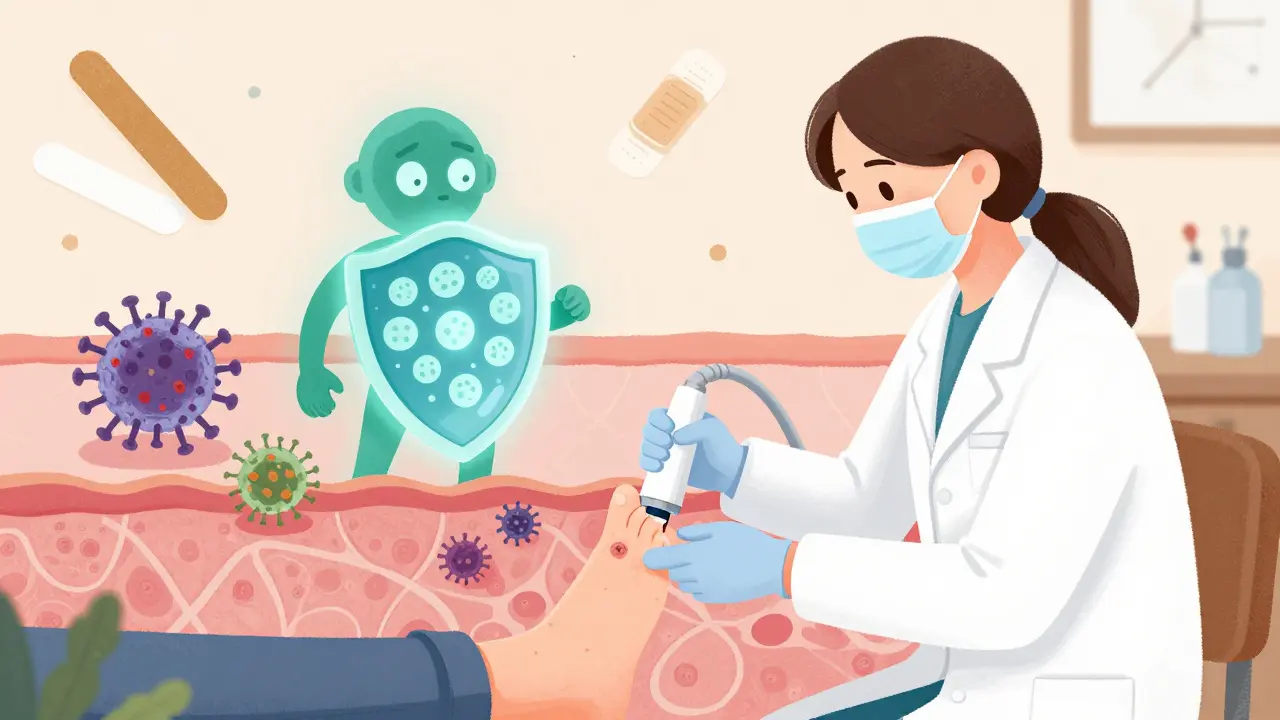
If warts keep coming back after salicylic acid or freezing, your body might not be recognizing the virus. That’s where immunotherapy comes in. Imiquimod cream (Aldara) is applied to the wart three times a week. It doesn’t kill the wart directly. Instead, it wakes up your immune system to attack the HPV-infected cells. It’s been used successfully on warts that resisted other treatments. Side effects include redness, itching, and swelling - which is actually a good sign. It means your immune system is working.
For really stubborn warts, doctors may turn to electrosurgery or laser treatment. Electrosurgery uses a small electric needle to burn the wart off. It’s quick, but it can leave a scar. Laser treatment, like the VBeam pulse dye laser, targets the blood vessels feeding the wart. It’s less damaging to surrounding skin, but it’s expensive and not always covered by insurance. It’s usually reserved for warts that won’t respond to anything else.
Surgical removal is rarely recommended. Cutting out a wart often leads to recurrence because the virus is still in the skin around the edges. Plus, it leaves a noticeable scar.
What Doesn’t Work - And Why
There are a lot of home remedies floating around: duct tape, apple cider vinegar, garlic, tea tree oil. Some people swear by them. But the science doesn’t back them up. Duct tape, for example, was once thought to work by suffocating the wart. Later, better studies showed it was no better than a placebo. Garlic has antiviral properties in the lab, but applying raw garlic to your skin can cause chemical burns. Tea tree oil has no proven effect on HPV.
Even some professional treatments have weak evidence. Silver nitrate, phenol, cantharidin, and even zinc have been used for decades. But the 2022 review from the Royal Australian College of General Practitioners found almost no high-quality studies supporting them. That doesn’t mean they never work - it just means we don’t know how well they work, or how often they fail.
Realistic Expectations and Prevention
No treatment works 100% of the time. Even the best methods have recurrence rates of 10% to 30%. That’s because HPV can hide in the skin even after the wart is gone. That’s why following through with the full treatment course is so important. Don’t stop when the wart looks gone. Keep treating for another week or two.
Prevention is just as important as treatment. HPV spreads through direct skin contact. Avoid walking barefoot in public showers or pools. Don’t pick at warts - that spreads them to other parts of your body. Wash your hands after touching a wart. Keep your skin moisturized - dry, cracked skin is more vulnerable to infection. If you have a wart, cover it with a waterproof bandage when swimming or using shared gym equipment.
And remember: warts are common. They’re not a sign of poor hygiene. They’re not contagious in the way colds are. You don’t need to avoid people. But you do need to treat them properly so they don’t spread or hang around longer than they have to.
Choosing the Right Treatment for You
There’s no one-size-fits-all solution. Here’s how to pick:
- Small, painless warts on hands or face? Start with salicylic acid. It’s cheap, safe, and effective if you’re consistent.
- Painful plantar warts? See a dermatologist. Cryotherapy or TCA works better on thick skin. File the wart before treatment.
- Warts that keep coming back? Try imiquimod. It treats the root cause - your immune system’s failure to fight HPV.
- Multiple warts or resistant cases? Laser or electrosurgery may be worth considering, but only after other options fail.
Don’t waste money on unproven remedies. Stick with what’s been studied. And if you’re unsure, see a dermatologist. They can tell you what kind of wart you have and what’s most likely to work.
When to See a Doctor
You don’t need to rush to a doctor for every wart. But call if:
- The wart bleeds, changes color, or grows rapidly.
- It’s on your face, genitals, or anus - those need special care.
- You have diabetes or a weakened immune system - you’re at higher risk for complications.
- Home treatment hasn’t worked after 12 weeks.
- The wart is painful and interfering with daily life.
A dermatologist can confirm it’s a wart and not something more serious - like skin cancer. Some melanomas mimic warts. It’s better to be safe.
Are viral warts contagious?
Yes, viral warts are contagious through direct skin contact. HPV spreads easily in warm, moist environments like locker rooms, pools, and shared towels. You can also spread warts to other parts of your own body by picking or scratching them. But they’re not as contagious as colds or the flu. Simple hygiene - like washing hands after touching a wart and not sharing personal items - reduces risk significantly.
Do warts go away on their own?
Yes, about 60 to 70% of viral warts disappear without treatment within two years. Your immune system eventually recognizes and clears the HPV virus. But waiting isn’t always the best choice. Warts can multiply, spread to others, or become painful - especially plantar warts on the feet. Many people choose treatment to speed up the process and avoid complications.
Can salicylic acid and cryotherapy be used together?
Yes, combining salicylic acid and cryotherapy can improve results. A 1976 study found that using both treatments together cleared 78% of hand warts, compared to 69% with cryotherapy alone and 67% with salicylic acid alone. While the difference wasn’t statistically significant in that study, many dermatologists now use a combination approach: patients apply salicylic acid daily at home and get cryotherapy every 2-3 weeks in the office. This dual approach attacks the wart from two angles - dissolving it and triggering an immune response.
Why do warts come back after treatment?
Warts return because the HPV virus can hide in the skin around the treated area. Even if the visible wart is gone, the virus may still be present. That’s why treatments often require multiple sessions and why it’s important to keep applying topical treatments for a week or two after the wart disappears. Recurrence rates are 10% to 30% even with proper treatment. Immunotherapy like imiquimod helps reduce recurrence by training your immune system to recognize and destroy lingering HPV cells.
Is it safe to treat warts at home?
It’s generally safe to treat common warts at home with over-the-counter salicylic acid or cryotherapy kits. But avoid treating warts on the face, genitals, or anus without medical advice. Also, don’t use strong acids like trichloroacetic acid at home - they can cause burns. If you have diabetes, poor circulation, or a weakened immune system, always see a doctor first. And if the wart doesn’t improve after 12 weeks, or if it changes shape or color, get it checked.
Shweta Deshpande
January 25, 2026 AT 19:30OMG I had warts on my fingers for like 3 years and I tried everything - garlic, duct tape, even that weird apple cider vinegar hack my aunt swore by. Nothing worked until I started salicylic acid patches at night. It took 10 weeks, but they just… vanished. I’m not even mad about the peeling skin, honestly. It felt like my fingers were finally free. If you’re struggling, just keep at it. You got this 💪
Aishah Bango
January 26, 2026 AT 19:40People still believe in home remedies? Honestly, it’s embarrassing. If you have a medical issue, go see a professional. Not everyone has time to play scientist with their skin. Salicylic acid is literally in the drugstore aisle next to Band-Aids. Stop wasting your life on TikTok cures.
Simran Kaur
January 27, 2026 AT 15:49My cousin in Mumbai had a plantar wart so bad she couldn’t walk to the market. She cried every day. Then she found a local Ayurvedic clinic that used a paste made from neem and turmeric - and after 6 weeks, it was gone. No burning, no freezing, just gentle healing. I know Western medicine says it’s not proven, but sometimes tradition knows what science hasn’t caught up to yet. Maybe it’s not about ‘proven’… maybe it’s about ‘worked for someone’?
Neil Thorogood
January 27, 2026 AT 18:44So you’re telling me I paid $80 for a cryo kit that’s basically a fancy popsicle stick… and the doc’s version is 10x stronger? 😂
Meanwhile my dermatologist just shrugged and said, ‘Your immune system’s lazy. Try imiquimod.’
So now I’m slathering this cream on like it’s face moisturizer and hoping my skin doesn’t revolt. Spoiler: it did. But the wart’s shrinking. 🤷♂️
Jessica Knuteson
January 28, 2026 AT 21:02Warts are a metaphor for systemic failure. The body’s immune response is a social contract. HPV exploits the breakdown. Treatment is not eradication. It’s negotiation. Salicylic acid is the quiet diplomacy. Cryotherapy is the ultimatum. Imiquimod is the revolution. And yet - the virus persists. Because systems don’t collapse. They adapt.
Robin Van Emous
January 29, 2026 AT 05:33I get it. People want quick fixes. But warts are slow. And that’s okay. I used salicylic acid for 14 weeks. I didn’t stop when it looked gone. I kept going. I didn’t pick. I didn’t share my pumice. I washed my hands. And it worked. No drama. No magic. Just patience. And yeah, I know it’s boring. But sometimes boring is the best kind of healing.
Angie Thompson
January 30, 2026 AT 02:56Y’all. I just used the OTC freeze spray on my little toe wart and it turned into a tiny volcano. Like, literal blister city. But guess what? It fell off in 9 days. 🎉 I’m so proud of myself. I didn’t cry. I didn’t scream. I just taped it up and watched Netflix. Also, I bought a new shower flip-flop. No more barefoot gym vibes. 🙌
SWAPNIL SIDAM
January 31, 2026 AT 16:20My uncle in Delhi had warts for 15 years. He stopped touching them. He stopped worrying. And one day, they were just… gone. Maybe your body knows better than the doctor. Sometimes, just leaving it alone is the bravest thing you can do.
Geoff Miskinis
February 1, 2026 AT 12:54The notion that salicylic acid is ‘effective’ is a product of pharmaceutical marketing masquerading as clinical evidence. The 84% success rate cited is derived from unblinded, non-randomized trials with inadequate controls. Cryotherapy? A 1976 study? Please. Modern dermatology has moved beyond Victorian-era interventions. We need gene-targeted therapies, not acid baths and liquid nitrogen.
Sally Dalton
February 1, 2026 AT 21:37i just wanted to say thank you for this post!! i had a wart on my knee for 2 years and i felt so self consious. i tried the acid and it worked but i kept forgetting to file it 😅 and then i started using the patch and it just kinda… disappeared. i’m not a doctor but if anyone’s scared to start - just start slow. you’re not alone 💕
Betty Bomber
February 2, 2026 AT 05:49Warts are weird. Like, why do they look like little rocks? Anyway, I did the freeze thing. It hurt. I cried. Then I got a new tattoo over the spot. Now it’s just part of my story. No regrets.
Mohammed Rizvi
February 2, 2026 AT 05:51Salicylic acid is the real MVP. I used it on my foot while I was stuck in bed with the flu. No fancy clinic. No pain. Just me, a bowl of warm water, and a file. Took 3 months. Worth it. Don’t let anyone tell you it’s not worth the effort. Your feet deserve better than pain.
eric fert
February 2, 2026 AT 10:09Let’s be real - this entire post is just a glorified ad for dermatologists and pharmaceutical companies. Salicylic acid? Used since the 1800s. Cryotherapy? A 1976 study? That’s not science. That’s nostalgia. And don’t get me started on imiquimod - that’s just a fancy immune stimulant that makes your skin look like it got into a fight with a wasp nest. Meanwhile, the real cause? Chronic stress, poor gut health, and the fact that we live in a world that’s literally poisoning our microbiomes. But no, let’s just rub acid on it and call it a day. Classic Western medicine. Quick fix. No root cause. No accountability.
George Rahn
February 2, 2026 AT 18:55As an American citizen, I find it deeply troubling that we are promoting over-the-counter chemical treatments over the disciplined, time-tested, and morally superior approach of personal hygiene and national discipline. In my grandfather’s time, we didn’t have salicylic acid - we had clean feet, clean floors, and clean minds. We did not tolerate parasites. We eradicated them. This post is a symptom of cultural decay. Warts are not medical conditions. They are moral failures.
Shweta Deshpande
February 3, 2026 AT 16:09Wow, I didn’t think anyone else would get this - but I used to be the person who thought warts were just a sign of bad luck. Then I read your comment, Geoff. And I realized… maybe you’re right. Maybe I was just giving up too easily. I didn’t just treat the wart. I started drinking more water. I stopped walking barefoot. I even started meditating. And yeah, the wart finally left. Maybe it wasn’t just the acid… maybe it was me.