Warfarin INR Risk Calculator
INR Risk Assessment Tool
Enter your INR value to determine bleeding risk level and appropriate actions
Warfarin has been used for over 70 years to prevent dangerous blood clots. It’s one of the most common blood thinners prescribed worldwide - especially for people with atrial fibrillation, deep vein clots, or mechanical heart valves. But while it works, it’s not without serious risks. The biggest danger? Bleeding. If you’re taking warfarin, you need to know what to watch for, when to act, and how to stay safe every single day.
Why Bleeding Is the #1 Concern
Warfarin doesn’t just stop clots - it makes your blood less able to clot at all. That’s the point. But sometimes, that balance tips too far. About 1 in 6 people on warfarin will have a major bleeding event within a year. That’s not rare. It’s expected. Major bleeding means bleeding that requires hospital care, a blood transfusion, or causes serious harm. This includes bleeding in the brain, stomach, intestines, or from injuries that won’t stop.
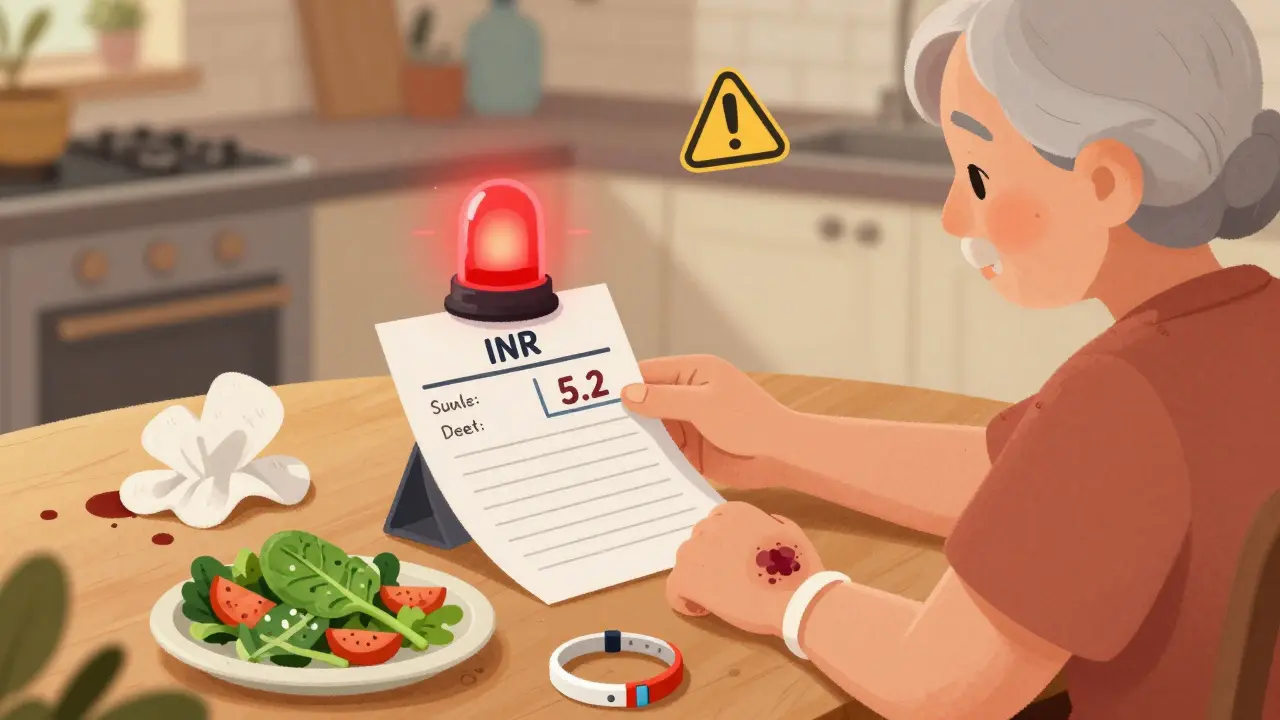
The risk isn’t random. It’s tied directly to your INR - a blood test that measures how long it takes your blood to clot. The ideal range for most people is 2.0 to 3.0. If your INR goes above 4.0, your bleeding risk doubles with every 1-point increase. An INR of 5.0? That’s a red flag. An INR over 6.0? That’s an emergency.
Signs of Bleeding You Can’t Ignore
You don’t need to be in a car crash to bleed dangerously on warfarin. Many bleeding events happen without trauma. Here’s what to look for:
- Unexplained bruising - large purple patches that show up without bumping into anything
- Nosebleeds that last more than 5 minutes even after pinching your nose
- Bleeding gums when brushing or flossing - more than just a little pink
- Pink, red, or brown urine - this isn’t just dehydration
- Black, tarry, or bloody stools - like tar or coffee grounds
- Vomiting blood or material that looks like coffee grounds
- Sudden, severe headache or dizziness - could be bleeding in the brain
- Severe back or abdominal pain - might mean internal bleeding
- Heavy vaginal bleeding - more than your normal period or bleeding between cycles
If you notice even one of these, call your doctor immediately. Don’t wait. Don’t assume it’s “just something.”
Other Rare but Dangerous Side Effects
Bleeding isn’t the only risk. Warfarin can cause rare but serious reactions:
- Warfarin-induced skin necrosis - This is rare (about 1 in 10,000 people), but terrifying. Within days of starting warfarin, you might get painful, dark patches of skin - often on the breasts, thighs, or buttocks. It’s linked to low protein C levels and can lead to tissue death. Stop the drug and get help immediately.
- Purple toe syndrome - About 3 to 8 weeks after starting warfarin, some people notice their toes turning purple or blue. It’s caused by tiny cholesterol fragments blocking small blood vessels. It’s painful but usually goes away after stopping warfarin.
- Calciphylaxis - Extremely rare, mostly in people with kidney failure. Calcium builds up in blood vessels, causing painful skin ulcers. If you have kidney disease, your doctor should monitor you closely.
- Changes in taste, nausea, or stomach bloating - These are common but not dangerous. Still, if they’re new or worse, mention them.

Who’s at Highest Risk?
Not everyone on warfarin bleeds. But some people are far more likely to. You’re at higher risk if you:
- Are 65 or older
- Have high blood pressure
- Have had a stomach bleed before
- Have heart disease or a history of stroke
- Have anemia or cancer
- Have kidney problems
- Take more than one blood thinner or NSAIDs (like ibuprofen or naproxen)
If you have three or more of these, your risk of major bleeding jumps to nearly 20% per year. That’s why doctors use tools like HAS-BLED to assess your risk before starting warfarin. If your score is high, they may consider switching you to a newer drug - if it’s safe for you.
How to Stay Safe Every Day
Managing warfarin isn’t just about taking a pill. It’s about habits.
- Get your INR checked regularly. Most people need it every 4 weeks. If you’re new to warfarin or your dose changed, you might need it weekly. Never skip a test.
- Keep your vitamin K intake steady. Vitamin K fights warfarin. Leafy greens like spinach, kale, broccoli, and Brussels sprouts are high in it. Don’t avoid them - just eat about the same amount every week. A sudden salad binge can drop your INR. A sudden salad cutback can spike it.
- Avoid NSAIDs. Ibuprofen, naproxen, and aspirin (unless prescribed) can double your stomach bleeding risk. Use acetaminophen (Tylenol) for pain instead - but don’t overdo it.
- Use an electric razor. A blade razor can nick your skin. A small cut on warfarin can turn into a big problem.
- Use a soft toothbrush and waxed floss. Gum bleeding is common. You can reduce it with gentle tools.
- Wear a medical alert bracelet. If you’re in an accident and can’t speak, paramedics need to know you’re on warfarin. It changes everything they do.
- Never start a new medicine or supplement without checking. Over 300 drugs and herbs interact with warfarin - from antibiotics to garlic pills. Even St. John’s Wort can make warfarin useless.
- Avoid contact sports. Football, rugby, hockey - no. Skiing, cycling, or hiking? Maybe, but wear protective gear. Falls are dangerous.

What to Do If You Bleed
Minor bleeding - like a small nosebleed that stops in 5 minutes - you can manage at home. Call your doctor the next day.
Major bleeding? Go to the ER. Now. Don’t call. Don’t wait. Don’t drive yourself if you’re dizzy. Call 911.
In the hospital, doctors will:
- Check your INR immediately
- Stop your warfarin
- Give you vitamin K (by IV) to reverse the effect
- Use a product called PCC (prothrombin complex concentrate) if bleeding is life-threatening - this works in minutes
- Use fresh frozen plasma if PCC isn’t available
For brain bleeds, every minute counts. Reversal should happen within 30 to 60 minutes. That’s why knowing the signs and acting fast saves lives.
Warfarin vs. Newer Blood Thinners
Since 2010, newer drugs like apixaban (Eliquis), rivaroxaban (Xarelto), and dabigatran (Pradaxa) have become popular. They don’t need INR tests, have fewer food interactions, and carry about 30% less risk of major bleeding.
But warfarin still has its place. If you have a mechanical heart valve - especially in the mitral position - warfarin is still the gold standard. Newer drugs don’t work as well there. Also, if you have severe kidney disease, warfarin is often safer because it’s cleared by the liver, not the kidneys.
Cost matters too. Generic warfarin costs $4 to $10 a month. Newer drugs can cost $300 to $500. If you’re on a tight budget, warfarin is still a smart choice - if you’re willing to do the work.
What’s New in 2026?
Home INR testing devices like the CoaguChek Pro II are now widely available and FDA-approved. If you’re stable, you can test yourself weekly. Studies show this improves time in the target range by 15-20%. That means fewer bleeding events and fewer hospital visits.
Genetic testing for CYP2C9 and VKORC1 genes can help predict your ideal dose. It’s not routine yet - but if you’ve had trouble stabilizing on warfarin, ask your doctor if it’s an option.
One thing hasn’t changed: vigilance still saves lives. Warfarin is not a “set it and forget it” drug. It demands attention. But for millions, it’s still the best tool they have.
Can I drink alcohol while taking warfarin?
Moderate alcohol (1 drink per day for women, 2 for men) is usually okay. But binge drinking or heavy daily use can raise your INR and increase bleeding risk. Alcohol also affects liver function, which is how warfarin is processed. If you drink, be consistent - don’t go from 3 drinks a week to 7 in one weekend.
Can I take herbal supplements with warfarin?
Avoid most herbal supplements. Garlic, ginkgo, ginseng, ginger, and green tea can all increase bleeding risk. Even fish oil in high doses (over 3 grams daily) can thin your blood. Always tell your doctor about every supplement you take - even if you think it’s "natural."
Do I need to stop warfarin before dental work?
For most routine dental procedures - cleanings, fillings, root canals - you should keep taking warfarin. Stopping it increases your risk of clotting more than the risk of bleeding from the procedure. Dentists use local measures like sutures, gauze, or tranexamic acid mouthwash to control bleeding. Only for major oral surgery (like multiple extractions) might your doctor consider a short pause - and even then, they’ll likely use a "bridge" with heparin.
What happens if I miss a dose of warfarin?
If you miss one dose, take it the same day if you remember before bedtime. If it’s already the next day, skip the missed dose and take your regular dose the next day. Never double up. Missing doses can cause your INR to drop, raising your risk of clots. If you miss more than one dose, call your doctor - they may want to check your INR sooner.
Is warfarin safe during pregnancy?
No. Warfarin can cross the placenta and cause birth defects, especially in the first trimester. If you’re pregnant or planning to be, your doctor will switch you to heparin injections, which are safe during pregnancy. If you’re on warfarin and think you might be pregnant, stop it immediately and call your provider.
Ashlyn Ellison
February 7, 2026 AT 21:35Just started warfarin last month. Had a nosebleed that wouldn’t stop for 12 minutes. Scared the hell out of me. Called my doc, they said INR was at 4.8. Gave me vitamin K and told me to chill on the kale. Still alive. Still taking it. Just… don’t ignore the little signs.
Joshua Smith
February 8, 2026 AT 05:58I appreciate how thorough this is. I’ve been on warfarin for 8 years with no major issues, but I never realized how much vitamin K variability matters. I used to go crazy with spinach salads on weekends. Now I eat one cup every Tuesday. Small routine, huge difference. My INR’s been stable since.
PAUL MCQUEEN
February 10, 2026 AT 00:29So basically, you’re telling me this 70-year-old drug is still the gold standard because it’s cheap? Not because it’s better? I mean, we’ve got apps that track your INR now. Why are we still doing this the Stone Age way?
Lyle Whyatt
February 11, 2026 AT 13:54Let me tell you about my uncle. He was on warfarin for a mechanical mitral valve. One day, he took a fall. Just a stumble. No trauma, no head injury. But he went into a coma from a brain bleed. They said his INR was 6.3. He survived, but lost half his vision. I didn’t even know warfarin could do that. Now I check my INR like it’s my job. Because honestly? It kind of is.
And yeah, the new drugs are great-but if you’ve got a mechanical valve? Don’t listen to anyone who says you can switch. Warfarin’s the only thing that keeps the valve from turning into a paperweight.
Sam Dickison
February 12, 2026 AT 11:23INR 2–3 is the therapeutic window. Anything above 4 is a red zone. PCC reversal is gold standard for acute bleeding. Vitamin K takes hours. Don’t wait. If you’re in the ER with GI bleed and INR >5, they’re giving you 25 IU of PCC stat. No debate. Also-avoid NSAIDs like the plague. Acetaminophen’s your BFF.
Brett Pouser
February 12, 2026 AT 23:32I’m from rural Texas. My grandma’s on warfarin. She doesn’t have a smartphone. Doesn’t know what INR means. But she checks her blood every Friday at the clinic next to the Dollar General. They’ve got a machine they loan out. She’s had zero bleeds in 5 years. This isn’t just for tech-savvy people. It’s for anyone willing to show up.
John Sonnenberg
February 14, 2026 AT 05:43EVERYTHING ABOUT WARFARIN IS A NIGHTMARE. I MEAN, THINK ABOUT IT. YOU TAKE A PILLS THAT MAKES YOUR BLOOD THIN, AND THEN YOU HAVE TO WATCH EVERY SINGLE THING YOU EAT, DRINK, OR TOUCH BECAUSE A SLIGHT CUT COULD KILL YOU. AND THEN THEY TELL YOU TO WEAR A BRACELET? LIKE, WHAT IF I’M AT THE BEACH? WHAT IF I’M IN BED? WHAT IF I’M JUST… LIVING? THIS ISN’T MEDICINE. THIS IS A SURVIVAL GAME.
Angie Datuin
February 15, 2026 AT 10:36I’ve been on warfarin since 2019. I’ve had two nosebleeds, one bruise the size of a grapefruit, and once I thought I was bleeding internally-turned out it was just a really bad burrito. I’m still here. It’s not perfect, but it’s manageable. Just don’t panic. And get your INR checked.
Camille Hall
February 16, 2026 AT 04:10If you’re new to warfarin, please know you’re not alone. I’ve been on it for over a decade. It feels overwhelming at first-so many rules, so many warnings. But over time, it becomes routine. Like brushing your teeth. I track my greens, I use an electric razor, I have my INR calendar on my fridge. It’s not glamorous, but it’s peace of mind. You can do this.
Tricia O'Sullivan
February 16, 2026 AT 14:30While I acknowledge the utility of warfarin in specific clinical contexts, I must express concern regarding the systemic reliance on a pharmacological agent that necessitates such intensive monitoring and carries a substantial risk profile. In light of the availability of direct oral anticoagulants with superior safety profiles, one must question whether the continued dominance of warfarin is driven by clinical necessity or economic inertia.
Susan Kwan
February 18, 2026 AT 00:11Oh, so now I’m supposed to eat the same amount of kale every week? Like I’m a robot? And if I accidentally have a spinach smoothie? Do I get a warning label on my forehead? "Warning: May Bleed Out If Not Fed Correctly."
Random Guy
February 19, 2026 AT 04:32so like… if i miss a dose do i just… not die? i mean, what if i just forget for 3 days? is it like, "oh shit" or "eh, i’ll be fine"? also, can i still do kegels? idk why i’m asking this
Ryan Vargas
February 19, 2026 AT 08:17Think about this: warfarin isn’t just a drug. It’s a system of control. The INR test? A surveillance mechanism. The dietary restrictions? Social conditioning. The medical alert bracelet? A branding tool for pharmaceutical compliance. We’ve been trained to accept this as "necessary." But what if the real danger isn’t the clot… but the dependency? What if the system is designed to keep us tethered-to doctors, to labs, to pills? The new drugs aren’t safer… they’re just more expensive and less controllable. And that’s the point.
Tasha Lake
February 20, 2026 AT 16:03For anyone with AFib and a mechanical valve, warfarin is still the MVP. But if you’re just trying to prevent stroke and you’re young, ask your doctor about apixaban. No INR, no kale tracking, no hospital visits. Just one pill a day. Also, the cost difference? Warfarin is $5/month. Eliquis is $500. But if you have insurance? Sometimes it’s $10. Ask. Always ask.
Karianne Jackson
February 22, 2026 AT 00:55I had purple toes. Just… purple. Like someone painted them. I thought I had frostbite. Went to the ER. Doctor said, "Oh, warfarin." Took me off it. Two weeks later, back to normal. I didn’t even know that was a thing. Now I Google every weird symptom. My brain is a conspiracy board.