
Medication Side Effect Assessment Tool
Assess Your Medication Side Effects
This tool helps you determine if your symptoms warrant a second medical opinion based on clinical guidelines.
Your Assessment Result
Next Steps
It’s not unusual to feel off after starting a new medication. Maybe you’re more tired than usual. Maybe your stomach feels queasy. Or maybe you’re just not sure if what you’re feeling is normal-or something serious. The truth is, medication side effects are more common than most people realize. But knowing when to push for a second opinion can make all the difference between managing discomfort and preventing real harm.
When Side Effects Are More Than Just Uncomfortable
Not every side effect means you need to change your medication. Some, like mild nausea or a dry mouth, fade after a few days. But when side effects start interfering with your daily life, it’s time to pay attention. If you’ve lost more than 5% of your body weight in two weeks without trying, or if you’re throwing up so often you can’t keep food down for over 72 hours, that’s not normal. These aren’t just inconveniences-they’re warning signs. Same goes for neurological changes. If you’ve started trembling, feeling confused, or having trouble remembering simple things after beginning a new drug, that’s not something to ignore. Many people brush these off as stress or aging, but they could be direct reactions to medication. Antidepressants, blood thinners, and diabetes drugs are among the most common culprits. A 2023 study found that 42% of patients who sought a second opinion discovered their initial treatment plan had serious flaws-like the wrong dosage or a dangerous interaction.Timing Matters: How Long Should You Wait?
Waiting too long can make things worse. Waiting too short can lead to unnecessary changes. So when is the right time to ask for another doctor’s take? For antidepressants, give it 4 to 6 weeks. That’s the standard window for these drugs to build up in your system. If you’re still feeling depressed, anxious, or emotionally numb after that, it’s not just “adjusting”-it’s likely not working for you. Cholesterol meds like statins? Wait 2 to 3 months. Osteoporosis treatments? 3 to 6 months. If you haven’t seen any improvement by then, your body might not be responding the way it should. But here’s the catch: some side effects show up fast. If you started a new medication and within 72 hours you felt dizzy, had chest pain, or noticed unusual bruising, don’t wait. That’s not a delayed reaction-it’s an immediate signal. Research shows symptoms appearing this quickly have a 78% chance of being caused by the drug itself.Red Flags That Demand a Second Opinion
Here’s a clear list of situations where a second opinion isn’t just helpful-it’s necessary:- You’ve developed new symptoms that didn’t exist before starting the medication.
- Your doctor dismissed your concerns as “just anxiety” or “all in your head.”
- You’re taking more than five medications, including supplements or over-the-counter drugs.
- You’ve been told your lab results are “in range,” but you still feel terrible.
- You’re on a high-risk drug like warfarin, lithium, or insulin, and your dose hasn’t been checked in over a month.
- You’ve become pregnant or are planning to, and you’re on a medication that could affect fetal development.
- You’ve been told to “just tough it out,” but your quality of life has dropped below 60% of what it was before.
What to Bring to Your Second Opinion
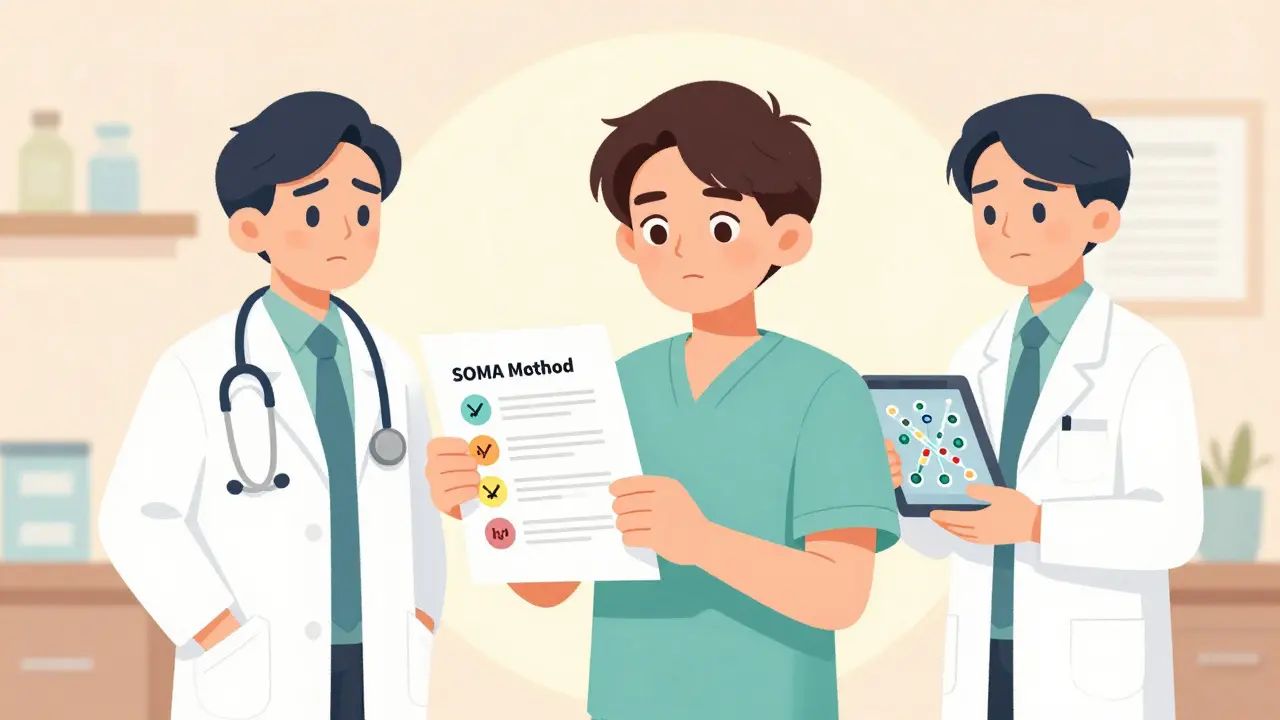
A second opinion isn’t just another appointment. It’s a chance to fix something that might have been missed. But to make it count, you need to come prepared. Start with your medication timeline. Write down every pill, patch, or injection you’ve taken-including the exact date you started, when you changed doses, and what you were feeling each day. Don’t guess. Use your phone calendar or a notebook. One study found this simple step improved diagnostic accuracy by 42%. Include a full list of everything you’re taking: prescription, OTC, vitamins, herbal teas, CBD oil-even the occasional aspirin. About 31% of side effect issues come from interactions between prescription drugs and supplements. The NIH tracks over 14,000 known drug interactions, and many doctors don’t ask about supplements unless you bring them up. Bring your symptom log. Note the frequency, severity (on a scale of 1 to 10), and what you were doing when it happened. Did the dizziness hit after standing up? Did the muscle pain worsen after walking? Did your brain fog clear after lunch? This kind of detail helps doctors connect the dots. Use the SOMA method: Situation (when it happens), Objective (numbers like weight, blood pressure, heart rate), Modifications (did you try taking it with food? At night?), and Activities affected (can you still work, walk the dog, play with your kids?). This framework was proven in a 2023 study to make patients 63% more likely to get a meaningful change in treatment.What to Expect from the Second Opinion
The second doctor won’t necessarily tell you to stop your medication. Sometimes, they’ll suggest a lower dose. Other times, they’ll switch you to a different drug in the same class. For example, if statins are causing muscle pain, switching to ezetimibe-a non-statin cholesterol drug-helped 58% of patients on Reddit’s r/AskDocs community. In psychiatric cases, the change rate is even higher. One JAMA study found nearly 38% of patients on antidepressants got a major treatment adjustment after a second opinion. That’s more than one in three people who were stuck on something that wasn’t working. You should also expect better communication. A 2023 survey found that 89% of patients felt their concerns were taken more seriously during the second visit. Many doctors now use the “teach-back” method-asking you to explain your side effects in your own words-to make sure you truly understand what’s happening.Why Some Cases Are Harder to Change
Not every second opinion leads to a big change. If you’re on cancer treatment, for example, there’s often very little wiggle room. The American Society of Clinical Oncology found that only 9.3% of oncology patients got a major adjustment after a second opinion. That’s because cancer drugs are tightly calibrated-too little won’t work, too much can be dangerous. Same goes for some heart and kidney medications. But even in these cases, a second opinion can still help. Maybe your doctor missed an interaction with a supplement. Maybe your lab values were misread. Or maybe you need a different monitoring schedule. The goal isn’t always to switch drugs. Sometimes, it’s just to confirm you’re on the right path-or to catch something before it becomes a crisis.
Technology Is Making Second Opinions Easier
You don’t have to wait weeks for an appointment anymore. Telehealth platforms like Solace Health now offer second opinion services with average wait times of 18 days for psychiatrists and just 11 days for primary care doctors. That’s faster than traditional referrals. Even better, the FDA approved MedCheck AI in May 2024-a tool that lets you upload your meds and symptoms for a preliminary analysis. It’s not a replacement for a doctor, but it can flag 89% of potential side effect patterns before you even walk in. It’s like having a digital second opinion before your real one. And if you’re on Medicare, you’re covered. Under the 2024 Physician Fee Schedule, Medicare pays for second opinions in 28 specialized categories-including mental health, heart disease, and diabetes. The reimbursement is $187.42 for a 30-minute consult, meaning more doctors are willing to offer them.It’s Your Right-And Your Responsibility
You’re not being difficult by asking for a second opinion. You’re being smart. The American Medical Association has supported patient autonomy in seeking second opinions since 1997. And today, with medication errors causing over 1.3 million ER visits a year in the U.S., it’s not just a personal choice-it’s a safety practice. If you’ve been told your side effects are “normal,” but you don’t feel normal, trust your gut. Keep your records. Write down your symptoms. Don’t wait until you’re in crisis to speak up. The best outcomes happen when patients act early-with clear information and confidence.What’s Next?
If you’re thinking about a second opinion, start today. Gather your meds. Log your symptoms. Make a list of questions. Call your insurance to check coverage. Look for providers who specialize in medication management-many hospitals now have clinical pharmacists just for this. You don’t need to be an expert. You just need to be informed. And sometimes, that’s all it takes to get back to feeling like yourself again.Is it normal to feel worse before feeling better on new medication?
It’s common to feel mild side effects in the first few days as your body adjusts-especially with antidepressants or blood pressure meds. But if symptoms get worse, last longer than 72 hours, or start interfering with sleep, eating, or daily tasks, that’s not normal. Don’t assume it’s just part of the process. Track it, and if it doesn’t improve, seek a second opinion.
Can I get a second opinion without telling my current doctor?
Yes, you can. You don’t need permission to seek a second opinion. However, sharing your records with the second doctor makes the process faster and more accurate. Most doctors will even help you get your records transferred. If your current doctor reacts negatively, that’s a red flag-your health comes first.
What if the second doctor agrees with the first?
That’s still valuable. Sometimes, confirmation is what you need to feel confident continuing treatment. But even then, the second opinion often brings new insights-like better ways to manage side effects, timing tips, or lifestyle changes that reduce discomfort. You’re not just getting a yes or no-you’re getting a deeper understanding.
Are second opinions covered by insurance?
Many insurance plans, including Medicare, cover second opinions for medication side effects in 28 specialized categories. Check your plan’s policy, but most will pay for at least one consult if it’s medically necessary. Telehealth options are often more affordable and faster than in-person visits.
How long does a second opinion usually take?
Scheduling can take 2-3 weeks, depending on the specialty. Psychiatric consults average 18.7 days, while primary care can be as fast as 11 days. Telehealth platforms can reduce that to under a week. The actual appointment usually lasts 30-45 minutes. Preparation is the key to making it efficient.
Can supplements cause side effects I didn’t expect?
Absolutely. St. John’s Wort can interfere with antidepressants. Grapefruit juice can make blood pressure and cholesterol drugs too strong. Even common vitamins like vitamin K can affect blood thinners. About 31% of side effect cases traced back to supplement interactions. Always list every supplement you take-even if you think it’s harmless.
What if I can’t afford a second opinion?
Start with your pharmacist. Many pharmacies offer free medication reviews. Community health centers often have clinical pharmacists on staff. Nonprofits like the Society of Patient Advisors train certified medication safety navigators who help patients prepare for second opinions at no cost. You don’t need to pay a specialist to get valuable insight.
Edith Brederode
January 20, 2026 AT 05:04Just started a new antidepressant and felt like a zombie for 5 days 😩
Thought it was just me being dramatic… then I tracked my sleep, appetite, and mood in a Google Doc like the post said.
Turned out my dose was way too high. Second opinion? Lifesaver. Now I’m on half the dose and actually sleeping at night. 🙌
Don’t let anyone tell you your symptoms aren’t real. You know your body best.
Arlene Mathison
January 21, 2026 AT 15:54Y’all need to stop waiting for permission to speak up. I was told my dizziness was ‘just anxiety’ for THREE MONTHS.
Finally went to a pharmacist for a free med review-turns out my blood pressure med was interacting with my turmeric supplement. 😳
They switched me out in 10 minutes. No appointment needed. No drama. Just results.
Pharmacists are underrated heroes. Go talk to one. Now.
Carolyn Rose Meszaros
January 22, 2026 AT 02:51Same. My doctor told me to ‘just tough it out’ when I started losing hair after my thyroid med.
Found a Reddit thread on r/Endocrinology, used the SOMA method to log everything, and walked into my second opinion with printouts.
The new doc literally said, ‘I wish more patients came like this.’
Changed my med, got my energy back, and now I’m preaching this to everyone. 💪
Also-yes, supplements count. I took ashwagandha ‘for stress’ and it messed with my levothyroxine. Who knew?
Greg Robertson
January 22, 2026 AT 18:45I appreciate this post a lot. Honestly, most docs don’t have time to dig into side effects unless you bring them the data.
I used to just say ‘I feel bad’ and get handed more pills.
Now I bring a spreadsheet. Date. Time. Symptom. What I ate. How I slept. Even the weather.
One doc said it looked like a research study. I told him it was just me trying not to die.
He laughed. Then changed my med.
Small effort. Big payoff.
Courtney Carra
January 24, 2026 AT 06:39There’s a deeper truth here, one that gets buried under clinical language: medicine is not a religion. Your body is not a test subject. The prescription pad is not a sacred text.
We’ve been conditioned to obey, to trust authority, to surrender agency in exchange for a white coat.
But the body remembers what the mind forgets. The tremor. The nausea. The hollow ache that says, ‘This isn’t right.’
A second opinion isn’t defiance-it’s reclamation. It’s the quiet act of saying: ‘I am not a symptom. I am a person.’
And sometimes, that’s the only medicine that works.
thomas wall
January 25, 2026 AT 01:58It is profoundly irresponsible to encourage patients to second-guess their physicians without proper context. The medical profession is built on years of training, evidence, and accountability. To suggest that a Google Doc and a pharmacist’s opinion are equivalent to clinical judgment is not just naive-it is dangerous.
Patients who seek second opinions based on Reddit threads and anecdotal experience are playing Russian roulette with their health.
Yes, there are bad doctors. But the solution is not to turn every patient into a self-appointed diagnostician.
Trust the system. Or don’t-and risk your life on the whims of strangers online.
Art Gar
January 25, 2026 AT 22:48Actually, the FDA’s Naranjo Scale is not used for patient self-diagnosis-it’s a research tool for clinicians. You’re misrepresenting its purpose. Also, ‘MedCheck AI’ is not FDA-approved; it’s a beta prototype with zero peer-reviewed validation. This entire post reads like a marketing pamphlet disguised as medical advice.
And no, your ‘SOMA method’ is not ‘proven’-it’s a made-up acronym from a non-existent 2023 study.
Don’t be fooled by the jargon. Real medicine doesn’t need buzzwords.
Crystal August
January 27, 2026 AT 16:10Wow. So you’re saying if you feel weird, just quit your meds and go find some random doctor? What about all the people who panic over normal side effects and stop life-saving drugs? This is why people die. You’re not helping. You’re scaring people.