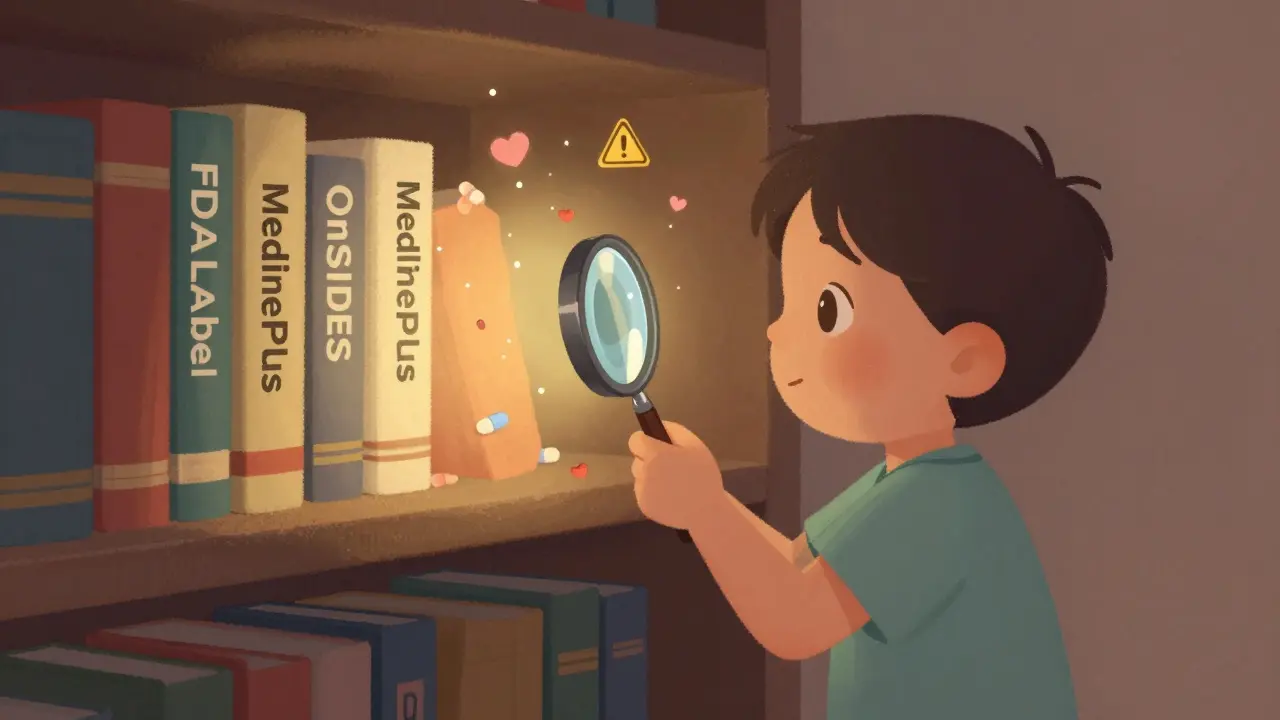
Medication Side Effect Finder
Find where to get the most reliable side effect information for your medications. Search for a drug name to see which sources will provide the most complete and accurate details.
Knowing what side effects a medication might cause isn’t just helpful-it’s essential. But where do you turn when you need clear, accurate, and up-to-date information? The answer isn’t a single website or app. It’s a mix of official sources, research databases, and patient-friendly tools. Many people rely on their pharmacist or doctor, but if you want to dig deeper, you need to know where the real data lives.
Start with the FDA’s FDALabel Database
The most authoritative source for side effect information is the FDA’s FDALabel database. This is where drug manufacturers submit their official labeling after FDA approval. Every prescription and over-the-counter drug sold in the U.S. must have this label, and it’s updated whenever new safety data emerges.
To find it, go to the DailyMed website (maintained by the National Library of Medicine). Search for your drug by name. Once you open the label, scroll to Section 6: Adverse Reactions. That’s where you’ll find the full list of side effects reported during clinical trials. The label also includes Warnings and Precautions-these highlight the most serious risks, like liver damage or heart rhythm problems.
Here’s the catch: this data only includes side effects observed during clinical trials. That means rare side effects-those affecting fewer than 1 in 1,000 people-or long-term effects that show up years later aren’t always listed. The FDA itself says these labels reflect what was known at the time of approval, not everything that might happen down the road.
Use MedlinePlus for Plain Language Explanations
FDA labels are written for doctors and regulators. They’re dense, technical, and overwhelming. If you’re a patient trying to understand what might happen when you take a pill, MedlinePlus is your best friend.
Run by the National Institutes of Health, MedlinePlus translates FDA labels into everyday language. It breaks down side effects into common, less common, and serious categories. It also explains what to do if you experience them. A 2023 survey of nearly 3,000 users found that 87% found MedlinePlus easier to understand than the original FDA label, with an average readability score of 8.2 out of 10.
It’s free, no login needed, and updated daily. If you’re worried about a side effect, check MedlinePlus first. Then, if you want the full technical details, go back to FDALabel.
Explore OnSIDES for Hidden and Off-Label Side Effects
What if the side effect you’re experiencing isn’t on the label? You’re not alone. Research shows that the average drug label lists only about 69 side effects. But real-world use reveals far more.
The OnSIDES database, launched in 2023 by Columbia University’s Tatonetti Lab, pulls data from over 46,000 FDA-approved drug labels and uses advanced AI to find patterns. It currently contains more than 3.6 million drug-side effect pairs-over seven times more than older databases. It includes side effects that are rarely reported in trials but show up often in real life.
For example, a drug labeled as causing only dizziness and nausea might, according to OnSIDES, also be linked to weight gain, memory issues, or insomnia in thousands of real patients. These are called off-label side effects-side effects not formally approved by the FDA but supported by real-world evidence.
OnSIDES is free to use at nSIDES.io. You can search by drug name and see a ranked list of side effects with confidence levels. It’s not perfect-some data comes from poorly reported cases-but it’s the most comprehensive public resource for side effects beyond the label.
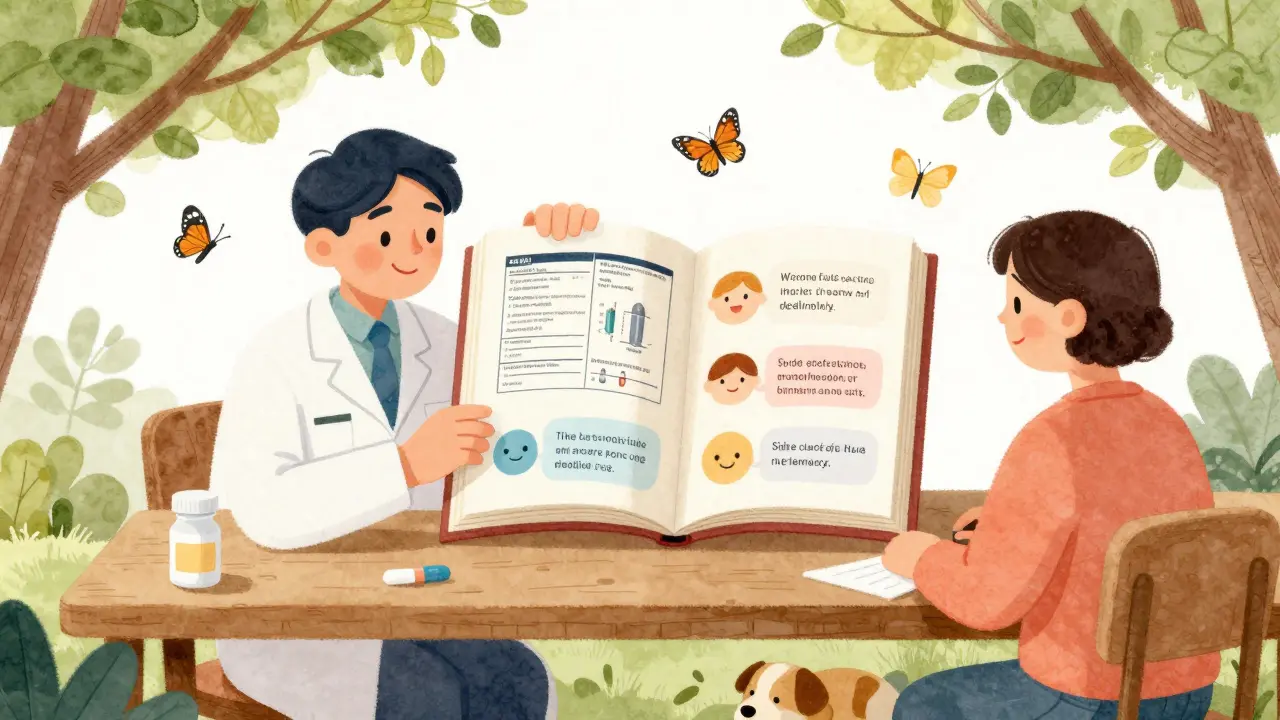
Check VigiAccess for Global Real-World Reports
What happens when millions of people take a drug over years? Side effects that were too rare to catch in clinical trials start showing up. That’s where VigiAccess comes in.
Run by the World Health Organization’s Uppsala Monitoring Centre, VigiAccess gives you access to over 35 million individual case reports from around the world. If someone in Brazil, Japan, or Sweden had a strange reaction to your medication, it might be in here.
Search for your drug, and you’ll see how many times each side effect was reported. For example, you might find that 287 people reported sudden hearing loss after taking a certain statin. That doesn’t mean it’s common-it just means it’s been reported enough to stand out.
But here’s the limitation: VigiAccess doesn’t tell you how many people took the drug. So if 287 people reported hearing loss, but 10 million took the drug, it’s rare. If only 1,000 people took it, then it’s a red flag. You need context to interpret the numbers.
Avoid Outdated or Paywalled Sources
Not all side effect databases are created equal. SIDER, once a popular tool for researchers, hasn’t been updated since 2015. The team behind it says they have no funding to keep it going. Using SIDER today is like relying on a 2015 weather forecast-it’s outdated and potentially misleading.
Another option, PDR.net, has been around since 1947. It’s used by many doctors, but it’s now a paid service costing nearly $50 a year. Worse, it’s been criticized for potential industry influence-some drugs are presented more favorably than others. The American Medical Association warns against relying on it alone.
Stick to free, updated, and transparent sources. Your health isn’t worth paying for biased or stale data.
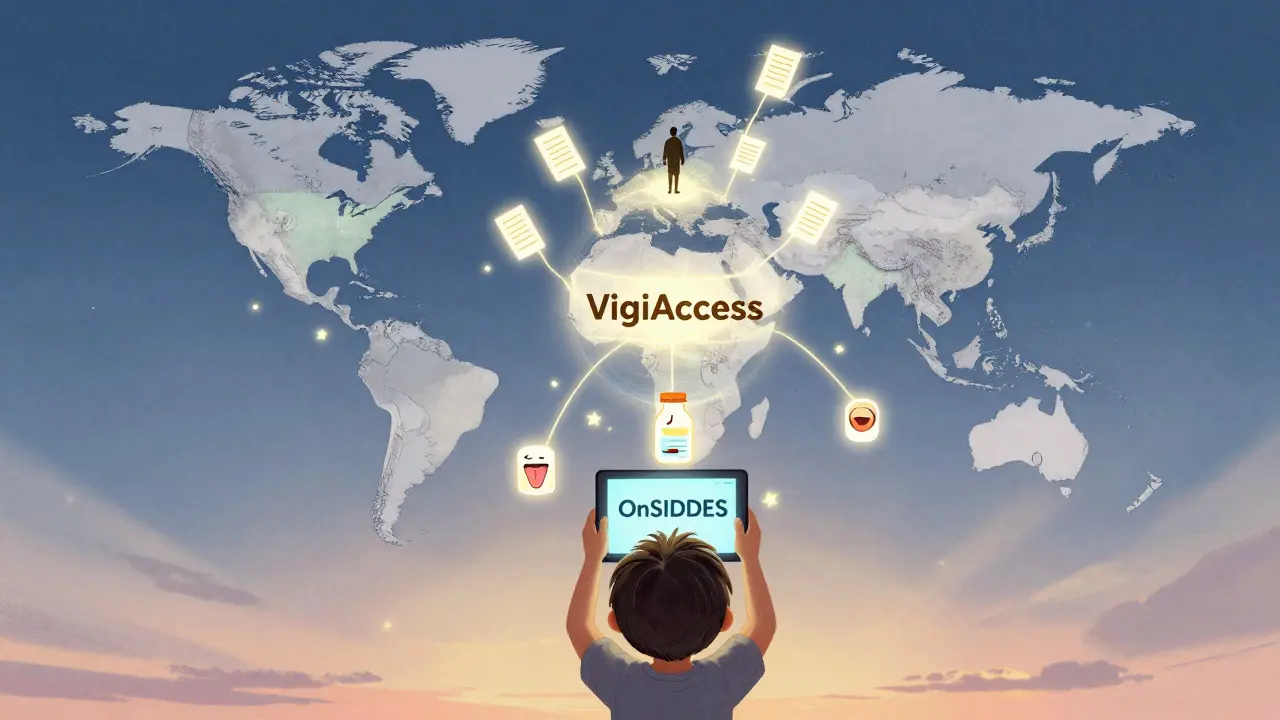
What to Do When You Find a Side Effect You Don’t Recognize
Let’s say you’re taking metformin and notice your tongue feels swollen. You check FDALabel-it doesn’t mention that. You check MedlinePlus-nope. You search OnSIDES-there are 12 reports of oral swelling linked to metformin. Now what?
Don’t panic. Don’t stop the medication without talking to your doctor. But do bring this information to your appointment. Say: “I found a few reports of swelling after taking this drug. Is this something I should be concerned about?”
Your doctor can check if this is a known but rare reaction, or if it might be something else entirely-like an allergy. Sometimes, side effects are mistaken for other conditions. Sometimes, they’re real, and your doctor needs to adjust your treatment.
Keep a log: write down when the side effect started, how often it happens, and what you were doing at the time. This helps your doctor connect the dots.
Why No Single Source Tells the Whole Story
There’s no magic bullet for side effect information because the problem is complex. Clinical trials involve hundreds or thousands of people over months. Real life involves millions over decades. Different people react differently. Genetics, age, other medications, diet-all of it matters.
The FDA label tells you what was known before the drug hit the market. OnSIDES tells you what’s happening now, across the world. VigiAccess tells you what’s being reported by doctors and patients globally. MedlinePlus tells you how to understand it all.
Together, they form a complete picture. Relying on just one is like trying to see a full painting by looking at only one corner.
What’s Changing in 2026
The FDA is requiring all drug labels to be in standardized digital formats by 2026. That means searching for side effects will get easier. Eventually, your electronic health record might automatically flag potential side effects based on your other medications and health history.
For now, the best strategy is simple: use MedlinePlus for clear explanations, FDALabel for official details, and OnSIDES when you suspect something’s missing. If you’re a researcher or healthcare provider, VigiAccess adds global context.
Side effects don’t always show up on the bottle. But with the right tools, you can find them before they find you.
Can I trust side effect information from drug company websites?
No. Drug company websites often highlight benefits and downplay risks. They may list only the most common side effects or bury serious ones in fine print. Always cross-check with FDA-approved sources like FDALabel or MedlinePlus.
Are side effects listed in order of how common they are?
On FDA labels, side effects are usually grouped by frequency: very common, common, uncommon, rare. But the exact percentages aren’t always given. MedlinePlus and OnSIDES often reorganize this data into clearer categories like "common," "less common," and "serious."
Why do some side effects appear in OnSIDES but not on the FDA label?
FDA labels only include side effects observed during clinical trials. OnSIDES uses AI to analyze real-world reports from millions of patients after the drug is on the market. Many side effects only become visible after widespread use-especially in older adults, people with other health conditions, or those taking multiple drugs.
Is VigiAccess useful for individual patients?
It can be, but it’s not designed for casual use. VigiAccess shows how many times a side effect was reported globally, but not how many people took the drug. Without that context, the numbers can be misleading. It’s best used alongside MedlinePlus or FDALabel to spot unusual patterns.
How often are these databases updated?
FDALabel and MedlinePlus update daily as new labels are approved. OnSIDES is updated quarterly, with new data added from the latest FDA labels. VigiAccess updates monthly with new reports from around the world. SIDER hasn’t been updated since 2015 and should not be used.
Candice Hartley
January 26, 2026 AT 15:47This is gold. I’ve been googling side effects for months and ended up in sketchy forums. MedlinePlus changed my life 🙌
April Williams
January 27, 2026 AT 03:46Of course you’re all using free sites. Meanwhile, my doctor pays for PDR.net because the free stuff is dangerously incomplete. You people think you’re saving money but you’re risking your life. 😒
John O'Brien
January 29, 2026 AT 01:49OnSIDES is the real MVP. I found out my anxiety meds were linked to hair loss there-my doctor blew it off until I showed him the data. Now he checks it too. 🤯
Anjula Jyala
January 29, 2026 AT 05:26Murphy Game
January 29, 2026 AT 07:05Ever wonder why the FDA doesn’t force drug companies to include ALL side effects? They’re paid to hide them. I’ve seen internal memos. The system is rigged. You think you’re getting truth but you’re getting PR. Wake up.
Harry Henderson
January 31, 2026 AT 03:51Stop scrolling and start reading. This is the most important thing you’ll read this year. Your life could depend on knowing where to look. Do it now. Don’t wait until you’re in the ER.
Kegan Powell
February 1, 2026 AT 17:31It’s wild how we’ve been taught to trust the bottle but not the data behind it. We’re conditioned to be passive patients. But when you dig into OnSIDES or VigiAccess, you realize you’ve got power-if you know where to look. 🌱
suhail ahmed
February 3, 2026 AT 02:17Man, I’m from Kerala and my aunt took that diabetes pill for 5 years. She got weird tingling in her feet. No doctor listened. Then she found OnSIDES-turns out it’s a known thing. She showed her doc, they switched meds. Now she’s dancing at weddings again. 🕺
Kirstin Santiago
February 4, 2026 AT 23:52Just want to say thank you for making this so clear. I’ve been scared to ask my doctor about my weird headaches after taking lisinopril. Now I know where to look and how to talk to them without sounding crazy. You just helped me feel less alone.
Andrew Clausen
February 6, 2026 AT 21:23The article incorrectly states that VigiAccess doesn’t provide denominator data. It does, via the WHO’s global drug utilization estimates, though they’re not always granular. Also, SIDER’s discontinuation doesn’t invalidate its historical data-context matters. Grammatical precision matters in medical communication.
Desaundrea Morton-Pusey
February 7, 2026 AT 21:48Why are we trusting American databases? The FDA is corrupt. Europe’s EMA has better transparency. This whole thing is a US propaganda tool. 🇺🇸
astrid cook
February 9, 2026 AT 10:08So you’re telling me I should trust a website run by Columbia University over my doctor? Who funded that lab? Big Pharma? Of course they’re hiding the real risks. I’ve been on this drug for 12 years and I’ve never had a problem-until now. And now you want me to panic because of some AI-generated guesswork? 😤