The Great Divide in Generic Adoption
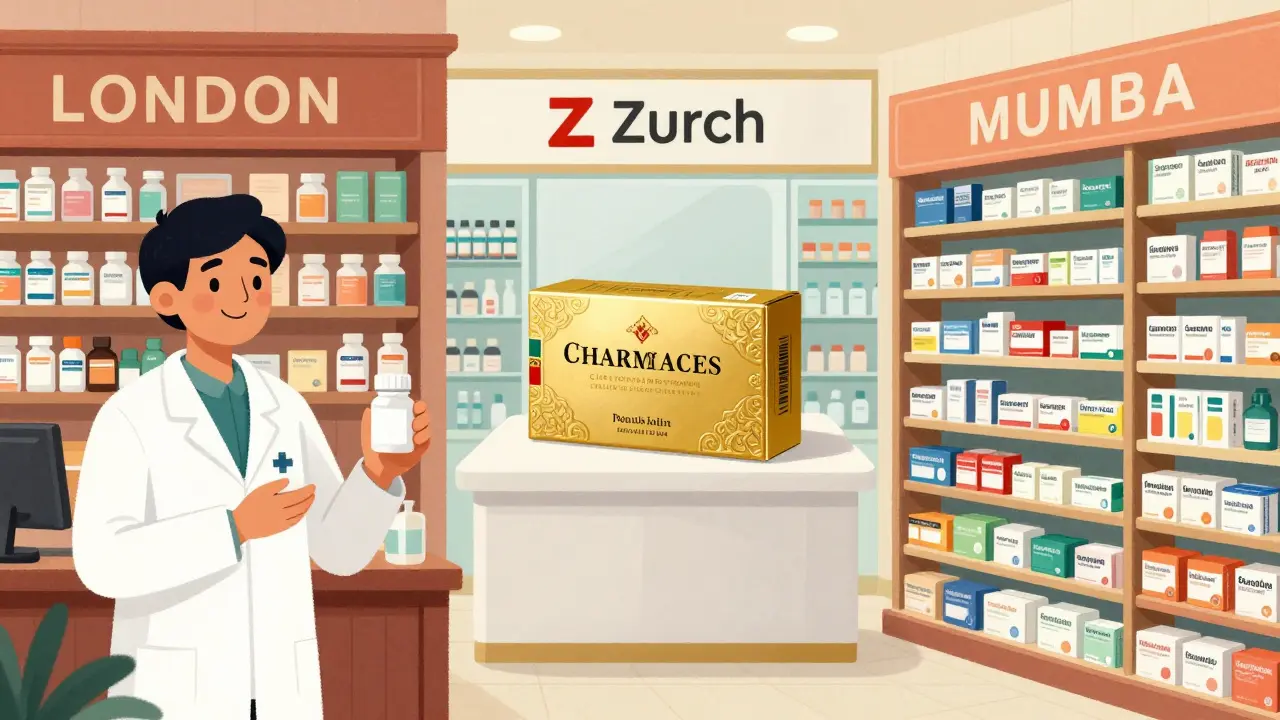
Why is it that some countries embrace generics while others cling to brand names? It usually comes down to how the government and doctors view Generic Substitution, the practice of replacing a brand-name drug with a generic equivalent. In the United Kingdom and the Netherlands, substitution is often mandatory or heavily encouraged, leading to generic utilization rates as high as 83%. In these markets, the system is designed to push the cheapest effective option to the patient. Contrast that with Switzerland or Italy. In Switzerland, the rate of generic use has historically been much lower-around 17% in some datasets-because patients and doctors often prefer the perceived prestige or reliability of the originator product. Additionally, reimbursement rates in Switzerland often make it more lucrative for pharmacists to dispense brand-name drugs. This creates a scenario where the same molecule is available globally, but the local "culture of prescribing" dictates whether you pay $10 or $100.The Regulatory Maze: Bioequivalence and Quality
To get a generic drug on the shelf, manufacturers must prove it is "the same" as the original. This is done through Bioequivalence, which is a scientific demonstration that a generic drug releases the active ingredient into the bloodstream at the same rate and to the same extent as the brand-name version. The U.S. Food and Drug Administration (FDA) typically requires this window to be between 80-125% of the reference product's pharmacokinetic parameters. However, "same" doesn't always mean identical. While the active ingredient is the same, the inactive ingredients (excipients) or the salt form can vary. This is where real-world problems crop up. For instance, patients traveling between the U.S. and Canada sometimes report adverse reactions when their usual generic is swapped for a version with a different salt form. This isn't necessarily a "bad" drug, but a difference in formulation that the human body reacts to differently.India: The Pharmacy of the World and Its Risks
If you look at the labels of your medication, there is a high probability it was manufactured in India. India produces roughly 20% of the global generic volume and supplies about 40% of the generics used in the U.S. This dominance is driven by massive scale and lower production costs, allowing them to offer prices that are sometimes 63% lower than in European countries like Belgium. But this efficiency comes with a trade-off. A study from Ohio State University highlighted a concerning gap: generics made in India were associated with 54% higher rates of severe adverse events-including hospitalization-compared to identical U.S.-made products. The issue often lies in oversight. While the FDA inspects facilities, many foreign inspections are pre-announced, which critics argue allows factories to "clean up" just for the visit, potentially masking systemic quality issues in the actual production line.| Country/Region | Generic Utilization Rate | Competition Level (2+ Manufacturers) | Primary Market Driver |
|---|---|---|---|
| United States | ~90% | 66% | High volume, high price variance |
| United Kingdom | ~83% | 50% | Mandatory substitution policies |
| Canada | High | 43% | Price regulation/Public health focus |
| Switzerland | ~17% | Low | Patient preference for brands |
The Paradox of American Pricing
The U.S. market is a strange beast. On one hand, it has some of the highest generic utilization rates in the world (over 90% for some drug classes). On the other, it often has the highest prices. How is that possible? In many OECD countries, governments negotiate prices directly with manufacturers. In the U.S., the pricing is more fragmented. We see a phenomenon where "irrational pricing" occurs-sudden price spikes for old, off-patent drugs that have been around for decades. When a few manufacturers consolidate or a single-source facility in China or India shuts down due to quality issues, the price can skyrocket overnight because there isn't a diversified supply chain to absorb the shock.The Next Frontier: Biosimilars
Most of the conversation around generics focuses on "small-molecule" drugs (simple chemical formulas like aspirin or metformin). But the industry is shifting toward Biosimilars, which are generic versions of complex biologic medicines derived from living organisms. These aren't exact copies because you can't "copy-paste" a living cell, but they are "highly similar." Biosimilars are projected to be a $60 billion market by 2028, but they face much steeper hurdles. The regulatory requirements are stricter, and the costs to develop them are higher. Because they are injected rather than swallowed, doctors are more hesitant to switch patients from a brand-name biologic to a biosimilar, fearing a different immune response. This means the "savings wave" for biologics will be slower and more complicated than the one we saw with traditional generics.
Fighting the 'Evergreening' Strategy
One reason you might find a drug is available as a generic in one country but not another is a tactic called "evergreening." This is when a pharmaceutical company makes a tiny, insignificant change to a drug's formula-like changing the coating or the release time-and files a new patent. Between 2015 and 2022, over 1,200 supplemental patents were filed for just 12 top-selling drugs. This effectively extends the brand-name monopoly, blocking cheaper generics from entering the market. While the European Medicines Agency (EMA) and FDA try to police this, the legal battles often last years, leaving patients to pay brand-name prices long after the original innovation has expired.Supply Chain Fragility and the Global Ripple Effect
The pandemic proved that we are too dependent on a few hubs. When India imposed temporary export restrictions on 26 active pharmaceutical ingredients (APIs), 22 countries felt the pinch. We saw shortages of basic antibiotics and blood pressure meds almost instantly. This fragility is exacerbated by the "race to the bottom" on pricing. When margins become too thin, manufacturers stop investing in plant upgrades. This leads to the quality failures we see-like the 147 generic shortages documented by the FDA in 2023, where the majority were caused by manufacturing flaws at single-source sites. We are essentially trading long-term supply security for short-term low prices.Why is a generic drug in Canada cheaper than in the US?
Canada utilizes more centralized price regulation and different reimbursement structures. While the U.S. has high generic volume, its pricing is less regulated, allowing for greater variance and occasionally higher retail costs even for off-patent drugs.
Are generics from India as safe as those made in the US?
Most are safe and meet FDA bioequivalence standards. However, some studies have shown higher rates of adverse events in certain Indian-manufactured generics, often attributed to quality oversight gaps and the use of different excipients compared to U.S. versions.
What is the difference between a generic and a biosimilar?
Generics are chemically identical copies of small-molecule drugs. Biosimilars are "highly similar" versions of complex proteins made from living cells. Because biologics are too complex to copy exactly, biosimilars undergo a different, more rigorous approval process.
What does "evergreening" mean in the pharmaceutical industry?
Evergreening is a strategy where companies file new patents for minor modifications to an existing drug to extend their patent protection and delay the entry of cheaper generic competitors.
Can I trust a generic drug if it has a different name than the brand?
Yes. Generic drugs are required to have the same active ingredient and demonstrate bioequivalence to the original. The different name is simply a branding requirement for the manufacturer.
Goodwin Colangelo
April 6, 2026 AT 01:48Just a heads up for anyone switching generics, definitely keep a log of the manufacturer name on the bottle. It helps a lot if you suddenly feel off and need to tell your doctor exactly which version caused the reaction since the active ingredient is the same but the fillers can be totally different.
Beth LeCours
April 7, 2026 AT 00:13too long didn't read but sounds like pharma companies are just greedy.
Divine Manna
April 7, 2026 AT 10:34The systemic failure of the American pharmaceutical pricing model is not merely an economic quirk, but a profound moral collapse. One must realize that the fragmentation mentioned here is a curated outcome designed to maximize profit margins at the expense of human longevity. It is truly fascinating, in a morbid sense, how we allow the 'irrational pricing' of off-patent drugs to persist while pretending to operate a healthcare system. The lack of centralized negotiation is a choice, not a mistake, and those who defend it are simply blind to the inherent contradictions of a profit-driven wellness industry.
Joey Petelle
April 9, 2026 AT 03:43Oh sure, let's just outsource everything to India and act shocked when the quality dips. Truly a masterclass in 'saving money' while playing Russian Roulette with your bloodstream. Absolute geniuses at work in the FDA office, clearly.
simran kaur
April 9, 2026 AT 17:48The mention of FDA inspections being 'pre-announced' is the only honest part of this piece. It is an open secret that the regulatory bodies are practically shaking hands with the manufacturers under the table. These 'quality gaps' aren't accidents; they are calculated risks taken by global conglomerates who know that the people in power are too compromised to actually stop them. Everything is rigged to keep us dependent on these synthetic chemicals while they pivot to biologics to lock us in for another twenty years of patent extensions.
angel sharma
April 9, 2026 AT 18:55It is truly an honor to see the global contribution of the Indian pharmaceutical sector being discussed here because we are not just producing volume but we are fundamentally driving the accessibility of life-saving medicine for millions of people across the globe who would otherwise be left to suffer in silence. We must continue to push for better infrastructure and higher standards of quality control to ensure that our reputation as the pharmacy of the world remains untarnished while we empower the underdeveloped regions of the world to achieve health equity and long-term wellness through affordable generics!
Dipankar Das
April 10, 2026 AT 16:31I must insist that the focus remains on the incredible potential of the Indian manufacturing spirit to revolutionize global health. While some critics dwell on adverse events, they completely ignore the millions of lives saved by the sheer accessibility of our products. We shall overcome these temporary regulatory hurdles and establish a gold standard of purity and efficacy that will leave the Western monopolies in the dust. The future of medicine is not in the boardrooms of Big Pharma but in the industrious factories of India!
The Charlotte Moms Blog
April 11, 2026 AT 14:47Absolutely disgusting!!! Why is nobody talking about how this affects our kids' medications??? The thought of 'pre-announced' inspections makes me sick to my stomach!!! Total negligence!!!!
Jenna Carpenter
April 13, 2026 AT 03:24honestly i dont trust any generic if the pill is a diffrent color lol just feels like fake medicine to me
Hudson Nascimento Santos
April 14, 2026 AT 08:14The concept of 'evergreening' is such a perfect metaphor for the human condition-constantly iterating on the same basic patterns just to maintain a facade of novelty and control. We are essentially paying a premium for the illusion of progress.
Lawrence Rimmer
April 14, 2026 AT 20:54The whole thing is just a game of musical chairs with our health. Who cares about the science when the real goal is just keeping the stock price high for some CEO in a penthouse.
Joseph Rutakangwa
April 16, 2026 AT 18:48just check the active ingredients
Ace Kalagui
April 17, 2026 AT 13:40I really feel like it is so important for us to support each other in navigating these confusing pharmacy trips and maybe we could all just try to be a bit more patient with the pharmacists who are often just trying to follow the rules their corporate office gave them while also trying to make sure we get the most affordable option available in their current inventory because at the end of the day we are all just trying to get healthy and get home to our families in a world that feels increasingly fragmented and complicated for everyone involved!