Every day, millions of people in the U.S. take generic drugs without even knowing it. In fact, 90% of all prescriptions filled are for generics. But how exactly are these affordable medications made? And why are they so much cheaper than brand-name drugs - yet just as effective?
The Core Idea: Same Medicine, Lower Price
Generic drugs aren’t copies. They’re exact matches in active ingredients, strength, dosage form, and how they work in your body. The only differences? Color, shape, flavor, and price. A generic version of metformin, for example, has the same chemical structure, same dose, and same effect on blood sugar as the brand-name Glucophage. But it might cost $4 instead of $150. The legal foundation for this system came from the 1984 Hatch-Waxman Act. Before that, companies had to run full clinical trials to prove a new drug worked - even if it was chemically identical to one already approved. That made generics too expensive to develop. The Act changed everything by creating the Abbreviated New Drug Application (ANDA) pathway. Now, manufacturers only need to prove their drug behaves the same way in the body as the original - no need to repeat years of human trials.Step 1: Reverse Engineering the Original
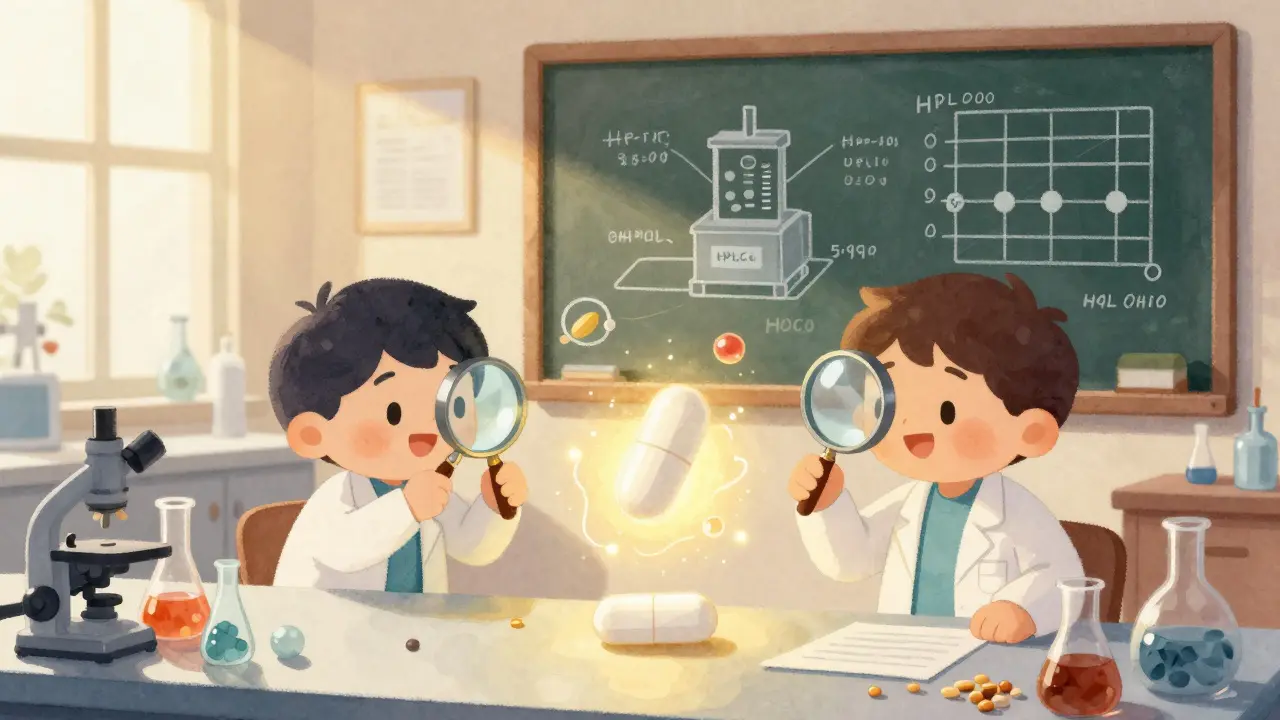
The first step in making a generic drug isn’t mixing chemicals. It’s figuring out exactly what’s in the brand-name version. This is called characterizing the Reference Listed Drug (RLD). Manufacturers don’t just guess the ingredients. They use advanced lab techniques - like high-performance liquid chromatography (HPLC) and mass spectrometry - to break down the brand drug and identify every component: the active ingredient, fillers, binders, coatings, and even the particle size of each substance. Why does particle size matter? Because it affects how fast the drug dissolves in your stomach. If a generic dissolves too slowly, it won’t be absorbed properly. Too fast, and it could cause side effects. The goal is to match the original’s dissolution profile within strict limits.Step 2: Designing the Formula - Quality by Design
Once they know what’s in the original, manufacturers start building their version using the Quality by Design (QbD) framework. This isn’t trial-and-error. It’s science-based planning. They identify three key things:- Critical Quality Attributes (CQAs): What properties must the final drug have? (e.g., dissolution rate, tablet hardness, purity)
- Critical Material Attributes (CMAs): What properties of the raw ingredients affect those CQAs? (e.g., lactose granule size, API crystal form)
- Critical Process Parameters (CPPs): What settings during manufacturing change the outcome? (e.g., mixing time, compression force, drying temperature)
Step 3: The Manufacturing Process - Seven Precise Stages
Once the formula is locked in, production begins. Here’s what happens in the factory:- Formulation: The active pharmaceutical ingredient (API) is blended with excipients - the non-active ingredients like fillers, lubricants, and disintegrants. This mixture must be perfectly uniform. Even a 1% variation can cause some pills to be too strong or too weak.
- Mixing and Granulation: The powder blend is turned into granules. This helps the material flow smoothly during pressing and ensures even distribution of the active ingredient. Wet granulation adds a small amount of liquid; dry granulation uses pressure.
- Drying: If wet granulation was used, the granules are dried in ovens at controlled temperatures. Too much moisture? The tablets may crumble. Too little? They won’t bind properly.
- Compression and Encapsulation: For tablets, the dried granules are pressed into shape using high-speed tablet presses. For capsules, the powder is filled into gelatin or vegetarian shells. Each tablet must weigh within ±5% of the target for pills under 130mg - or ±7.5% for heavier ones.
- Coating: Many tablets get a thin coating. This protects the drug from moisture, masks a bitter taste, or controls how quickly it dissolves (enteric coatings, for example, only break down in the intestine).
- Quality Control: At every stage, samples are tested. Tablets are checked for weight, hardness, thickness, and dissolution rate. The dissolution test is critical: the drug must release 80-125% of its active ingredient in the same time frame as the brand drug. If it doesn’t, the whole batch is rejected.
- Packaging and Labeling: Tablets go into blister packs or bottles with child-resistant caps. Labels must list the generic name, strength, manufacturer, and expiration date. Crucially, they cannot look like the brand-name version - U.S. trademark law blocks exact copies of shape and color.
Strict Rules: CGMP and Cleanrooms
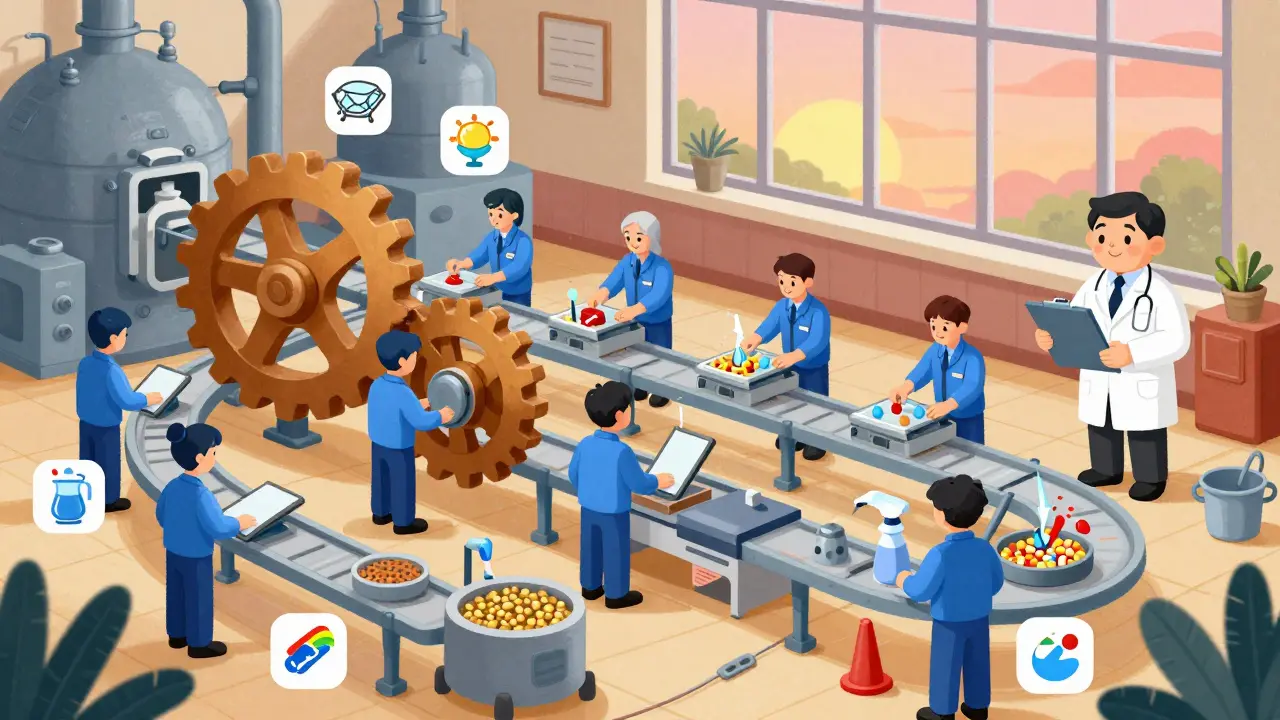
Manufacturing doesn’t happen in just any factory. Every facility must follow Current Good Manufacturing Practices (CGMP) set by the FDA. These rules cover everything from air quality to employee hygiene. - Cleanrooms must be classified as ISO Class 5 to 8, depending on the stage. The most sensitive steps - like filling sterile injectables - happen in Class 5 rooms, where fewer than 3,500 particles per cubic meter are allowed. - Temperature is kept at 20-25°C. Humidity stays between 45-65% RH. - Every batch is tracked. If a tablet fails a test, the entire lot is quarantined. Investigators must find out why - and fix the root cause - within 24 hours. - Employees wear gowns, masks, and gloves. They can’t bring in food, jewelry, or personal items that could contaminate the product. The FDA inspects these facilities regularly. In 2023, the most common violations were: inadequate investigation of failed tests (37%), lack of process validation (29%), and weak oversight by the quality unit (24%).Proving It Works: Bioequivalence Testing
You can’t just say a generic works. You have to prove it. Before approval, manufacturers run bioequivalence studies. These involve 24-36 healthy volunteers who take both the brand drug and the generic on different days, with a washout period in between. Blood samples are taken over 24-72 hours to measure how much of the drug enters the bloodstream and how fast. The results are compared using two key numbers:- Cmax: The highest concentration of drug in the blood
- AUC: The total amount of drug absorbed over time
Complex Generics: The Harder Cases
Not all generics are created equal. Simple pills like ibuprofen or lisinopril are easy to copy. But complex products? That’s where things get tough. Think inhalers, eye drops, topical creams, or long-acting injectables. These aren’t just chemicals in a bottle. Their effectiveness depends on how they’re delivered - particle size in an inhaler, viscosity in a cream, or how the drug slowly leaks out of a capsule. In these cases, bioequivalence studies don’t always predict real-world results. That’s why the FDA has launched the Complex Generic Products Initiative. Since 2022, they’ve published 127 product-specific guidances to help manufacturers meet these challenges. One case study involved a generic version of Clobetasol Propionate cream. The original had a unique skin penetration profile. The generic maker spent 7 years and $47 million just to match it. They had to redesign the emulsion, change the preservatives, and test dozens of formulations before getting approval.
Real-World Challenges and Myths
Some people worry generics aren’t as good. But here’s what the data says: - A 2023 survey by the Association for Accessible Medicines found 89% of pharmacists have full confidence in generic quality. - Only 3% reported any meaningful difference in patient outcomes. Still, problems happen. In 2021, Teva recalled 14 generic drugs due to CGMP violations at its Puerto Rico plant. Contaminated batches ended up in pharmacies. That’s why inspections matter. Another issue? Excipient variability. A pharmaceutical engineer on Reddit shared that changing the supplier of lactose - a common filler - once caused all their tablets to become too soft. Why? Different particle sizes changed how the powder compressed. It took weeks to fix. And yes, some generics have multiple sources. A single drug like metformin might have 15 different manufacturers. Each one’s product is slightly different - but all meet FDA standards. For most people, that’s fine. But for patients on drugs with a narrow therapeutic index - like warfarin or lithium - even small differences can matter. Doctors sometimes stick with one brand for these cases.The Bigger Picture: Why It All Matters
Generic drugs saved the U.S. healthcare system over $1.7 trillion in the last decade. In 2023, they made up 90% of prescriptions but only 19% of total drug spending. New technologies are making this even better. The FDA has approved 17 continuous manufacturing lines for generics. Instead of making drugs in batches that take weeks, these systems run nonstop - like a factory line for pills. One company using it saw batch acceptance jump from 95% to 99.98%. AI is helping too. Pfizer’s pilot program used machine learning to spot defects in tablets during inspection. It cut errors by 40%. The future? More complex generics, more AI, and more global supply chain challenges. Right now, 78% of active ingredients come from China and India. That’s a risk - but also an opportunity for innovation.What You Should Know
- Generics are not cheaper because they’re lower quality. They’re cheaper because they don’t repeat expensive clinical trials. - Every generic must prove it works the same way as the brand - down to how fast it dissolves in your body. - The FDA inspects every factory. Violations lead to recalls. - If you’re on a narrow therapeutic index drug, talk to your pharmacist. Some generics are better suited than others. - Don’t assume all generics are identical. They’re all approved, but slight differences exist - just like different brands of aspirin. The system isn’t perfect. But for most people, generics are safe, effective, and life-changing. They make chronic disease management affordable. They keep insulin, blood pressure meds, and antibiotics within reach. That’s not just science. It’s public health.Are generic drugs as safe as brand-name drugs?
Yes. The FDA requires generic drugs to meet the same strict standards for safety, strength, purity, and quality as brand-name drugs. Every generic must prove bioequivalence - meaning it delivers the same amount of active ingredient into your bloodstream at the same rate. The FDA inspects manufacturing facilities regularly, and any product that fails testing is rejected or recalled.
Why do generic drugs look different from brand-name drugs?
U.S. trademark law prevents generic drugs from looking identical to brand-name versions. So manufacturers change the color, shape, or markings to avoid confusion. But the active ingredient, dose, and effect are exactly the same. The differences are only in inactive ingredients like dyes or flavorings, which don’t affect how the drug works.
How long does it take to make a generic drug?
For simple generics, the process typically takes 3-4 years and costs $5-10 million. That includes developing the formula, running bioequivalence studies, preparing the ANDA application, and passing FDA inspections. Complex generics - like inhalers or topical creams - can take 7+ years and cost tens of millions. The FDA aims to review standard ANDAs within 10 months under current performance goals.
Can a generic drug be less effective?
Legally, no - if it’s FDA-approved. All generics must meet bioequivalence standards within 80-125% of the brand drug. However, for drugs with a narrow therapeutic index (like warfarin or thyroid meds), even small differences in absorption can matter. In rare cases, patients report different side effects or effectiveness with different generic brands. If this happens, talk to your doctor - switching to a different generic or staying on the brand may be needed.
Where are generic drugs made?
Most active pharmaceutical ingredients (APIs) for U.S. generics come from India and China - about 78% of the total supply. Finished pills are often manufactured in the U.S., Europe, or other countries with FDA-approved facilities. The FDA inspects all facilities, regardless of location. A drug made in India is held to the same standards as one made in New Jersey.
Why are some generics so much cheaper than others?
Price differences come down to competition and supply. When a new generic enters the market, multiple companies may start making it. As more join, prices drop - sometimes by 80% within two years. If only one or two companies make a drug, prices stay higher. Complex generics have fewer competitors, so they cost more. Also, some manufacturers have lower production costs or better supply chains.
What is an ANDA?
ANDA stands for Abbreviated New Drug Application. It’s the FDA’s pathway for approving generic drugs. Instead of repeating full clinical trials, manufacturers submit data proving their drug is bioequivalent to the brand-name version. The ANDA process is much faster and cheaper than the full approval process for new drugs - which is why generics are affordable.
Do generic drugs have the same side effects as brand-name drugs?
Yes - because they contain the same active ingredient. Side effects come from the active drug, not the fillers or coatings. However, some people may react differently to inactive ingredients - like dyes or preservatives - which can cause minor issues like stomach upset or allergic reactions. These are rare and usually not serious.
Christina Widodo
January 14, 2026 AT 06:28Wow, I had no idea generics had to match dissolution profiles within such tight limits. I always thought they were just cheap knockoffs, but this level of science is wild. My pharmacist switched me to a generic for my blood pressure med last year and I didn’t even notice - which is exactly the point, huh?
Also, the part about particle size affecting absorption? Mind blown. I’m gonna start asking my doctor which generic brand they recommend now.
Prachi Chauhan
January 15, 2026 AT 00:17in india we make these pills for the world. but no one talks about the workers. the ones who breathe in the powder for 12 hours a day. the ones who don’t get masks. the ones who get paid less than a dollar an hour. you call it science. i call it exploitation wrapped in a white coat.
Katherine Carlock
January 15, 2026 AT 12:08This is so fascinating. I used to be super skeptical about generics until my dad started taking them for his diabetes. He was saving $120 a month. We were crying happy tears. Honestly, I think the real villain here isn’t the generic manufacturer - it’s the brand-name companies charging $150 for a pill that costs $2 to make.
Also, the fact that they can’t copy the color or shape? That’s such a weird law. Like, why not just let people choose? But hey, I’m glad it works.
Sona Chandra
January 15, 2026 AT 20:18OMG I JUST FOUND OUT MY LITHIUM IS A GENERIC AND I’M SCARED TO DEATH. I’VE BEEN ON IT FOR 8 YEARS. WHAT IF IT MAKES ME SUICIDAL BECAUSE IT DISSOLVES TOO SLOW?? I’M GOING TO THE ER. SOMEONE CALL 911. I’M DYING.
Rinky Tandon
January 16, 2026 AT 00:13Let me break this down for the laypeople: The FDA’s 80-125% bioequivalence window is a joke. That’s a 45% variance. If your insulin is 15% weaker, you’re hyperglycemic. If it’s 15% stronger, you’re hypoglycemic. Both can kill you. This isn’t science - it’s regulatory gambling with human lives.
And don’t get me started on the Indian factories. You think they’re cleaning those cleanrooms? They’re washing them with tap water and praying. The FDA inspects once every 3 years. By then, the mold’s already growing in the HVAC.
jordan shiyangeni
January 17, 2026 AT 03:48It’s appalling how casually people accept that a drug’s absorption rate can vary by 45% and still be deemed ‘safe.’ The FDA’s bioequivalence standards are not just lax - they’re negligent. There is no ethical justification for permitting a 20% difference in Cmax when the drug in question is a narrow-therapeutic-index agent like digoxin or warfarin.
And yet, we’re told to trust ‘the system.’ The system is broken. It’s been captured by pharmaceutical conglomerates and regulatory capture is rampant. The fact that 78% of APIs come from China and India - countries with documented history of falsified data - is not a ‘global supply chain opportunity,’ it’s a public health time bomb. I’ve reviewed FDA 483s. The violations are systemic. And no one cares.
Until patients start demanding full traceability - from API source to final tablet - this isn’t medicine. It’s pharmaceutical roulette.
Eileen Reilly
January 17, 2026 AT 13:37so i just found out my generic metformin is made in bangalore and i’m kinda salty. like… why does it make me feel like i swallowed a brick? the brand one didn’t do that. also, why do all generic pills look like they were designed by a 12-year-old in paint? why is mine purple? who decided purple??
also the label says ‘USP’ but i think that’s just a fancy way of saying ‘we tried.’
steve ker
January 19, 2026 AT 04:28generic drugs are fine. china makes everything. why are you surprised. also why are you reading this post. go outside.
George Bridges
January 19, 2026 AT 13:02I’ve worked in community pharmacies for 18 years. I’ve seen patients switch from brand to generic and back again - sometimes because of insurance, sometimes because of price. The truth? 95% of them never notice a difference. The other 5%? They’re usually on narrow-window meds, and they’re the ones who tell us right away.
What matters isn’t the country of origin - it’s the FDA inspection record. I check it every time we get a new batch. If a plant has three violations in a year? We stop stocking it. Simple as that.
Generics saved my sister’s life. She’s on three of them. Without them, she’d be choosing between rent and insulin. That’s not just science. That’s dignity.
Rebekah Cobbson
January 20, 2026 AT 02:33Hey everyone - if you’re worried about your generic meds, talk to your pharmacist. They know which manufacturers have the best track record. And if you’re on something like warfarin or thyroid meds? Stick with the same generic brand. Don’t switch unless you have to.
Also - if you’re feeling off after a switch? Don’t panic. But do call your doctor. It’s not always the drug - sometimes it’s the filler. I had a patient allergic to red dye #40 in her generic version of lisinopril. She had hives every time. Switched to a different brand? Gone in 24 hours.
You’re not being paranoid. You’re being smart.
Audu ikhlas
January 20, 2026 AT 09:14india makes the best generics in the world. america is weak. you pay 10x for same pill because you lazy. we have engineers who sleep in labs to make your pills. you complain about color? go drink your brand name water and cry. africa and india feed the world. america just buys and whines.
Christina Widodo
January 21, 2026 AT 12:04Wait - so if the FDA approves generics based on bioequivalence, why do some doctors still refuse to prescribe them for epilepsy patients? I’ve got a friend whose neurologist insists on the brand because ‘we’ve seen seizures when they switch.’ Is that just fear, or is there real science behind it?
Also, I just read that one generic manufacturer had to recall 14 drugs last year because of mold in the packaging. That’s terrifying. How do we even know which ones are safe?