Safe Dose Splitting Calculator
Determine if your medication can be safely split based on key pharmacological factors.
Results will appear here after calculation
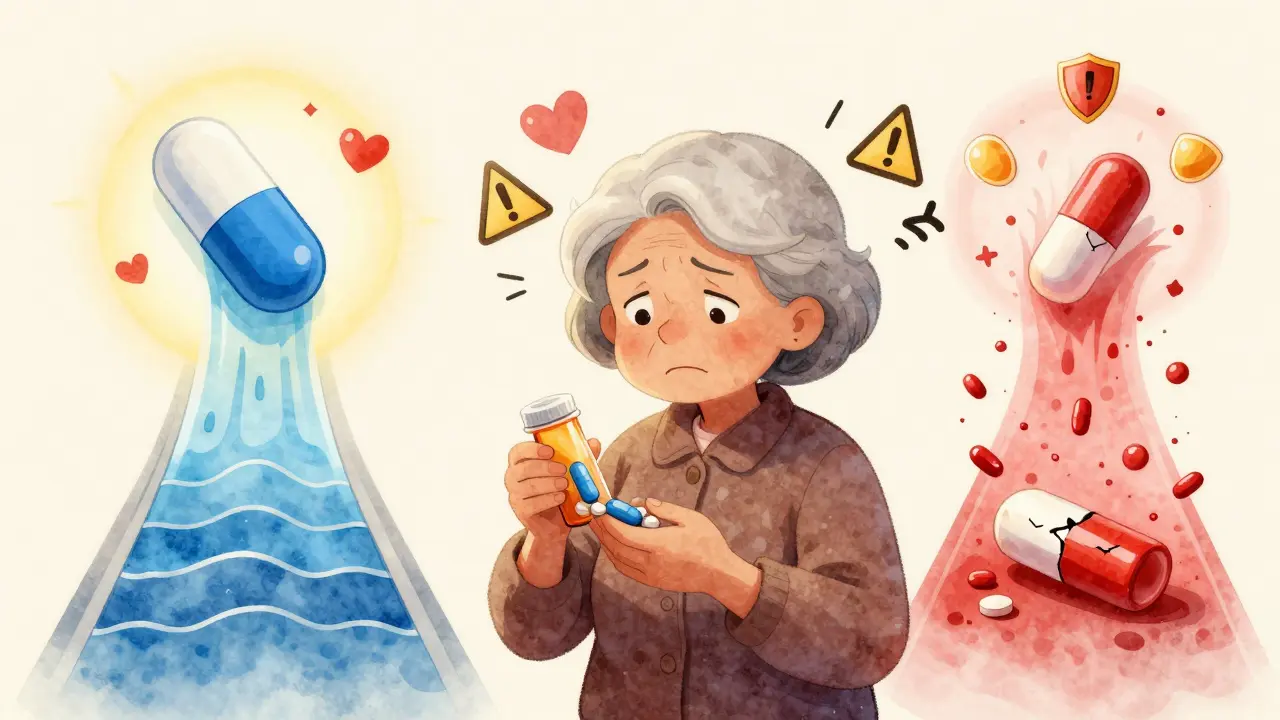
Many people think splitting a pill in half is a simple way to save money or ease side effects. But what if that common habit could actually make things worse? The truth is, dose splitting isn’t just about cutting a tablet-it’s a precise pharmacological strategy that only works under specific conditions. For some medications, splitting the daily dose into smaller, more frequent amounts can smooth out sharp spikes in blood concentration and reduce side effects. For others, it’s a dangerous gamble that could lead to hospitalization.
Why Peak Concentrations Matter
When you take a medication, your body doesn’t absorb it all at once. It rises to a peak level, then slowly drops. That peak is where most side effects happen. If the peak is too high, you might feel dizzy, nauseous, or get a sudden drop in blood pressure. For drugs with a narrow therapeutic index-like warfarin or digoxin-the difference between a safe dose and a toxic one is razor-thin. Warfarin’s therapeutic range is 2-3 INR. A single spike above 4 can cause dangerous bleeding. Digoxin’s safe window? 0.5 to 2.0 ng/mL. Go just a little over, and you risk heart rhythm problems.That’s why managing how quickly a drug enters your bloodstream matters more than most people realize. A single 20mg dose might cause a sharp spike. But if you split that into two 10mg doses taken 12 hours apart, the peak is lower, the drop is smoother, and your body handles it better.
Dose Splitting vs. Tablet Splitting: Don’t Confuse Them
This is where most people get it wrong. Dose splitting means taking the same total daily amount, but in smaller doses spread throughout the day. For example, instead of 1000mg of metformin twice a day, you take 500mg four times a day. This lowers the peak concentration without changing the total amount you get.Tablet splitting is physically cutting a pill in half-often because it’s cheaper than buying the lower dose. But this doesn’t always reduce peaks. In fact, it can make them worse. Cutting an extended-release tablet, like felodipine or tramadol, breaks open the time-release coating. Suddenly, the whole dose floods into your system at once. Research shows this can increase drug absorption by 30-50% in the first hour. That’s not a smoother curve-it’s a crash landing.
The Australian Prescriber (2015) warns that tablet splitting can lead to "unpredictable clinical consequences." The FDA has logged over 1,200 adverse events between 2015 and 2020 linked to improper splitting. Nearly 40% involved blood thinners. One case involved a 68-year-old woman who split a 40mg lisinopril tablet thinking she was getting two 20mg doses. She ended up with a systolic blood pressure of 192 mmHg and an emergency room visit.
Which Medications Can Be Safely Split?
Not all drugs respond the same way. The key factors are half-life, formulation, and therapeutic index.- Short half-life drugs (under 6 hours) benefit most. These clear out of your system fast, causing levels to dip too low before the next dose. Splitting helps keep levels steady. Examples: immediate-release lisinopril, metformin, and some painkillers.
- Immediate-release formulations are generally safe to split. They’re designed to dissolve quickly, so splitting doesn’t change how they work.
- High therapeutic index (>3) means there’s room for error. Acetaminophen has a therapeutic index of 10. You can take a little more or less without major risk. Drugs like levothyroxine also fall here.
On the flip side, avoid splitting:
- Extended-release, enteric-coated, or sustained-release pills
- Drugs with narrow therapeutic index (warfarin, digoxin, lithium, cyclosporine)
- Tablets without a score line-these often split unevenly
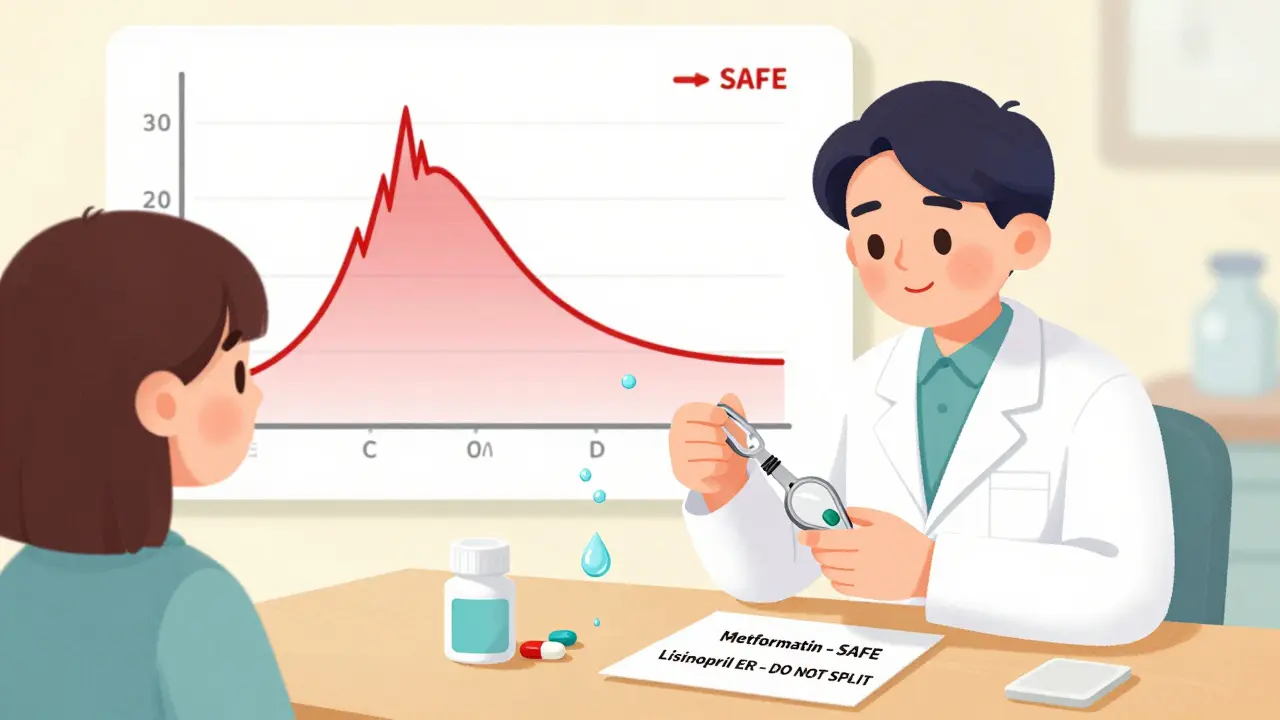
There are exceptions. Isosorbide mononitrate and bupropion XL can be halved safely because their release mechanisms stay intact. But these are rare. Most manufacturers don’t test for this. If it’s not written on the label, assume you shouldn’t split it.
How to Split Safely (If You Must)
If your doctor approves splitting a tablet, don’t just use a knife or scissors. Here’s how to do it right:- Use a dedicated pill splitter-these are designed to cut evenly. A study from UBC found they reduce dose variation from 25% down to 5-8%.
- Only split tablets with a clear score line. Unscored tablets can vary by 80-120% in content.
- Split only one tablet at a time. Don’t pre-split a week’s supply. Drug stability drops after exposure to air and moisture.
- Store split tablets in their original container and use within one week.
- Ask your pharmacist to show you how. Without training, 65% of people split pills unevenly.
Even then, monitor closely. If you’re splitting a blood pressure or blood thinner, get your levels checked within 7 days. A simple INR test or blood pressure check can catch problems before they become emergencies.
Cost Savings Aren’t Always Worth the Risk
A lot of people split pills to save money. GoodRx data shows 42% of patients do it for cost reasons. Splitting an 80mg atorvastatin tablet into two 40mg doses can save up to $300 a year. That’s tempting.But here’s the catch: The JMCP (2015) estimates that improper splitting could cost the U.S. healthcare system $12.3 billion annually in emergency visits and hospitalizations. For high-risk drugs like warfarin, splitting increases adverse event risk by 15-20%. For elderly patients on multiple medications, that’s not a risk worth taking.
Pharmaceutical companies are responding. Pfizer introduced 5mg and 10mg rivaroxaban tablets after noticing 78% fewer splitting attempts. The FDA is pushing for mandatory content uniformity testing for all scored tablets. The message is clear: designing lower-dose options is safer than asking patients to cut pills.
Real-Life Successes and Failures
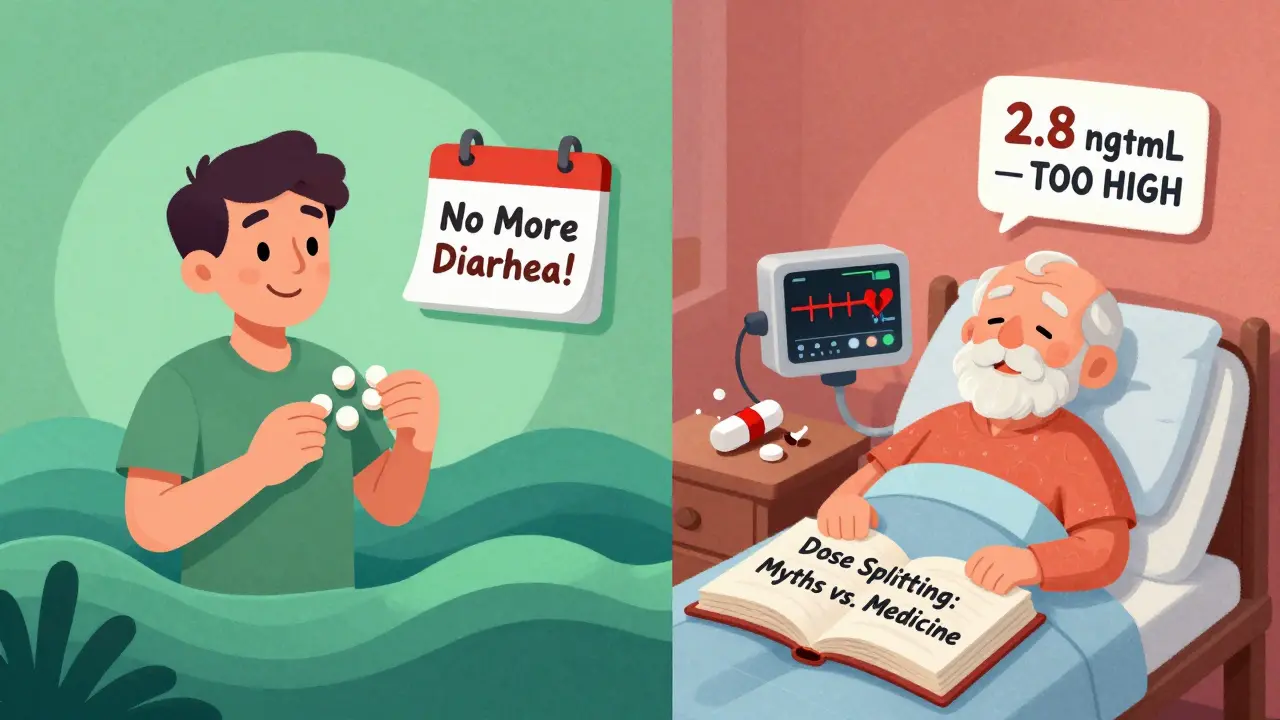
One Reddit user reported that splitting their metformin from 1000mg twice daily to 500mg four times daily cut their diarrhea from 60% of doses down to 15%. No more stomach pain. No more missed work. That’s a win.But another patient, a 71-year-old man taking digoxin, split his 0.125mg tablet in half to save money. His levels spiked to 2.8 ng/mL-well above the safe limit. He was hospitalized with atrial fibrillation. His family had no idea the tablet wasn’t meant to be split.
Pharmacists report that 73% of patients try to split medications they shouldn’t. The most common mistakes? Extended-release oxycodone and enteric-coated aspirin. Splitting oxycodone can cause an overdose. Splitting aspirin can ruin its stomach protection.
When to Talk to Your Doctor
Don’t guess. Don’t assume. If you’re thinking about splitting a dose-whether for side effects or cost-ask your doctor or pharmacist first. They can tell you:- Is this drug even eligible for splitting?
- Is there a lower-dose version available?
- Will splitting affect how well the drug works?
- Do I need follow-up tests?
For drugs like metformin, venlafaxine, or immediate-release beta-blockers, dose splitting might help. For others, it’s a trap. The American Society of Health-System Pharmacists (ASHP) lists 14 drug classes where splitting can reduce side effects-and 11 where it’s strictly off-limits.
The bottom line? Dose splitting isn’t a hack. It’s a medical decision. Done right, it can make your treatment easier. Done wrong, it can be deadly.
Can I split any pill to reduce side effects?
No. Only certain medications are safe to split. Immediate-release drugs with a wide therapeutic index and short half-life (under 6 hours) are the best candidates. Extended-release, enteric-coated, or narrow-therapeutic-index drugs like warfarin, digoxin, or lithium should never be split. Always check with your pharmacist or doctor first.
Does splitting a pill lower the peak concentration?
Yes-but only if you’re splitting the total daily dose into smaller, more frequent doses. For example, taking 500mg of metformin four times a day lowers the peak compared to 1000mg twice a day. Simply cutting a pill in half doesn’t guarantee this effect. If the tablet is extended-release, cutting it can cause a dangerous spike instead.
Is it safe to split a scored tablet?
Scored tablets are designed to split more evenly, but not all are safe. A UBC analysis found that even scored tablets can vary by 80-120% in content if not split properly. Always use a pill splitter, not a knife. And never split a tablet if it’s labeled "do not split," or if it’s extended-release, enteric-coated, or a controlled substance.
Why do some drugs have a narrow therapeutic index?
Drugs with a narrow therapeutic index have a very small gap between the dose that works and the dose that causes harm. Warfarin, digoxin, and lithium are examples. Their effects are powerful but dangerous if levels fluctuate even slightly. For these drugs, even a 10% dose variation can lead to serious side effects or toxicity. That’s why dose splitting is risky and often avoided.
Can I save money by splitting pills?
Sometimes, yes. Splitting an 80mg atorvastatin tablet can save up to $300 a year. But the savings are only worth it if the drug is safe to split and you follow proper techniques. For high-risk medications, the cost of an emergency visit or hospitalization far outweighs the savings. Always ask your pharmacist if a lower-dose version is available-it’s often safer and sometimes just as cheap.
Aisling Maguire
March 1, 2026 AT 10:18Just split my mom's metformin last week after reading this-no more bloating and she’s actually eating dinner now. 😊
Pharmacist said it was fine since it’s immediate-release and scored. She’s 74, no other meds. Took the advice to split one at a time and use the little plastic splitter. Best $5 I ever spent.
Brandon Vasquez
March 2, 2026 AT 14:19Good breakdown. I’ve seen too many elderly patients split extended-release pills because they think it’s the same as taking two smaller doses.
It’s not. The coating exists for a reason. One man came in with a systolic of 210 after splitting his felodipine. He said he was just trying to save money. We ended up switching him to a generic 5mg tablet instead.
Vikas Meshram
March 3, 2026 AT 08:57Uhhhh this article is wrong on multiple levels. First, the FDA data cited is from 2015-2020 but the Australian Prescriber study is from 2015-so you’re cherry-picking. Second, not all scored tablets have 5-8% variation, that’s only true for poorly manufactured ones. Third, you say metformin benefits from splitting but didn’t mention that ER metformin exists and is safer. You’re spreading misinformation.
Also, the word ‘peaks’ is misspelled as ‘peeks’ in one paragraph. Amateur.
Ben Estella
March 4, 2026 AT 14:09Look, I get it. You want to save money. But this isn’t some DIY biohack. You’re playing Russian roulette with your heart.
Splitting warfarin? That’s not frugal, that’s stupid. We’ve got 300 million people in this country. Half of them can’t even spell ‘pharmacist’-and now you want them cutting pills with scissors? No. We need lower-dose options, not more dumbassery.
Jimmy Quilty
March 6, 2026 AT 05:31Did you know the pharmaceutical companies designed these pills to be unsplitable on purpose? They want you to buy two pills instead of one. It’s pure greed.
My cousin works at a compounding pharmacy-she says 80% of the time, when you ask for a lower dose, they just charge you double. They don’t even make 5mg versions of some drugs. It’s a scam. The FDA is in on it. You think they care about your safety? They care about your wallet.
Miranda Anderson
March 6, 2026 AT 21:08I’ve been splitting my venlafaxine XR for two years now, and honestly, it changed my life. I was getting these crushing waves of nausea and dizziness after my morning dose.
My psychiatrist was skeptical at first, but we looked at the half-life-about 5 hours-and she agreed it was worth a try. I split the 150mg into 75mg twice daily. No more afternoon crashes. No more vomiting. My sleep improved too. I know it’s not for everyone, but for some of us, it’s not about saving money-it’s about surviving the day. And if you’ve ever felt like your meds are making you feel worse instead of better, maybe it’s not the drug-it’s the dosing schedule. Just something to think about.
Gigi Valdez
March 8, 2026 AT 12:21The distinction between dose splitting and tablet splitting is critical and often misunderstood. This post accurately highlights the pharmacokinetic principles at play.
It is imperative that patients understand that physical manipulation of a dosage form alters its intended release profile. The clinical consequences are not hypothetical. The data from JMCP and the FDA adverse event reports are compelling. Healthcare providers must proactively educate patients, rather than assume compliance or understanding. Prescribing lower-strength formulations when available remains the gold standard.
Sneha Mahapatra
March 9, 2026 AT 07:50There’s a quiet wisdom in how our bodies handle medicine…
It’s not just about chemistry. It’s rhythm. Like breathing. Like eating. We don’t gulp down a whole day’s food at once, yet we do that with pills and wonder why we feel off.
Splitting isn’t about saving money-it’s about honoring the body’s need for balance. I’ve seen friends with depression stabilize after switching from once-daily to twice-daily sertraline. Not because it’s stronger. Because it’s gentler.
Maybe the real problem isn’t the pill. It’s that we treat healing like a one-time event, not a flow. 🌿