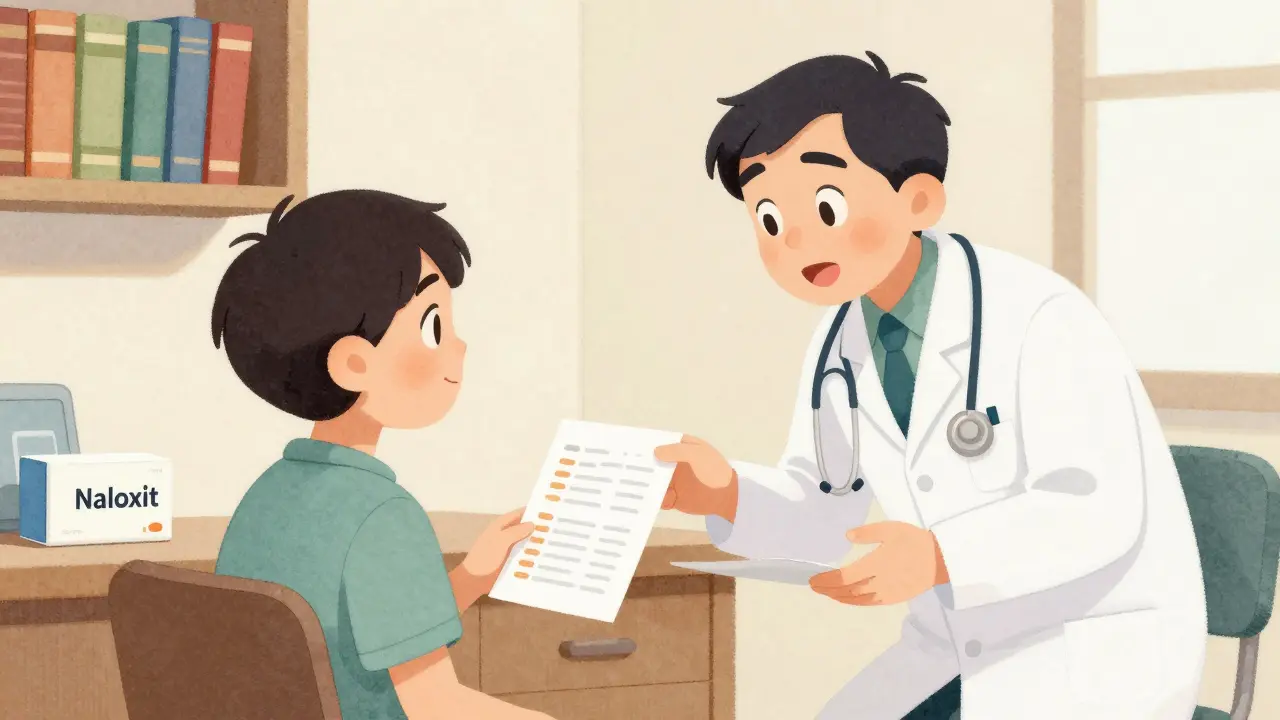
Talking to your doctor about overdose risk shouldn’t feel like confessing a crime. Yet for many people using opioids, benzodiazepines, or other high-risk medications - even when prescribed - the fear of being judged stops them from asking for life-saving help. You’re not alone. In 2022, over 70,000 people in the U.S. died from drug overdoses. Many of those deaths could have been prevented if the person had access to naloxone and felt safe enough to ask for it.
Why This Conversation Matters
Overdose isn’t just about illegal drugs. It happens to people taking prescription painkillers exactly as directed. The CDC now says overdose risk should be discussed with every patient prescribed opioids, no matter their background. That’s because risk isn’t about who you are - it’s about what you’re taking, how much, and what else you’re using. Mixing opioids with alcohol or sleep meds? That’s a red flag. Taking more than prescribed? That’s a warning sign. Even if you’ve never used street drugs, you can still be at risk.But here’s the problem: 68% of people with substance use disorder say they’ve been treated with shame or disrespect by healthcare providers. Phrases like “You’re just looking for drugs” or “Why would you need that?” aren’t just hurtful - they push people away from care. And when you avoid the doctor, you lose access to naloxone, which can reverse an opioid overdose in minutes.
What to Say - And How to Say It
The key isn’t to apologize. It’s to speak like you’re discussing blood pressure or cholesterol. Use clear, factual language. Here’s what works:- “I’d like to discuss overdose prevention as part of my health plan.”
- “I’m taking [medication name] at [dose] and sometimes [context, e.g., ‘I have trouble sleeping’ or ‘I’ve been under a lot of stress’]. I want to make sure I’m safe.”
- “Can I get a prescription for naloxone? I see it like an EpiPen - it’s a safety tool.”
- “I’m concerned about being judged. I need to talk openly so I can stay safe.”
These phrases aren’t magic. They’re backed by data. A 2021 study in JAMA Internal Medicine found patients who used direct, calm language like these were 62% more likely to get naloxone than those who said vague things like “I’m scared I might overdose.”
And don’t let the word “addict” slip in - not from you, not from them. Use “person with a substance use disorder.” That’s not political correctness. It’s science. A 2022 Johns Hopkins study showed that using person-first language made doctors 37% more likely to respond with empathy.
Prepare Before You Go
Walking in unprepared is like showing up to a car repair without knowing your model. Bring a short list:- All medications you take - including prescriptions, OTC painkillers, sleep aids, and anxiety meds.
- How much and how often you take each one.
- Any alcohol or recreational substances you use - even if you think it’s “not a big deal.”
- Any past overdoses, near-misses, or times you felt you couldn’t breathe after taking something.
This takes 15 to 20 minutes. Write it down. Print it. Bring it with you. Studies show patients who do this are 53% more likely to have a productive conversation. Your doctor doesn’t need to guess. Give them the facts.
What to Do If Your Doctor Reacts Poorly
Not every provider is trained. In rural areas, only 28% of primary care doctors are certified to prescribe buprenorphine. Some still believe addiction is a moral failure. If your doctor says something like, “Are you using heroin?” or “You’re just looking for drugs,” here’s what to do:- Stay calm. Say, “I understand you’re concerned. I’m not here to get drugs. I’m here to stay alive.”
- Ask for a referral. “Can you recommend another provider who specializes in safe pain management?”
- Know your rights. Under the 21st Century Cures Act, providers receiving federal funding are required to complete stigma training. You can ask if they’ve done it.
- Leave if you feel unsafe. Your health is more important than loyalty to one provider.
One patient on Reddit shared: “I brought the CDC’s talking points to my appointment. My doctor said, ‘You’re right - let’s get you naloxone.’” Another said: “I got shut down. I didn’t go back for eight months. I almost didn’t make it.”
Naloxone Is Not a Reward - It’s a Right
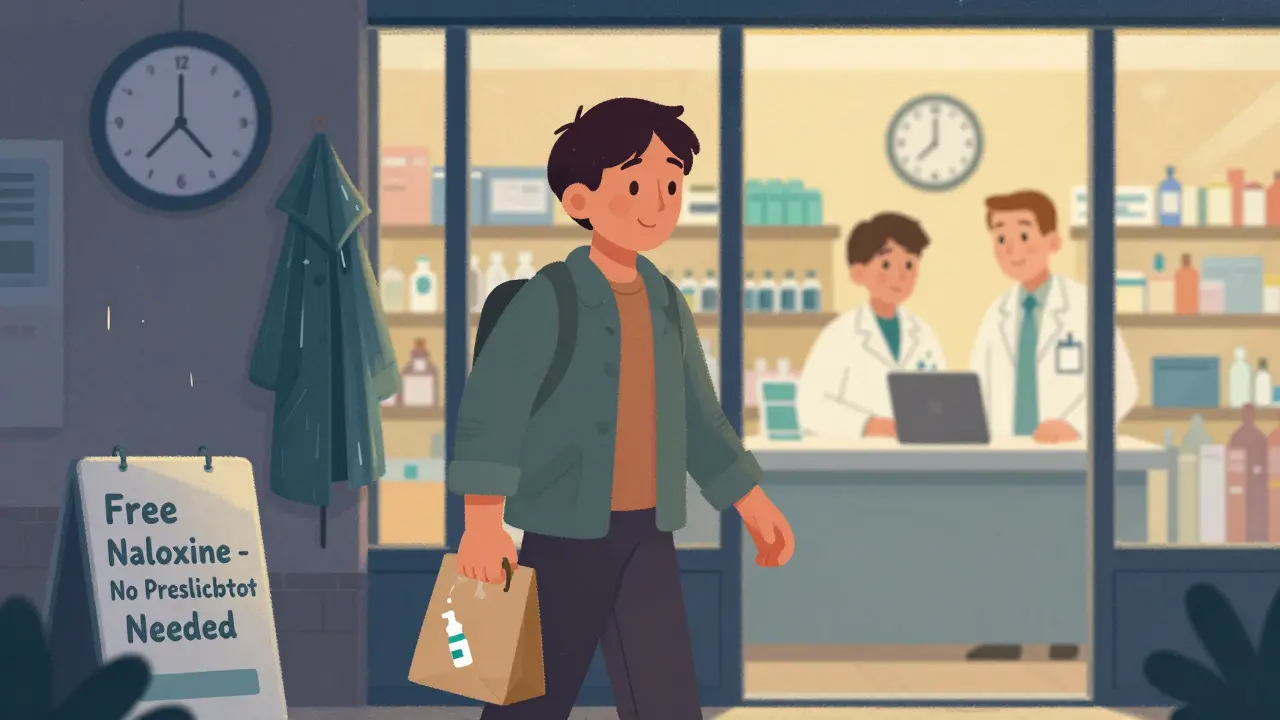
Naloxone isn’t for “drug users.” It’s for anyone who might accidentally overdose. It’s not addictive. It doesn’t get you high. It doesn’t encourage drug use. It saves lives. In 2023, the FDA approved the first generic nasal naloxone - now it costs under $25 instead of $130. Many pharmacies give it out for free. You don’t need a prescription in 47 states. You can walk in and ask: “I’d like to pick up naloxone for overdose prevention.”Think of it like a fire extinguisher. You don’t wait until your house is on fire to buy one. You keep it handy. Same with naloxone.
Who Else Can Help?
You don’t have to do this alone.- SAMHSA National Helpline (1-800-662-4357): Free, confidential, available 24/7. They’ll help you prep for your appointment.
- SMART Recovery: Online meetings specifically for preparing for medical visits. Over 1,200 people join monthly.
- Reverse Overdose Oregon: Offers free, tested scripts for patients. Available online.
- AMA’s Patient Guide: Repurposed from their physician guide. Available in 12 languages.
These aren’t just resources. They’re lifelines. In 2022, the helpline answered nearly 300,000 calls - up 22% from the year before. People are asking for help. And help is there.
The Bigger Picture
Stigma isn’t just about words. It’s about systems. Insurance still denies treatment 41% of the time. In some states, there’s one treatment center per 100,000 people. But change is happening. The 2023 National Overdose Prevention Strategy aims to train half a million providers in non-stigmatizing care by 2025. Medicare will soon tie 15% of payments to how well doctors reduce stigma. That’s real progress.But none of it matters if you don’t speak up.
You’re not weak for needing help. You’re smart for preparing. You’re brave for asking. And you deserve care - not judgment.
What if my doctor refuses to give me naloxone?
If your doctor refuses, ask why. If they say it’s not necessary, respond with, “The CDC says overdose prevention should be discussed with all patients on opioids.” If they still say no, ask for a referral to another provider. You can also get naloxone without a prescription at most pharmacies in 47 states. Many offer it for free - just ask at the counter.
Is it safe to use naloxone if I’m not sure someone overdosed?
Yes. Naloxone is safe to use even if the person didn’t overdose on opioids. It won’t harm someone who didn’t take opioids. If someone is unresponsive, not breathing, or has pinpoint pupils, give naloxone. Then call 911. It can’t hurt - but it can save a life.
Can I bring someone with me to the appointment?
Absolutely. Having a trusted friend or family member with you can help you stay calm, remember what was said, and reinforce your request. Many patients say their appointments went better when someone else was there to support them.
What if I’m taking opioids for chronic pain - does that make me at risk?
Yes. People on long-term opioid therapy for pain are at higher risk of overdose, even if they take it exactly as prescribed. Risk increases with higher doses, longer use, or mixing with other sedatives like benzodiazepines or alcohol. The CDC recommends all patients on opioids discuss overdose prevention - not just those with a history of misuse.
Will my doctor report me if I admit to using recreational drugs?
No. Doctors are not required to report recreational drug use to law enforcement. Their job is to keep you safe. If you’re honest, they can help you reduce risk - with naloxone, safer use strategies, or referrals. Hiding your use puts you at greater danger.
Dan Gaytan
December 23, 2025 AT 08:49Just got my free naloxone kit from the pharmacy today. Walked in like I was buying band-aids. No judgment, no questions. Just handed it over. Life-saving stuff shouldn't be a secret.
👍
Isaac Bonillo Alcaina
December 24, 2025 AT 08:56This whole post is pure performative wokeness. People who misuse prescriptions deserve the consequences. Naloxone isn't a right-it's enabling. You're not saving lives, you're just delaying the inevitable.
Stop treating addiction like a medical condition. It's a choice. And choices have costs.
claire davies
December 24, 2025 AT 14:59I love how this post doesn't just give you the script-it gives you the *why*. Like, I had a friend who was on oxycodone after a back surgery and was terrified to even mention alcohol. She thought she'd be labeled an addict just for having wine with dinner.
She finally said, 'I'm taking 10mg three times a day, and sometimes I have a glass of wine to unwind. I'm scared I might pass out.' And guess what? Her doctor didn't flinch. He gave her naloxone, adjusted her dose, and even sent her to a pain psychologist. No shame. Just care.
It's not about being perfect. It's about being honest. And the fact that we have to *practice* how to ask for help? That's the real tragedy here. We've made asking for safety sound like begging for mercy.
Steven Mayer
December 25, 2025 AT 13:48According to the CDC's 2022 pharmacovigilance dataset, the relative risk of respiratory depression increases by 3.7x when opioids are co-ingested with GABAergic agents, particularly when CYP3A4 metabolism is inhibited. Naloxone's binding affinity is competitive but transient, which necessitates prolonged monitoring post-administration due to potential re-narcotization.
Also, most community pharmacies lack the infrastructure for proper patient counseling on reversal protocols. This is why institutional protocols are critical.
EMMANUEL EMEKAOGBOR
December 26, 2025 AT 08:29In my country, we do not speak of such things openly. But I have seen a man die from an overdose because no one dared to say, 'You are not safe.'
This post is not just advice. It is courage in written form. I will share it with my nephew who takes painkillers for his nerves. He needs to know he is not alone. He needs to know he is worth saving.
Blow Job
December 26, 2025 AT 22:37One time I walked into my doctor's office with a list of everything I was taking-including the weed I smoked to sleep. I didn't apologize. I didn't stutter. I just said, 'I need to be safe.'
He nodded, wrote me a naloxone script, and said, 'Good on you for showing up.'
That's all it took. No lecture. No judgment. Just a human being recognizing another human being trying to stay alive.
Payson Mattes
December 27, 2025 AT 00:17Did you know the FDA approved naloxone because Big Pharma wanted to reduce liability? They knew people were dying from their own pills, so they pushed the 'safety net' to cover their asses.
And now they're selling it for $25? That's a scam. The real cost is pennies. This is all a profit play. You think they care about you? They care about lawsuits.
Also, the CDC? They're funded by the same people who make the opioids. Coincidence? I think not.
Joe Jeter
December 28, 2025 AT 01:02So now we're supposed to treat people who take too many pills like they're victims? What about personal responsibility? I work 60 hours a week and never touch anything stronger than ibuprofen. Why should I subsidize your poor decisions?
And why is it always the doctor's fault if they don't hand out naloxone like candy? Maybe you should stop being so lazy and go to a specialist instead of expecting your GP to be your addiction counselor.
Andrea Di Candia
December 29, 2025 AT 07:45I used to think naloxone was for 'those people.' Then my brother took a wrong pill at a party and stopped breathing. We had no idea what to do.
His friend had a kit. Used it. Called 911. He woke up confused but alive.
That kit didn't enable him. It gave him a second chance to get help.
Now I keep one in my glovebox. Because you never know who's holding their breath in the passenger seat.
Bhargav Patel
December 30, 2025 AT 11:39There is a metaphysical dimension to this issue. To ask for help is to admit vulnerability. To offer help is to recognize dignity. Yet our medical institutions have been structured to reward detachment over presence.
The prescription pad is a tool of power. The naloxone kit is a tool of grace. The question is not whether we can distribute it-but whether we are ready to receive it.
Perhaps the real epidemic is not of substances, but of silence.
Pankaj Chaudhary IPS
January 1, 2026 AT 02:29As a public servant who has witnessed the consequences of stigma in healthcare, I commend this article. In India, we face similar challenges-families hide addiction out of shame, and doctors lack training. This guide is not just useful-it is essential.
I have distributed printed copies to community health workers in my district. We are not waiting for policy changes. We are acting now.
Katie Taylor
January 1, 2026 AT 21:28Stop being so polite. If your doctor refuses naloxone, tell them you're going to the state medical board and file a complaint for failing to follow CDC guidelines. You have rights. Use them.
And if they still say no? Go to the pharmacy. Walk in. Say, 'I want naloxone.' They can't legally say no in 47 states. Don't ask. Don't beg. Just take it.
Your life is not up for debate.
bharath vinay
January 3, 2026 AT 08:41This is all a psyop. The government wants you dependent on their 'safe' drugs so they can control you. Naloxone is a tool to keep you alive so you stay on the grid. They don't want you cured. They want you compliant.
Also, the CDC is funded by the Gates Foundation, which has ties to pharmaceutical conglomerates. This isn't about health. It's about surveillance.
Bartholomew Henry Allen
January 5, 2026 AT 05:29Why are we giving free drugs to people who can't control themselves
My grandfather fought in the war he never touched anything
Why should I pay for your mistakes
Stop coddling weak people
Rachel Cericola
January 6, 2026 AT 04:20Let me tell you what actually works. I used to be the person who thought asking for naloxone made me look like a drug user. I was wrong.
I started carrying it after a friend overdosed in my living room. I didn't know how to use it. I panicked. I called 911. He lived.
But here's the thing-he didn't live because he was lucky. He lived because his roommate had training, a kit, and didn't wait for permission.
So if you're reading this and you're scared to ask your doctor-stop. Print this page. Bring it. Say it like you mean it. You're not asking for a favor. You're asking for a basic safety measure.
And if your doctor rolls their eyes? Find a new one. Your life is not a negotiation. You don't owe anyone an apology for wanting to survive.